If you prioritize convenience and consistent batch brewing with minimal effort, a classic drip coffee maker suits your daily routine. It automates heating and pouring but limits flavor control.
On the other hand, manual brewing demands more time and skill. It offers precise control over grind size, temperature, and pour rate, which enhances complexity and customization. It’s perfect for smaller servings and mindful preparation.
Choosing between them really comes down to how much you value convenience versus flavor precision. There’s more to consider, but that’s the basic trade-off.
Classic Drip Coffee Makers: How They Work Daily
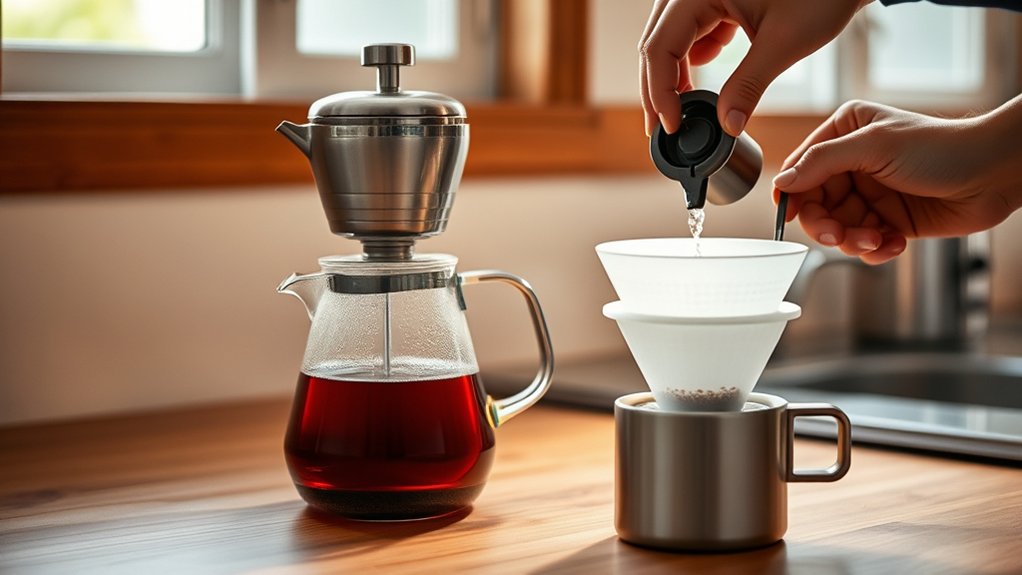
Although classic drip coffee makers operate automatically, they perform a precise sequence: heating water, distributing it evenly over coffee grounds via a shower head, and filtering the brewed coffee into a carafe.
This drip coffeemaker relies on controlled water temperature to optimize extraction, though it offers limited adjustment capabilities.
The brewing process typically takes 8–10 minutes, efficiently producing multiple cups with minimal manual input.
You mainly need to fill the water reservoir and add grounds to the filter basket, usually lined with a paper filter that removes oils and sediment, resulting in a clean cup.
While automatic operation simplifies daily use, the drip coffeemaker’s fixed parameters restrict fine-tuning of variables such as water temperature and extraction time.
However, unlike espresso machines, drip coffee makers generally do not require complex plumbing or electrical setups, making them easier to integrate into most kitchens.
What Makes Manual Brewing Methods Different?
When you brew manually, you get to control every little detail—from the grind size to how fast you pour. This means you have precise control over how your coffee extracts.
It’s a hands-on way to really dial in the flavors, often beyond what automatic machines can do.
And because the equipment is simpler, there’s less chance for mechanical hiccups. So, the whole process boils down to your technique and timing, which makes a big difference in the final cup.
Controlling variables like grind size and brew time helps prevent over-extraction, which can cause bitterness and harsh flavors.
Brewing Control Precision
While electric drip coffee makers offer convenience through automation, manual brewing methods provide unmatched precision by giving you direct control over key variables like pour rate, water temperature, and extraction time.
In the pour-over process, you regulate these parameters meticulously to influence extraction, enhancing clarity, body, and acidity.
Adjusting grind size and pour speed allows you to fine-tune the balance between under- and over-extraction, which electric machines can’t replicate due to their preset cycles.
Although automated drip coffee makers ensure consistency in volume and water-to-coffee ratio, they limit your brewing control, restricting your ability to customize flavor profiles.
Manual methods demand active participation, granting you the analytical advantage to optimize extraction and achieve a tailored cup with superior precision and consistency.
It’s all about being hands-on and dialing in your brew just the way you like it.
Additionally, selecting the appropriate grind size and consistency is crucial for maximizing flavor extraction in manual brewing methods.
Flavor Extraction Techniques
Because manual brewing methods like pour-over and AeroPress let you control pour rate, water temperature, and brew time, they enable precise manipulation of flavor extraction. You adjust brewing variables to optimize contact with water, ensuring targeted extraction of desirable compounds.
In pour-over, the controlled pour technique modulates flow rate and saturation, enhancing extraction control and producing nuanced flavor profiles. Manual immersion in AeroPress allows you to vary pressure and steep time, further refining extraction.
These methods often employ paper filters that reduce oils and fine particles, improving clarity and brightness.
In contrast, classic drip machines fix brewing variables, limiting your ability to influence extraction dynamics. So, manual brewing techniques offer superior flavor extraction by giving you direct control over key parameters that shape coffee’s complexity and vibrancy. Precise control of water temperature during brewing is essential to optimize flavor balance and avoid undesirable sourness or bitterness.
Equipment Simplicity Benefits
How does equipment simplicity enhance the manual brewing experience? Manual brewing methods, such as pour-over and French press, rely on minimal equipment with few mechanical parts. This markedly reduces operational complexity and maintenance demands.
Without dependence on electricity or electronic timers, you gain precise control over every brewing variable. This minimizes potential failures common in automated devices.
The straightforward design means cleaning involves only basic rinsing or washing, eliminating the need to troubleshoot internal components.
This simplicity not only streamlines maintenance but also allows you to easily adapt or repair your equipment without specialized knowledge.
Ultimately, the reduced equipment complexity fosters a mindful, hands-on brewing process. This ensures consistent quality and greater control over your daily coffee preparation.
Additionally, manual brewing methods allow better management of brew temperature, which is crucial for extracting balanced flavors and avoiding sourness in coffee.
How Brewing Control Affects Your Coffee Flavor
When you brew coffee manually, you get to control important factors like how fast you pour, the temperature of the water, and the grind size. All of these play a big role in shaping the flavor of your coffee.
On the other hand, automatic drip machines don’t give you as much control—they stick to set settings that make your coffee consistent, but sometimes less interesting in taste.
Knowing how these variables affect extraction is pretty useful. It means you can adjust things to bring out more acidity, a fuller body, or extra sweetness, depending on what you like.
Additionally, understanding and controlling the coffee dose can significantly impact the extraction balance and flavor profile of your brew.
Brewing Variables Impact
Although both classic drip coffee makers and manual brewing methods aim to produce a quality cup, the degree of control you have over brewing variables really influences the flavor outcome.
In manual brewing, you get to adjust grind size, water temperature, pouring technique, and extraction time precisely. This lets you play around with acidity, body, and clarity in your coffee.
For example, changing the water temperature can bring out or tone down certain flavor notes. And tweaking the extraction time affects the strength and balance of your brew.
On the other hand, classic drip machines work with fixed settings. That means you can’t fine-tune these variables much, so while the flavor is consistent, it’s less customizable.
Knowing how each variable impacts extraction helps you get the best sensory experience from your coffee. Manual methods are great if you want to tailor your flavor exactly how you like it.
Drip machines, meanwhile, focus on making the process repeatable rather than allowing for subtle adjustments.
Manual Versus Automatic
When you gain direct control over brewing variables like pour rate, water temperature, and steep time, you unlock the ability to shape your coffee’s flavor profile with real precision. Manual brewing methods, like pour-over and French press, let you adjust these factors on purpose. This helps you optimize extraction and bring out more flavor complexity.
On the other hand, automatic drip coffee makers limit your control. They rely on preset settings designed for convenience and consistency, rather than customization. While automatic machines give you a reliable cup, they often miss out on the subtle flavor development you get from manual brewing.
By mastering things like grind size, pour technique, and brew duration manually, you can tailor the flavor exactly how you like it. This opens the door to experimenting and finding a taste that’s truly superior.
In the end, the level of control you have with manual brewing really shapes the depth and quality of your coffee’s flavor.
Comparing Flavor: Drip Coffee vs. Manual Brewing
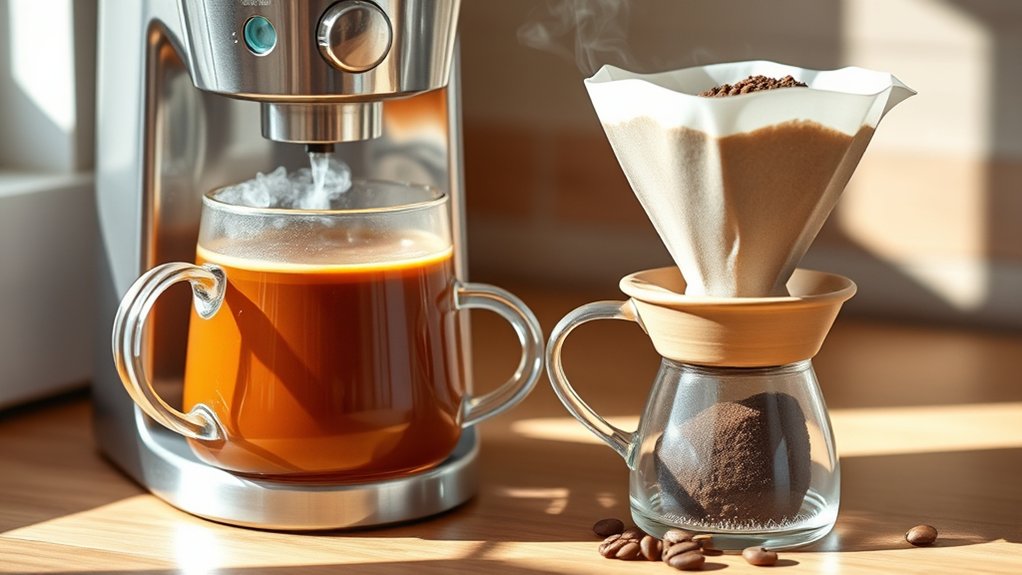
While drip coffee makers deliver a lighter and more consistent flavor profile, manual brewing methods give you greater control over extraction variables such as grind size, water temperature, and brew time.
With manual brewing, you can precisely adjust these factors to manipulate the coffee grounds’ extraction, enhancing complexity and richness.
Drip machines typically use paper filters that absorb coffee oils, resulting in a cleaner but less full-bodied cup.
In contrast, manual techniques like pour-over or French press retain more oils, contributing to a fuller flavor.
Furthermore, manual methods allow you to vary the pour rate and steeping time, directly influencing extraction balance.
Ultimately, manual brewing offers a nuanced and customizable flavor profile, while drip coffee prioritizes consistency and convenience without the same depth of control.
Time and Effort: Which Method Fits Your Routine?
You’ll find that automatic drip coffee makers brew a full pot in about 10 minutes with minimal effort. It’s perfect if you want a hands-off routine.
On the other hand, manual pour-over methods need your full attention and precise pouring. This often stretches the process to 10-15 minutes per cup.
Brewing Time Comparison
Although manual pour-over brewing demands more active involvement and precise timing, it typically takes just 3 to 5 minutes per batch, depending on your pouring technique. This brewing time includes the critical extraction phase, where control over pour speed influences flavor development.
In contrast, a drip coffee maker automates the process, completing a full pot within 8 to 10 minutes with minimal manual effort. While the drip coffee maker’s brewing duration is longer, it requires less hands-on attention after setup.
The manual pour-over’s shorter brewing time offers greater precision but demands constant engagement during the extraction phase.
Ease Of Use
Because automatic drip coffee makers streamline the brewing process to just filling the reservoir and pressing a button, they fit seamlessly into busy routines with minimal effort. Their ease of use comes from needing very little input from you. This lets you make multiple cups at once in about 10 minutes.
Manual brewing methods like pour-over or French press need more active involvement. You have to heat water, measure grounds carefully, and control pouring or steeping time. These methods give you more control over flavor, but they take more time and attention—usually 5 to 15 minutes per batch.
For daily use, automatic drip coffee makers offer better convenience and consistent results with less effort. They’re great if you want efficiency and don’t need the hands-on experience that manual methods require.
Cleaning and Maintenance for Drip Coffee Makers and Manual Brewers
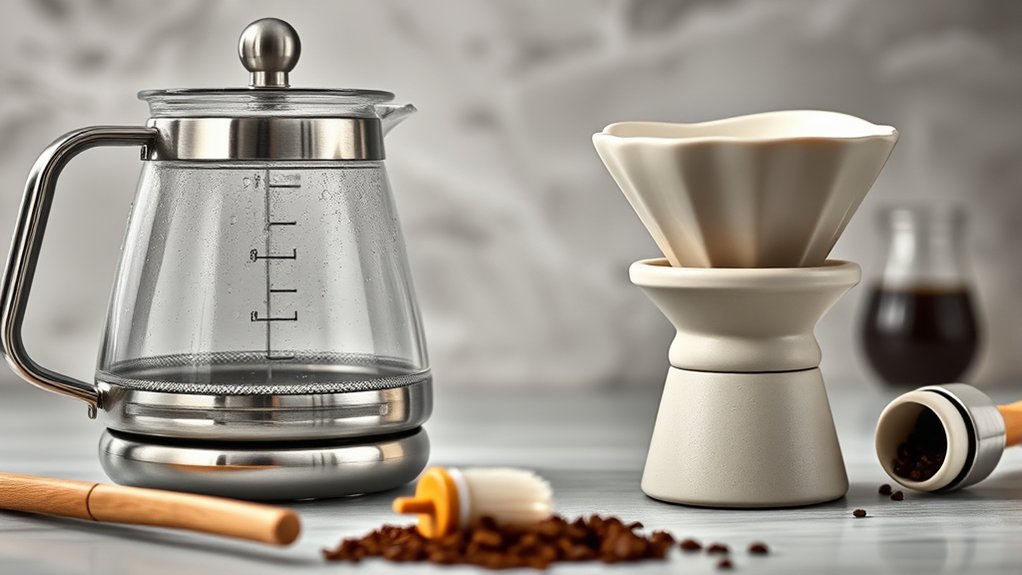
When maintaining your coffee equipment, manual brewers like pour-over cones and French presses offer a straightforward cleaning process because of their simple design and fewer parts. You just need to rinse them thoroughly after each use.
Every now and then, wash them with warm water and mild soap to get rid of any leftover coffee oils. This helps prevent any flavor contamination.
Drip coffee makers, on the other hand, need more thorough cleaning and maintenance. Their internal water reservoirs and filters can build up mineral deposits and bacteria if you don’t keep up with cleaning.
You’ll want to descale these machines every few months using vinegar or a commercial descaling agent. This keeps them working at their best.
Taking good care of both manual brewers and drip coffee makers is key to extending their lifespan and keeping your coffee tasting great.
That said, manual brewers usually require less frequent and less complicated maintenance compared to electric drip coffee makers.
Cost Comparison: Upfront and Long-Term Expenses
While automatic drip coffee makers often boast advanced features and larger capacities that raise their initial purchase price, manual brewing devices like pour-over cones and French presses usually come with a considerably lower upfront cost.
Typically, manual brewers range from $20 to $100, whereas automatic machines start around $50 and can exceed $300.
Over time, manual methods minimize long-term expenses due to fewer mechanical parts, which reduces maintenance and repair costs.
Moreover, manual brewers incur lower filter and cleaning supply costs compared to automatic machines that require electricity and frequent filter replacements.
While automatic drip coffee makers offer convenience, their ongoing expenses related to descaling, part replacements, and energy consumption increase total ownership cost.
Brewing Capacity: Serving One or Many Cups
Although you might appreciate the precision of manual brewing, drip coffee makers excel in serving multiple cups quickly, typically producing between 4 and 12 cups per cycle. Their brewing capacity is ideal when you need to serve several people at once without repeated effort.
Automatic drip machines make this process even easier, delivering consistent volume with minimal intervention.
On the other hand, manual brewing methods like pour-over usually yield just one or two cups per brew. That means you have to repeat the process for each additional cup.
Even a French press, while a bit more variable, rarely exceeds 8 cups per batch.
So, if your priority is efficiently serving multiple cups with minimal time investment, the automatic drip’s larger brewing capacity is definitely the more practical choice.
Manual brewing, meanwhile, suits individual or small-scale servings better.
Portability and Convenience of Manual Brewing
If serving multiple cups quickly favors automatic drip machines, manual brewing stands out in portability and convenience. Manual brewing devices like pour-over cones and AeroPress feature a compact size and lightweight design, often weighing less than a pound, which enhances portability.
Their travel-friendly nature allows you to pack them easily into small bags or suitcases, making them ideal for trips or outdoor use.
Unlike electric drip machines, manual brewers don’t need power, enabling you to brew anywhere with access to hot water. The absence of cords and bulky machinery simplifies setup and breakdown, saving time and effort.
Furthermore, manual brewing equipment’s compact size makes it easy to store in limited kitchen spaces. This really emphasizes its practicality for daily use when mobility and convenience matter most.
Choosing the Best Brewing Method for Your Taste and Lifestyle
Deciding on the best brewing method hinges on balancing your priorities between convenience, control, and flavor complexity. If you value speed and ease, an automatic drip machine delivers a full pot in about 10 minutes with minimal effort. It’s ideal for busy routines.
Choosing the best brewing method depends on balancing convenience, control, and flavor complexity to suit your lifestyle.
Conversely, manual brewing methods like pour-over offer superior flavor control through precise manipulation of brew time, water temperature, and pouring technique. This caters to enthusiasts who really want to explore taste nuances.
Think about your personal preferences. If you enjoy active participation and customization, manual brewing suits your lifestyle, even if it means longer prep times.
But if durability and straightforward cleanup are essential, automatic drip is more practical.
Ultimately, choosing between manual brewing and automatic drip depends on how much you’re willing to invest in the process versus your desired coffee complexity and daily convenience. It’s all about what fits you best.
Frequently Asked Questions
Can I Use Flavored Coffee Beans With Both Brewing Methods?
Yes, you can use flavored coffee beans with both drip machines and manual brewing methods. Manual techniques like pour-over tend to preserve delicate flavor notes better.
On the other hand, drip machines with paper filters might slightly mute those flavors since the filters absorb some oils.
Methods like moka pots or French presses can actually bring out stronger flavors. But keep in mind, they might also cause oil buildup, which could affect your future brews.
For the best results, try to choose freshly roasted, non-oily flavored beans no matter which brewing method you go with. It really makes a difference!
Do Either Method Affect Caffeine Content Significantly?
Neither brewing method substantially affects caffeine content if you use the same amount of coffee grounds.
You might notice a slight increase in caffeine with manual methods like pour-over or French press due to longer extraction times, but the difference is minimal.
The key factor in caffeine levels is the quantity of coffee you use and how long you brew, not whether you choose a drip coffee maker or manual brewing.
Are There Specific Water Types Recommended for Each Brewing Style?
You might think any water works, but the difference is striking. For drip machines, filtered or spring water prevents scale buildup and preserves taste.
For manual brewing, you’ll want fresh, clean water heated precisely between 195-205°F to optimize extraction.
Avoid softened water, as it lacks essential minerals, while hard water risks off-flavors.
Choosing the right water type guarantees your coffee brews consistently balanced and flavorful every time.
How Do Different Grind Sizes Impact Brewing Time?
Different grind sizes directly impact your brewing time by controlling how fast water flows through the coffee grounds. Finer grinds increase the surface area, which speeds up extraction and shortens brew time, like in espresso that takes about 25-30 seconds.
On the other hand, coarser grinds slow down the water passage, so you need longer brew times. Think of a French press, which usually takes around 4-5 minutes.
Using a medium grind strikes a balance between extraction speed and flavor, typically brewing for about 4-6 minutes.
If you don’t get the grind size right, you risk over-extracting or under-extracting your coffee, which can really mess with the taste. So, it’s worth paying attention to the grind size depending on your brewing method.
Can Drip Coffee Makers Be Used for Cold Brew Preparation?
Using a drip coffee maker for cold brew is like trying to fix a watch with a hammer. It’s not designed for that. You can’t replicate the slow, 12-24 hour steeping process since drip machines use hot water cycling.
You might try steeping grounds manually in the filter basket overnight, but this usually gives inconsistent results. For precise cold brew extraction, specialized equipment or containers guarantee balanced flavor and proper steeping time.
Conclusion
When choosing between a classic drip coffee maker and manual brewing, think about your daily routine and flavor preferences. Drip machines offer convenience and capacity, which is perfect for busy mornings.
Manual methods give you precise control over extraction. This can elevate your coffee to near-perfection. Neither option is universally better.
It really comes down to matching your taste, time, and budget. So, pick wisely. Your ideal brew is waiting, ready to transform your mornings more dramatically than a lightning bolt.