You control your coffee’s strength and flavor by mastering the water-to-coffee ratio, which governs extraction balance. A lower ratio yields a stronger, more concentrated brew, while a higher ratio creates lighter, brighter flavors. Precision is key. Small adjustments in grams can considerably alter acidity, body, and aroma.
Grind size and temperature also affect how you should adjust ratios to avoid under- or over-extraction. Understanding these dynamics lets you tailor your brew’s complexity and clarity. It’s all about finding what works best for your taste.
What’s the Coffee-to-Water Ratio and Why It Matters
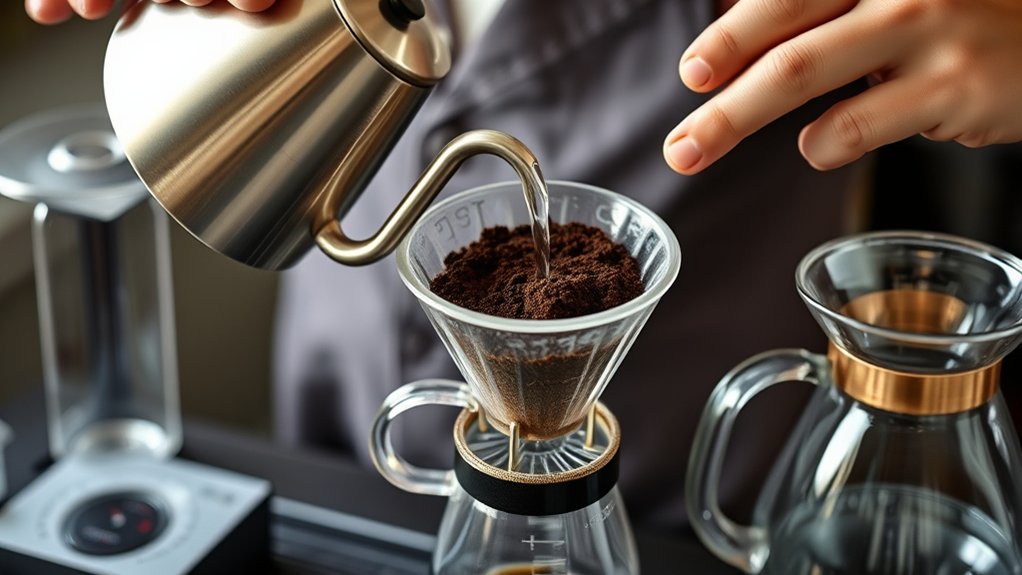
How do you determine the ideal strength and flavor of your coffee? It starts with accurately controlling the coffee-to-water ratio, which is the weight proportion of coffee grounds to water used during brewing. This ratio directly impacts extraction and influences the balance and taste of your brew.
Determining ideal coffee strength begins with precisely balancing the coffee-to-water ratio for perfect flavor extraction.
For instance, a lower ratio means more coffee relative to water, resulting in a stronger, more concentrated flavor. Different brewing methods require specific ratios to optimize flavor. Drip coffee often uses about 1:16, while French press leans toward 1:12.
Precise measurement guarantees consistent strength and balanced extraction, which highlights desired flavor notes like acidity and body. Understanding and adjusting the coffee-to-water ratio lets you tailor brewing parameters.
This way, you can control the intensity and complexity of your coffee’s flavor profile. Additionally, mastering the espresso dose is crucial for maintaining consistency and flavor balance in espresso brewing.
The Golden Ratio for Balanced Brewing
One widely accepted benchmark for brewing balanced coffee is the Golden Ratio: 1 gram of coffee to 16 grams of water. This water-to-coffee ratio optimizes the extraction process, producing a flavor profile that balances brew strength, clarity, and aroma across various brewing methods.
By applying precise measurement tools, like a digital scale, you guarantee consistency in every batch, which is critical for replicating results.
Starting with the Golden Ratio gives you a reliable baseline. From there, you can fine-tune the coffee-to-water ratio to your taste without compromising balanced brewing fundamentals.
Whether you use pour-over, drip, or immersion methods, sticking to this ratio helps you maintain control over extraction variables.
This way, you ensure a consistent, well-rounded cup that highlights the coffee’s inherent characteristics every time.
Using a digital kitchen scale to measure ingredients precisely is essential for maintaining the Golden Ratio and achieving consistent extraction.
How the Coffee-to-Water Ratio Changes Strength and Flavor
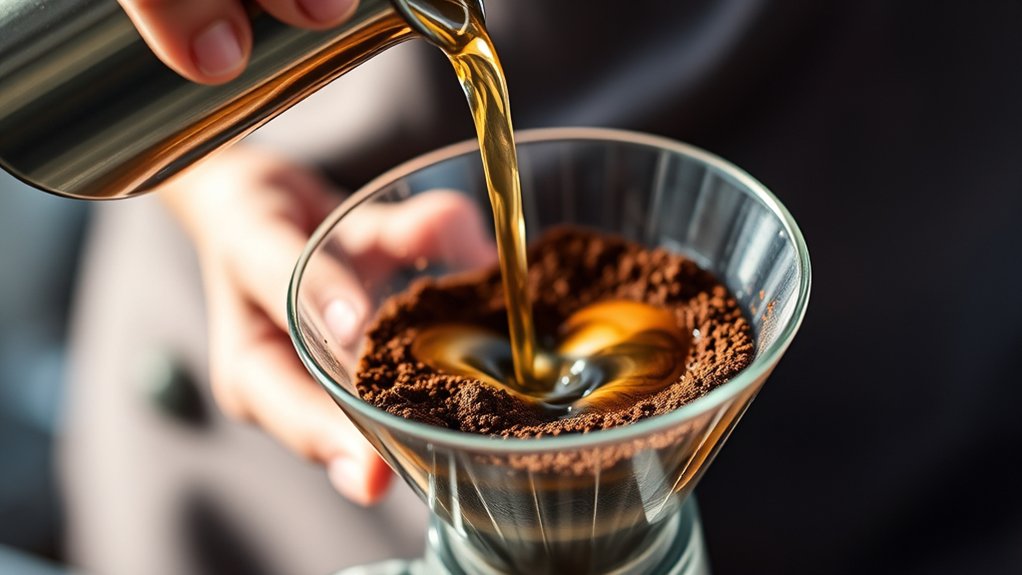
You control your brew’s strength and flavor by adjusting the coffee-to-water ratio. When you use a lower ratio, your cup turns out denser and more intense.
On the other hand, higher ratios make for lighter, brighter flavors with less body.
Getting a good handle on this relationship lets you fine-tune your extraction. That way, you can avoid bitterness or sourness and dial in the exact profile you want.
Using the proper grind size and consistency is essential to complement the coffee-to-water ratio and achieve balanced extraction.
Ratio Impact On Strength
Why does tweaking the coffee-to-water ratio change your brew’s strength so noticeably? The ratio directly controls the concentration of solubles extracted during brewing.
A higher coffee-to-water ratio means more coffee relative to water, increasing extraction and solubles concentration, which intensifies perceived strength and body.
For example, a 1:14 ratio yields a robust, full-bodied cup with pronounced flavor, while a 1:18 ratio produces a delicate, lighter brew with less extraction and a brighter profile.
By adjusting the ratio, you influence how much soluble material dissolves, therefore controlling flavor intensity and strength.
This precise manipulation allows you to tailor the strength to your taste, balancing between a powerful, concentrated brew and a subtle, delicate cup without altering other variables.
It is important to note that using a higher brew ratio relative to coffee often results in under-extraction, which can cause a weaker, watery taste.
Flavor Variations By Ratio
Although altering the coffee-to-water ratio primarily affects strength, it also considerably shifts flavor profiles by modulating extraction levels and solubles concentration. When you use a lower coffee-to-water ratio, like 1:14, the brew intensifies in strength, revealing richer chocolate tones and boldness.
Conversely, increasing the ratio to 1:18 or higher produces a delicate brew with subtler flavor nuances, highlighting brighter fruit notes and clarity. This balance is vital. Too little water risks over-extraction, causing bitterness, while too much leads to under-extraction, resulting in sourness.
Adjusting the ratio allows you to fine-tune perceived sweetness, acidity, and bitterness, revealing specific flavor variations. By mastering the coffee-to-water ratio, you control extraction precision and achieve your desired flavor profile. It’s all about finding that perfect balance to suit your taste. Additionally, factors such as grind consistency play a crucial role in optimizing extraction and flavor outcome.
Ideal Coffee-to-Water Ratios for Popular Brewing Methods
When calibrating your brewing process, understanding the ideal coffee-to-water ratio for each method is essential to achieving the desired flavor profile and strength.
In drip coffee, a coffee-to-water ratio between 1:16 and 1:18, with 1:17 as a benchmark, optimizes flavor extraction and balance.
French press brewing demands a slightly denser ratio, typically 1:12 to 1:16. Around 1:15 usually yields a full-bodied cup.
Pour-over methods operate between 1:14 and 1:16, with a ratio closer to 1:14 enhancing body without over-extraction.
Cold brew concentrates use much lower ratios, from 1:4 to 1:8, which you can tailor for dilution or direct consumption.
Each brewing method requires precise ratio control to maintain the balance between strength and flavor during the brewing process. This ensures consistent and desirable results every time.
When preparing espresso, matching the dose with the appropriate espresso basket size is critical to optimize extraction and flavor.
Adjusting Ratios to Match Your Taste Preferences
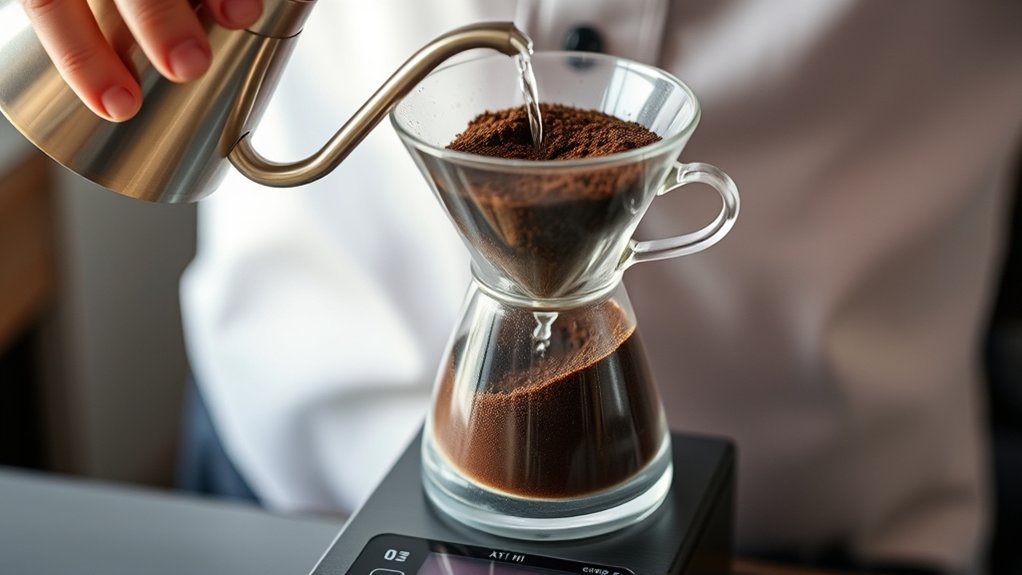
Since your taste preferences vary, adjusting the coffee-to-water ratio lets you tailor strength and flavor precisely. By modifying the ratio, you control the balance between coffee grounds and water, which impacts the brew’s body, acidity, and sweetness.
Adjusting the coffee-to-water ratio lets you precisely customize your brew’s strength and flavor.
For example, increasing coffee grounds from a 1:16 to 1:14 ratio intensifies flavor, while a 1:18 ratio lightens it. Small adjustments, like adding 0.5 grams of coffee, can considerably shift the flavor profile.
When adjusting ratios, consider your desired strength and the balance between robustness and brightness. Think about how changes affect flavor notes, like roastiness or acidity.
Also, keep in mind the interplay between ratio and brew time because that influences extraction.
Tailoring the ratio helps align the final cup with your personal taste. It’s a great way to optimize both flavor and strength.
How Grind Size and Water Temperature Affect Ratios
Because grind size and water temperature directly influence extraction rate, you need to adjust your coffee-to-water ratio accordingly to get balanced flavors. Finer grind sizes increase surface area, speeding up extraction and risking over-extraction if you don’t lower the ratio. On the flip side, coarser grinds slow down extraction, so you’ll want a higher coffee-to-water ratio to avoid under-extraction.
Hotter water (195–205°F) boosts extraction, which often means tweaking the ratio to keep bitterness at bay. Balancing grind size and water temperature gives you precise control over extraction and helps you get the best flavor for your brewing method.
| Grind Size | Water Temperature | Ratio Adjustment |
|---|---|---|
| Fine | High (200°F) | Lower ratio to avoid bitter |
| Fine | Low (190°F) | Slightly higher ratio |
| Coarse | High (200°F) | Moderate ratio |
| Coarse | Low (190°F) | Higher ratio to prevent weak |
| Medium | Medium (195°F) | Standard ratio |
Measuring Coffee and Water for Consistency
How can you make certain of consistent coffee extraction every time you brew? You need precise measurements of both coffee and water by weight. Using a reliable digital kitchen scale ensures accuracy, eliminating guesswork.
Ensure consistent coffee extraction by weighing both coffee and water with a reliable digital kitchen scale.
Always tare or zero the scale before adding coffee or water to avoid skewed measurements. For example, a standard 1:16 coffee-to-water ratio requires about 12-15 grams of coffee paired with 192-240 grams (or milliliters) of water. Remember, 1 tablespoon of coffee weighs roughly 5-6 grams, so adjust accordingly.
Key steps to maintain precision:
- Use a scale with high accuracy for weighing coffee and water
- Tare the scale before adding each ingredient to ensure correct weight
- Measure water in grams or milliliters to maintain the targeted ratio
This method guarantees repeatable brewing results and flavor consistency. It’s a simple way to make sure every cup tastes just right.
Common Coffee-to-Water Ratio Mistakes and How to Avoid Them
You’ll notice over-extraction when your coffee tastes bitter or burnt. This often happens because you’re using too much coffee compared to the amount of water.
On the other hand, under-extraction leads to sour or weak flavors, which usually occurs when the ratio is too watery or when you don’t adjust for grind size and brew method.
To avoid these problems, it’s a good idea to always use a scale for precise measurements. Plus, make sure to tweak your ratio based on your specific brewing setup.
Over-Extraction Warning Signs
When your coffee tastes bitter and burnt, it often means you’re dealing with over-extraction. This usually happens because you’re using too little water or too much coffee, which makes the flavors too concentrated.
Over-extraction comes from an off water-to-coffee ratio, usually less than 1:14 for drip or 1:2 for espresso. That messes with the extraction and throws off the flavor balance.
Common signs are a harsh bitterness and an acrid aftertaste.
To avoid these problems, keep an eye on a few things. Brewing time is important—if it’s too long, your coffee will get bitter. Water temperature matters too; anything over 205°F speeds up over-extraction.
Also, make sure you’re sticking to the right ratio like 1:16 for drip coffee. Getting these details right will help you enjoy a smooth, well-rounded cup without those over-extracted flaws.
Under-Extraction Causes
Although many factors contribute to under-extraction, improper coffee-to-water ratios are among the most common mistakes. Using too high a water ratio, such as above 1:18 in drip brewing, causes over-dilution. This prevents adequate solubilization of essential flavor compounds.
This imbalance leaves grounds underdeveloped, producing sour, weak coffee. Moreover, incorrect grind size reduces surface area contact, which hampers the extraction process. Coarser grounds, for instance, make it harder for proper solubilization to happen.
Insufficient brew time or water temperature below 195–205°F also limits extraction efficiency. To avoid under-extraction, you need to use precise scale measurements for both coffee and water.
It’s important to maintain the ideal water temperature and adjust grind size and brew time according to your method. These controls help ensure full extraction of flavor compounds, delivering a balanced, developed cup without the pitfalls of under-extraction.
Measurement Inaccuracy Issues
Mistakes in measuring coffee and water often undermine efforts to maintain proper brewing ratios, even if you control grind size and temperature effectively. Measurement inaccuracies mainly come from relying on volume measurements like scoops, which can vary with grind density and cause inconsistent ratios.
Miscalculations also happen when using approximate ratios like “two tablespoons per six ounces,” since tablespoons can differ in weight depending on the coffee type and grind. Plus, forgetting to calibrate your scale or using a low-precision scale (less than 0.1 g) can mess with precise measurement. This, in turn, affects brew strength and flavor consistency.
To avoid these pitfalls, use a high-precision scale that’s regularly calibrated for accuracy. Measure both coffee and water by weight, not volume. And skip the approximate ratios—calculate the exact water-to-coffee ratio every time you brew.
Doing these things will help you get consistent flavor and keep your water-to-coffee ratio just right.
Fine-Tuning Your Brew Ratio to Match Your Taste
Since even a one-gram adjustment in your coffee-to-water ratio can noticeably change the brew’s strength and flavor, fine-tuning this balance is essential to match your taste.
By incrementally modifying your brew ratio, you control extraction levels, influencing the flavor profile and overall balance.
For example, increasing coffee relative to water intensifies body and roastiness, while adding water highlights brighter acidity and lighter taste.
Your personal preference, combined with brewing method and roast level, dictates ideal ratio adjustments.
Fine-tuning lets you emphasize specific flavor notes without risking over or under-extraction.
Systematically testing small ratio changes enables you to dial in a precise taste that complements your coffee’s characteristics and your sensory goals.
This way, you ensure a consistently satisfying cup tailored to your individual palate.
Frequently Asked Questions
How Does Altitude Affect the Ideal Coffee-To-Water Ratio?
Altitude affects your ideal coffee-to-water ratio by requiring a slightly higher coffee dose. The denser beans and lower boiling point at elevation slow extraction, so you need more coffee to maintain flavor clarity and strength.
Cooler temperatures further reduce extraction efficiency, making it necessary to adjust grind size and brew time alongside your ratio.
Can Water Mineral Content Influence Coffee Extraction?
Water mineral content can influence coffee extraction like a conductor shaping an orchestra’s sound. When you brew with hard water rich in calcium and magnesium, extraction intensifies, potentially causing bitterness.
Soft water may under-extract, leaving sour notes.
You should aim for balanced mineral levels, around 50-150 mg/L calcium, to optimize solubility and flavor clarity.
Adjusting mineral content through filtration or additives helps you control extraction precision and maintain consistent, desirable coffee profiles.
Does Coffee Bean Roast Level Change Brewing Ratios?
Yes, roast level directly changes your brewing ratios.
Lighter roasts are denser and less soluble, so you’ll need to increase your coffee dose or reduce water to fully extract their complex flavors.
Darker roasts are more soluble and less dense, so they require less coffee relative to water. This helps you avoid over-extraction and bitterness.
Adjusting ratios based on roast guarantees balanced extraction. It maximizes flavor clarity and prevents under- or over-extraction issues in your brew.
How Does Brewing Time Interact With Coffee-To-Water Ratio?
If you ignore brewing time, your coffee can turn into a bitter disaster or a weak, sour mess overnight. You’ve got to balance brewing time with the coffee-to-water ratio precisely.
Longer times extract more compounds, so using too much coffee amplifies bitterness.
Shorter times need less coffee to avoid under-extraction. You can adjust one to compensate for the other, but nailing both is essential for a harmonious, flavorful cup every time.
Are There Differences in Ratios for Espresso Versus Drip Coffee?
Yes, espresso uses a much lower coffee-to-water ratio, typically around 1:2, making it highly concentrated.
Drip coffee, on the other hand, employs a higher ratio, often between 1:15 and 1:18, resulting in a lighter brew.
You’ll notice espresso’s bold intensity contrasts with drip’s milder profile.
Adjusting these ratios directly influences extraction efficiency and flavor concentration.
Conclusion
Understanding your coffee-to-water ratio can transform your brew. Did you know that a 1:16 ratio, one gram of coffee to 16 grams of water, is widely accepted as the “golden ratio” for balanced extraction?
By precisely adjusting this ratio and considering factors like grind size and temperature, you control strength and flavor with scientific accuracy. Consistent measurement helps avoid common pitfalls.
This way, every cup matches your unique taste preferences perfectly. It’s all about dialing in the details to get your ideal brew each time.

Pingback: Whole Bean vs Pre-Ground Coffee: Which Is Actually Better? – iPourCoffee