If you want bold, full-bodied coffee with rich oils, choose the French press. Its coarse grind and immersion steeping extract maximum flavor and texture.
For cleaner, brighter coffee that highlights delicate notes, go with pour-over. It demands precise pour control and a medium-fine grind to get the best clarity and brightness.
Both methods require different maintenance levels and suit different roast profiles. Understanding these nuances will help you make an informed brewing choice that matches your flavor preferences and technique.
French Press vs. Pour-Over: Which Coffee Method Is Right for You?
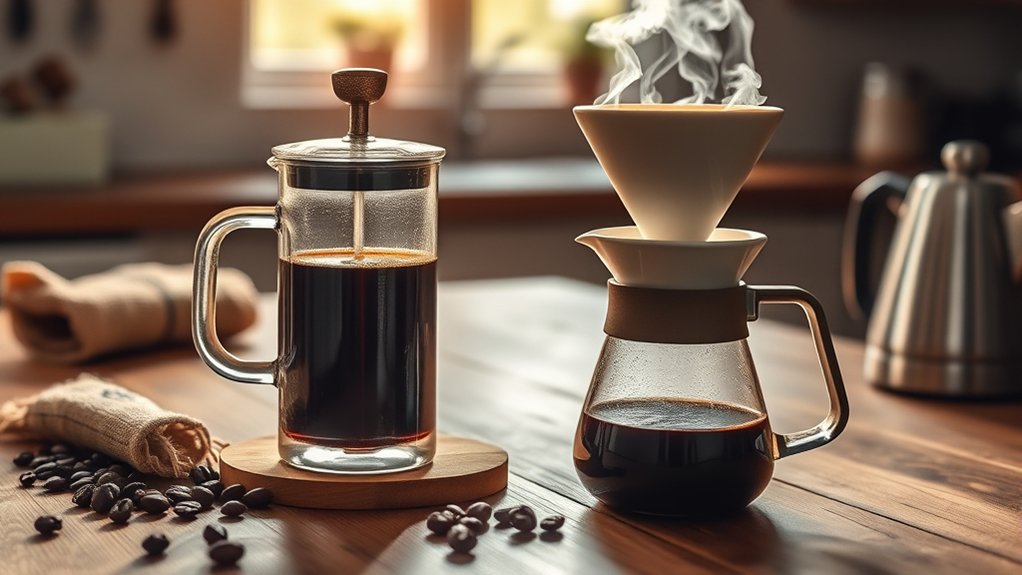
When deciding between French press and pour-over, consider the flavor profile and brewing technique that best suits your preferences. The French press employs immersion brewing, steeping coarse coffee grounds for about four minutes.
This produces a full-bodied, oily coffee with a rich texture. This method is ideal if you prefer a bold flavor profile and appreciate a more robust cup.
Enjoy a full-bodied, rich coffee that delivers a bold and robust flavor experience.
On the other hand, the pour-over method relies on a precise, controlled pour over a paper or metal filter. It extracts a cleaner, brighter coffee with enhanced clarity, especially suited for light, delicate roasts.
Pour-over demands careful filter management and grind size consistency. Meanwhile, the French press tolerates grind variations and simplifies cleaning.
Your choice really hinges on whether you favor immersion brewing’s depth or pour-over’s nuanced clarity. Choosing the right basket size for espresso can similarly impact flavor and extraction balance in other brewing methods.
French Press: Unique Flavor and Brewing Technique
You start by steeping coarsely ground coffee in hot water for about four minutes. It’s all about using the French press’s immersion method to pull out those rich oils and bold flavors.
The key here is the coarse grind—it helps prevent over-extraction and makes sure the coffee filters properly through the metal mesh.
The end result? A full-bodied, textured brew that really brings out the coffee’s complexity. Using a grinder that produces uniform coarse grounds is essential to avoid uneven extraction and achieve the best flavor from your French press.
Immersion Brewing Process
Because the French press employs an immersion brewing method, you fully submerge the coffee grounds in hot water for about four minutes. This allows thorough extraction of oils and flavors. Immersion brewing maximizes flavor extraction through steeping, resulting in a rich, full-bodied cup.
You start by blooming the grounds with a small amount of water, then let them steep. This ensures ideal extraction of coffee oils. The mesh plunger filter retains fine particles, enhancing texture and body.
Proper extraction time is crucial in immersion brewing to balance acidity, sweetness, and bitterness for a flavorful cup.
| Step | Description |
|---|---|
| Blooming | Wet grounds briefly to release gases |
| Steeping | Grounds immersed for 4 minutes |
| Extraction | Oils and flavors fully extracted |
| Filtration | Mesh filter retains oils, fines |
Bold Flavor Profile
The immersion brewing process in a French press directly influences its bold flavor profile by preserving natural oils and fine coffee particles that other methods often filter out. This immersion method extends the extraction time, allowing you to draw out a richer, more intense taste.
Utilizing coarser grounds enhances this process by maximizing oil and flavor extraction without over-extraction or bitterness. As a result, you get a full-bodied coffee with a rich and bold character that highlights nuanced flavor notes often muted in other techniques.
This method suits dark and medium roasts particularly well, emphasizing depth and strength. By controlling steeping duration and grind size, you can tailor the extraction to achieve a cup that balances bold flavor intensity with a smooth, all-encompassing mouthfeel. Additionally, factors like grind size significantly impact extraction resistance and flavor balance in brewing methods.
Coarse Grind Importance
When brewing with a French press, grinding your coffee beans to a coarse texture, resembling sea salt, is essential for ideal extraction and clarity. This grind size prevents fine grounds from slipping through the mesh filter, minimizing sediment in your cup and easing cleanup.
A coarse grind enhances the immersion brewing method by allowing water to extract rich oils and complex flavor compounds evenly. Using a grind that’s too fine disrupts this balance, causing over-extraction, bitterness, and a sludgy texture.
By selecting the correct coarse grind size, you guarantee consistent, full-bodied flavor that highlights the unique characteristics of your coffee beans.
Mastering this aspect of the French press brewing method is key to achieving a clean, flavorful, and enjoyable cup every time. Proper grind size is crucial to avoid under-extraction, which can lead to sourness and thin flavors in your coffee.
Pour-Over: Enhancing Coffee Clarity and Flavor Control
Although pour-over brewing requires careful attention to variables like pouring speed, water temperature, and flow rate, it gives you precise control over extraction. This results in a clean, crisp cup that’s free of oils and sediment.
Using a pour-over dripper and a paper filter, this manual brewing method emphasizes clarity and flavor by removing the oils and sediment that can cloud taste. To master this technique, focus on pouring speed, water temperature, and flow rate.
Pouring speed controls contact time, which helps balance extraction. Water temperature affects how flavor compounds dissolve. Flow rate influences clarity by regulating brew concentration.
This meticulous control lets you highlight delicate nuances in specialty beans, producing a bright, clean profile that reveals subtle origin characteristics. Pour-over’s clarity and flavor control make it perfect for anyone wanting precision in every cup. Consistent water temperature control is essential to maintain flavor balance and avoid bitterness or under-extraction.
Best Roast Levels for French Press and Pour-Over Brewing
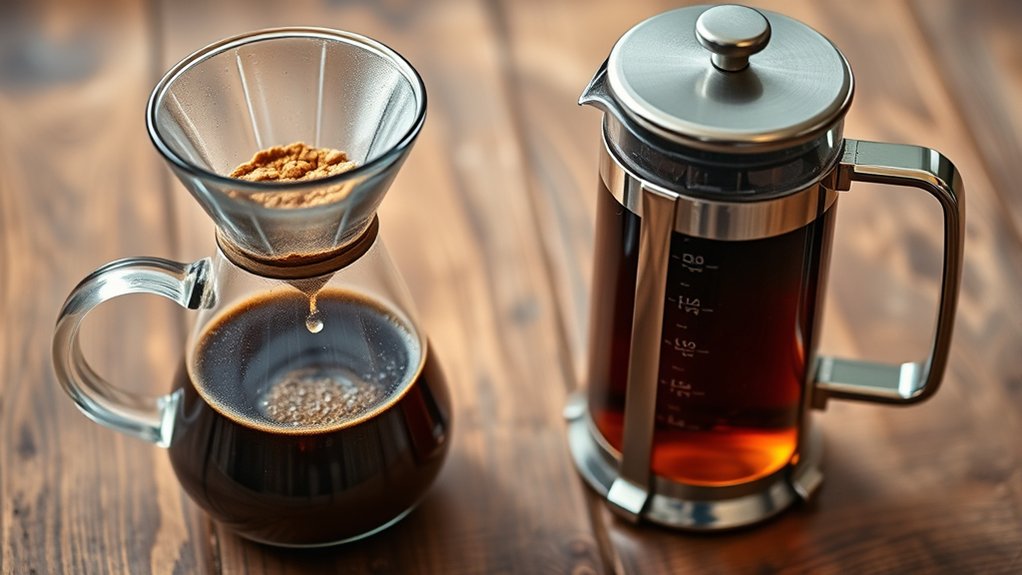
You’ll want to match roast levels carefully to your brewing method to get the best flavor.
For example, French press works best with dark and medium roasts because it preserves the oils and body.
On the other hand, pour-over really brings out the brightness and complexity of light and medium roasts.
Ideal Roast Pairings
Since each brewing method extracts flavors differently, choosing the right roast level is crucial to maximize your coffee’s potential. With precise roast pairings, you can fully exploit the strengths of your brewing methods.
French Press excels with dark roasts, producing a bold and rich flavor profile by extracting oily compounds through immersion. Medium roasts also perform well, balancing body and acidity.
Pour-over highlights light roasts, emphasizing delicate flavors such as brightness, fruitiness, and nuanced aromatics via controlled filtration and flow rate.
Medium roasts serve as a versatile bridge, adapting smoothly to both brewing methods. They offer balanced flavor and body without overpowering subtle notes or muting richness.
Selecting the ideal roast level ensures your coffee’s character aligns with the extraction style, delivering a tailored sensory experience. It’s all about matching the roast to how you brew for the best cup.
Flavor Profiles By Roast
Understanding how different roast levels influence flavor extraction helps you maximize your brewing method choice.
Light roasts exhibit bright acidity and delicate aromatics. Pour-over brewing really brings this out by giving you a clean, vibrant cup that reveals subtle fruity, floral, and caramel notes.
On the other hand, French press works better with medium to dark roasts. Its immersion method extracts a fuller body and retains oils, which enhances richness and mouthfeel.
Dark roasts, with their lower acidity and muted complexity, tend to yield flat results in pour-over.
Medium roasts strike a nice balance and perform well with either method. They deliver a harmonious blend of clarity and depth.
Roast Impact On Brewing
Although both French press and pour-over methods can brew excellent coffee, each responds differently to roast levels, affecting extraction and flavor development. The choice of roast level considerably influences the brewing method and final flavor profile. Here’s how:
French press really shines with dark roast and medium roast beans. It maximizes full extraction and preserves rich oils, which gives you a bold, full-bodied flavor profile.
Pour-over, on the other hand, highlights light roast coffees. It captures bright acidity and delicate floral or fruity notes thanks to precise extraction and a paper filter that retains subtle flavors.
Medium roast is pretty versatile and works well with both methods. But depending on how you brew, the flavor emphasis changes. French press pulls out deeper oils, while pour-over brings out brightness.
Understanding how roast impacts brewing helps you tailor extraction to get the flavor profile you want.
How Grind Size and Brewing Time Affect Your Coffee
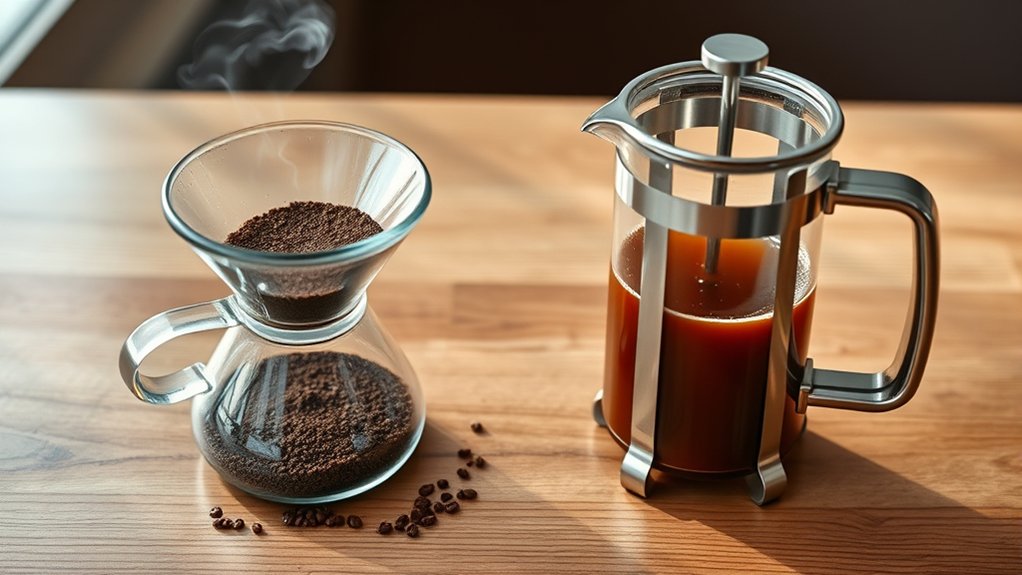
When you adjust grind size and brewing time, you directly control extraction rates and flavor profiles in both pour-over and French press methods.
For French press, use a coarse grind size resembling sea salt to prevent grounds from slipping through the mesh filter and guarantee proper extraction during the longer 4-minute brewing time. This combination extracts full-bodied flavors but risks over-extraction if extended.
In contrast, pour-over requires a medium-fine grind, similar to sugar, facilitating ideal water flow and balanced extraction within a shorter 2-3 minute brewing time. This preserves delicate flavor notes and avoids bitterness from over-extraction.
Cleaning and Maintenance: French Press vs. Pour-Over
Since coffee grounds tend to cling to the mesh filter and carafe, cleaning a French press demands careful rinsing and occasional scrubbing to remove trapped residue. Maintenance involves disassembling the plunger and mesh filter to thoroughly remove grounds.
In contrast, pour-over cleaning is simpler and faster. You just discard the filter and rinse the dripper and carafe.
To keep either method in ideal condition, follow these steps:
- Immediately rinse your French press or pour-over components after brewing to prevent buildup.
- For French press, scrub the mesh filter and carafe periodically to dislodge stubborn grounds.
- For pour-over, simply remove the paper or stainless steel filter and rinse the dripper thoroughly. It’s easy to clean with minimal effort.
Choosing French Press for a Rich, Bold Coffee Experience
If you want to maximize flavor depth and body in your coffee, choosing a French press is a smart move. This method uses immersion brewing, which means the coffee grounds are fully submerged in hot water. That allows for ideal extraction during a controlled steeping time, usually around four minutes.
The French press keeps essential oils and fine particles in your cup, giving you a rich coffee with a full-bodied texture and bold flavor. It works especially well with darker roasts, bringing out their natural oils and intensifying that deep, robust profile.
Its straightforward design makes it easy to get consistent results with minimal effort. By controlling the steeping time precisely, you extract maximum strength without any bitterness.
Pour-Over Equipment and Setup for Flavor Precision
While the French press emphasizes immersion and full-bodied extraction, pour-over brewing focuses on precision and control to highlight clarity and brightness. To achieve this, your pour-over equipment must be meticulously prepared. Start with a reliable dripper, such as a Hario V60, paired with a paper or metal filter.
Begin by setting the filter in the dripper and rinsing it with hot water. This helps purge any paper taste and preheats the vessel, which is pretty important for flavor.
Using a gooseneck kettle is a smart move because it lets you pour with precision, giving you better control over the water flow and ensuring even extraction.
Make sure to measure your coffee grounds and water accurately. Pour slowly and consistently to regulate the flow rate and contact time.
Taking care with every step like this guarantees superior flavor clarity through precise pouring and attention to every variable.
Frequently Asked Questions
Can I Use the Same Coffee Beans for Both Methods?
Yes, you can use the same coffee beans for both pour-over and French press, but you’ll need to adjust the grind size and roast level accordingly.
For French press, go with a medium to medium-coarse grind to avoid too much sediment.
Pour-over, on the other hand, works best with a medium-fine grind for ideal extraction.
Also, keep freshness in mind. Fresher beans always deliver better flavor no matter which brewing method you choose.
How Does Water Temperature Impact Each Brewing Style?
Think of water temperature as the conductor guiding your coffee’s flavor symphony. If you use water near 200°F, you’ll extract balanced flavors. It’s bright and clear in pour-over, rich and full-bodied in French press.
Too hot, above 212°F, bitterness takes over. On the other hand, slight drops in temperature give you lighter, less extracted coffee. Higher temps boost body and strength.
Controlling temperature precisely makes sure each method highlights its unique flavor profile just right. It’s all about getting the best from your brew.
Are There Specific Filters Required for Pour-Over Machines?
Yes, pour-over machines require specific filters that match the dripper’s shape and size. Most use cone-shaped or flat-bottomed paper filters designed to fit precisely, ensuring ideal extraction.
Some models, like Bodum’s pour-over, accept reusable stainless steel filters. These allow more oils through for a richer flavor.
You’ll want to use the filter type recommended for your device to maintain proper flow rate and avoid clogging or under-extraction.
It really makes a difference in your coffee’s taste and brewing consistency.
What Is the Ideal Coffee-To-Water Ratio for Each Method?
Coincidentally, your ideal coffee-to-water ratio hinges on precision. Use 1:11 to 1:16 for French press to achieve a bold, rich extraction.
For pour-over, stick between 1:15 and 1:17 to reveal lighter, nuanced flavors.
You’ll want to weigh your coffee and water carefully. Too much coffee causes bitterness, and too little yields weak brews.
Adjust within these ranges to tailor strength and taste exactly how you like it. It’s all about finding the perfect balance for your cup.
Can Either Method Be Used for Iced Coffee Preparation?
Yes, you can use both methods to prepare iced coffee effectively. With a French press, brew a strong concentrate, then pour it over ice to minimize dilution and maintain flavor intensity.
For pour-over, use a smaller water-to-coffee ratio to create a concentrated brew. You can either drip it directly over ice or cool hot coffee rapidly.
Both methods need freshly brewed, robust coffee to ensure your iced coffee stays flavorful and vibrant after chilling. It’s all about keeping that rich taste, even when it’s cold!
Conclusion
You might think choosing between French Press and Pour-Over is just about taste, but it’s really a commitment to your patience and precision. If you crave bold richness and don’t mind a bit of sediment, French Press suits your style.
Prefer clarity and control, and ready to master grind size and timing? Pour-Over’s your method. Either way, you’re signing up for a ritual because great coffee doesn’t brew itself, no matter how much you want it to.