You control espresso pressure to push hot water evenly through finely ground coffee, shaping flow, extraction time, and flavor. Standard machines use 9 bars, striking a balance between under-extraction at 6 bars and bitterness risks at 12 bars.
Higher pressure doesn’t always speed extraction. In fact, it often slows flow by increasing puck resistance. Fresh coffee’s CO₂ also alters flow dynamics under pressure.
Understanding these factors helps you nail consistent, flavorful shots. It also lets you explore how pump type affects pressure control.
What Is Espresso Pressure and Why It Matters
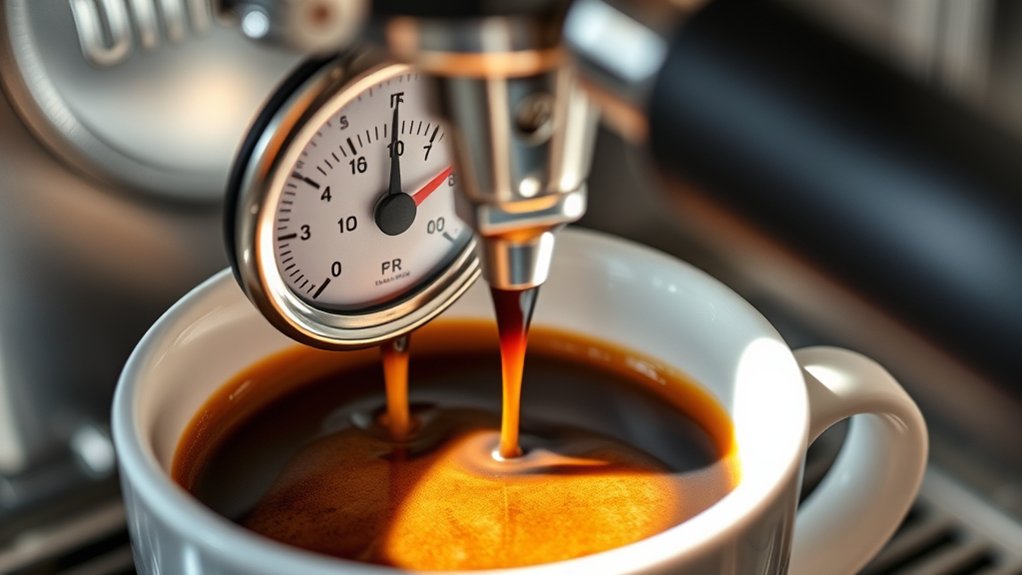
What exactly is espresso pressure, and why should you care about it?
Espresso pressure is the force, measured in bars, that pushes hot water through finely ground coffee during extraction.
Espresso pressure, measured in bars, drives hot water through finely ground coffee for extraction.
Most machines use an electric pump to maintain this pressure, with 9 bars, or about 130 psi, being the standard benchmark.
This pressure makes sure you get a strong, balanced extraction by driving water evenly through the compacted coffee puck.
If the pressure drops too low, around 6 bars, your shot will likely taste thin and under-extracted.
On the other hand, too much pressure can slow down the flow, which risks over-extraction and bitterness.
Maintaining consistent pressure is crucial during the pre-infusion stage to reduce channeling and ensure even extraction.
How Espresso Pressure Affects Extraction Time and Flow
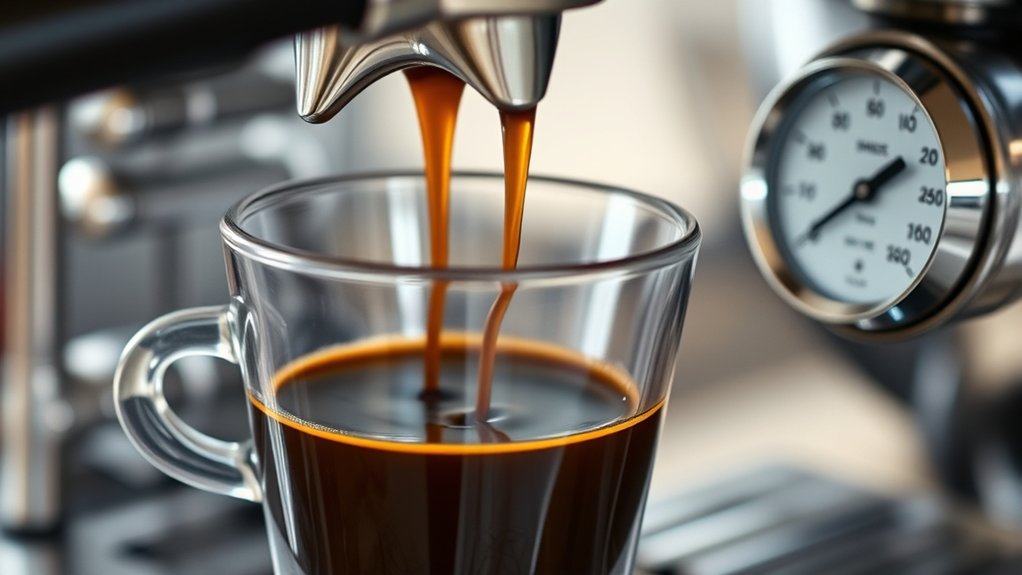
You might think that higher pressure would speed up your shot, right? But actually, it often slows the flow down and makes the extraction take longer.
Here’s why: fresh coffee grounds create more resistance early on when the pressure is higher.
This resistance causes the flow to drop after the initial saturation.
Knowing how pressure affects extraction time can really help you dial in your shot and get that perfect balance in your espresso.
Maintaining steady espresso machine pressure throughout extraction is key to achieving consistent shot timing and flavor.
Pressure Impact On Flow
Although increasing pump pressure might seem like it would speed up espresso extraction, it often has the opposite effect by extending extraction time due to the puck’s changing resistance. When you push at 12 bars, the coffee bed saturates quickly but then slows flow as internal resistance rises. An “early resistance” effect telemetry reveals.
Fresh coffee complicates things further. Freshly released CO₂ alters how water moves, so higher pressure doesn’t always mean faster flow. With stale coffee, you’ll see the expected pattern: higher pressure boosts flow rate. Additionally, maintaining stable extraction temperature is crucial to ensure consistent flow and balanced flavor during pressure changes.
Extraction Time Variation
A rise in espresso brew pressure from 6 to 12 bars consistently extends extraction time, causing the flow to slow rather than speed up as one might expect. Flow telemetry reveals an early saturation at 12 bars, where water quickly wets the puck, then the flow rate drops sharply.
This counterintuitive slowdown often relates to factors like CO₂ in fresh coffee, which alters internal resistance and disrupts the usual “more pressure = faster flow” pattern.
Because higher pressure changes how the bed saturates and slows flow, you can’t rely solely on pressure settings to hit your target shot time around 25–30 seconds.
Instead, adjusting your grind becomes key. In stale coffee, the flow behavior aligns more predictably with theory, showing faster flow at higher pressure.
Accurate extraction time measurement supports making the right grind adjustments to maintain consistent espresso yield and flavor.
Why 9 Bars Became the Standard Espresso Pressure
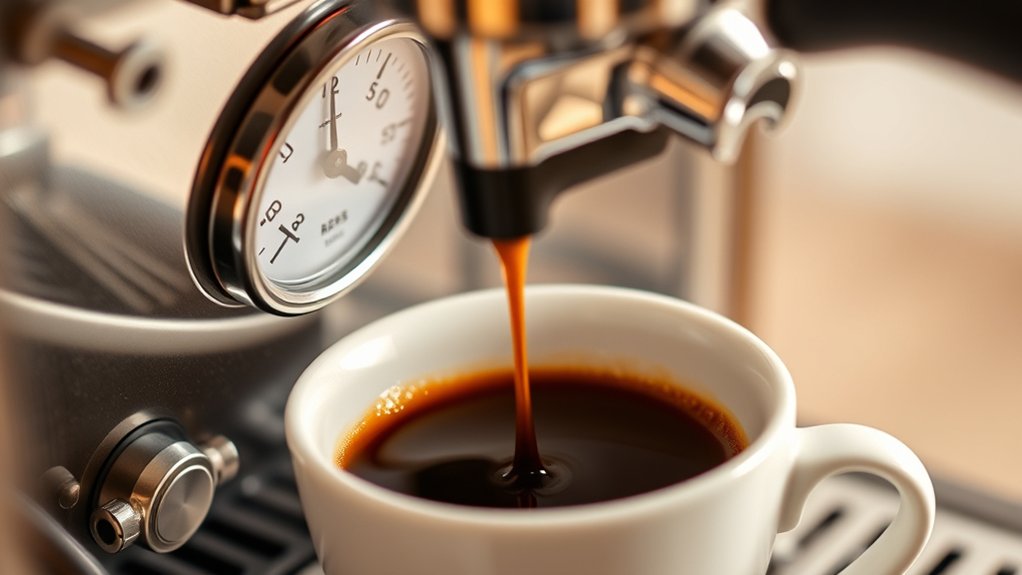
You’ll find that 9 bars became the standard pressure mainly because it strikes the right balance between flow and resistance. This balance helps optimize extraction without overdoing it.
This benchmark actually goes back to the 1961 Faema E61, which was a game-changer. It brought consistent pump pressure to both home and commercial machines.
Plus, lever machines played a role too. They start with high pressure that gradually tapers off, which influenced the idea of having a fixed pressure. All of this helped shape the 9-bar standard as a reliable way to get quality espresso every time.
Maintaining this pressure is crucial because grind size and machine pressure work together to ensure optimal extraction time and flavor balance.
Historical Pressure Benchmarks
Since the early 1900s, espresso machine pressure has evolved *significantly*, shaping the standards you see today.
Early steam-boiler machines operated at about 1–2 bar, relying on steam pressure to raise water temperature for extraction.
As technology progressed, lever machines in the late 1940s introduced peak pressures near 16 bar, though pressure declined during extraction.
This variability influenced later designs.
When electric-pump machines emerged, specifically with Faema’s E61 in 1961, manufacturers settled on a steady 9-bar pressure.
This benchmark wasn’t arbitrary; it balanced efficient extraction, allowing fine grinding and rich flavor without harshness.
Higher pressures slowed initial flow, so 9 bars offered a practical compromise between flow rate and flavor quality.
Understanding these historical benchmarks helps you appreciate why 9 bars remain the espresso pressure standard today.
Controlling pressure alongside factors like grind size and tamping pressure is essential for achieving consistent espresso extraction and flavor.
Lever Machine Influence
Although lever espresso machines generate a pressure that starts high, often around 16 bars, and gradually declines during extraction, this dynamic profile helped shape the 9-bar standard you see in modern machines.
The spring-loaded lever naturally averages pressure over time, leading to a mid-shot effective pressure near 9 bars.
This became a practical target for electric pump machines, offering consistency and repeatability.
Here’s why 9 bars became the norm:
- It matches the average pressure profile lever machines produce during extraction.
- It supports strong, consistent flow through a finely packed puck.
- It avoids over-extraction and harsh flavors common at higher pressures.
- It provides a balanced taste, outperforming both lower (6 bar) and higher (12 bar) pressures.
Understanding lever influence clarifies why 9 bars is more than just tradition.
It’s science-backed practicality.
Controlling pressure alongside dose and grind size is essential to optimize extraction time and flavor balance during espresso brewing.
Optimal Extraction Balance
When you dial in espresso pressure, hitting around 9 bars strikes the best balance between flow rate and extraction quality. This pressure forces hot water evenly through finely packed grounds, extracting sweetness and body without pushing into bitter over-extraction. Trials show moving from 6 to 9 bars improves texture and thickness noticeably, while 12 bars often complicate dialing in and can yield inconsistent or harsh results.
At 9 bars, extraction time slows just enough to maximize flavor without channeling or saturation issues common at higher pressures. Plus, 9 bars aligns with modern fixed-pressure pump systems, like E61 machines, ensuring stable, repeatable shots.
It’s also roughly nine times atmospheric pressure, essential for producing the crema that coffee lovers prize.
This balance made 9 bars the espresso pressure standard you rely on today.
How Different Pressure Levels Influence Espresso Flavor and Texture
Espresso pressure frequently shapes both the flavor and texture of your shot in subtle yet significant ways. Understanding how different pressures affect extraction helps you dial in the perfect balance.
At 6 bars, expect a thinner, watery espresso. Even tweaking grind and dose can’t fully replicate a richer texture.
At 6 bars, espresso turns thin and watery, with grind and dose adjustments unable to restore full texture.
The standard 9 bars delivers balanced intensity and sweetness, with ideal extraction and about 9.66% TDS, making it the benchmark for many.
Increasing pressure to 12 bars thickens texture and magnifies flavors, but it risks over-extraction and an altered taste, especially in milk-based drinks.
Higher pressures cause the puck to saturate quickly and reduce flow later, shifting extraction dynamics rather than simply speeding it up.
Adjust pressure thoughtfully to shape your espresso’s character and mouthfeel precisely.
Why Fresh and Stale Coffee Behave Differently Under Pressure
Why does freshly roasted coffee behave so differently under pressure compared to stale beans? Fresh coffee contains extra dissolved CO₂, which causes early resistance. This saturates the puck quickly at high pressure and then slows the flow.
Stale coffee has less CO₂ and responds more predictably. Higher pressure increases flow consistently without that initial resistance.
This difference changes how water channels form during extraction. So, when you adjust the pressure, it’s not just about grind size or time—it’s also about how fresh your beans are.
| Coffee Freshness | CO₂ Content | Flow Behavior Under Pressure |
|---|---|---|
| Fresh | High | Fast saturation, then reduced flow |
| Stale | Low | Steady, pressure-driven increase |
| Impact | Gas affects water flow channels, requiring pressure tuning for fresh beans |
Identifying Your Espresso Machine’s Pump Type
How can you tell what type of pump your espresso machine uses? Start by listening and looking closely.
Rotary pumps are larger and quieter. You’ll mostly find them in commercial or high-end machines. Vibrating pumps, on the other hand, are smaller and noisier. Brands like Breville or Delonghi usually use these.
If you can open your machine, rotary pumps look like a bigger, more solid unit. Vibrating pumps are compact and have an oscillating mechanism inside.
Another easy way is to check your machine’s manual or look online for specs. Search for terms like “rotary” or “vibrating” pump.
Rotary pumps usually have a pressure control screw, which makes calibration simple. Vibrating pumps tend to have fixed pressure, so you won’t have much room to adjust.
Knowing your pump type helps you understand how much control you’ll have over espresso pressure during extraction. It can really make a difference in your coffee experience.
How to Adjust Brew Pressure on Rotary Pump Machines
Once you’ve identified that your machine uses a rotary pump, you can start fine-tuning brew pressure to match your preferences. Begin with the machine fully warmed up, then pull a fresh single or double shot. Watch the pressure gauge carefully during extraction.
Locate the brew pressure adjustment screw, which is common on rotary systems. Turn it in small increments, like fractions of a turn, to nudge the pressure toward your target, usually around 8 to 9 bars for balanced extraction. Make sure to keep your dose, basket, tamp, and distribution consistent throughout the adjustments.
Pressure changes will impact flow and extraction time, so this is pretty important.
If the gauge doesn’t respond as expected, pause for a moment. Double-check the gauge calibration and confirm you’re adjusting the correct control within the brew circuit. Taking a methodical approach like this ensures you get precise pressure control and the best espresso quality.
Why Adjusting Pressure Is Harder on Vibrating Pump Machines
Although vibrating pump espresso machines are popular for their simplicity and affordability, they come with some unique challenges when it comes to adjusting brew pressure.
Unlike rotary pumps, vibrating pumps usually don’t have an accessible pressure adjustment screw. That makes it tough to set consistent pressure levels like 6, 9, or 12 bar.
Vibrating pumps often lack an easy pressure adjustment, making consistent pressure settings a real challenge.
Here’s why adjusting pressure on vibrating pumps is harder:
- They lack a simple, reliable way to calibrate pressure during extraction.
- Shot-to-shot pressure varies due to changes in grind resistance, causing inconsistency.
- Pressure profiling mid-shot is nearly impossible without complex DIY modifications.
- Indirect workarounds like grind size or dose adjustments are your only practical options.
In short, vibrating pump machines offer less control and repeatability. So, you’ll need patience and careful tweaking to dial in your shots.
Frequently Asked Questions
How Does Water Temperature Interact With Espresso Pressure During Extraction?
You’ll find that water temperature affects espresso pressure by altering extraction speed. Hotter water lowers resistance, which reduces pressure, while cooler water increases resistance and raises pressure.
Balancing both temperature and pressure ensures you get supreme flavor and great crema quality in your shot. It’s all about finding that sweet spot for the perfect espresso experience.
Can Altitude Affect the Ideal Espresso Pressure Settings?
Altitude shifts your espresso pressure like a mountain breeze changes the air. You’ll need to tweak pressure settings because lower air pressure affects extraction.
This helps make sure your shot stays rich and balanced despite the thinner atmosphere. It’s all about adjusting so your espresso tastes just right, no matter how high up you are.
What Maintenance Tips Improve Consistent Pressure in Espresso Machines?
You should routinely clean and descale your machine. It’s also important to examine and replace worn seals or gaskets to keep everything tight and working well.
Don’t forget to oil moving parts regularly to avoid any friction that could mess with the pressure. And make sure to calibrate the pressure gauge so it stays accurate.
These simple steps help keep the pressure consistent and ensure your espresso tastes perfect every time. Trust me, your morning coffee will thank you!
How Does Grind Size Specifically Impact Pressure and Extraction?
You’ll find that a finer grind increases resistance, raising pressure and slowing extraction. On the other hand, a coarser grind lowers pressure and speeds it up.
Adjust grind size carefully to balance pressure for maximum flavor extraction. It’s all about finding that sweet spot where your coffee tastes just right. Keep tweaking until you nail it!
Are There Any Health Effects Linked to Varying Espresso Pressure Levels?
You won’t find direct health effects from varying espresso pressure, but inconsistent pressure might alter extraction, affecting bitterness and acidity. That could impact your digestion or caffeine intake, so maintaining proper pressure helps ensure a balanced, enjoyable espresso experience.
Keeping the pressure steady means you get a consistent flavor every time. And when your espresso tastes good, it’s easier to enjoy without any unwanted side effects like stomach upset. So, focusing on the right pressure is really about making your coffee experience the best it can be.
Conclusion
Understanding espresso pressure is key to mastering your shot. For example, a barista adjusted their rotary pump from 9 to 7 bars and noticed a smoother, less bitter espresso. This is perfect for lighter roasts.
By tuning pressure, you control extraction time, flavor, and crema quality. Whether you’re using fresh beans or older ones, knowing how pressure impacts your brew helps you tailor every cup to your taste. Don’t just pull a shot, craft it with precision.

Pingback: Espresso Grinder vs Coffee Grinder: Know Actual Differences – iPourCoffee