You should pick a commercial espresso machine if you need high-volume, consistent shots with robust durability. It’s a great choice if you have ample space and can manage professional maintenance.
Choose a home or prosumer model for convenience, smaller scale use, easier setup, and lower costs. This is especially true if you prefer simpler controls and moderate brewing.
Your choice hinges on volume, environment, and control needs. Understanding these factors will help you figure out which machine best fits your espresso goals.
Understanding the Key Differences Between Commercial and Home Espresso Machines
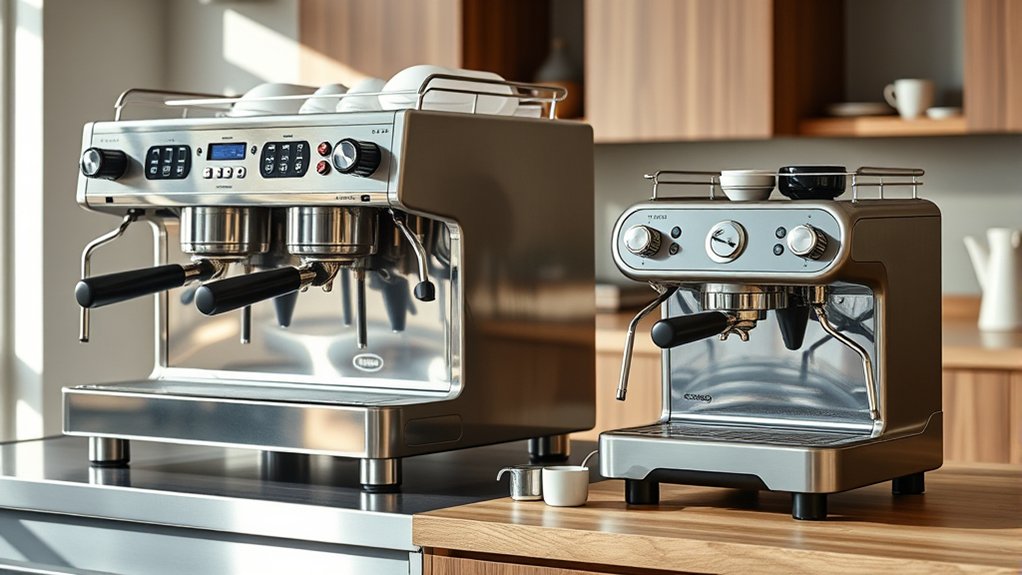
Although both commercial and home espresso machines serve the same fundamental purpose of brewing espresso, they differ quite a bit in design, functionality, and intended use. A commercial machine is built for high-volume, continuous operation. It features durable components, integrated plumbing, and large boilers designed for repetitive brewing cycles.
On the other hand, home espresso machines focus more on convenience. They come with smaller boilers, water reservoirs, and user-friendly controls, making them perfect for limited, occasional use. Commercial units are also bigger, heavier, and need professional maintenance because of their industrial-grade build quality and complexity, which usually requires deep barista expertise.
Home machines, by contrast, are designed to be ergonomic and fit nicely into your home’s aesthetic. Plus, commercial machines usually cost a lot more—often 5 to 10 times as much. That price difference reflects their robustness, capacity, and the demands of their operation compared to the more accessible and compact home espresso machines.
How Brewing Volume and Frequency Affect Your Espresso Machine Choice
When you brew espresso frequently and in high volumes, your machine has to keep a consistent temperature and pressure without any downtime. Commercial espresso machines are built just for this. They’ve larger boilers and tough components that handle heavy use while still making great shots.
These machines can crank out dozens of shots per hour with little recovery time, which makes them perfect if you’re brewing a lot. On the other hand, home espresso machines usually have smaller boilers and take longer to recover. This means they aren’t great for continuous, high-frequency use.
If your brewing volume is more moderate or you don’t brew often, a prosumer or home model will do the job just fine. They offer enough capacity and won’t break the bank. Choosing a machine that matches how much and how often you brew helps keep your espresso tasting great and your machine lasting longer.
Size, Installation, and Space Requirements for Espresso Machines
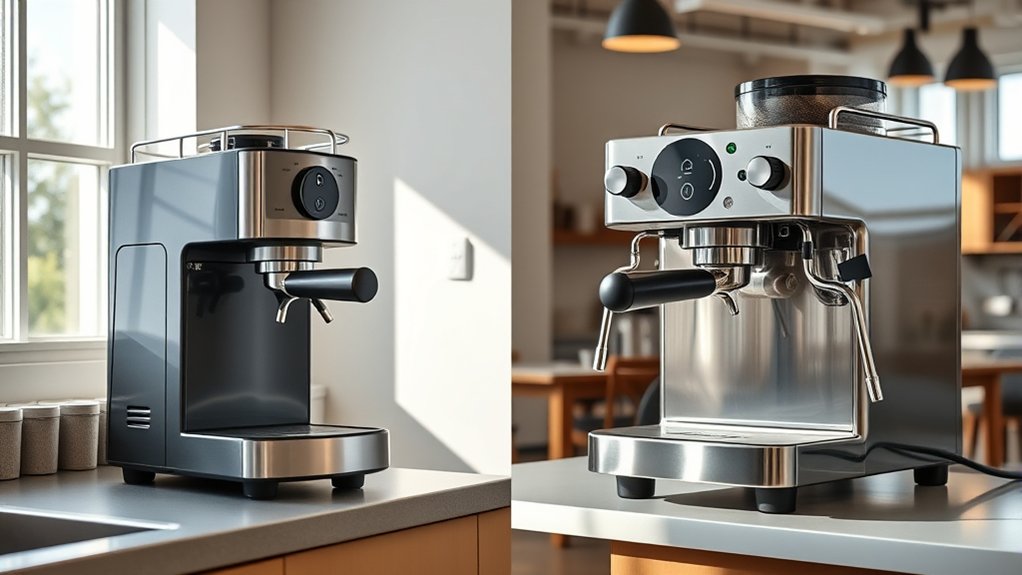
Because commercial espresso machines require substantial space and professional installation, you’ll need to carefully evaluate your available area before selecting one. Their considerable size demands several square feet of counter space, plus clearance for operation and routine maintenance.
Commercial espresso machines need ample counter space and professional installation for optimal use and maintenance.
Installation often involves complex plumbing and electrical work, which means you’ll need skilled technicians to get it right.
In contrast, home espresso machines prioritize compactness, fitting comfortably within a standard kitchen counter footprint. Their size makes installation easier and usually doesn’t require specialized skills—just basic electrical access.
Plus, home units come with ergonomic controls and storage solutions that help optimize smaller spaces.
When choosing between commercial and home machines, think about how the size will affect your workspace layout and whether professional installation fits your capacity. This way, you can pick a machine that matches your spatial constraints and installation capabilities.
Water and Plumbing Basics for Espresso Machine Setup
Since water supply is fundamental to espresso machine performance, understanding the plumbing requirements is vital for proper setup. Commercial espresso machines rely on integrated plumbing systems, connecting directly to water intake and wastewater lines. This setup guarantees a continuous water supply and efficient drainage, which is critical for sustaining high-volume operations without interruption.
On the other hand, home espresso machines typically use water reservoirs that require manual refilling. This makes direct plumbing connections unnecessary and often impractical. While some premium home models may offer optional plumbing integration for added convenience, they’re designed to function best with a tank system.
For commercial setups, precise water sourcing and plumbing installation help prevent issues like dry runs or inconsistent flow. These problems can directly impact machine reliability and espresso quality.
Espresso Machine Durability and Maintenance: What to Expect
You’ll notice that commercial espresso machines usually need professional servicing and part replacements about twice a year to keep them running smoothly.
On the other hand, home machines don’t require maintenance quite as often, but they still need regular check-ups to stay in good shape.
The materials and build quality make a big difference too. Machines with metal components tend to last longer and might need fewer repairs compared to those with plastic parts.
This directly impacts how much you’ll spend over time.
Maintenance Frequency Differences
Although commercial and home espresso machines serve similar functions, their maintenance schedules differ considerably because of usage intensity and design. You’ll find commercial machines need professional maintenance every few months due to high-volume use. Home machines, on the other hand, require servicing annually or biannually.
Commercial units often include automated cleaning cycles and water filtration. This reduces some of the maintenance frequency. Home machines rely on user-initiated cleaning, which makes maintenance simpler but less frequent.
| Aspect | Commercial Machine | Home Machine |
|---|---|---|
| Maintenance Frequency | Every few months | Annually or biannually |
| Key Tasks | Professional descaling, gasket replacements | Simple descaling, occasional gasket replacement |
| Repair Frequency | Higher initially, then decreases | Fewer initially, increases with age |
Knowing these differences helps you plan proper maintenance for your machine more efficiently. It’s all about keeping your espresso machine running smoothly for the long haul.
Durability Factors Explained
Understanding maintenance schedules sets the stage for evaluating what influences the durability of espresso machines. Build quality plays a pivotal role. Commercial machines use heavy-duty metal components designed to last 10-20 years, while home models often have plastic parts that limit their lifespan to 5-10 years.
Maintenance costs are closely tied to this difference. Commercial units need regular professional servicing like gasket replacements and boiler descaling to keep performing well and lasting longer.
On the other hand, lower-cost home machines, especially those under $400, tend to have higher relative upkeep because their parts wear out faster.
Proper water filtration is also critical. It helps prevent scale buildup, which reduces wear and extends the machine’s life. Routine tasks like cleaning and replacing gaskets are important no matter what type of machine you have.
Following maintenance protocols tailored to each machine’s build and use will help you get the most durability out of your espresso maker.
Cost Implications Over Time
When you invest in an espresso machine, the upfront cost only tells part of the story. Ongoing maintenance and repair expenses considerably affect your total ownership cost. Commercial machines have a high initial cost, and professional maintenance can add hundreds annually.
High-end home machines, like the La Marzocco GS3, also have steep initial costs with significant repair expenses over time. Lower-cost home machines may seem economical but often incur higher maintenance costs and shorter lifespans. Regular upkeep, including gasket replacements and water filtration, is essential to control expenses and extend durability.
| Machine Type | Initial Cost | Annual Maintenance | Lifespan (Years) | Total 10-Year Cost Estimate |
|---|---|---|---|---|
| Commercial | $5,000+ | $300-$500 | 10+ | $8,000+ |
| High-End Home | ~$6,800 | $240 (major repairs) | 10 | $9,200+ |
| Lower-Cost Home | <$1,000 | $150+ | 3-5 | $1,500-$2,000 |
Espresso Machine Cost Breakdown: Upfront and Ongoing Expenses
You’ll notice a big difference in upfront costs. Home espresso machines usually stay under $1,500, but commercial units can easily go beyond $20,000.
And it’s not just the purchase price to think about. Maintenance and repairs add ongoing expenses, especially since commercial machines need more frequent and costly service.
Initial Purchase Price
Although both home and commercial espresso machines serve the same core function, their initial purchase prices differ markedly due to design, capacity, and durability requirements.
When evaluating the initial purchase price, consider:
Home machines typically cost under $1,500. High-end prosumer models like Rocket Espresso range between $2,000 and $3,000. These offer advanced features without the commercial price tag.
Commercial machines demand a markedly higher upfront investment, often exceeding $10,000. This reflects their robust build, larger capacity, and intricate components designed for continuous use.
The price gap arises from commercial units’ emphasis on durability and operational efficiency. This makes them a substantial capital commitment compared to home models.
Understanding these distinctions helps you balance budget constraints with performance needs when choosing between home and commercial espresso equipment.
Maintenance And Repairs
How much should you expect to spend on maintenance and repairs for your espresso machine? Commercial models often cost more than $5,000 upfront and need professional maintenance, which can get pricey. Service visits to fix leaks or replace solenoids might run you hundreds of dollars each.
Over time, frequent repairs can even add up to more than the initial purchase price.
For high-end home machines, maintenance usually means replacing parts like gaskets and seals twice a year. This generally costs around $150 annually.
Both commercial and home machines benefit a lot from using filtered water and regular descaling. These simple steps help extend the machine’s lifespan and cut down how often you need repairs.
Knowing these ongoing expenses helps you get a clear picture of the total cost of ownership. That way, you can budget smarter for maintenance and repairs based on how complex your machine is and how much you use it.
Espresso Quality and Consistency: What to Expect From Different Machines
Because consistent temperature and pressure control are critical, commercial espresso machines excel at delivering uniform shots thanks to advanced features like PID controllers and larger boilers. This precision translates into superior espresso quality and consistency, especially under high-volume conditions.
When considering home machines, you’ll find prosumer models with heat exchangers or dual boilers that can approach commercial-level consistency but demand more skill and upkeep.
Lower-end home machines, often with single boilers, struggle to maintain stable temperatures, resulting in variable shot quality.
External factors like grind size, bean freshness, and technique remain pivotal across all machines for achieving consistent espresso.
Espresso Machine User Experience: Ease of Use and Learning Curve
While commercial espresso machines deliver unmatched precision and control, they do require specialized training and some technical know-how to use them well. Their steep learning curve comes from features like pressure profiling and manual adjustments. These things need a deep understanding to really get the best results.
On the other hand, home espresso machines focus on being easy to use. They come with automatic programs and clear instructions that simplify the whole brewing process. This makes the learning curve much gentler, so even beginners can make great espresso.
You’ll often find home machines with digital displays and guided tutorials, which help you master the art without much hassle. So, if you’re after precision and professional-level control, commercial machines are great—just be ready to put in the time to learn.
But if ease of use and a smooth learning experience matter more, home machines are definitely the way to go.
Is a High-End Prosumer Espresso Machine Right for You?
You’ll find that high-end prosumer espresso machines come packed with professional-grade features like dual boilers and precise temperature control. But keep in mind, they also come with significant upfront and maintenance costs.
Getting the hang of these machines means you’ll need some advanced knowledge of extraction techniques, so they mightn’t be the best fit if you’re just starting out.
However, if you’re serious about refining your skills and don’t mind the ongoing upkeep, these models can really deliver café-quality espresso right in your own kitchen.
Features and Benefits
What makes a high-end prosumer espresso machine stand out is its blend of professional-grade features tailored for serious home enthusiasts. Unlike bulky commercial units, these machines offer compactness without compromising performance.
You’ll benefit from dual boilers and PID temperature control, ensuring precise, stable brewing temperatures for consistent shot quality.
There’s also volumetric shot programming and advanced pressure profiling, which let you customize extraction parameters to mimic commercial standards.
Plus, heat exchange systems enable simultaneous steaming and brewing, making things more efficient during busy home use.
These features deliver café-level control and consistency in a home setting, making prosumer machines ideal if you want professional results without the scale or complexity of commercial equipment.
Just keep in mind that mastering these capabilities requires understanding brewing dynamics and regular upkeep to maintain ideal performance.
Cost and Maintenance
Investing in a high-end prosumer espresso machine means committing to a price range typically between $2,000 and $6,000. This is substantially higher than standard home models, which usually cost under $1,500.
Beyond the upfront cost, you also need to think about ongoing maintenance expenses. Biannual part replacements and specialized servicing can add hundreds of dollars annually. These machines require rigorous maintenance like cleaning, descaling, and professional repairs to keep performing well and lasting a long time.
Support and parts availability can also impact the total cost, especially for brands like La Marzocco GS3. It’s something to keep in mind when making your decision.
| Expense Type | Home Machines (<$1,500) | Prosumer Machines ($2,000-$6,000) |
|---|---|---|
| Initial Cost | Low | High |
| Part Replacements | Rare | Biannual |
| Servicing Cost | Minimal | Moderate to High |
| Support Needs | Basic | Specialized |
Ideal User Profile
Although high-end prosumer espresso machines demand a higher initial investment and ongoing maintenance, they reward users who’ve a solid understanding of espresso variables such as grind size, tamping pressure, and temperature control.
These machines, unlike standard home models, are made for those who want café-quality espresso at home and can handle the technical demands.
You should consider a high-end prosumer machine if you regularly prepare espresso at high volume and need consistent performance. Also, if you have experience adjusting brewing parameters to optimize extraction, these machines will suit you well.
Being committed to routine maintenance, including gasket replacements and water filtration, is important too.
If you fit this profile, machines like the Lelit Bianca V3 offer precise control and durability. They’re ideal for serious home enthusiasts willing to invest time and resources for superior espresso.
Matching Your Espresso Machine Choice to Your Brewing Volume and Environment
When selecting an espresso machine, you’ll want to match your choice with both the volume of coffee you plan to brew and the environment where the machine will operate.
Commercial espresso machines really shine in high-volume settings. They can handle dozens of drinks per hour thanks to multiple boilers and rapid temperature recovery.
Commercial espresso machines excel in busy environments with multiple boilers ensuring fast, consistent brewing of many drinks.
Their advanced features help keep the quality consistent during continuous use. But keep in mind, they need professional maintenance and extensive plumbing. That usually makes them unsuitable for most home settings.
On the other hand, home espresso machines are built for lower brewing volumes. They’ve smaller boilers and simpler controls designed for occasional use and longer recovery times.
These machines are compact and plug-and-play, perfect for casual brewing.
Frequently Asked Questions
Can I Use the Same Coffee Beans for Both Commercial and Home Machines?
Yes, you can use the same coffee beans for both commercial and home espresso machines. The key is to focus on grind size, freshness, and proper storage.
You’ll need to adjust grind consistency, tamp pressure, and extraction time to suit each machine’s requirements.
Freshly ground beans just before brewing enhance flavor markedly. So, while the beans remain constant, your technique and settings must adapt to optimize extraction for each machine type.
It’s all about tweaking your approach to get the best cup every time.
How Important Is Steam Power for Frothing Milk in Different Machines?
Steam power plays a subtle yet crucial role in milk frothing, especially when you aim for silky microfoam. You’ll notice commercial machines’ robust boilers deliver stronger, more consistent steam, allowing you to texture milk swiftly and precisely.
In contrast, home machines offer gentler steam, which means you’ll spend more time frothing. That can potentially affect foam quality.
So, the steam’s strength directly influences the creaminess and stability of your milk.
This is essential for high-quality lattes.
Do Commercial Machines Require Special Electrical Outlets or Voltage?
Yes, commercial espresso machines usually require special electrical outlets and higher voltage, typically 208V or 240V, often with three-phase power. You can’t just plug them into standard 120V home outlets.
You’ll need upgraded wiring, circuit breakers, and possibly an electrician to guarantee safe, reliable operation.
Ignoring these requirements can cause overloads or damage. So, proper installation is essential to maintain performance and safety.
Can Home Machines Handle Different Types of Coffee Blends Effectively?
Yes, your home espresso machine can handle different coffee blends effectively if it offers precise temperature control and stable pressure.
Prosumer models with PID controllers and heat exchangers let you fine-tune grind size, tamping, and extraction parameters. This helps you optimize flavor for lighter or specialty roasts.
However, cheaper machines often lack this accuracy. That can cause uneven extraction and flavor inconsistency, especially with complex or oily blends.
Are There Any Warranty Differences Between Commercial and Home Espresso Machines?
You’ll notice commercial espresso machines offer longer, more thorough warranties than home models, often covering parts and labor for several years. However, these warranties usually require authorized maintenance, which adds some complexity.
In contrast, home machines typically come with simpler, shorter warranties, usually lasting 1 to 2 years. They also offer more flexible service options.
Conclusion
Choosing between commercial and home espresso machines is like picking the right tool for a craftsman’s workshop versus a kitchen countertop. If you brew frequently and value precision, a commercial or high-end prosumer model suits you.
For casual use, a home machine offers simplicity without sacrificing quality. Assess your volume, space, and maintenance willingness carefully. This decision shapes your espresso journey’s consistency and satisfaction, much like selecting the perfect engine for your desired ride.

Pingback: Which Brewing Method Should You Start With? A Beginner’s Guide – iPourCoffee
Pingback: Classic Drip Coffee Maker vs. Manual Brewing: Which Is Better for Daily Use – iPourCoffee
Pingback: Arabica vs Robusta Coffee Beans: What’s the Real Difference? – iPourCoffee
Pingback: Coffee Roast Levels Guide: Light, Medium, and Dark Roast Explained – iPourCoffee
Pingback: What Is Direct Trade Coffee, and Why Does It Matter? – iPourCoffee