You need an espresso grinder because it delivers the precise, ultra-fine, and uniform grind essential for balanced espresso shots. Regular coffee grinders, on the other hand, focus more on versatility and coarser grinds.
Espresso grinders come with stepless adjustments that let you control the fineness exactly. They also have higher build quality and dose consistency to help avoid over- or under-extraction.
Plus, they minimize heat buildup, which can ruin the flavor. This ensures you get rich crema and clear, vibrant taste in every shot. Keep exploring to uncover more on how these differences impact your brew.
Espresso vs Coffee Grinders: Which One Should You Choose?
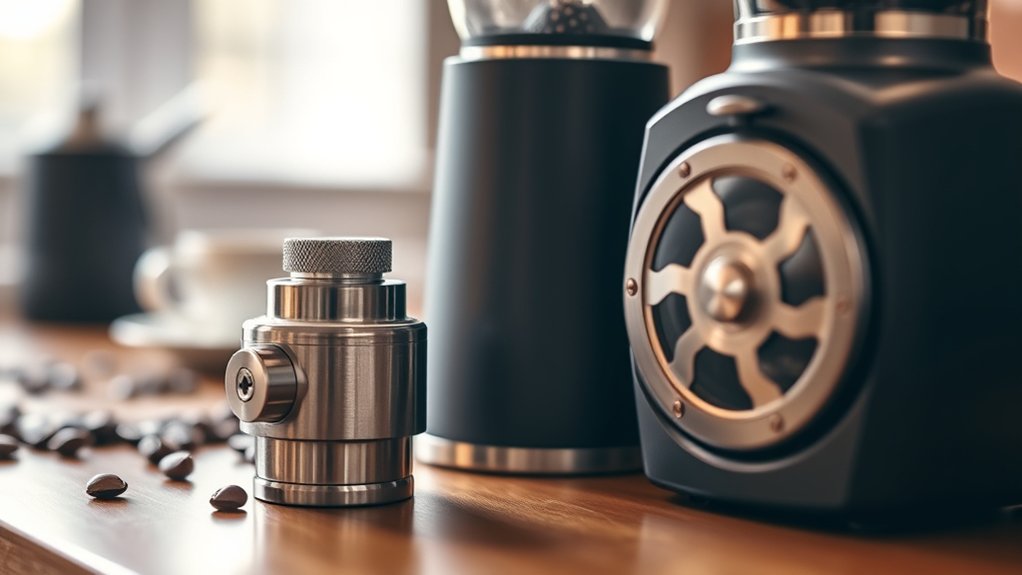
How do you decide between an espresso grinder and a regular coffee grinder? First, consider what type of coffee you brew most often. If you primarily make espresso, an espresso grinder will give you the fine, consistent grind essential for proper extraction.
Decide based on your coffee preference; espresso grinders provide the fine, consistent grind needed for espresso.
For drip or French press, a regular coffee grinder usually suffices, providing coarser grinds.
Next, think about grind consistency and control. Espresso demands precise adjustments, so an espresso grinder offers finer tuning options.
Also, assess your budget and space. Espresso grinders tend to be pricier and larger.
Finally, evaluate your brewing equipment’s requirements and your personal preferences.
Choosing the right grinder means matching it to your brewing style, grind precision needs, and convenience. That way, you’ll get the best flavor from your coffee beans every time.
How Espresso Grinders Differ From Regular Coffee Grinders
What sets espresso grinders apart from regular coffee grinders lies primarily in their design and grind output. When you use an espresso grinder, you’ll notice it employs flat or conical burrs engineered for consistent, ultra-fine grounds essential for espresso’s pressure extraction.
Regular coffee grinders, often designed for drip or French press, prioritize versatility and produce coarser grinds.
Espresso grinders also feature stepless adjustment mechanisms, giving you precise control over grind size to fine-tune espresso shots. Furthermore, espresso grinders operate at slower speeds to minimize heat, preserving coffee’s flavor integrity.
In contrast, many regular grinders use stepped adjustments and higher speeds.
Understanding these differences ensures you pick the right grinder to match your brewing method and extract maximum flavor from your beans every time. It’s all about matching the grinder to how you brew, so your coffee always tastes its best.
How Grinder Grind Size Affects Espresso and Drip Coffee
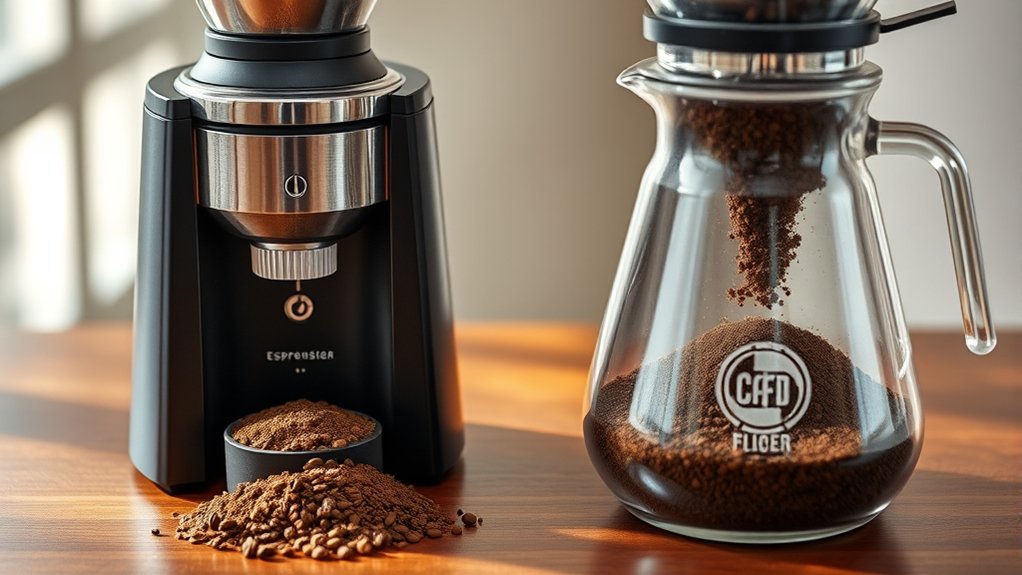
You’ll notice that grind size really affects the extraction and flavor in both espresso and drip coffee.
For espresso, you need a fine grind because it helps create the right pressure and extraction time.
On the other hand, drip coffee calls for a coarser grind so water flows properly and you don’t end up with bitterness.
Knowing these differences makes it easier to adjust your grinder and get the best cup every time.
Grind Size Impact
Because grind size directly influences extraction time and flavor balance, choosing the right setting is vital for both espresso and drip coffee. When you use a finer grind, coffee particles expose more surface area, which speeds up extraction and makes the flavors more intense. For espresso, this means you get a rich, concentrated shot with proper crema.
On the other hand, coarser grinds slow down extraction, which is perfect for drip brewing. Here, water flows longer through the grounds, bringing out brighter, cleaner notes without bitterness.
If your grind is too coarse for espresso, the shot will under-extract and taste sour and weak.
If the grind is too fine for drip, you risk over-extraction, which leads to bitterness and muddled flavors.
Understanding how grind size affects water contact time and flavor clarity helps you dial in your grinder just right. That way, you can optimize the taste profile for your brewing method every time.
Espresso Grind Fineness
Mastering espresso grind fineness means understanding how subtle adjustments impact both extraction speed and flavor clarity. When you dial in your grinder to a finer setting, you increase the coffee’s surface area, which slows water flow, allowing more flavor compounds to dissolve.
Too fine, however, and you risk over-extraction, creating bitterness and harshness.
Conversely, a grind that’s too coarse speeds up extraction, producing weak, under-extracted espresso lacking complexity. Precise control over grind size is essential because espresso machines use high pressure and short brew times, making the grind fineness critical for balancing shot time and flavor profile.
Drip Coffee Coarseness
Although espresso demands a fine grind for ideal extraction, drip coffee needs a coarser grind size to balance brewing time and flavor clarity. Using a grind that’s too fine for drip coffee can cause over-extraction, which leads to bitterness.
On the other hand, if your grind is too coarse, you’ll get under-extraction. That means your coffee might taste weak and sour. So, adjusting the grind coarseness is key to getting the best flavor from your drip brew.
| Grind Size | Impact on Drip Coffee |
|---|---|
| Fine | Over-extraction, bitter taste |
| Medium-Coarse | Balanced extraction, optimal flavor |
| Coarse | Under-extraction, sour & weak |
Why Consistency Matters for Espresso and Coffee Grinders
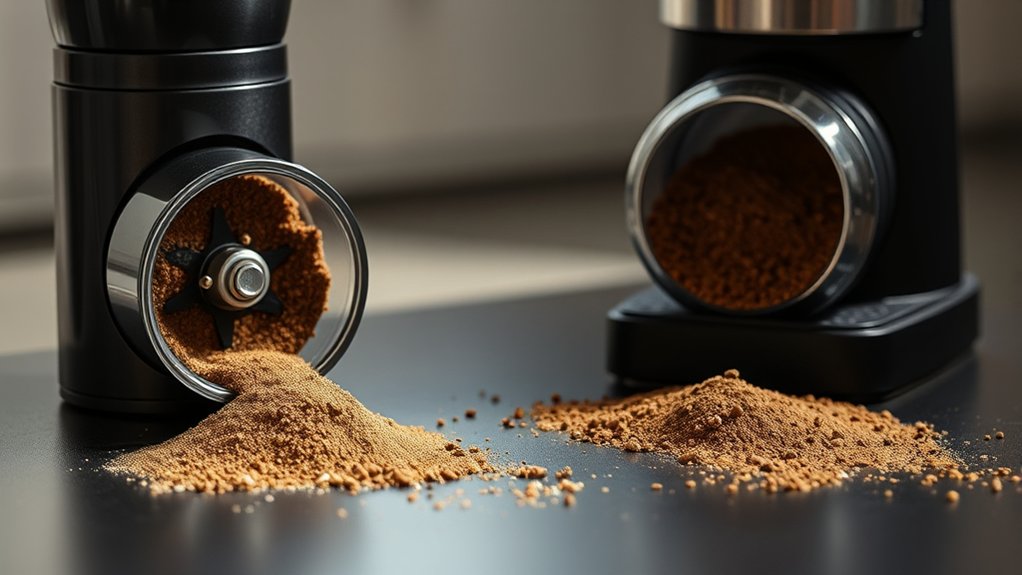
You need a consistent grind size to make sure your espresso or drip coffee extracts evenly. This really impacts the flavor balance in your cup.
When the particles are all over the place, some get over-extracted and others under-extracted, which can make your coffee taste bitter or sour.
Keeping things uniform lets you get the most out of your beans every single time you brew.
Grind Size Uniformity
Because grind size uniformity directly impacts extraction quality, understanding its significance is vital when choosing between an espresso grinder and a coffee grinder. Uniform particle size ensures even water flow and consistent extraction, which helps prevent under- or over-extracted flavors.
Espresso grinders excel here by producing finely ground coffee with a tight particle size distribution. This is essential for the high-pressure, short-contact brewing method that espresso demands.
On the other hand, coffee grinders designed for drip or French press tolerate more particle size variation without drastically affecting the taste.
When your grinder delivers uneven particles, you risk channeling or inconsistent brew strength. So, if you prioritize precision and flavor clarity—especially for espresso—it’s best to opt for a grinder that emphasizes grind size uniformity.
This consistency not only optimizes your brew but also improves repeatability in your daily coffee routine.
Extraction Flavor Impact
When grind consistency falters, your espresso or coffee brew won’t reach its full flavor potential. Uneven particle size leads to uneven extraction. Some grounds over-extract, becoming bitter, while others under-extract, tasting sour or weak.
This imbalance muddles the nuanced flavors you’re aiming to highlight. You need a grinder that delivers uniform particles to guarantee balanced extraction. That way, you preserve the complexity of your beans.
| Grind Consistency | Extraction Quality | Flavor Profile |
|---|---|---|
| High | Even | Balanced, rich |
| Medium | Slightly uneven | Muted, inconsistent |
| Low | Uneven | Bitter, sour, flat |
Choosing the right grinder directly impacts how well your brew extracts. It basically defines your coffee’s final taste.
Burr vs Blade Grinders: Which Works Better for Espresso?
Although both burr and blade grinders can grind coffee, burr grinders consistently deliver the precise, uniform grind size essential for extracting the rich flavors espresso demands. When you use a burr grinder, you’ll get consistent particle size, which guarantees even extraction and prevents over- or under-extraction.
Blade grinders chop beans unevenly, producing a mix of fine powder and larger chunks, which disrupts espresso’s delicate balance. You want a grinder that lets you dial in the grind size accurately, and burr grinders offer this control through adjustable settings.
This precision makes burr grinders the superior choice for espresso, where grind consistency directly affects crema, body, and flavor clarity.
How Grinder Speed Influences Coffee Flavor and Temperature
Understanding grinder speed is essential because it directly impacts both the flavor profile and temperature of your coffee grounds. When your grinder spins too fast, friction generates excess heat. This heat can prematurely extract bitter compounds and degrade delicate aromas.
The heat buildup changes the coffee’s chemical balance, resulting in a flatter, less vibrant cup. On the other hand, slower grinders produce less heat, which helps preserve those nuanced flavors. This allows for a more balanced extraction.
That said, extremely slow speeds might increase grind time, which could lead to oxidation. High-speed grinders often create inconsistent particle sizes due to the rapid cutting action. This affects extraction uniformity and can throw off your brew.
Adjusting Grind Settings: Precision Needs for Espresso vs Coffee
Balancing grinder speed to control heat and particle size sets the stage for how you adjust grind settings for espresso versus regular coffee. When dialing in your grind, you’ll need to recognize espresso demands far greater precision due to its fast extraction time and pressure.
Balancing grinder speed helps manage heat and particle size, key for precise espresso versus regular coffee grinds.
For drip or French press, you have more flexibility with coarser, uneven grinds. Focus on these points:
- Espresso requires a consistent, fine grind to ensure uniform extraction and avoid bitterness.
- Regular coffee tolerates a broader particle size distribution without sacrificing flavor.
- Small adjustments, often just one notch, can drastically alter espresso taste, so adjust incrementally.
- Coarser grinds suit methods like French press, where steeping time compensates for grind size variance.
Why Dose Control Matters More for Espresso Grinders
Since espresso extraction happens quickly and under high pressure, controlling the exact dose of coffee grounds becomes critical to achieving a balanced shot. You need a consistent, precise dose because even small variations can lead to under-extraction or over-extraction, which affects flavor and crema.
Unlike drip coffee, where small dose fluctuations are more forgiving, espresso demands exactness to maintain the right concentration and body. Dose control lets you replicate your preferred taste profile shot after shot. This is essential for dialing in recipes or adjusting to bean freshness.
Grinder Build Quality and Materials: Espresso vs Coffee
Precise dose control relies not only on design but also on the grinder’s build quality and materials. When you invest in an espresso grinder, expect sturdy, durable components that withstand frequent use and maintain consistency. Coffee grinders often emphasize versatility and affordability, sometimes compromising on materials.
Consider these factors when comparing build quality:
- Burr Material: Espresso grinders use hardened steel or ceramic burrs for longevity and precision. Coffee grinders may opt for less durable metals.
- Housing: Espresso grinders feature solid metal or reinforced plastic for stability. Coffee grinders often use lighter plastics.
- Motor Quality: Espresso grinders have high-torque motors to ensure uniform grind size. Coffee grinders might have lower power.
- Adjustment Mechanism: Espresso grinders provide precise, stable grind adjustments. Coffee grinders often have simpler, less exact settings.
Understanding these differences helps you choose a grinder that matches your coffee routine’s demands. It’s all about finding the right balance between quality and what works for your daily brew.
Choosing the Right Grinder Based on Your Brewing Method
When selecting a grinder, your brewing method plays a crucial role in determining the ideal grind size and consistency you need.
Your brewing method is key to choosing the perfect grinder for optimal grind size and consistency.
For espresso, you require a fine, uniform grind to guarantee maximum extraction under high pressure. An espresso grinder excels here with precise, stepless adjustments.
If you brew using a drip coffee maker or a French press, a coarser grind is necessary. A standard coffee grinder with multiple settings will serve you well for these methods.
Pour-over methods demand medium to medium-fine grinds, emphasizing consistency to avoid over or under-extraction.
Blade grinders, lacking uniformity, generally don’t suit these methods. Match your grinder to your preferred brewing style to maximize flavor clarity and extraction control.
This guarantees every cup you make reflects the brewing method’s unique requirements.
Frequently Asked Questions
How Often Should I Clean My Espresso Grinder?
You should clean your espresso grinder at least once a week to keep it performing at its best and to preserve great flavor. Daily, just wipe down the hopper and burrs to get rid of coffee oils and grounds.
Every few months, it’s a good idea to do a deep clean by taking the burrs apart and clearing out any buildup. Regular cleaning stops stale coffee residue from messing with your taste.
Plus, it helps make sure your grind size stays consistent, so your espresso shots come out rich and balanced every time you brew.
Can I Use One Grinder for Both Espresso and French Press?
Yes, you can use one grinder for both espresso and French press, but it needs to be versatile and adjustable. You’ll want a burr grinder with precise grind size control to switch between the fine grind for espresso and the coarse grind for French press.
Keep in mind, frequent adjustments and thorough cleaning between uses are essential. This helps prevent flavor contamination and ensures consistent performance for both brewing methods.
It might take a bit of practice, but it’s definitely doable!
What Is the Average Lifespan of an Espresso Grinder?
You can expect an espresso grinder to last around 5 to 10 years with regular use and proper maintenance. High-quality grinders with durable burrs and motors tend to reach the upper end of that range.
To maximize lifespan, clean the burrs frequently. Avoid grinding oily beans excessively, and replace worn parts like burrs when needed.
If you maintain it well, your grinder will consistently deliver precise grinds for years to come.
Do Espresso Grinders Require Special Maintenance Tools?
Yes, espresso grinders often require special maintenance tools. You’ll need cleaning brushes designed to reach tight spaces between the burrs, and sometimes specific cleaning pellets or tablets to remove coffee oils and residue.
A burr alignment tool might be necessary if your grinder allows adjustments. Using these tools regularly helps maintain grind consistency and extends your grinder’s lifespan.
This way, your espresso tastes great every time. So, don’t skip this essential upkeep!
How Noisy Are Espresso Grinders Compared to Regular Coffee Grinders?
Espresso grinders typically produce noise levels around 70-80 decibels, while regular coffee grinders often range from 60-75 decibels. So, you’re likely to hear a bit more buzz from an espresso grinder.
This difference happens because espresso grinders require finer, consistent grinds, demanding higher burr speeds and pressure.
If noise bothers you, consider grinders with sound insulation or quieter motor designs. They make a noticeable difference during early morning brewing.
It’s definitely worth looking into if you want a quieter kitchen vibe.
Conclusion
So, you want the perfect cup, but don’t think a grinder makes a difference? Sure, just toss your beans in any grinder and hope for espresso magic. But if you’re serious, you’ll know espresso grinders require precision, consistency, and control that regular coffee grinders simply can’t match.
In the end, choosing the right grinder isn’t about gadgets—it’s about respecting your brew. Or you can keep winging it, and enjoy your “espresso” surprise.

Pingback: Step-by-Step Guide to the Perfect AeroPress Coffee – iPourCoffee
Pingback: Make Italian-Style Espresso-Like Coffee at Home With a Moka Pot – iPourCoffee
Pingback: Single-Origin vs Blended Coffee Beans: Which Should You Buy? – iPourCoffee
Pingback: How to Tell If Coffee Beans Are Fresh (Plus Proper Storage Tips) – iPourCoffee