You should match your espresso dose precisely to your basket size and roast level for consistent flavor and extraction. Smaller baskets need around 14–17 grams, larger ones 18–20 grams. Lighter roasts require slightly less than denser darker roasts.
Adjust your dose in 1-2 gram increments and calibrate grind size to maintain a 25–30 second brew time. Correct dosing helps prevent channeling and balances taste complexity.
Exploring how dose affects your espresso further reveals ways to optimize your shots perfectly. It’s all about finding that sweet spot for your unique setup.
What Is Espresso Dose and Why Does It Matter?
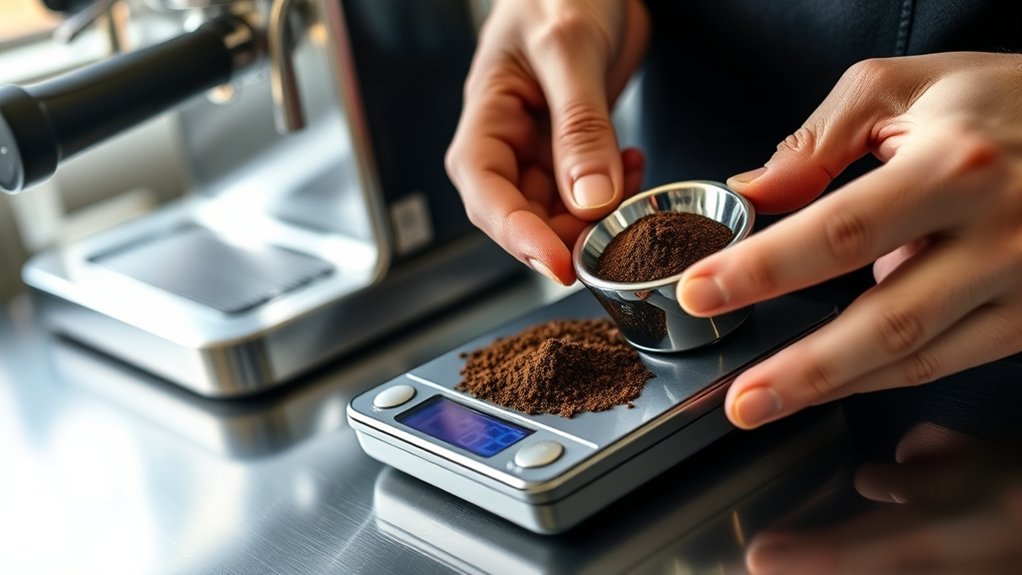
Although it might seem straightforward, the espresso dose, the exact weight of coffee grounds you use, plays a critical role in shaping your shot’s flavor and strength. You typically measure this dose in grams, aiming for precision to control extraction quality.
If you use too little coffee, your shot risks being weak and under-extracted, lacking body and complexity. Conversely, over-dosing can lead to over-extraction, producing bitterness and harsh flavors. Adjusting the dose also influences the extraction time, which directly affects the balance of acids, sugars, and oils in your espresso.
By accurately dosing, you guarantee consistency across shots, enabling you to replicate desired taste profiles reliably.
Proper measurement also allows you to manage variables effectively, optimizing the balance between acidity, sweetness, and bitterness.
Mastering espresso dosing is essential if you want to produce high-quality, balanced espresso every time. Adjusting dose along with grind size and tamping helps maintain ideal extraction time and flavor balance.
How Basket Size Affects Your Espresso Dose
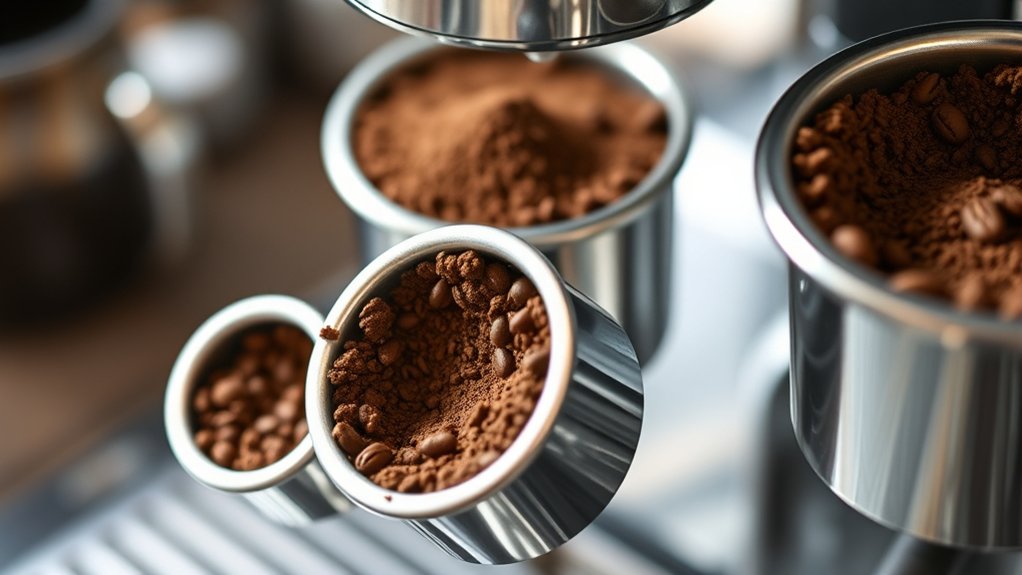
Because basket size directly influences the volume of coffee grounds it can hold, adjusting your espresso dose accordingly is vital for achieving ideal extraction. Different basket diameters require precise dosing to maintain consistent bed depth and saturation. The choice of dose also impacts the espresso extraction ratio, which is crucial for flavor balance.
Basket size impacts coffee volume, so precise dosing ensures consistent extraction and optimal espresso quality.
Larger baskets, like 58mm, need higher doses, typically 20 to 20.5 grams. Smaller baskets, such as 53mm, require lower doses, around 14 to 17 grams. Using the same dose across different basket sizes leads to uneven extraction due to inconsistent bed depth.
Overfilling small baskets causes channeling, which disrupts flow and flavor. So, making sure you adjust your dose properly guarantees uniform extraction.
This way, you optimize your espresso’s quality every single time. Maintaining a consistent dose is essential for perfect shots and flavor balance.
Why You Need to Scale Dose to Your Portafilter Size
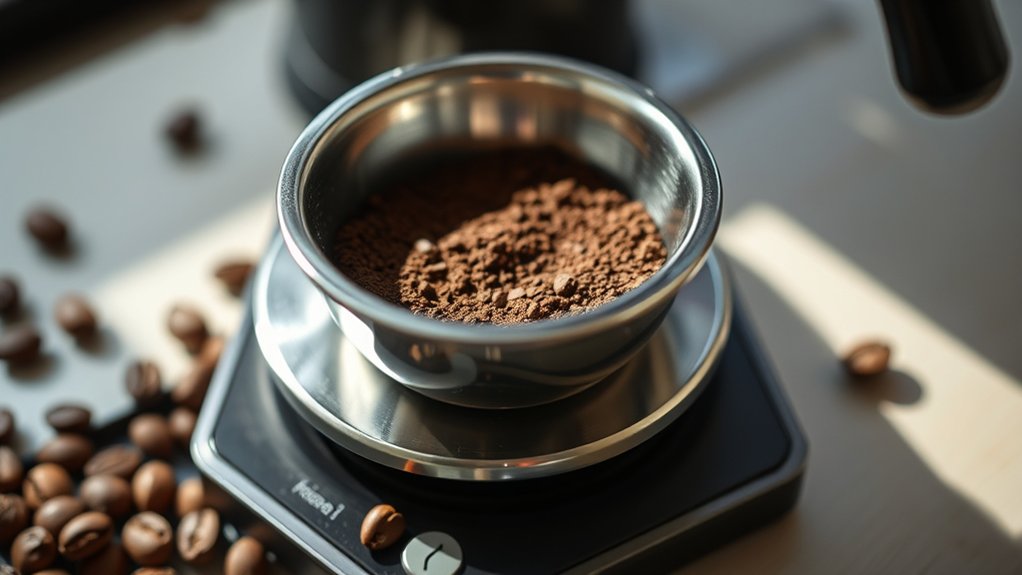
When you scale your espresso dose to match your portafilter size, you maintain the ideal coffee bed depth essential for even extraction. Using the proper dose for each basket size, about 20 grams for a 58mm basket and roughly 15 grams for a 53mm, prevents under- or over-filling. Both of these issues can cause channeling or weak shots.
This precise adjustment guarantees consistent bed depth, which promotes uniform saturation and extraction across the coffee puck. By minimizing the risk of channeling, you ensure even distribution of grounds. That improves shot quality and flavor consistency.
Neglecting to scale the dose compromises the coffee bed’s integrity, leading to uneven flow and extraction inefficiencies. So, tailoring your dose to your portafilter size is vital for achieving ideal espresso performance.
How Dose Influences Grind Size and Extraction Time
Adjusting your espresso dose directly impacts the grind size you’ll need to maintain ideal extraction time. When you increase the dose, the coffee bed thickens, slowing water flow and extending extraction if grind size stays the same. Conversely, lowering the dose thins the bed, speeding water flow and risking under-extraction without grind adjustments.
Changing your espresso dose alters the grind size needed to keep extraction time consistent.
To hit the target 25–30 second brew time, precise grind calibration is vital.
Consider these points:
- Larger doses require coarser grinds to prevent over-extraction
- Smaller doses need finer grinds to avoid under-extraction
- Dose and grind size must balance to control extraction time
- Extraction time influences flavor balance and shot quality
- Minor grind tweaks are necessary when changing dose amounts
Mastering this interplay ensures consistent, balanced espresso shots every time.
Understanding Channeling and How Espresso Dose Impacts It
You’ll want to understand how dose directly influences channeling. That’s when water creates narrow paths through the coffee bed, leading to uneven extraction.
If you use too small a dose with a fine grind, it can actually increase the risk of channeling. On the other hand, an ideal dose helps promote a uniform water flow by creating a balanced coffee bed.
Let’s dive into how adjusting your dose and using some prevention techniques can help minimize channeling. Doing this will improve the consistency of your espresso, making each shot taste better than the last.
Dose Effects On Channeling
Although channeling can undermine espresso quality, controlling your dose plays a critical role in managing this issue. The dose directly influences the coffee bed depth and uniformity, which affects water flow during extraction.
Here’s how dose impacts channeling: increasing dose deepens the coffee bed, promoting uniform resistance to water flow and reducing channel formation. Using too little coffee leads to uneven saturation, making channels more likely as water bypasses grounds.
Excessive dose can cause over-compaction, disrupting even water distribution and increasing channeling risk. Proper dose adjustment maintains ideal bed depth, which is essential for consistent extraction.
Balancing dose with grind size and tamping pressure helps keep the coffee bed’s structural integrity intact, minimizing channeling potential.
Mastering dose control is key to mitigating channeling and achieving balanced espresso extraction.
Preventing Channeling Techniques
When you control the espresso dose accurately, you create a coffee bed that resists uneven water flow, which is essential for preventing channeling. Channeling happens when water exploits weak spots in an uneven or sparse coffee bed, causing over-extraction along narrow paths.
Using the correct dose ensures the bed is dense and uniformly filled, providing consistent resistance to water.
Avoid under-dosing, which produces a shallow puck vulnerable to fast water paths. Conversely, overdosing compresses the puck excessively, distorting flow and encouraging channeling.
To prevent this, precisely measure your dose, distribute grounds evenly, and apply consistent tamping pressure.
These techniques maintain uniform bed depth and density, ensuring water flows evenly through the coffee. This optimizes extraction and minimizes channeling risks.
It’s all about balance and consistency to get the best shot every time.
Adjusting Pre-Infusion Time for Dose and Bed Depth
Since higher doses and deeper coffee beds require more thorough saturation, adjusting your pre-infusion time becomes essential to achieve even extraction. You need to extend pre-infusion to fully wet the coffee bed before applying pressure, especially with doses above 20 grams.
This prevents channeling and promotes uniform extraction.
Focus on the first drops to confirm saturation and tailor pre-infusion duration to bed depth and dose. It’s all about making sure the water is evenly spread before you ramp up the pressure.
- Increase pre-infusion time with doses over 20 grams
- Observe first drops as saturation confirmation
- Match pre-infusion duration to bed depth
- Adjust based on flow rate and shot quality
- Prevent uneven extraction and channeling
How Roast Level Affects Espresso Dose and Basket Fill
Because roast level directly affects coffee bean density, you’ll need to adjust your espresso dose to guarantee proper basket fill and extraction. Darker roasts are denser, so you typically increase dose weight to fill the basket adequately. Lighter roasts are less dense, often requiring a slightly lower dose by weight to avoid overfilling, even if the volume looks consistent.
Understanding this interplay helps you optimize extraction and avoid channeling.
| Roast Level | Bean Density | Dose Adjustment |
|---|---|---|
| Light | Low | Slightly lower weight dose |
| Medium | Medium | Standard dose |
| Dark | High | Slightly higher weight dose |
Adjust doses precisely based on roast to maintain consistent puck depth and extraction quality.
Pros and Cons of Different Espresso Dose Sizes
Although adjusting espresso dose size might seem straightforward, it considerably impacts flavor, body, and extraction dynamics. You need to understand the trade-offs between different doses to optimize your shot.
Smaller doses (7-9g) yield intense, concentrated espresso but often a thinner body and simpler flavor.
Standard doses (15-17g) provide balanced strength, consistent extraction, and manageable brew time.
Larger doses (18-20g) enhance body, flavor complexity, and crema but require precise dialing and longer extraction.
Very high doses (20g+) risk channeling and over-extraction without careful technique and appropriate basket size.
Very low doses can under-extract, producing sour or weak shots.
So, dose selection is really vital for getting the flavor profile you want.
Choosing the right dose size directly affects your espresso’s quality and consistency. It’s worth experimenting to find what works best for your taste and equipment.
Tips for Dialing In Your Ideal Espresso Dose
Finding the ideal espresso dose involves more than just selecting a number; it requires careful measurement and incremental adjustments to fine-tune extraction.
Start with an 18 to 20 gram dose for a double shot, using a digital scale for precise and consistent measurement. Adjust the dose in 1 to 2 gram increments while observing changes in brew time, flavor profile, and extraction quality.
Aim for the lowest dose that guarantees even saturation without channeling, typically between 16 and 18 grams. Remember, larger doses call for coarser grinds and longer pre-infusion to maintain balanced extraction and proper bed saturation.
Frequently Asked Questions
How Does Water Temperature Affect Espresso Extraction?
Water temperature directly influences espresso extraction by controlling solubility. If the water is too hot, you risk over-extracting bitter compounds. But if it’s too cold, you’ll end up under-extracting weak flavors.
You want to keep your water between 90-96°C. That range helps you get a balanced, ideal flavor extraction every time. It’s all about finding that sweet spot where the flavors come through just right.
Can Different Coffee Origins Require Different Doses?
Yes, different coffee origins require adjusting doses to optimize extraction. You’ll need to tweak the dose based on bean density, roast level, and flavor profile. This helps balance acidity, sweetness, and bitterness.
That way, your espresso really highlights each origin’s unique characteristics. It’s all about finding what works best for the beans you’re using. A little adjustment can make a big difference in flavor.
What Impact Does Tamping Pressure Have on Shot Quality?
Tamping pressure acts like a gatekeeper, controlling water flow through coffee grounds. If you don’t tamp evenly or firmly, you risk channeling, causing an uneven extraction.
That means your shot could end up weak or bitter instead of balanced and rich. So, getting your tamp just right really makes a difference.
How Often Should You Recalibrate Your Grinder for Dose Consistency?
You should recalibrate your grinder daily or whenever you notice dose inconsistencies. Environmental changes, bean freshness, and grinder wear all affect grind size and output.
Does Espresso Dose Affect the Crema Thickness?
Yes, your espresso dose affects crema thickness. A proper dose guarantees ideal extraction pressure, which produces a rich, stable crema.
If you use too little or too much coffee, it disrupts the balance. This can thin the crema and impact the flavor complexity and texture. So, getting the dose right really matters!
Conclusion
When dialing in your espresso dose, remember that even a 0.2-gram difference can change extraction by up to 5%. This can drastically alter the flavor balance.
By precisely matching your dose to basket size and roast level, you get to control grind, extraction time, and channeling. This helps you craft a consistent, rich shot every time.
Fine-tuning this variable transforms your espresso from average to exceptional. Mastering dose isn’t just science; it’s the key to revealing your coffee’s full potential.