When you use Specialty Coffee Association (SCA) cupping scores, you evaluate coffee on a 100-point scale emphasizing balance, aroma, flavor, acidity, and cleanliness. Scores above 80 indicate specialty grade, with higher points reflecting complexity, sweetness, and defect-free quality. Defects or taints lower scores considerably.
Single origins usually score higher than blends because they showcase distinct regional traits. This system lets you objectively assess quality, consistency, and ethical sourcing. These are key factors shaping premium coffee experiences.
Understanding this scoring method gives you a deeper insight into grading nuances ahead. It helps you appreciate what makes specialty coffee truly special.
SCA Coffee Cupping Scores: Definition and Importance
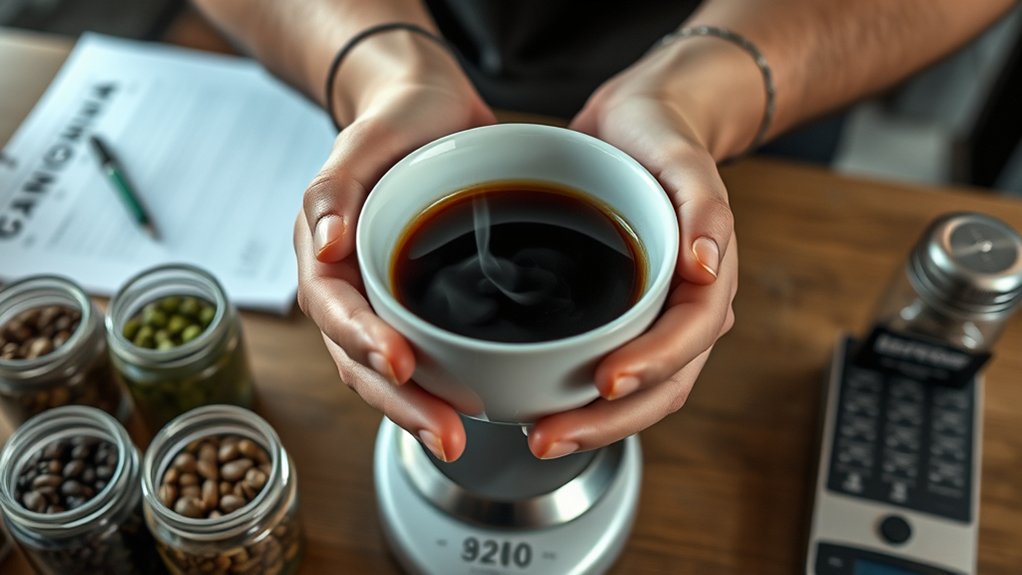
Although many factors influence coffee quality, the SCA coffee cupping score provides a standardized, objective method to evaluate it on a 100-point scale. When you engage in coffee grading, the SCA cupping scores help quantify sensory evaluation parameters like aroma, flavor profile, acidity, body, and aftertaste.
Scores of 80 and above qualify as specialty coffee, reflecting adherence to stringent quality standards. You’ll notice that defect assessment plays an essential role; any flaws detected during cupping deduct points, notably impacting the final score.
Certified Q-graders apply a rigorous scoring methodology to green coffee samples, ensuring consistent, reliable results worldwide. While exceptional coffees rarely exceed 90, scores above 85 indicate high-quality, well-crafted coffees that excel in balance and complexity. This helps guide buyers and roasters in quality selection.
Optimal coffee flavor development also depends on precise control of water temperature and brew time, which influence the extraction and final sensory attributes evaluated during cupping.
Green Bean Inspection and Its Role in Coffee Scoring
Since green bean quality directly impacts the final cup, inspecting these beans before cupping is critical to accurate coffee scoring. Green bean inspection ensures only samples meeting strict grading standards proceed to sensory evaluation.
Inspecting green beans before cupping is essential for precise and reliable coffee scoring.
During defect assessment, you analyze approximately 900 green beans for primary defects. Any presence disqualifies specialty grade status.
You also check for secondary defects; fewer than five are allowed for specialty classification.
Broken beans are a significant factor that can exclude a batch from specialty grading.
You must complete roasting within 24 hours before the cupping process, followed by at least 8 hours of resting to stabilize the roast.
This rigorous quality evaluation guarantees that the sensory evaluation reflects the true potential of the green beans. It provides a reliable foundation for specialty coffee scoring.
Accurate dose measurement during preparation is essential to maintain consistency and reflect the true characteristics of the coffee.
Key Coffee Attributes Evaluated in Cupping Scores
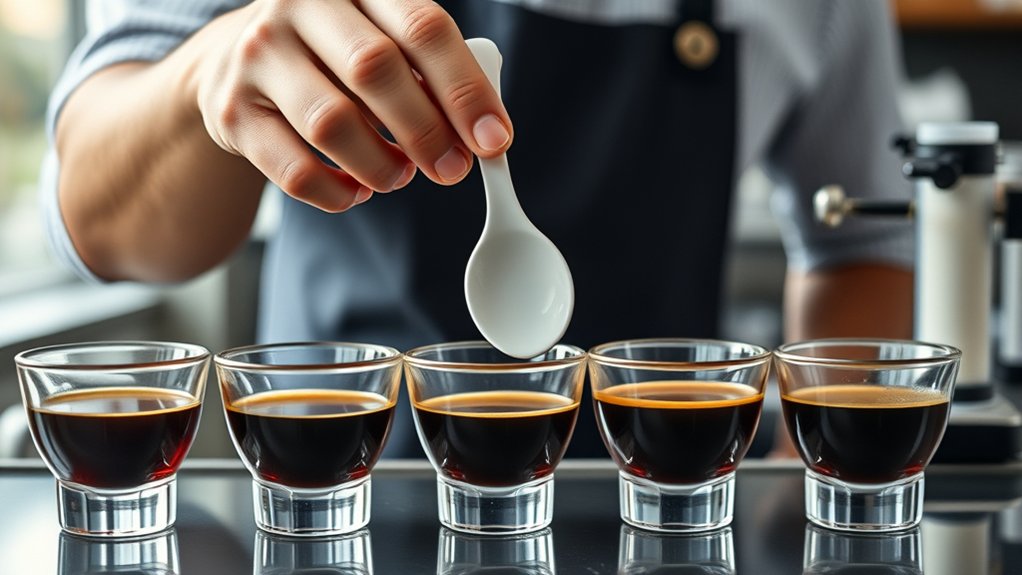
After confirming the quality of green beans through inspection, the next step is to evaluate the coffee’s sensory attributes during cupping. You assess fragrance and aroma first, noting intensity and complexity. Flavor follows, capturing unique profiles like cherry or chocolate.
Aftertaste measures the persistence of pleasant flavors. Acidity and body describe brightness and mouthfeel, essential for balance and overall harmony. Each attribute is scored on a 100-point scoring scale, reflecting its quality and development.
Balance integrates sweetness and complexity, influencing the final score markedly. Proper water temperature control during brewing is crucial for accurately reflecting these sensory attributes.
| Attribute | Description | Evaluation Focus |
|---|---|---|
| Aroma | Fragrance and initial scent | Intensity, complexity |
| Flavor | Taste profile | Uniqueness, balance |
| Aftertaste | Lingering pleasant flavors | Duration, cleanliness |
How Defects Affect Coffee Cupping Scores
You need to recognize how primary and secondary defects, like mold or broken beans, directly lower cupping scores by introducing off-flavors.
Even a few defects can disqualify coffee from specialty classification, so inspection standards have to be really rigorous.
Understanding these impacts helps you evaluate quality with precision and keep that high scoring potential intact.
It’s all about knowing what to look for and how it affects the final cup.
Additionally, factors such as coffee freshness play a critical role in preserving flavor integrity and preventing score degradation.
Types Of Coffee Defects
Although some defects may seem minor, they can drastically lower a coffee’s cupping score and overall quality. Understanding the types of defects is essential during the cupping process and quality assessment. You need to focus on:
1. Primary defects
These include sour beans, mold, and insect damage. Their presence disqualifies coffee from specialty grade, so defect removal is critical.
2. Secondary defects
Examples are broken beans and partial black or sour beans. You can only allow fewer than five per 350g sample to maintain quality.
3. Taints and faults
Taints deduct 2 points, faults deduct 4 points from the cupping score. Both considerably impact the evaluation of defective beans and overall green bean quality.
Proper inspection and defect removal ensure your coffee meets specialty standards. It really pays off to keep an eye out for these issues to maintain the best quality. Additionally, controlling brewing variables such as temperature stability during extraction directly influences the final cup quality and the accuracy of cupping scores.
Defect Impact On Scores
How exactly do defects influence your coffee’s cupping score? Primary defects like sour beans, mold, or insect damage must be entirely absent for your coffee to qualify as specialty coffee under grading standards.
Secondary defects are limited to fewer than five per batch. Even minor flaws cause flavor reduction and can considerably impact quality scores.
During the cupping process, defects impact aroma and taste. Taints deduct 2 points and faults deduct 4 points from the cupping score.
For example, six broken beans in a 12 oz sample can disqualify your batch from specialty classification. Rigorous defect removal is essential because these defects drastically reduce scores, often dropping them below the critical 80-point threshold.
Understanding defect impact helps you maintain the high standards required for specialty coffee. It’s all about keeping your coffee at its best.
Precise control of variables such as espresso dose can similarly influence flavor balance and highlight or mask defects during evaluation.
Inspection And Quality Standards
Since defects directly influence the sensory experience, inspection and quality standards play a crucial role in coffee cupping scores. During the cupping process, you rely on rigorous visual inspection to verify green beans are defect-free. Here’s what you need to focus on:
Primary defects must be zero in a 12 oz sample; even a small presence disqualifies high grading. Secondary defects should be fewer than five per sample, as these subtly degrade cup quality.
Roasted coffee must contain no quakers in 100g to meet quality standards.
Visible defects like mold or insect damage immediately lower cupping scores, with taints deducting 2 points and faults 4 points. Your quality assessment hinges on eliminating these defects to maintain top-tier cupping scores. Additionally, factors such as pressure control during espresso extraction can indirectly influence the sensory attributes detected in cupping evaluations.
Understanding the SCA Scoring Scale: Specialty to Extraordinary
When you explore the Specialty Coffee Association (SCA) scoring scale, you’ll find it ranges from 0 to 100 points. Any score above 80 qualifies as specialty coffee. This system carefully evaluates coffee quality through sensory evaluation, focusing on flavor profile and the absence of defects in green beans.
Entry-level specialty coffee scores between 80-82 points, which means it’s acceptable quality. Scores of 83-85 reflect well-balanced coffees with consistent attributes.
High-end coffee appears at 86-87 points, showcasing complexity and floral or fruity notes.
Exceptional coffees scoring 88-89 reveal expressive, refined profiles. Coffees surpassing 90 points are extraordinarily rare and represent multidimensional, award-winning lots.
Understanding these cupping scores helps you discern subtle quality differences. This way, you can appreciate and select specialty coffee with precision and confidence.
Balance, Sweetness, and Clean Cup in Coffee Scores
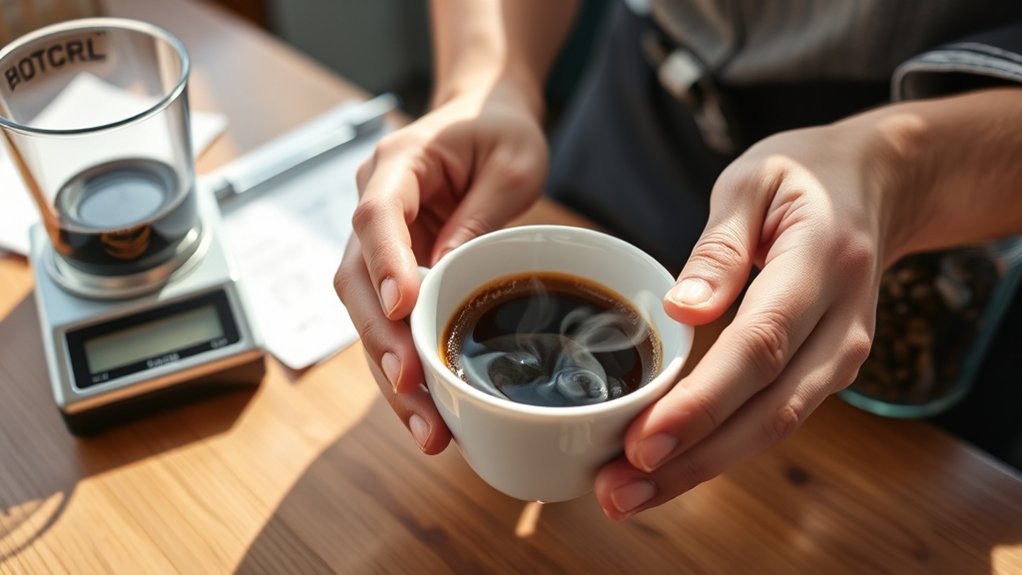
You’ll find that balance plays a vital role in coffee scoring. It measures how well acidity, aroma, flavor, and aftertaste work together in harmony.
Achieving a clean cup means the coffee is free from any off-flavors or taints, which helps ensure consistency with every sip.
When you put these factors together, they’ve a big impact on the overall quality and final score of the coffee.
Balance Importance In Scoring
How does balance influence your coffee’s overall score? In coffee scoring, balance means achieving equilibrium among sensory attributes like acidity, flavor, and sweetness. A coffee with well-integrated elements creates harmony that elevates its score.
Here’s why balance matters:
- Harmony of Sensory Attributes: When acidity, sweetness, and flavor align without overpowering one another, your coffee achieves a smooth, cohesive profile essential for a high score.
- Impact on Scoring: Imbalances such as excessive acidity or muted flavor disrupt harmony and lower the score, reflecting a less refined cup.
- Role of Sweetness and Clean Cup: Sweetness enhances perception of balance by up to 2 points, while a clean cup ensures no off-flavors interfere with scoring.
Ultimately, mastering balance is key to reaching scores above 85 and showcasing a well-rounded, harmonious coffee.
Clean Cup Criteria
Achieving balance in acidity, sweetness, aroma, and aftertaste sets the stage for a clean cup, which is a key criterion in specialty coffee scoring. When you evaluate coffee quality, a clean cup means there are no defects, taints, or off-flavors across all samples.
Sensory evaluation demands flavor uniformity. Any discrepancies among the five cupping samples will directly reduce the cupping scores. So consistency really matters here.
Sweetness, which comes from natural sugars, can boost the score by up to two points. It enhances harmony and gives the impression of a well-rounded profile.
To secure top cupping scores, you have to spot and exclude any coffees showing off-flavors or taints. These will disqualify a clean cup.
In the end, achieving a clean cup confirms you have a defect-free, pure-tasting coffee that truly exemplifies superior coffee quality.
Single Origins vs. Blends: Differences in Coffee Cupping Scores
While blends aim for balance and approachability, single origin coffees often outscore them in cupping evaluations by showcasing unique terroir and consistent quality.
Blends prioritize balance, but single origin coffees shine through unique terroir and consistent quality in cupping.
In specialty coffee, these differences show up in cupping scores and flavor profile clarity.
Single origin coffees typically score between 86-88 points, highlighting distinctive regional characteristics and expressive varietal traits. Blends score slightly lower, around 83-85 points, focusing on harmony and versatility rather than singular terroir expression.
Single origins can exceed 88 points, revealing complexity and transparency. Blends maintain uniformity but often lack standout features.
When you look at cupping evaluations, you’ll notice that single origin coffees emphasize consistency and distinctiveness in scoring range.
On the other hand, blends prioritize balance across multiple beans.
Using Coffee Cupping Scores to Choose Quality and Ethical Coffee
Because coffee cupping scores above 80 signify specialty grade, you can rely on them to identify higher-quality and ethically sourced coffees. The SCA grading system’s score thresholds help you distinguish coffee quality. Coffees scoring 86+ often come from single-origin or premium batches, reflecting transparent sourcing and refined coffee evaluation.
When roasters share cupping scores, you get insight into the coffee’s flavor profile, consistency, and ethical standards. Scores above 90 are rare and usually reserved for award-winning, sustainably farmed coffees. This means you’re getting both exceptional quality and ethical coffee practices.
Frequently Asked Questions
How Often Are SCA Cupping Score Standards Updated?
You’ll find that SCA cupping score standards are updated roughly every 10 to 15 years, although the timing can vary based on industry needs and new research.
For instance, major revisions happened in 2014 and again in 2025.
These updates refine evaluation protocols and scoring criteria to guarantee consistency and relevance.
Can Brewing Methods Influence Cupping Scores?
Yes, brewing methods can influence cupping scores because they affect extraction, which changes the flavor, aroma, and balance of the coffee. If you over-extract or under-extract, some attributes might get masked or exaggerated, which can skew the scores.
To really understand the true quality of the coffee, you need to keep certain things consistent, like water temperature, grind size, and steep time.
Different brewing methods can also change how you perceive the coffee’s sensory qualities.
That’s why standardized protocols are important—they make sure the scores reflect the coffee itself, not the variations in how it was brewed.
Are SCA Cupping Scores Recognized Globally by All Coffee Buyers?
No, not all coffee buyers recognize SCA cupping scores globally. While specialty coffee buyers and major industry events rely heavily on these scores to assess quality objectively, some commercial and mass-market brands prioritize branding over standardized scoring.
If you’re buying specialty coffee, you’ll find SCA scores invaluable for consistency and quality. However, depending on your market or buyer type, these scores may not always influence purchasing decisions.
It really varies from one buyer to another.
How Do Climate Changes Impact Coffee Cupping Scores?
Climate change impacts your coffee cupping scores by causing uneven cherry ripening, which leads to inconsistent bean quality. You’ll face more defects and taints from extreme weather events like droughts or heavy rains, lowering sensory scores.
As climate zones shift, you might need to source new varieties, which can alter traditional flavor profiles.
What Training Is Required to Become a Certified SCA Coffee Grader?
To become a certified SCA coffee grader, you’ll complete rigorous training covering sensory analysis, defect identification, and standardized scoring methods.
You’ll attend multiple cupping workshops and calibration sessions to hone consistency.
Passing an extensive exam that tests your ability to accurately evaluate flavors and defects is essential.
This process guarantees you develop the precision and reliability needed to assess coffee quality and earn the title of SCA Certified Coffee Taster or Q Grader.
Conclusion
Understanding SCA cupping scores is like decoding a coffee’s fingerprint, revealing its true quality and character. By analyzing green bean inspection, defects, and key attributes, you gain clear insight into what sets specialty coffee apart. Whether you prefer single origins or blends, these scores guide you to make ethical, informed choices.
Relying on the SCA scale ensures your coffee experience is consistently exceptional, balancing sweetness, cleanliness, and complexity with precision. It’s a handy tool that helps you appreciate every cup on a deeper level. So next time you pick up coffee, let the scores lead the way!