An espresso machine works by forcing hot water through finely ground coffee at high pressure, extracting rich flavors and creating a creamy crema. You control key components like the boiler to maintain precise temperatures and the pump to guarantee consistent pressure. The group head evenly distributes water over the coffee, while steam wands froth milk for lattes and cappuccinos.
Understanding these parts and processes helps you appreciate what makes each shot perfect and opens up even more details to explore.
How Does an Espresso Machine Extract Coffee Under Pressure?
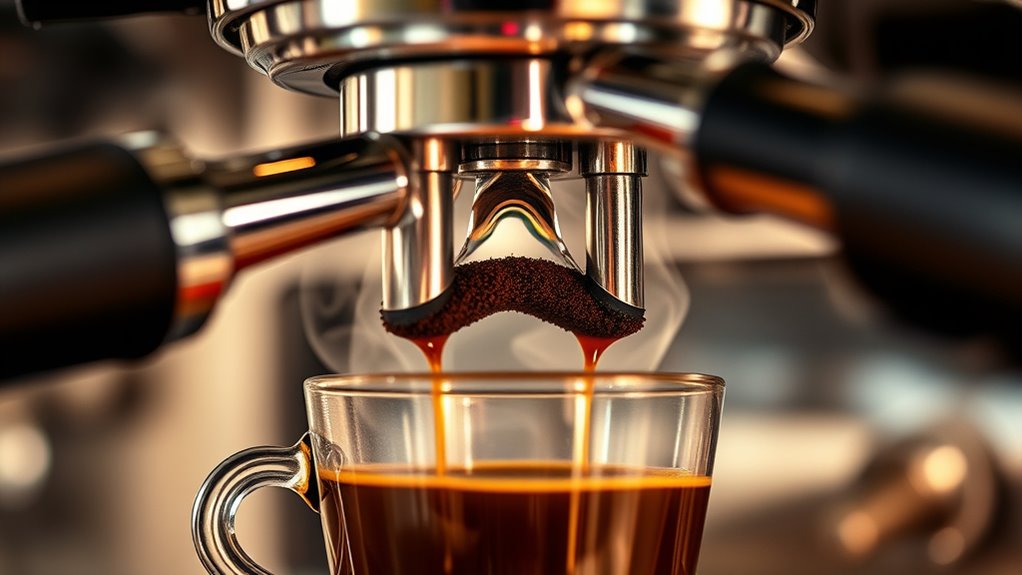
Although it might seem simple, an espresso machine extracts coffee by forcing hot water through finely ground coffee at about 9 bars of pressure. You rely on this high pressure to quickly and evenly push water through the tightly packed coffee grounds. This helps dissolve the rich flavors and essential oils locked inside.
This process creates a concentrated shot with a thick, golden crema on top. The group head plays a pivotal role by directing the pressurized water evenly through the coffee puck, ensuring consistent extraction.
You’ll find that precise control over both pressure and water temperature is vital. Any deviation can affect flavor balance and shot quality.
Mastering these elements is key to pulling the perfect espresso shot every time. Consistent extraction timing is also crucial, typically lasting 25-30 seconds, to ensure balanced flavor and crema development.
What Are the Key Parts Inside a Pump-Driven Espresso Machine?
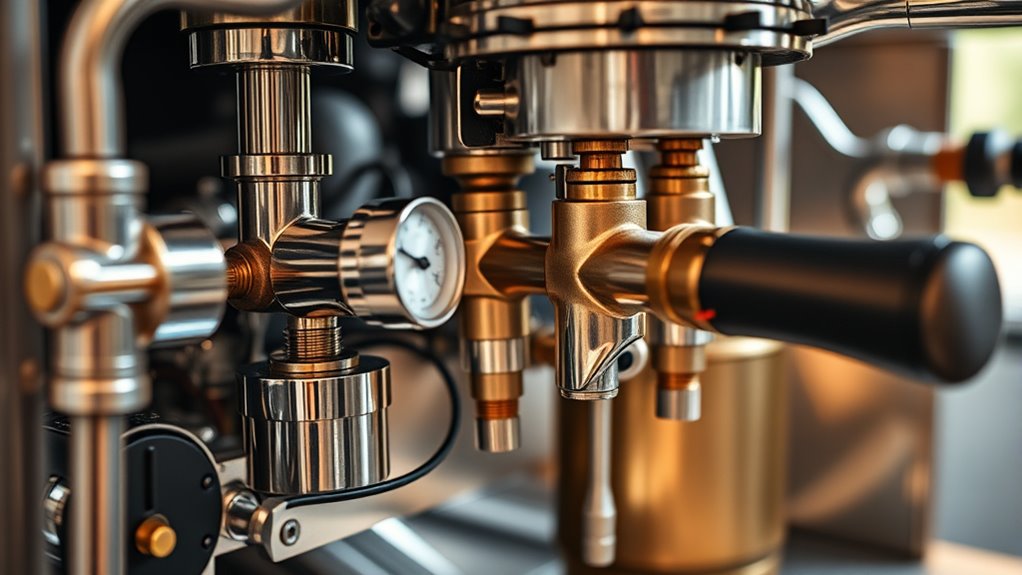
When you explore a pump-driven espresso machine, you’ll find several essential components working together to deliver that perfect shot. First, the water reservoir stores fresh water, feeding it into the system.
Discover how key parts in a pump-driven espresso machine work together for the perfect shot.
The pump, either vibratory or rotary, generates the vital pressure, around 9 to 15 bars, that forces hot water through the coffee grounds.
The boiler heats this water to the ideal brewing temperature, typically between 190°F and 205°F. It also produces steam for frothing milk.
The group head then evenly distributes the pressurized hot water over the coffee grounds in the portafilter, ensuring consistent extraction.
Inside, pathways and valves precisely control water flow, pressure, and temperature. This careful management makes sure every espresso shot is balanced and rich in flavor. It’s all about getting that perfect cup every time.
Additionally, mastering milk frothing techniques such as using steam to create velvety texture plays a key role in making a quality latte with espresso machines.
How Does the Boiler Control Water Temperature?
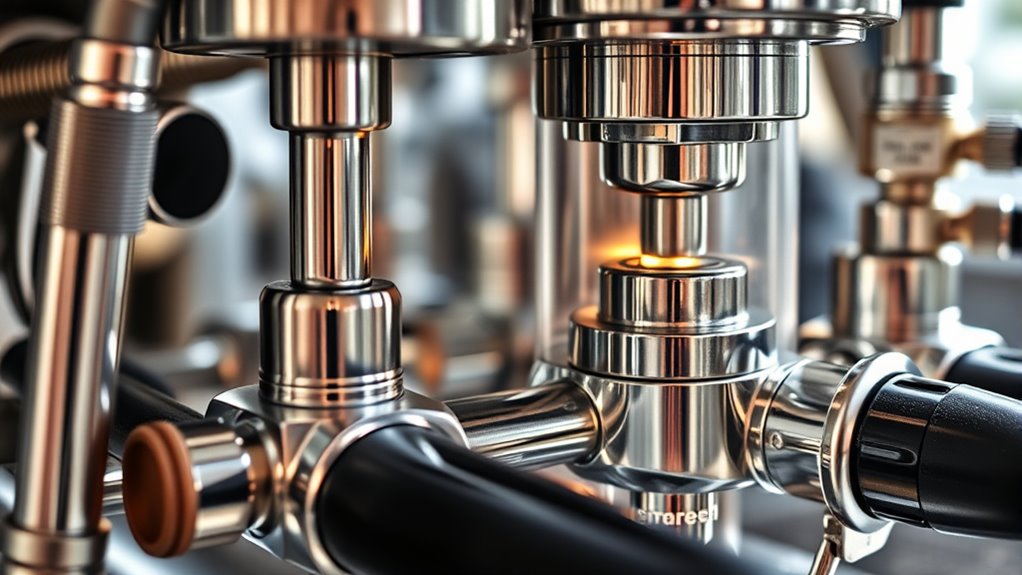
Because maintaining precise water temperature is essential for extracting the best flavors, the boiler uses a thermostat or a digital PID controller to regulate its heating elements.
Traditional boilers rely on a pressure stat that switches the heating element on or off based on preset pressure, indirectly managing temperature.
In contrast, advanced espresso machines with PID controllers use temperature probes to continuously monitor and adjust the water temperature with high accuracy.
Dual boiler machines take this a step further by having independent boilers for brewing and steaming, each with its own temperature controls.
This setup guarantees water stays within the ideal 195-205°F (90-96°C) range.
It provides consistent extraction and optimal espresso flavor every time you brew.
Maintaining proper brew temperature is crucial, as it works together with water quality to prevent under- or over-extraction and ensure balanced flavor.
How Does the Pump Help Brew Espresso?
You rely on the pump to generate the intense pressure needed to push hot water through the coffee grounds and extract that perfect shot. Different pump types, like vibration and rotary, play a role in how stable and consistent this pressure stays during brewing.
Knowing how the pump works helps you appreciate how it shapes the espresso’s flavor and crema. It’s pretty cool to realize that this little part makes such a big difference in your cup! Regular maintenance, including descaling to prevent mineral buildup, ensures the pump operates efficiently and prolongs the machine’s lifespan.
Pump Types Explained
How exactly does an espresso machine generate the intense pressure needed to extract rich, flavorful shots? It relies on two main pump types: vibratory and rotary vane pumps.
Vibratory pumps, common in home and super-automatic machines, use electromagnetic force to push water through coffee grounds, generating 4 to 16 bars of pressure. However, their pressure can fluctuate slightly.
Rotary vane pumps, found in commercial and high-end machines, use mechanical components to deliver more stable, consistent pressure. This stability is essential for superior shot quality.
Acting as the machine’s heart, these pumps force hot water through coffee at roughly 9 to 15 atmospheres. This process enables proper extraction and crema formation.
Maintaining your pump guarantees your espresso tastes just right every time. Understanding the pressure range used during extraction helps ensure balanced flavor and optimal alcohol content when making espresso-based cocktails like the Espresso Martini.
Pump’s Role In Brewing
Although many components contribute to espresso brewing, the pump plays a vital role by generating the intense pressure needed to push hot water evenly through the coffee grounds. Without this pressure, usually between 9 to 15 atmospheres, you wouldn’t extract the rich oils and flavors that define espresso.
The pump actively forces hot water from the boiler into the portafilter, guaranteeing a consistent and even infusion. It also maintains stable pressure, which is essential for producing that creamy crema on top.
Here’s how the pump helps brew espresso:
- Creates high pressure for maximum flavor extraction
- Ensures even water distribution through coffee grounds
- Provides precise pressure control during brewing
- Influences machine performance and noise based on pump type
In short, the pump is your espresso machine’s heart, driving quality with every shot. Regular maintenance, including descaling, is crucial to keep the pump functioning optimally and prevent mineral buildup that can impair pressure and flow.
How Do the Espresso Machine Group Head and Portafilter Work Together?
When the portafilter locks into the group head, it creates a sealed chamber that’s vital for brewing espresso. This tight seal allows hot water, pushed by pressure, to flow evenly through the coffee grounds. That way, it extracts rich flavors and forms the signature crema.
The group head’s dispersion screen makes sure water spreads uniformly, avoiding channeling and under-extraction.
Maintaining a consistent pressure of approximately 9 bars is essential for optimal flavor extraction and crema formation.
| Component | Function |
|---|---|
| Portafilter | Holds ground coffee, locks to form sealed space |
| Group Head | Directs hot water under pressure |
| Dispersion Screen | Distributes water evenly over coffee grounds |
| Seal | Guarantees no leaks for consistent pressure |
| Coffee Grounds | Extract flavors during pressurized water flow |
What Are the Main Types of Espresso Machines and Their Automation Levels?
You’ll find espresso machines come in all kinds of styles, from fully manual to super-automatic. Each type gives you a different level of control and convenience.
Manual machines are for those who want to be hands-on with every step — you manage everything, from grinding to tamping to brewing.
On the other hand, super-automatic models take care of it all for you, grinding the beans, tamping the coffee, and brewing the espresso with just a push of a button.
Knowing these automation levels makes it easier to pick the right machine based on how involved you want to be in making your espresso.
Many machines also offer features like pressure stability to enhance the quality of your espresso shots.
Espresso Machine Automation Levels
Since espresso machines vary widely in their automation levels, it’s important to understand the main types and how much control you’ll have during the brewing process. Each type offers a different balance between manual effort and automation, which affects convenience and customization.
Manual machines demand you control every step, from water volume to timing, for full personalization.
Semi-automatic machines automate water flow but require you to grind and tamp the coffee.
Automatic machines handle grinding, tamping, and brewing, simplifying espresso-making.
Super-automatic machines provide the highest automation, integrating grinders and milk frothers for quick, consistent results at the push of a button.
Knowing these levels helps you pick a machine that matches your skill and lifestyle perfectly. It’s all about finding what works best for you.
Additionally, features like pre-infusion and pressure profiling can further enhance control and espresso quality, especially in semi-automatic and higher-end machines.
Types Of Espresso Machines
Understanding the different types of espresso machines helps you choose the right balance between control and convenience. You’ll find four main types: manual, semi-automatic, automatic, and super-automatic.
Manual machines put you in full control. You manage water flow and brewing time yourself.
Semi-automatic models automate water flow with an electric pump but still require you to tamp and time the extraction.
Automatic machines take it a step further by handling grinding, tamping, and brewing with just a button press. Sometimes they even froth milk for you.
Super-automatic machines offer the highest automation, integrating grinders and milk frothing systems for a nearly hands-free espresso experience.
Knowing these types helps you select a machine that fits your skill level and how involved you want to be in crafting espresso. It’s all about finding the right fit for your coffee routine. Additionally, precise control over extraction time is crucial for optimizing both flavor and caffeine content in your espresso.
User Involvement Differences
How much control do you want over your espresso-making process? Your choice of machine defines how involved you’ll be.
Manual machines put you in the driver’s seat, requiring you to grind, tamp, and time every shot.
Semi-automatic models ease this by automating water flow but still need your input on grinding and tamping.
Automatic machines take it further, controlling water volume and brew time for consistency.
If convenience is king, super-automatic machines handle everything, from grinding to milk frothing, with just a button press.
Here’s a quick overview:
- Manual: Full control, no automation
- Semi-automatic: Automated water flow, manual grinding and tamping
- Automatic: Controls water volume and brew time automatically
- Super-automatic: Fully automated, including grinding and milk frothing
Choose your level of involvement accordingly.
Why Is the Espresso Machine Steam Wand Essential for Milk-Based Drinks?
Although espresso machines excel at extracting rich coffee, their steam wand truly sets them apart when it comes to milk-based drinks. The wand heats and froths milk by generating steam pressure that introduces air, creating the creamy foam essential for lattes and cappuccinos.
You get precise control over milk temperature and texture, allowing you to craft smooth microfoam perfect for latte art and consistent flavor. Unlike the brewing process, the steam wand operates independently, so you can froth milk without interrupting espresso extraction.
This capability distinguishes espresso machines from simple coffee makers.
To maintain quality and hygiene, you must clean the steam wand properly, preventing bacterial buildup. Ultimately, the steam wand is crucial for producing the rich, textured milk that defines classic espresso-based beverages.
How Do You Maintain Key Espresso Machine Components for Best Performance?
The steam wand plays a key role in crafting milk-based drinks, but keeping your entire espresso machine in top shape is what really guarantees every shot tastes just right. Regular upkeep helps prevent flavor issues and mechanical problems, so your machine performs consistently.
Focus on these essentials: Clean the group head and portafilter frequently to avoid coffee oil buildup that can cause bitterness and clogging. Descale the machine periodically, especially if you use hard water, to clear mineral deposits and keep the pressure and heat transfer working perfectly.
Clean group heads and portafilters regularly and descale often to ensure smooth pressure and perfect flavor.
Make it a habit to flush water lines and the steam wand after every use. This prevents bacteria and mineral buildup inside the components.
Also, replace worn gaskets and seals promptly. Doing this keeps brewing pressure steady and helps avoid leaks during extraction and steaming.
How Do Automation Levels Affect Espresso Machine Use and Convenience?
When you choose an espresso machine, the level of automation greatly influences both your involvement and the machine’s convenience. Fully automatic machines do everything at the push of a button, which is perfect if you want speed and consistency.
Semi-automatic models give you control over grinding and tamping but handle brewing automatically. This setup balances ease and customization nicely. Manual machines demand skill and effort, offering full control but less convenience.
| Automation Level | User Involvement |
|---|---|
| Fully Automatic | Minimal; push-button use |
| Semi-Automatic | Moderate; grind and tamp |
| Manual | Full; control all steps |
| Consistency | High with automation |
| Cost | Increases with automation |
Choosing depends on what you value more: convenience or hands-on control. It really comes down to your personal preference and how involved you want to be in the espresso-making process.
Frequently Asked Questions
What Grind Size Is Best for Making Espresso?
You should use a very fine grind, like powdered sugar, for espresso. This guarantees proper pressure and extraction. Avoid too coarse or too fine, as both affect flavor and machine performance.
Consistency is key for perfect shots. It really makes a difference in how your espresso turns out. Just stick with that fine grind, and you’ll be good to go!
How Long Should an Espresso Shot Take to Pull?
You should pull an espresso shot for about 25 to 30 seconds. This timing guarantees balanced extraction, avoiding weak flavors or bitterness.
Adjust your grind and tamp to hit that sweet spot consistently for rich, flavorful espresso every time. It’s all about finding that perfect balance. Keep practicing, and you’ll get there!
Can I Use Pre-Ground Coffee in an Espresso Machine?
You can certainly use pre-ground coffee, but it’s like settling for a whisper instead of a symphony.
Make sure it’s finely ground, or you’ll miss the rich, bold flavor and creamy espresso texture you crave.
What Water Quality Is Ideal for Espresso Brewing?
You’ll want water with 75-150 ppm total dissolved solids. It should be filtered to remove chlorine and impurities but still contain balanced minerals like calcium and magnesium.
This guarantees rich flavor, stable crema, and helps prevent scale buildup in your machine. Using the right water really makes a difference in your espresso.
How Does Espresso Differ From Regular Coffee?
Espresso hits your taste buds like a lightning bolt. It’s brewed under high pressure with finely ground beans, creating a concentrated, thicker shot with rich crema. This makes it stand out from regular coffee.
Regular coffee is made through a slower, milder drip extraction. It has a lighter body and a less intense flavor. So, espresso and regular coffee really offer two different experiences.
Conclusion
Now that you know how every part of an espresso machine works together, you’re basically a barista genius in disguise! These machines aren’t just gadgets, they’re precision coffee wizards brewing liquid gold under pressure.
Whether you’re pulling shots manually or letting automation handle it, understanding the process transforms your coffee game from “meh” to mind-blowing. So go ahead, master your machine and make every cup an espresso masterpiece that could wake the entire city!