You want an espresso machine that offers precise temperature control, stable 9-bar pressure, and a quality grinder for consistent grounds. Super-automatic models like the Jura Giga X8 provide convenience with automated grinding and frothing, while semi-automatics give you full control over extraction.
Consider features such as PID systems, build quality, and programmable shot volumes based on your brewing style. Exploring these aspects will help you find the perfect balance between performance and ease.
Key Features to Consider When Choosing an Espresso Machine
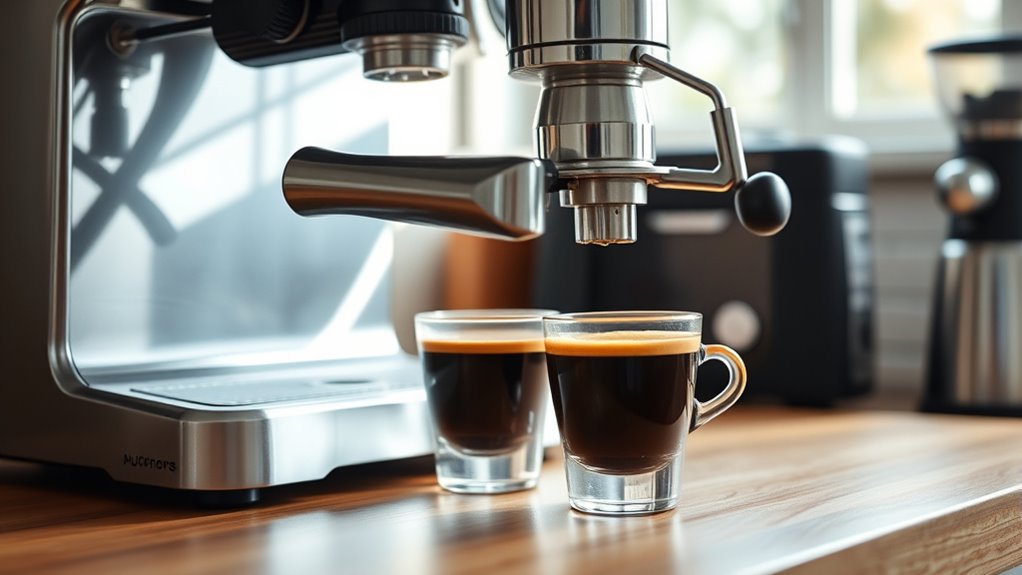
When selecting an espresso machine, you should prioritize precise temperature control, ideally through a PID system. This helps keep brewing temperatures stable, which is essential for extracting consistent, high-quality espresso.
Next, make sure the machine has a commercial-grade pump that can sustain around 9 bars of pressure during extraction. Pressure stability directly impacts the flavor balance, so this is pretty important to consider.
Take a look at the steam wand type too. Automatic frothers offer convenience, while manual wands give you fine control over the microfoam texture.
Also, look for advanced features like pre-infusion, pressure profiling, and programmable shot volumes. These allow you to tailor extraction parameters precisely to your taste.
Finally, check the build quality. Stainless steel components and a durable portafilter improve longevity and ensure consistent performance. This way, your machine becomes a reliable investment for all your espresso-making needs.
Additionally, maintaining a consistent extraction time of 25-30 seconds is crucial for achieving balanced flavor and crema in your espresso shots.
Our Favorite Super-Automatic Espresso Machines
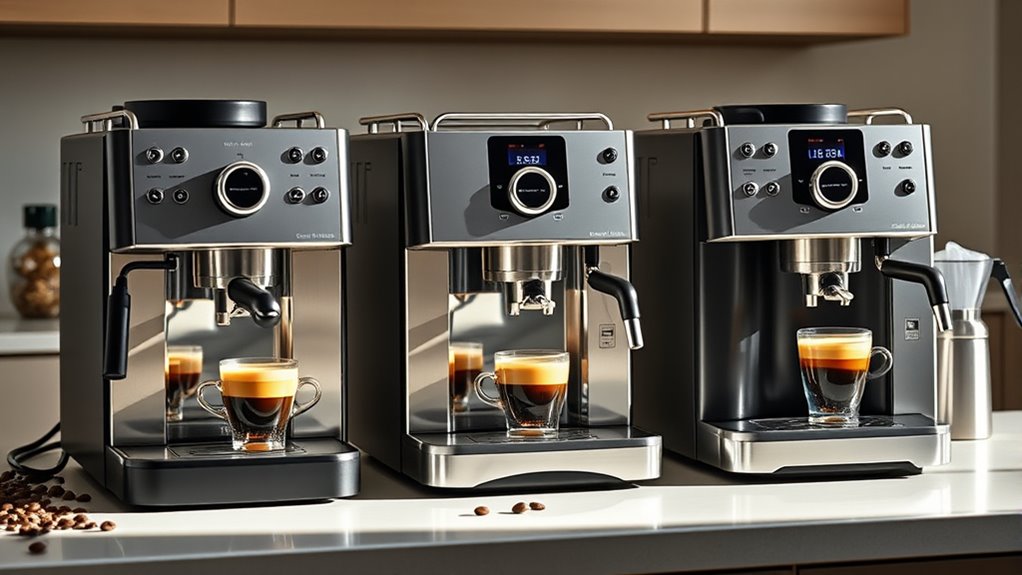
Although super-automatic espresso machines handle most brewing steps for you, selecting one with advanced customization and robust build quality guarantees you achieve café-level results with minimal effort. These machines combine integrated grinders, programmable drink profiles, and advanced milk frothing systems to meet diverse preferences.
Super-automatic espresso machines with customization and durability deliver effortless, café-quality coffee tailored to your taste.
The Gaggia Cadorna Over Ice excels with a dedicated over-ice brewing mode, optimizing extraction temperature and time for perfect iced espresso.
Gaggia Accademia delivers superior espresso quality, durable metal panels, and a milk carafe with customizable drink profiles.
High-end Jura Giga X8 and Rancilio Silvia Pro X feature PID temperature stability, flow control, and high steam power for consistent results. Multiple user profiles and programmable parameters let you tailor each shot precisely.
Choose a model that matches your technical needs for effortless, professional-grade espresso. You’ll enjoy café-quality drinks at home without the hassle. For best results, always use fresh, roasted beans stored in airtight containers to preserve flavor and prevent moisture.
Comparing Semi-Automatic and Super-Automatic Machines
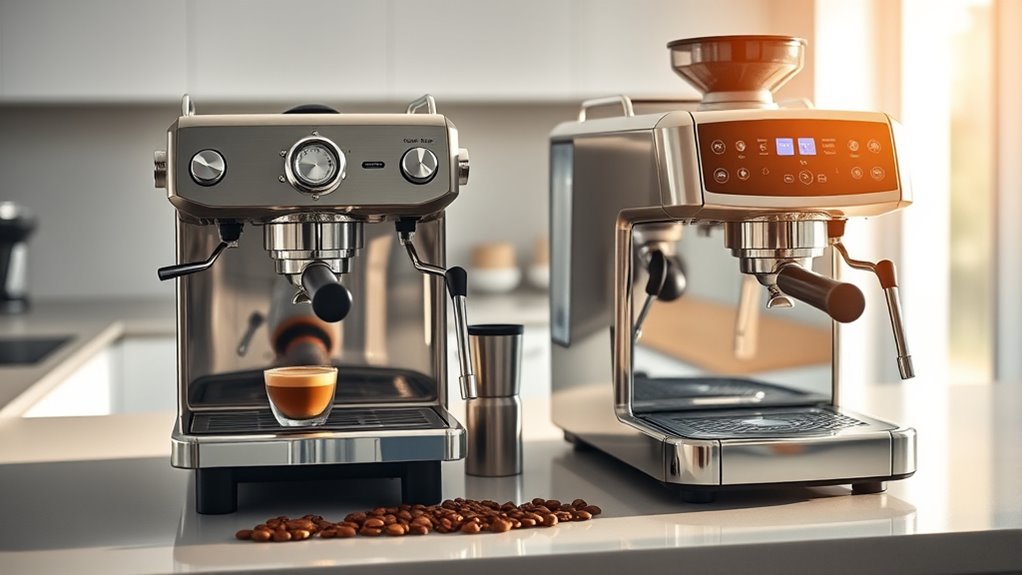
You’ll find that semi-automatic machines give you full control over things like grind size, tamping pressure, and shot timing. This means you can fine-tune each variable to get that perfect extraction just the way you like it.
On the other hand, super-automatic machines handle everything for you — grinding, tamping, brewing, and even frothing the milk. They’re great if you want consistent results quickly and with minimal effort.
Additionally, using freshly brewed espresso with full crema is key to achieving a rich, flavorful shot regardless of machine type.
Manual Control Benefits
How much control do you want over your espresso-making process? Choosing a semi-automatic machine lets you manipulate key variables to perfect each shot, unlike super-automatics that rely on preset programs.
Here’s why manual control matters:
- Grind Size and Tamping Pressure – You can adjust these to influence extraction rate and flavor clarity.
- Shot Timing – Start and stop extraction precisely, tailoring shot strength and crema quality.
- Temperature and Pressure Profiles – Fine-tune these parameters to bring out different coffee beans’ characteristics.
- Skill Development – Experimenting helps you understand espresso science deeply and craft unique profiles.
Manual control also enables you to optimize pre-infusion techniques, which improve flavor clarity and extraction balance.
If you value customization and hands-on involvement, semi-automatic machines offer a technical edge super-automatics can’t match. This lets you enjoy a truly personalized espresso experience.
Automation Convenience Comparison
Mastering manual control over grind size, tamping, and shot timing gives you the power to tailor espresso shots precisely, but it demands time and attention.
Semi-automatic machines require this hands-on approach, letting you fine-tune each variable to achieve your ideal shot, though they lack automation convenience.
In contrast, super-automatic machines automate grinding, tamping, extraction, and milk frothing, delivering consistent results quickly with minimal input.
These machines often include programmable settings and one-touch operation, prioritizing speed and ease.
Semi-automatics generally cost less and suit enthusiasts who value craftsmanship, while super-automatics appeal if you prefer fast, hassle-free brewing.
Your choice hinges on whether you prioritize manual precision or streamlined automation in your espresso-making routine.
Maintaining consistent brew temperature is critical for flavor balance and shot quality, which can be more easily managed with semi-automatic machines that offer precise control.
How Grinder Quality Affects Your Espresso Machine’s Performance
You’ll notice that the quality of your grinder has a big impact on your espresso’s flavor. That’s because it controls how consistent the grind size is, which in turn affects how well the coffee extracts.
Conical burr grinders are great at producing uniform grounds, and that’s key for even water flow and getting a clear, balanced shot.
Plus, being able to adjust the grind settings precisely means you can customize the flavor, body, and crema to really match what your espresso machine can do.
It’s all about dialing it in just right for the best cup possible.
Additionally, understanding how grind size influences caffeine extraction can help you maximize both flavor and strength in your espresso.
Grinder Impact On Flavor
Although the espresso machine plays a critical role, the grinder’s quality directly influences the flavor extraction by producing consistent particle sizes essential for balanced espresso. When you use a high-quality grinder, you guarantee uniform grounds that maximize extraction, preserving aroma and richness.
Inconsistent grinding leads to uneven extraction, causing bitterness or weak taste. Think about it this way: consistent particle size avoids over- or under-extraction, which helps stabilize the flavor profile.
Plus, precise grind settings let you fine-tune extraction parameters for the best taste. Uniform grounds maximize surface area contact, enhancing flavor clarity and intensity.
Investing in a quality grinder really elevates your espresso machine’s performance by delivering superior grounds. So, selecting the right grinder is vital to reveal your espresso’s full flavor potential. Regular calibration and maintenance of your grinder further ensure grind consistency and optimal flavor extraction over time.
Burr Type Importance
The grinder’s burr type plays a major role in determining the consistency and quality of your coffee grounds, which directly affects espresso extraction. Conical burrs, often made of stainless steel, generate less heat and help preserve delicate flavor compounds during grinding.
On the other hand, flat burrs produce a more uniform particle size, which can enhance shot clarity.
Choosing burrs made from durable materials like ceramic or high-grade steel guarantees longevity and consistent grind performance over time. Plus, high-quality burrs usually offer multiple grind settings, giving you precise control to optimize extraction.
Burr type also influences noise levels and heat generation—both are important for maintaining flavor integrity. Understanding these technical differences helps you pick a grinder that maximizes your espresso machine’s potential.
That way, you get richer crema and a balanced, flavorful shot every time.
Grinding beans immediately before brewing preserves aromatic oils and CO₂, which is essential for achieving the best flavor and crema in your espresso, as detailed in Grinding and Measuring Coffee.
Consistency And Grind Size
When aiming for a consistently excellent espresso, maintaining precise control over grind size is essential because it directly impacts extraction uniformity and flavor balance. Your grinder’s quality determines how uniform the grounds are, influencing water flow and extraction rate.
A high-quality grinder with conical burrs and multiple grind settings lets you tailor grind size to specific beans and espresso machines. Poor grind consistency leads to uneven extraction, causing weak or bitter shots.
To optimize performance, focus on:
- Uniform grind size for balanced extraction.
- Adjustable settings to fine-tune for different beans.
- Avoiding too fine grinds that cause channeling.
- Preventing coarse grinds that yield weak espresso.
Investing in a superior grinder enhances your espresso machine’s ability to deliver rich, balanced shots every time. It’s definitely worth it if you want your espresso to taste its best. Measuring and adjusting the espresso yield by weight rather than volume ensures you can fine-tune your grind size accurately for optimal shot consistency.
Choosing an Espresso Machine Based on Your Coffee Habits
Since your coffee preferences and daily consumption vary widely, selecting an espresso machine that aligns with your specific habits is essential.
If you favor milk-based drinks like lattes, choose a machine with milk frothing capabilities. For espresso purists, prioritize quick shot extraction features.
Consider the number of users and daily volume. Machines with larger water reservoirs or dual boilers handle multiple drinks efficiently.
Match the machine’s control level to your skill. Manual or semi-automatic models offer customization, while fully automatic units provide convenience.
For iced or cold brew enthusiasts, options like the Gaggia Rivelia, with dual bean hoppers and Cold LatteCrema compatibility, are ideal.
Align your choice with your long-term usage and budget. Balancing advanced features against simplicity will give you the ideal performance and satisfaction.
Also, understanding the importance of grind size and pressure can help you optimize extraction quality and flavor with your chosen machine.
Best Espresso Machines for Every Budget
Finding an espresso machine that matches your coffee habits also means considering your budget without compromising quality or features. Here’s a breakdown to guide you:
- Under $500: Models like the Gaggia Classic Pro require manual operation but yield high-quality shots with proper technique.
- $500 to $1,000: Mid-range machines such as the Breville Barista Express integrate grinders and intuitive controls for convenience.
- Above $1,000: Premium options like the Profitec Pro 700 offer dual boilers, advanced temperature stability, and customizable parameters.
- Beginners’ models across all price points ensure you can find a machine suited to your skill level and preferences.
Frequently Asked Questions
How Do I Clean and Maintain My Espresso Machine?
You should descale regularly with recommended solutions. Clean the brew group, portafilter, and basket after each use. Rinse the steam wand thoroughly.
Backflush periodically using espresso detergent. Don’t forget to replace water filters to keep your machine running at its best. It’s all about regular care to maintain peak performance.
What Is the Ideal Water Temperature for Espresso Extraction?
Think of espresso extraction like a delicate dance; you want water between 90°C and 96°C. Too hot, you scorch flavors; too cold, you lose depth.
Precise temperature regulation guarantees balanced, rich espresso with perfect crema every time. It’s all about hitting that sweet spot to bring out the best in your coffee.
Can I Use Pre-Ground Coffee With an Automatic Machine?
Yes, you can use pre-ground coffee with an automatic machine, but make sure it’s medium to fine grind. Use the bypass compartment if available.
Fresh grinding usually gives you better extraction and flavor. That’s because pre-ground coffee can sometimes clog the machine and doesn’t stay as fresh.
How Long Does It Take to Make a Shot of Espresso?
It takes about 25 to 30 seconds to pull a shot of espresso. You’ll want to control grind size, tamp pressure, and machine settings to hit that sweet spot for balanced flavor and proper crema extraction.
Getting these factors right makes all the difference. It’s kind of like dialing in your perfect cup—once you find the rhythm, it’s smooth sailing from there.
Are Espresso Machines Noisy During Operation?
Yes, espresso machines can be noisy during operation. Vibratory pumps generate more sound, reaching 60-75 decibels, while rotary pumps are quieter.
Built-in grinders and frothers add noise too, but keeping your machine well-maintained helps minimize unnecessary mechanical sounds. So, with a bit of care, the noise can be kept under control.
Conclusion
When choosing the best espresso machine, remember: the “perfect shot” theory isn’t one-size-fits-all. Your ideal machine depends on your grind quality, budget, and brewing habits. Super-automatics offer convenience, while semi-automatics give you more control.
Grinder precision directly impacts extraction, so never overlook it. By balancing these technical factors, you’ll find a machine that consistently delivers espresso tailored to your taste.
This way, every cup becomes a precise, satisfying experience rather than a guessing game.

Pingback: How Much Caffeine Is In 6 Shots Of Espresso – Answered