To descale your Breville espresso machine, first prepare a descaling solution using a Breville-approved agent. Fill the water tank, and make sure the machine is turned off.
Next, enter descale mode by holding the ‘2-cup’ and ‘power’ buttons until the indicator lights come on. Run the solution through both the group head and the steam wand.
After that, rinse everything thoroughly with fresh water cycles to remove any residues. Regular descaling helps prevent mineral buildup, which keeps your machine running smoothly and your coffee tasting great.
If you want more detailed steps and maintenance tips, you can explore further. It’s pretty straightforward once you get the hang of it!
Why You Need to Descale Your Breville Espresso Machine
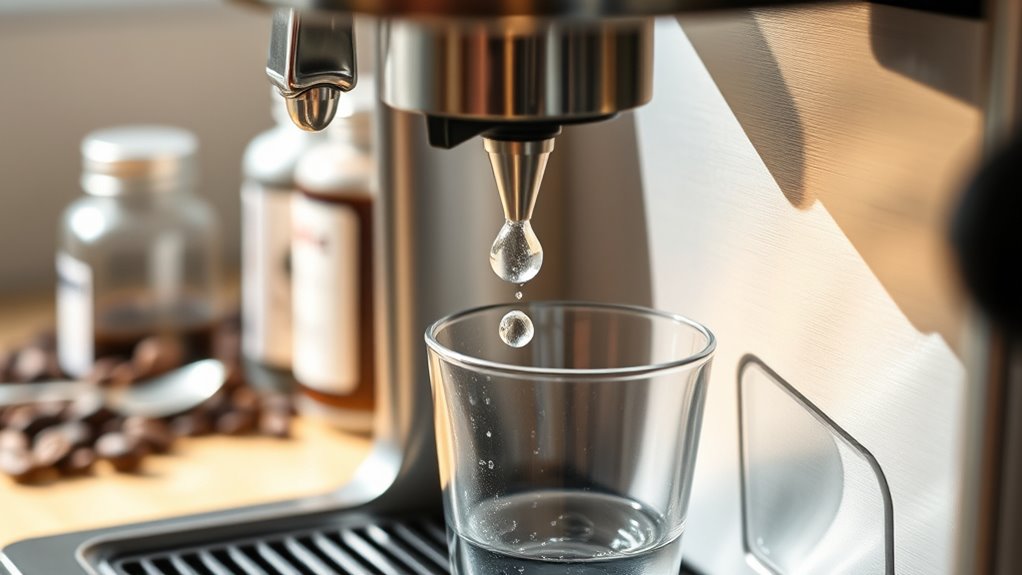
Why should you regularly descale your Breville espresso machine? Descaling removes mineral deposits, like calcium and limescale, that build up inside the machine over time. These deposits cause blockages, which disrupt water flow and lead to inconsistent brewing temperatures.
If you skip descaling, mineral buildup from hard water can weaken the internal parts, shortening your machine’s lifespan. Plus, scale formation gets in the way of proper water extraction, which can mess with the taste of your espresso.
By routinely descaling, you keep your machine performing at its best and preserve the quality of your coffee. This process helps ensure smooth water circulation and consistent temperature control—both are key for brewing espresso just right.
Regular maintenance through descaling protects your investment and makes sure your machine runs efficiently every time you use it. So, it’s definitely worth making it part of your routine! Using NSF-certified descalers ensures safe and effective removal of mineral buildup without damaging your machine.
How Often to Descale Your Breville
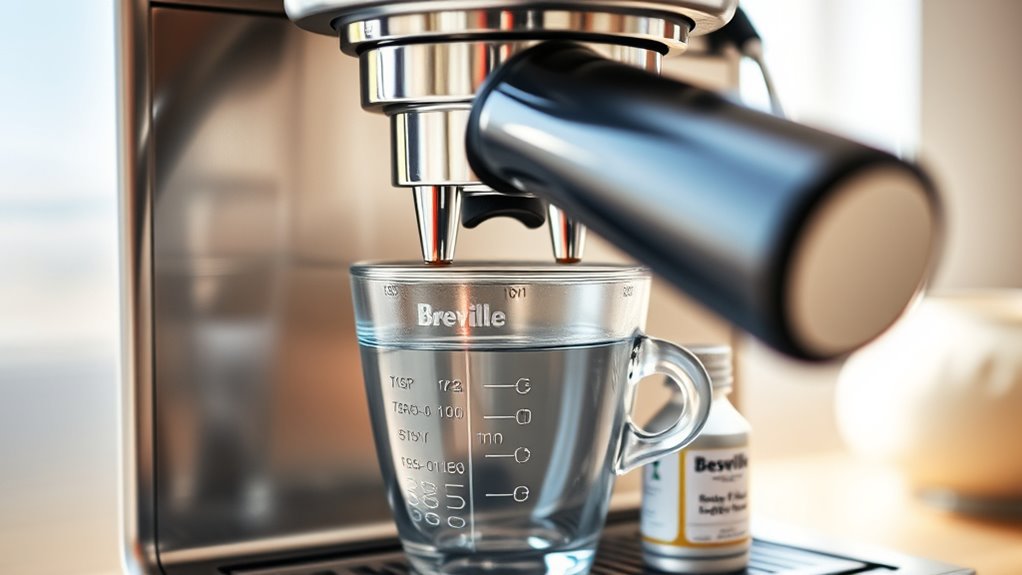
You should descale your Breville espresso machine every 3 to 6 months to keep it running smoothly.
But if you’re using it a lot—like several times a day—you might need to descale it more often, maybe every 3 weeks.
Keep an eye out for signs that it’s time to descale. If the water flow slows down, the coffee tastes weaker than usual, or the descaling indicator light comes on, that’s your cue to get it done.
Regular descaling helps maintain machine pressure stability, which is essential for consistent espresso extraction and flavor quality.
Recommended Descaling Frequency
Although descaling frequency depends on usage and water quality, you should generally descale your Breville espresso machine every 3 to 6 months to maintain ideal performance.
If you use the machine frequently, such as in an office with up to six uses daily, descaling every three weeks is necessary to prevent mineral buildup.
Using filtered or softened water can extend these intervals by reducing scale formation.
Adhering to this schedule guarantees maximum water flow and espresso strength.
Even if you follow the recommended timeline, monitor your machine’s performance closely.
If you notice slower water flow or a weaker espresso, descale immediately.
Regular descaling prevents clogs and preserves flavor quality, so don’t skip this essential maintenance step to keep your Breville running smoothly.
It really makes a big difference in how your espresso tastes and how long your machine lasts.
Maintaining proper water quality and mineral content is key to preventing scale buildup and ensuring consistent extraction performance.
Signs Descaling Needed
When mineral buildup starts affecting your Breville espresso machine, several clear signs indicate it’s time to descale. Look for slower water flow during extraction, weak espresso flavor, or frequent sputtering noises. If the “Descale” indicator light activates, immediately initiate the descaling cycle. This is a precise alert from the machine’s sensors.
In regions with hard water, expect to descale more often, potentially every three weeks with heavy use. Also, keep an eye on your espresso’s taste and temperature consistency. Irregularities here often signal mineral deposits interfering with heating elements.
To maintain peak performance, descale every 3-6 months depending on your water hardness and usage frequency. Staying attentive to these signs ensures your Breville espresso machine operates efficiently and prolongs its lifespan. Regular machine calibration can further improve consistency and reduce maintenance issues.
Essential Supplies for Descaling Your Breville
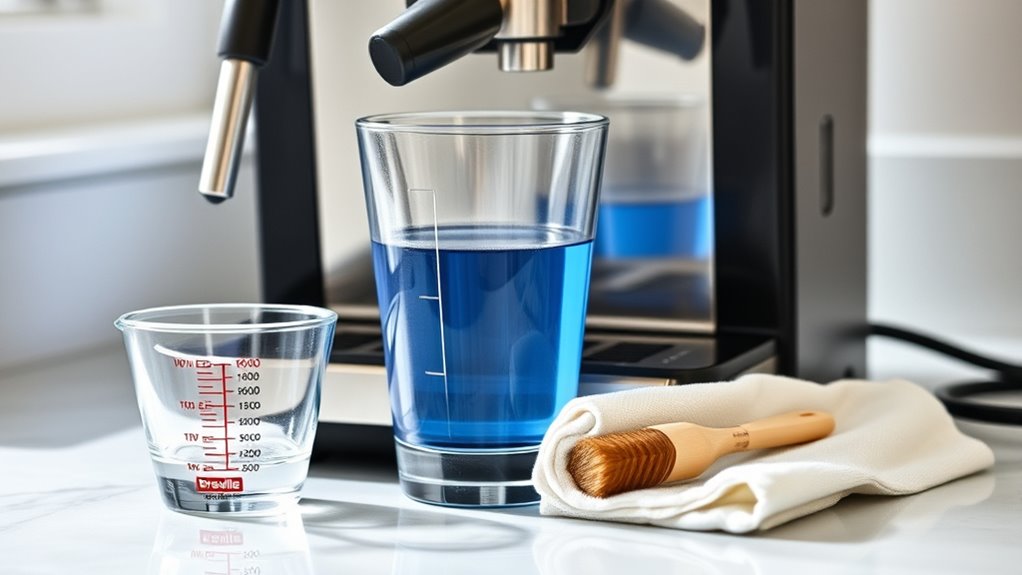
To descale your Breville espresso machine effectively, make sure to use only Breville-approved descaling solutions like Crema Descaler. This helps guarantee safety and compatibility with your machine.
Next, prepare some fresh water and accurately mix the solution using a measuring cup. Then, fill a clean, emptied water tank with the mixture to avoid any contamination.
You’ll also want to keep a large container nearby to catch the runoff.
And don’t forget to have a damp cloth handy—it’s great for wiping up any leftover solution during the process.
Maintaining proper temperature stability during descaling can help protect your machine’s internal components and ensure consistent espresso quality.
Recommended Descaling Solutions
Because using the right descaling solution is essential for maintaining your Breville espresso machine, you should opt for Breville’s official descaler or Crema Coffee Products Descaler for peak results. These solutions are formulated to effectively dissolve mineral buildup without harming internal components.
Alternatively, you can use a natural descaler like citric acid (10 grams per liter of water) or a vinegar-water mixture, but only if your model supports it. Some machines may be damaged or have their warranty voided if you’re not careful. Always verify compatibility before proceeding.
Prepare the solution exactly as instructed by the manufacturer, then run it through your machine to ensure thorough cleaning.
Using the recommended solutions guarantees effective descale cycles and prolongs your machine’s lifespan. Proper maintenance, including descaling, helps preserve grind consistency and flavor integrity by preventing buildup inside the machine.
Necessary Cleaning Accessories
Although selecting the right descaling solution is essential, you also need specific cleaning accessories to complete the process efficiently. Prepare a large container to catch the expelled solution and water during the cycle. Make sure the water tank is emptied and rinsed thoroughly before refilling.
Use a soft cloth or damp sponge to wipe external surfaces after descaling. Depending on your model, you might need a cleaning brush or a specialized descaling kit for the best results.
Regular descaling helps maintain optimal caffeine extraction by preventing mineral buildup that can affect your espresso’s quality and strength, ensuring consistent caffeine concentration.
| Accessory | Purpose |
|---|---|
| Descaling Solution | Removes mineral buildup inside the machine |
| Large Container | Collects used solution and water during cleaning |
| Soft Cloth / Sponge | Cleans external parts and removes residue |
Water Preparation Guidelines
Alongside having the right cleaning accessories, preparing the water correctly plays an essential role in the descaling process. First, empty and thoroughly clean the water tank to remove any residues. Use fresh, cold water mixed with the recommended descaling solution following the manufacturer’s dosage instructions.
Avoid using tap water alone to prevent mineral buildup. Next, fill a clean, large container or bowl to catch the descaling solution expelled during the cycle. After filling, securely reinsert the water tank into your Breville machine to avoid leaks.
Always use pure water and only approved descaling agents to maintain machine integrity. Proper water preparation guarantees efficient descaling, prolonging your espresso machine’s lifespan while preventing chemical or mineral deposits from forming inside the system. Additionally, maintaining water temperature within the ideal range is crucial for preserving extraction quality after descaling.
Preparing Your Breville for Descaling
Before you start descaling, make sure the machine is turned off and cooled down to prevent any accidents. Proper preparation guarantees an effective and safe descaling process.
Follow these steps to prepare your Breville espresso machine:
- Remove the water filter and empty the drip tray completely to avoid overflow during descaling.
- Detach the water tank, rinse it thoroughly, and fill it with the descaling solution or fresh water as required.
- Place a large container under the group head and steam wand to catch the descaling fluid.
- Also, check that all removable parts are clean and securely reinstalled to prevent blockages.
Doing these preparations will set your machine up for a smooth descaling cycle without any complications. It’s a simple way to keep things running smoothly. Using freshly brewed espresso regularly helps maintain your machine’s performance and flavor quality.
Entering Descale Mode on Your Breville
Once your Breville espresso machine is prepped and filled with descaling solution, you need to activate descale mode to begin the cleaning cycle. First, verify the machine is powered on and has cooled down.
Then, press and hold the ‘2-cup’ and ‘power’ buttons simultaneously.
Keep holding until the indicators light up, signaling descale mode activation. You’ll see the ‘1-cup,’ ‘power,’ ‘clean/descale,’ and ‘hot water/steam’ indicators illuminate, confirming the machine is ready.
Keep holding until the display or indicator lights confirm the setup.
If your Breville model differs, just check the user manual for any extra or different steps. Activating descale mode correctly is really important before you run the descaling solution through your machine.
Using filtered or low-mineral water during descaling helps prevent mineral buildup and protects your machine’s efficiency.
Running the Descaling Solution Through Your Machine
Although you’ve activated descale mode, you’ll need to place a large container beneath both the steam wand and coffee outlet. This will catch the descaling solution as it cycles through the machine. Doing this helps make sure no spills occur during the process.
Next, run the descaling solution through all the key machine functions to thoroughly clean the internal components.
Follow these steps precisely:
- Dispense the solution through the group head by starting an espresso extraction cycle.
- Purge the steam wand by turning on the steam function until the solution is fully expelled.
- Release the solution through the hot water outlet to clear any scale buildup there.
Keep repeating these cycles until the descaling solution is completely used up. This guarantees a thorough cleaning inside the machine.
Rinsing and Flushing Your Breville After Descaling
After you finish descaling, it’s important to flush your Breville with fresh water to get rid of any leftover solution. Just refill the water tank with cold water.
Then, run several rinse cycles. Make sure to collect the water from the group head, steam wand, and hot water outlet as it comes out.
Keep going until the water runs clear and you don’t notice any chemical smell or residue inside the machine. This helps keep your Breville clean and ready for the next use.
Importance Of Thorough Rinsing
Why is thorough rinsing critical after descaling your Breville espresso machine? It removes all residual descaling agents and mineral deposits, preventing damage and preserving flavor. If you skip this step or rinse inadequately, leftover chemicals can corrode internal parts or impart off-flavors to your espresso.
Focus on these key reasons for thorough rinsing:
- Eliminate cleaning solution residues completely, avoiding chemical tastes or odors in your coffee.
- Protect internal components and water pathways from corrosion and buildup to maintain peak machine performance.
- Ensure the rinse water runs clear by repeating the cycle, confirming no descaling agents remain.
Proper rinsing is vital to safeguard your machine’s longevity and guarantee consistent, high-quality espresso extraction every time. So, take your time with this step—it really makes a difference!
Step-By-Step Flushing Process
Once you finish descaling your Breville espresso machine, you’ll need to flush it thoroughly to remove any lingering descaling solution. Start by refilling the water tank with fresh, cold water.
Place a large container under both the group head and steam wand to catch the rinse water.
Activate the machine’s hot water or rinse function to circulate clean water through all internal components.
Run the brewing cycle with this clean water, making sure it flows through every passage that contained the descaling solution.
Keep repeating this rinsing process multiple times, refilling the tank as needed, until the water runs completely clear and doesn’t have any residual taste or scent of the descaler.
This step guarantees your machine is properly flushed and ready for safe, ideal espresso extraction.
Ensuring No Residue Remains
Although the descaling process removes most mineral buildup, you still need to thoroughly rinse your Breville espresso machine to eliminate any residual cleaning solution. Proper rinsing guarantees superior flavor and prevents chemical aftertastes.
Follow these steps: rinse the water tank thoroughly with fresh water to clear any leftover descaling agent. Then, run multiple brewing cycles with clean water through the machine, repeating until the water runs clear and odorless.
Next, use a damp cloth to wipe the steam wand and group head, removing any dissolved deposits or residue. Make sure there’s no cloudiness or chemical smell before brewing your next espresso shot.
If needed, just repeat this process to guarantee your machine is residue-free and ready for use.
Common Descaling Mistakes to Avoid
If you want to keep your Breville espresso machine functioning at its best, you must avoid common descaling mistakes that can cause damage or reduce performance.
First, never use vinegar on machines with aluminum parts, as it corrodes and damages components. Always remove filters and water tanks before running the descaling solution to guarantee proper circulation.
Ignoring scale buildup signs like slower water flow or longer brew times leads to incomplete descaling and potential harm. Rinsing thoroughly after descaling is essential because leftover solution alters espresso taste and can damage internal parts.
Finally, strictly follow the manufacturer’s instructions on solution types and procedures. Deviating from these guidelines increases the risk of damaging your machine and compromises its efficiency and longevity.
Alternative Breville Descaling Solutions
How can you effectively descale your Breville espresso machine without relying solely on brand-specific products? You can use alternative solutions that are both effective and budget-friendly. Just make sure to check your machine’s manual for compatibility to avoid any damage.
- Commercial Descaling Solutions: Products like Cafetto offer efficient descaling and are often more affordable than Breville’s own solutions.
- Citric Acid Solution: Mix 10 grams of citric acid per liter of water to create a natural, chemical-free descaler that’s safe for most machines.
- Vinegar: Use diluted vinegar cautiously, and be sure to rinse thoroughly afterward. Avoid it if your machine has aluminum parts because it can cause corrosion.
Always use recommended agents to keep your machine’s warranty and operational integrity intact.
Maintenance Tips to Extend Time Between Descaling
To extend the time between descaling sessions, you should prioritize using filtered or softened water. This substantially reduces mineral buildup inside your Breville espresso machine. Choosing high-quality, low-mineral water can further slow limescale development.
Make it a habit to do some daily maintenance by wiping down external surfaces and performing quick rinses. This helps flush residual minerals from internal components. Regularly cleaning the machine’s internal parts, especially the group head and steam wand, is important to prevent scale buildup.
Try to set a descaling schedule every 3 to 6 months. You can adjust this based on your local water hardness and how often you use the machine. Staying consistent with maintenance not only prolongs the interval between descaling but also keeps your machine performing at its best.
Frequently Asked Questions
Can I Use Vinegar Instead of Crema Descaler?
You can use vinegar, but it’s not recommended for Breville machines. It may damage aluminum parts and leave odors. Always check your model’s instructions before trying it.
If you do decide to use vinegar, make sure to run multiple rinse cycles. This helps avoid corrosion and off-flavors. Better safe than sorry, right?
Will Descaling Affect the Espresso Taste Immediately?
Think of descaling like resetting a clock: you’ll notice a temporary offbeat in flavor.
If you rinse your Breville thoroughly, you won’t let residual agents disrupt your espresso’s true taste.
Keep rinsing until it’s pure.
How Long Does the Descaling Process Take?
You’ll spend about 30 to 45 minutes descaling your Breville espresso machine. This includes preparation, running the descaling cycle for 10 to 15 minutes, and rinsing.
Sometimes, you might need to do multiple rinses, which can extend the process closer to one hour total. So, it’s good to set aside enough time to get it done properly.
Is It Safe to Descale if the Machine Is Still Under Warranty?
Descaling under warranty is as safe as following a GPS route. Just stick to Breville-approved solutions and instructions. Avoid unauthorized chemicals or methods, or you risk voiding your warranty.
Always check your manual before you begin. It’s better to be safe than sorry!
Can I Descale the Machine Without Removing the Water Tank?
You generally shouldn’t descale without removing the water tank, as it prevents solution dilution and guarantees effective cleaning.
Always check your model’s manual first, since some Breville machines require tank removal to activate descaling properly.
It’s best to follow those instructions to make sure the process works well and keeps your machine in great shape.
Conclusion
Think of your Breville espresso machine as a finely tuned clock. Just like dust can jam its gears, mineral buildup can clog your machine’s flow. By regularly descaling with the right supplies and following precise steps, you keep it running smoothly and extend its lifespan.
Skipping this essential maintenance is like letting sand grind your watch’s cogs. Eventually, it stops working. So, stay diligent, follow the process, and enjoy perfect espresso every time.

Pingback: How To Clean Breville Espresso Machine – Quick Guide
Pingback: How To Make Iced Brown Sugar Oatmilk Shaken Espresso Recipe