To tamp espresso properly, evenly distribute freshly ground coffee in your portafilter. Then use a tamper that fits snugly to apply firm, consistent pressure, about 20-30 pounds, straight down with a steady, vertical motion.
Finish with a gentle twist to polish the puck. Make sure it’s level and crack-free for uniform extraction. Avoid angled or uneven tamping to prevent channeling.
Mastering these basics boosts flavor and shot consistency. And exploring advanced techniques will refine your skills even further.
Why Tamping Matters for Great Espresso
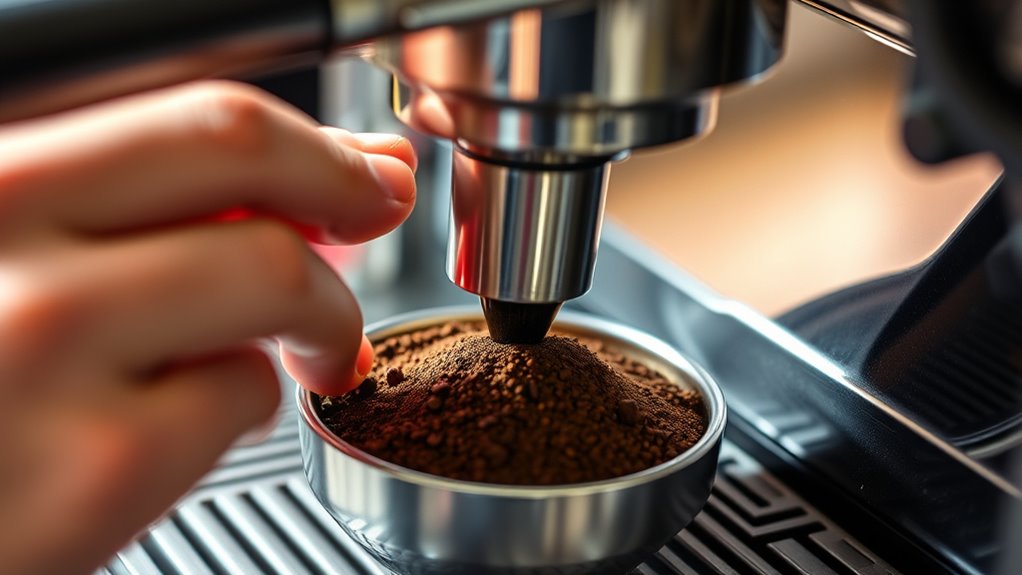
Although tamping might seem like a simple step, it plays a crucial role in brewing great espresso. When you tamp, you create a uniform density in the coffee bed, which guarantees even water flow and consistent extraction.
If you don’t tamp properly, water will channel through less dense areas, leading to uneven saturation and poor flavor.
By applying consistent pressure, you reduce variability between shots and baristas, making your espresso quality reproducible. A well-tamped puck is dense and flat, producing rich crema and balanced flavors.
On the other hand, uneven or insufficient tamping can cause under-extraction, resulting in sour notes, or over-extraction, which brings bitterness.
Mastering tamping is essential to reveal the full potential of your espresso grounds every time. It might take some practice, but once you get the hang of it, your espresso will taste noticeably better. Additionally, tamping works best when combined with the correct grind size to ensure balanced extraction and flavor clarity.
Preparing and Dosing Coffee Grounds for Tamping

Before tamping, you need to prepare and dose your coffee grounds carefully to guarantee a consistent puck. Start with high-quality, freshly roasted beans stored airtight to retain freshness. Grind slightly finer than table salt for ideal extraction.
Use a digital scale to dose precisely. Aim for 7-10 grams for a single shot, 18-22 grams for a double. Evenly distribute grounds in the portafilter. Break up clumps with a distribution tool like a WDT fork to avoid air pockets and uneven tamping.
| Freshness | Precision | Consistency |
|---|---|---|
| Fresh beans | Exact grams | Even bed |
| Proper grind | Scale use | No clumps |
| Airtight storage | Distribution tool | Smooth tamp |
This foundation ensures your espresso puck extracts smoothly and tastes balanced. It really makes a difference in the final cup. Consistent tamping pressure of about 30 pounds is essential for creating a uniform bed that promotes even extraction.
Choosing the Right Tamper for Effective Tamping
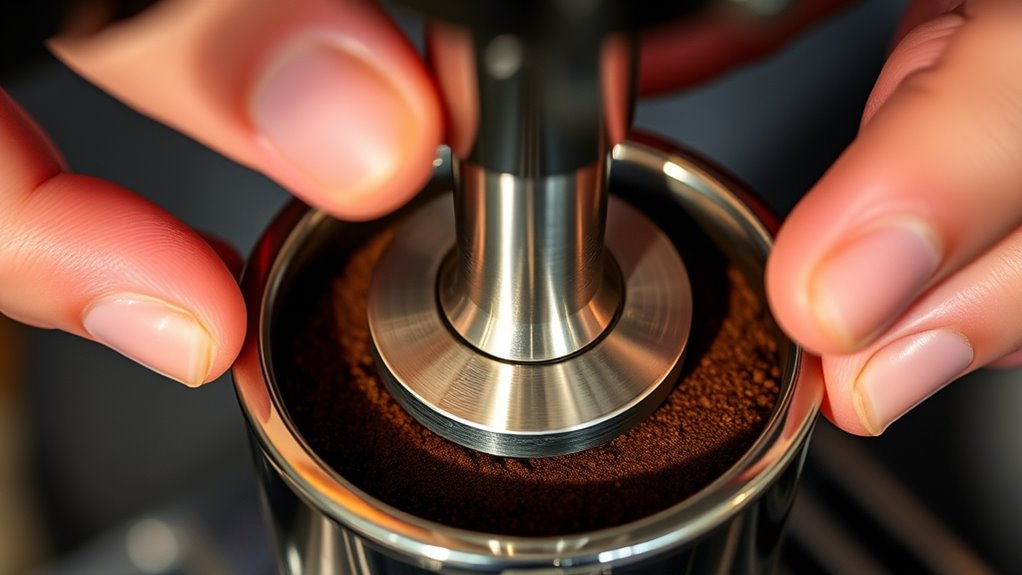
After preparing and dosing your coffee grounds precisely, the next step is selecting the right tamper to apply even pressure and achieve a consistent puck.
Start by matching your tamper size to your portafilter, typically 54mm or 58mm, ensuring a snug fit for uniform tamping. Choose between a flat-bottom tamper for even pressure distribution or a convex one to reduce side-channeling.
Consider a calibrated tamper that offers 20-30 pounds of consistent pressure with built-in resistance feedback to maintain repeatability. Pay attention to the handle’s grip. Opt for a comfortable design that minimizes wrist strain and gives you precise control.
Finally, select a tamper with a stable, sturdy base to guarantee level compression. This will result in a smooth, even coffee puck every time. Consistent tamping pressure is essential for maintaining proper shot timing and achieving balanced extraction.
Distributing and Leveling Coffee Grounds Evenly
When you distribute and level your coffee grounds evenly, you set the foundation for a balanced extraction and a consistent espresso shot. Start by using a distribution tool, like a WDT fork or coffee distributor, to break up clumps and spread the grounds uniformly across the basket.
Gently tap the portafilter’s edges to settle the grounds and remove air pockets, creating a flat surface.
Take a moment to visually inspect the coffee bed for any unevenness. If you spot any, manually level it with a slight shake or gentle tap. Make sure all grounds, including those in the corners and edges, are evenly spread to avoid channeling during extraction.
Finally, use your finger or a flat tool to smooth the surface before tamping. This careful preparation guarantees even resistance for the ideal espresso flow.
It’s a simple step that really makes a difference in your shot quality. Consistent grind size and tamping pressure directly impact crema quality and overall flavor extraction.
How to Grip and Position Your Tamper
Although tamping might seem straightforward, gripping and positioning your tamper correctly is essential to achieving an even, consistent espresso puck.
Hold the tamper with a relaxed grip, wrapping your fingers around the handle and placing your thumb on top for control.
Position your elbow directly above the portafilter to align your wrist, ensuring it stays straight and perpendicular to the coffee bed.
Avoid tilting or angling the tamper, as this disrupts even tamping.
Make sure your tamper size matches the portafilter, typically 54mm or 58mm, for a snug fit and uniform pressure distribution.
Regular maintenance, including descaling your espresso machine, helps preserve consistent water flow and extraction quality.
Applying the Right Pressure When Tamping
You’ll want to apply about 30 pounds of pressure when tamping to guarantee even extraction.
The key here is consistency—it matters more than brute force. So, focus on applying steady, level pressure each time.
A good tip is to use your body weight rather than just your arm strength.
This helps keep that pressure uniform, shot after shot.
Maintaining approximately 9 bars pressure during extraction is essential for developing the perfect crema and flavor.
Ideal Tamping Pressure
Because consistent tamping pressure directly affects extraction quality, applying the right force is crucial for every espresso shot. The industry standard is about 30 pounds of pressure, which provides perfect resistance for water to flow evenly through the coffee puck.
To develop a reliable feel for this, use a kitchen scale during practice sessions. This builds muscle memory and helps you apply consistent force.
Remember, even pressure across the puck’s surface is just as important as the amount of force. It prevents channeling and ensures uniform extraction.
Tools like calibrated tampers or feedback devices can assist you in hitting and maintaining this ideal pressure.
Mastering this balance sets the foundation for predictable, high-quality espresso shots every time you pull a shot.
Accurate tamping pressure helps control extraction time, which directly influences espresso yield and flavor balance.
Consistency Over Force
When tamping espresso, focusing on consistent pressure rather than pushing harder makes all the difference in shot quality. Aim for about 30 pounds of force each time, applying it centrally and smoothly to guarantee uniform density.
Use a kitchen scale during practice to train your tactile sense and develop muscle memory.
This steady, level pressure helps prevent channeling, which can cause uneven extraction and bitterness. Don’t rush or press unevenly. Repetition is key.
By maintaining the same tamping force shot after shot, you’ll achieve balanced flavors and stable quality. Remember, it’s not about how hard you push but how consistently you tamp.
Mastering this control elevates your espresso from average to exceptional every time.
Step-by-Step Tamping for Consistent Shots
Although tamping might seem straightforward, mastering a consistent technique is essential for extracting balanced espresso shots. Start by distributing the coffee grounds evenly in the portafilter. You can use a leveling tool or gentle taps to eliminate air pockets.
Grip the tamper firmly and align your elbow directly over your wrist for stable, vertical pressure. Make sure your tamper matches the portafilter size, typically 58mm.
Apply roughly 30 pounds of steady, vertical force, focusing on compressing the grounds evenly from the center outward.
After pressing, polish the puck’s surface with a gentle twist to create a smooth, level top.
Finally, inspect the puck carefully. Look for a flat, even surface without cracks or uneven spots.
This precise tamping step guarantees consistent extraction and improves shot quality every time. Proper tamping combined with a fine grind size ensures even water flow and optimal flavor extraction.
Finishing With a Polished, Even Coffee Puck
After tamping, go ahead and use a gentle twisting or polishing motion to smooth out the puck’s surface. This helps make sure the density is even throughout.
It’s a simple trick that prevents channeling by creating uniform contact between the water and the coffee grounds.
You can use a clean, damp cloth or even the tamper itself for that final polish. Just aim for a level, crack-free puck before you start brewing.
It really makes a difference in the quality of your espresso.
Ensuring the puck is firmly tamped with about 30 pounds of pressure creates an optimal uniform puck for extraction.
Polishing Techniques Explained
Because a smooth, even coffee puck is essential for a quality espresso, polishing your tamp requires a gentle twist of the tamper after the initial press. This final motion smooths the surface, ensuring the coffee bed is uniformly compressed.
Using a mirror or level tamper during polishing helps maintain an even puck, which is critical for consistent extraction.
Proper polishing reduces channeling risks by promoting even water flow, which enhances crema development and flavor balance.
But be careful not to over-polish, as it can disrupt puck density and lead to uneven extraction.
Apply a gentle, controlled twist without adding extra downward pressure.
Use a tamper with a flat, mirror-like base for better surface accuracy.
Focus on creating a smooth, level puck surface.
Complete polishing immediately after tamping to prevent the puck from drying out.
Stop polishing once the surface feels even and polished.
Achieving a consistent puck also supports full crema development for a richer espresso experience.
Ensuring Puck Uniformity
When you finish tamping, gently twisting the tamper creates a polished, even coffee puck that’s essential for consistent espresso extraction. This final twist compacts the grounds further and smooths the surface, ensuring uniform density throughout the puck.
A level, flawless puck promotes even water flow during brewing, minimizing channeling and preventing uneven flavor. Before locking the portafilter into the machine, inspect the puck’s surface carefully for any uneven spots or imperfections.
Consistently applying this finishing technique not only improves puck uniformity but also reflects proper distribution and tamping skills.
Common Tamping Mistakes and How to Avoid Them
Although tamping seems straightforward, common mistakes can considerably impact your espresso’s quality. To avoid these pitfalls, focus on tamping evenly and consistently.
Here are key errors to watch for:
- Tamping at an angle, which causes uneven puck density and channeling.
- Applying too much or too little pressure, leading to over or under-extraction.
- Inconsistent tamping force between baristas, resulting in shot variability.
- Neglecting to evenly distribute grounds before tamping, creating air pockets.
- Re-tamping or re-leveling after the initial tamp, which cracks the coffee bed and promotes channeling.
Just remember, tamping right isn’t about being perfect every time; it’s about being consistent and paying attention to the little details. That way, your espresso will come out tasting great more often than not.
Practice Tips to Perfect Your Tamping Technique
Mastering your tamping technique requires deliberate practice and attention to detail. Start by practicing consistent pressure, aiming for about 30 pounds. Use a bathroom scale to gauge your force until it feels natural.
Consistent tamping pressure around 30 pounds is key—practice with a scale until it becomes second nature.
Always tamp with a level tamper or place a mirror underneath to verify your tamp stays flat and even. Focus on a smooth, controlled motion, avoiding rushing, and maintain steady force throughout each press.
Repeat this process regularly to build muscle memory and improve consistency. After every tamp, inspect the puck to confirm it’s level and evenly compressed.
If you notice unevenness, adjust your technique accordingly.
With persistent practice and mindful adjustments, your tamping will become precise, resulting in a better espresso extraction every time. Keep at it, and soon it’ll feel second nature.
Frequently Asked Questions
How Often Should I Clean My Tamper?
You should clean your tamper after every use to prevent residue buildup and keep things hygienic. It’s a quick way to make sure your tool stays in good shape.
Every week, give it a deep clean with warm water and mild soap. Just avoid any harsh chemicals—they can do more harm than good.
After washing, always dry it properly to stop rust from forming. A little care goes a long way with your tamper!
Can Tamping Affect Espresso Machine Maintenance?
You might think tamping doesn’t impact machine upkeep, but it does. Uneven or excessive tamping causes channeling and pressure strain, leading to residue buildup and wear.
Is Tamping Pressure Different for Light vs. Dark Roasts?
Yes, you should adjust tamping pressure. Apply slightly more force for denser light roasts to guarantee proper resistance.
Use lighter pressure for brittle dark roasts to avoid over-compacting and guarantee balanced extraction. It’s all about finding the right balance for each roast type.
What’s the Best Way to Store My Tamper?
A stitch in time saves nine. Store your tamper in a clean, dry place, ideally a dedicated holder or drawer.
Always dry it thoroughly before storing to prevent rust. This helps keep it in top shape for consistent tamping.
Can Tamping Techniques Vary by Espresso Machine Brand?
Yes, tamping techniques can vary by espresso machine brand. You’ll need to adjust pressure, tamper size, or angle depending on your portafilter design and basket shape. This helps guarantee a consistent, level tamp and avoid channeling.
It’s all about finding what works best with your specific machine. So, don’t be afraid to experiment a little until you get that perfect shot.
Conclusion
Tamping might seem simple, but it’s the secret handshake between you and your espresso machine. When you dose, distribute, and press just right, you’re not only locking in flavor, you’re setting the stage for a perfect shot every time.
Remember, even slight changes in pressure or angle can make or break your brew. So keep practicing, stay consistent, and soon tamping will feel as natural as your morning coffee routine.

Pingback: How Hard To Tamp Espresso – Perfect Pressure