To make espresso with a French press, start by using 7-8 tablespoons of medium-coarse ground medium roast coffee. Heat water to around 200°F. Pour a small amount to bloom the grounds for 30 seconds, then add the rest and steep for 2-4 minutes.
Press the plunger down slowly and pour immediately to preserve the rich crema-like foam. You can adjust coffee-to-water ratios and steep times to get the strength and flavor just right.
Keep experimenting and exploring to really master this bold brewing style. It’s all about finding what works best for your taste!
French Press Espresso Equipment and Ingredients
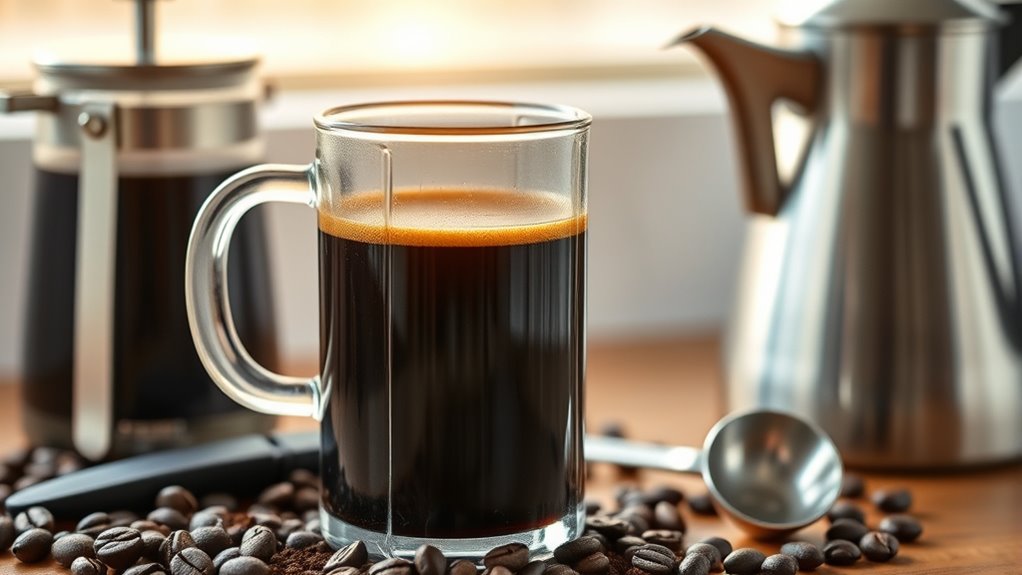
Although a traditional French press isn’t designed specifically for espresso, you can use it to craft a strong, espresso-style coffee by selecting the right equipment and ingredients. Start with a standard French press featuring a glass cylinder, mesh plunger, and lid. It’s perfect for steeping and filtering coffee.
A traditional French press can craft a strong, espresso-style coffee with the right equipment and ingredients.
You’ll need about 7 to 8 tablespoons (roughly 39 grams) of medium-coarse ground coffee. You can achieve this using a burr grinder for uniformity. Think grind size resembling sea salt.
Heat water to approximately 200°F (93°C) with a kettle, just below boiling, to guarantee ideal extraction.
For precision, consider using a scale to measure coffee and water accurately, and a thermometer to monitor water temperature. These tools help you maintain consistency and elevate your French press espresso experience.
Keep in mind that grind size plays a crucial role in controlling extraction time and flavor balance, even when using a French press.
How to Choose Coffee Beans and Grind Size for French Press Espresso
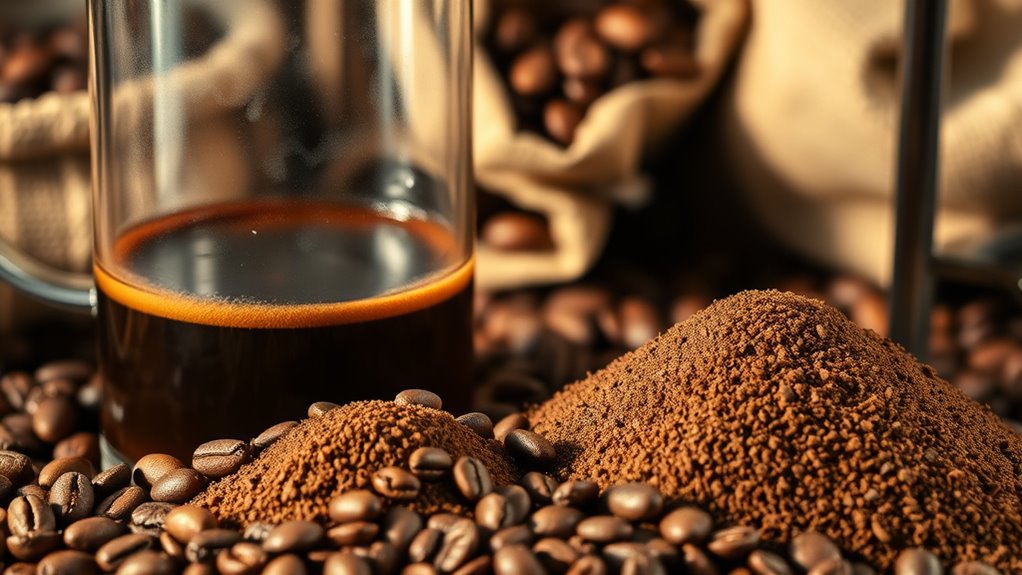
If you want to get the best French press espresso, start by choosing medium roast beans. These beans bring out balanced flavors and a great aroma that really makes your coffee shine.
When it comes to grinding, go for a coarse grind—think about the size of breadcrumbs. This helps keep bitterness and sediment out of your cup, so your coffee tastes smooth and clean.
Using a burr grinder is the way to go because it gives you a consistent and uniform grind. That means your coffee extracts evenly, resulting in a rich, full-bodied brew every time.
For an added flavor boost in your coffee recipes, you can incorporate espresso powder, a finely ground, dehydrated form of brewed espresso that enhances richness and complexity.
Bean Type Selection
When choosing coffee beans and grind size for making espresso with a French press, selecting a medium roast with a bold, dark profile will bring out the rich flavors you want. Opt for freshly roasted beans to capture the fullest aroma and depth. Medium roasts strike the perfect balance, offering robust flavors without the bitterness of darker roasts.
Avoid very fine espresso grounds since they can slip through the French press filter, causing muddiness and cloudiness. Instead, use a coarse grind with a texture similar to sea salt for clean extraction. To maintain freshness, grind your beans just before brewing or request a medium-coarse grind from your roaster.
Choosing the right bean type and roast ensures your French press espresso delivers that bold, satisfying punch every time. It really makes a difference in the flavor and overall experience. So, take your time picking the beans and grind size that suit your taste. Keep in mind that espresso requires precise grind size to avoid issues like over-extraction or bitterness, even when using alternative brewing methods.
Optimal Grind Size
Selecting the right grind size plays a significant role in capturing the full flavor potential of your chosen beans.
For French press espresso, use a medium-coarse grind, similar to sea salt. This guarantees proper extraction while preventing over-extraction or muddiness.
Avoid fine espresso grinds. They can slip through the French press filter, making your coffee cloudy and bitter.
Adjust your grind size based on brewing time. Coarser grounds need longer steeping to develop ideal flavor.
Always grind fresh beans just before brewing to preserve essential oils and aroma that deliver a rich espresso-like profile.
To achieve consistency, rely on a burr grinder. It produces uniform grounds, helping you extract a balanced, robust cup every time.
Keep in mind that grind size consistency is crucial to avoid uneven extraction and ensure optimal flavor clarity.
Roast Level Impact
Although French press espresso isn’t traditional espresso, the roast level of your coffee beans considerably shapes the flavor and extraction. For the best balance, choose medium roast beans. They offer a harmonious blend of acidity and flavor.
Dark roasts deliver a richer, bolder profile but can risk bitterness if over-extracted. Light roasts are more delicate and might require a slightly finer grind for proper extraction. However, they aren’t typically ideal for French press espresso.
Remember, the grind size must complement the roast. Use a coarse grind resembling breadcrumbs to avoid over-extraction and ease pressing. Fine grounds, perfect for espresso machines, cause bitterness and make plunging difficult in a French press.
Selecting the right roast and grind guarantees a fuller-bodied, espresso-like brew with ideal flavor and strength. It’s all about finding that sweet spot to get the best cup possible.
How Water Temperature and Steeping Time Affect French Press Espresso Flavor
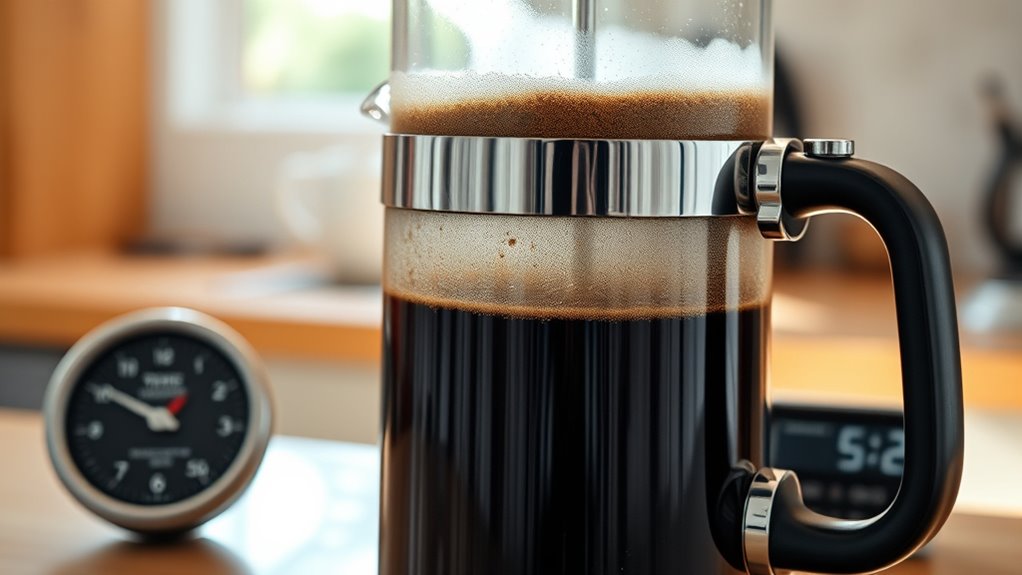
Because water temperature and steeping time directly influence extraction, mastering these variables is essential to crafting a rich French press espresso. Aim for water between 195°F and 205°F (90°C to 96°C) to extract the coffee’s full flavor without introducing bitterness.
Steep your grounds for 2 to 4 minutes, balancing richness and smoothness.
If the water’s too hot or you steep too long, the espresso can become harsh and overly bitter due to over-extraction.
On the other hand, using cooler water or shortening the steeping time results in weak, under-extracted coffee that lacks depth.
Maintaining temperature stability within this range is key to achieving consistent flavor and avoiding undesirable taste shifts.
Adjust Coffee-to-Water Ratios to Control Espresso Strength
To control the strength of your French press espresso, start by adjusting the coffee-to-water ratio. Using about 1 to 2 tablespoons of coffee per 2 ounces of water creates a bold, concentrated shot.
If you want a stronger flavor, try reducing the water or adding more coffee grounds. This way, you can mimic the taste of traditional espresso quite well.
Feel free to experiment with ratios around 1:1.5 to 1:2. Also, don’t forget to tweak the steeping time to find that perfect balance that suits your taste. It’s all about what works best for you!
Keep in mind that grind size and steeping time significantly influence extraction and flavor balance in your coffee.
Ideal Coffee Ratios
When you adjust the coffee-to-water ratio in your French press, you directly control the strength and flavor intensity of your espresso-style brew. Aim for a 1:4 ratio, about 2 tablespoons (10 grams) of coffee per 4 ounces (120 ml) of water, as a solid starting point.
Want a bolder, richer espresso? Increase the coffee to a 1:3 ratio, using around 2.5 tablespoons per 4 ounces of water.
Prefer a lighter, milder cup? Drop the ratio to 1:5.
Each adjustment changes the espresso’s body and flavor profile, letting you tailor every cup to your taste.
Try experimenting systematically with these ratios to find the perfect balance between strength and smoothness in your French press espresso. It’s all about what works best for you.
Remember that using fresh, finely ground coffee is essential to achieve the best extraction and flavor.
Water Volume Impact
How much water you use dramatically shapes the strength and flavor of your French press espresso. Using more water with the same coffee amount dilutes the brew, making it lighter and less intense. Cutting back on water relative to coffee grounds concentrates the extraction, delivering a richer, bolder espresso-like coffee.
Typically, 2 tablespoons of coffee per 6-8 ounces of water work well. But tweaking this balance lets you control strength precisely.
| Water Volume (oz) | Resulting Strength |
|---|---|
| 6 | Strong, intense |
| 7 | Balanced, moderately strong |
| 8 | Mild, less concentrated |
| 9+ | Weak, diluted |
| <6 | Very strong, robust |
Adjust water volume carefully to match your desired espresso profile every time. It’s all about finding what suits your taste best. Understanding the role of coffee-to-water ratios is essential for optimizing flavor extraction regardless of brewing method.
Strength Adjustment Tips
Although dialing in the perfect espresso strength requires some experimentation, adjusting the coffee-to-water ratio is your most effective tool. Start by increasing the ratio. Try 2 tablespoons of coffee per 4 ounces of water for a more concentrated, espresso-like brew.
If you want it stronger, experiment with 3 tablespoons. Keep in mind that reducing water volume or steeping time between 2 to 5 minutes can prevent over-extraction and bitterness. This results in a smoother taste.
Use medium roast beans with a coarser grind to optimize extraction without overwhelming intensity. By fine-tuning these variables, you control the flavor and strength precisely to your liking.
Brewing French Press Espresso: Step-by-Step
Since perfecting espresso with a French press requires attention to detail, start by preheating your press with hot water and measuring about 7 tablespoons of medium-coarse ground coffee.
Master espresso with a French press by preheating it and using 7 tablespoons of medium-coarse grounds.
Next, bloom the grounds by pouring 78 grams of hot water over them. Then wait 30 seconds to release the coffee’s aromas.
After blooming, add the remaining water to fill your French press. Let the coffee steep for 2 to 4 minutes, adjusting time based on your preferred strength and the roast’s darkness.
When steeping is complete, press the plunger down slowly to extract a rich espresso, forming a foam layer similar to crema.
Immediately pour the espresso into your cup to enjoy its bold, intense flavor at its freshest. It’s best to drink it right away so you don’t miss out on any of that amazing taste.
Keep in mind that factors like extraction time and grind size significantly influence the caffeine content and flavor intensity of your brew.
Press and Pour Techniques for a Better French Press Espresso
Once your espresso has steeped, the way you press and pour can make all the difference in flavor and texture.
Press the plunger slowly and steadily, using gentle, consistent pressure to avoid agitation that causes bitterness. Keep the plunger upright and aligned to prevent grounds from slipping through the mesh filter.
Stop pressing as soon as you feel resistance. Over-pressing leads to cloudy, bitter espresso. So, it’s best to maintain a smooth, controlled plunge speed to ensure even extraction and a balanced taste.
When pouring, do so carefully to preserve the thin foam layer, similar to crema, that forms on top.
Mastering these techniques will really elevate your French press espresso and deliver a rich, clean cup every time. For best flavor, use water just below boiling at around 185°F to optimize extraction and crema formation, as recommended for optimal espresso crafting.
Common French Press Espresso Mistakes and How to Avoid Them
Mastering French press espresso means avoiding common pitfalls that can ruin your cup. First, skip fine grounds because they cause over-extraction, bitterness, and make pressing tough. Use a coarser grind instead.
Don’t steep longer than four minutes. Extended steeping leads to a bitter, muddy texture.
Always preheat your French press and cup to keep the ideal temperature and boost extraction.
Avoid boiling water and aim for about 195°F to prevent scorching the grounds and harsh flavors.
When pressing, apply gentle, steady pressure. Pressing too fast or hard lets grounds slip through the filter, leaving grit in your drink.
Creative Ways to Enjoy French Press Espresso
When you brew espresso with a French press, you open up a world of creative possibilities to elevate your coffee experience. Start by using dark roast beans with a slightly fine grind for an intense, concentrated shot.
Brewing espresso with a French press unlocks rich, bold flavors using dark roast and a fine grind.
Steep the grounds in hot water for 4-5 minutes, then press the plunger slowly to extract rich flavor.
To mimic crema, pour your brew into an insulated cup and press the plunger gently, creating a delicate foam layer on top.
For a unique twist, mix spices like cinnamon or cardamom into the grounds before brewing to add aromatic depth.
Afterward, transform your espresso by adding flavored syrups or milk alternatives, turning it into a customized latte or a flavored mini-shot you’ll love.
It’s a simple way to enjoy your coffee just the way you like it!
Frequently Asked Questions
Can I Use Pre-Ground Coffee for French Press Espresso?
You can use pre-ground coffee for French press espresso, but make sure it’s a coarse grind. Avoid fine espresso grind to prevent clogging. Store it airtight and fresh for the best flavor and smooth pressing experience.
That way, you’ll get the most out of your French press without any hassle. Just keep an eye on the grind size and freshness, and you’re good to go!
How Do I Clean My French Press After Making Espresso?
You clean your French press by disassembling the plunger and rinsing all parts with warm water. Then, gently scrub the mesh filter with mild soap to get rid of any coffee oils or residue. Make sure to be gentle so you don’t damage the filter.
After that, dry everything completely before putting it back together. It’s a good idea to soak the parts in vinegar regularly. This helps remove any stubborn oils that build up over time.
Doing this keeps your French press clean and your espresso tasting fresh every time. Easy, right?
Is French Press Espresso Suitable for Iced Coffee Drinks?
Yes, French press espresso is perfect for iced coffee drinks. You’ll love its bold flavor and creamy texture, especially when cooled quickly and poured over ice. It preserves that rich, intense taste without dilution.
It’s a great way to enjoy espresso without the bitterness that sometimes comes with hot brewing. Plus, it’s super easy to make at home and customize to your liking. You can add milk, sweeteners, or even flavored syrups to mix things up.
Can I Froth Milk for Lattes With French Press Espresso?
You can froth milk with a French press like a painter blending colors. Warm milk meets your plunger’s rhythm, creating creamy foam. Just heat it right, pump vigorously, and your latte’s velvety crown is ready to shine.
It’s pretty simple once you get the hang of it. Just make sure your milk isn’t too hot before you start. Then, the fun part—pumping up that foam until it’s just right.
How Long Can I Store Leftover French Press Espresso?
You can store leftover French press espresso up to 24 hours in an airtight container. Make sure to keep it chilled in the fridge.
When you’re ready to drink it, reheat it gently to help preserve the flavor. If it smells off or tastes sour, it’s best to discard it to stay safe.
That way, you can enjoy your espresso without any worries!
Conclusion
Making espresso with your French press is like tending a small, vibrant garden. Each step, from choosing beans to perfecting your press, nurtures a rich, bold bloom of flavor.
With patience and care, you transform simple elements into a spirited cup that awakens your senses. So, embrace the process, avoid common pitfalls, and let your French press espresso become a daily ritual.
It brings warmth and joy, one satisfying sip at a time.