To use an espresso machine, start by choosing fresh, finely ground beans. Ideally, go for Arabica roasted specifically for espresso.
Fill the machine with filtered water and preheat it. Grind your beans just before brewing to keep all that flavor fresh.
Tamp the grounds evenly with steady pressure, then lock the portafilter in place. Extract your shot at around 9 bars pressure. Aim for 23-26 seconds to get rich crema and a balanced flavor.
Keep practicing—it gets easier as you master each step. You’ll be pulling great shots before you know it!
Choose the Right Coffee Beans for Espresso
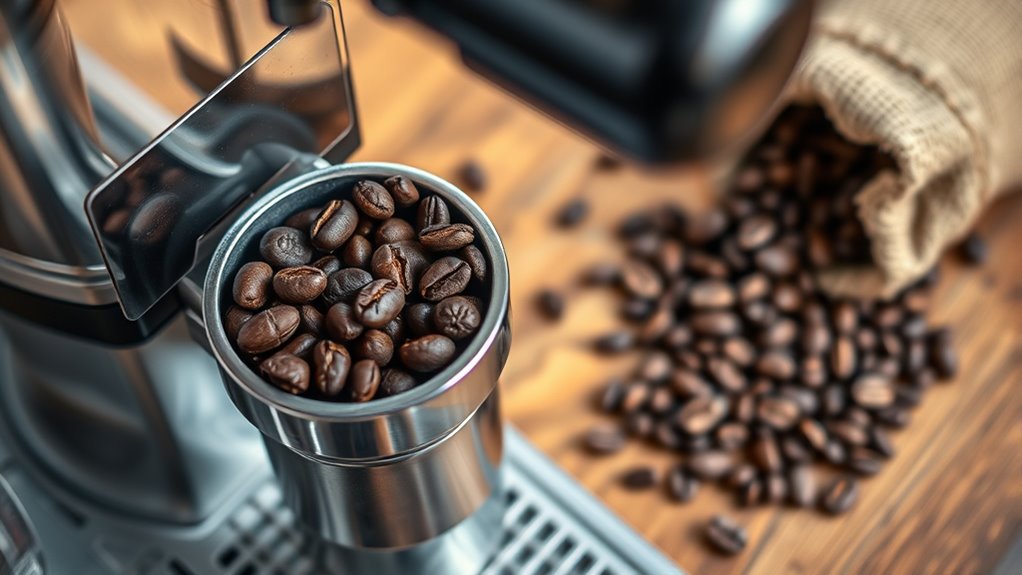
When you choose the right coffee beans for espresso, you set the foundation for a rich and flavorful shot. Opt for high-quality Arabica beans if you want a smoother, more nuanced flavor, or Robusta beans for a stronger, slightly bitter punch.
Always pick freshly roasted beans labeled specifically for espresso; these are roasted and processed to bring out the best crema and extraction.
Pay attention to the origin. Ethiopian beans often offer fruity notes, while Colombian beans lean toward chocolatey flavors.
Avoid very dark roasts or filter coffee beans, as they tend to produce a burnt taste and weak crema.
Espresso roast beans generally have a higher caffeine density due to longer roasting and extraction methods, which contributes to a stronger caffeine punch per shot.
Grind Coffee Beans for Espresso Perfection
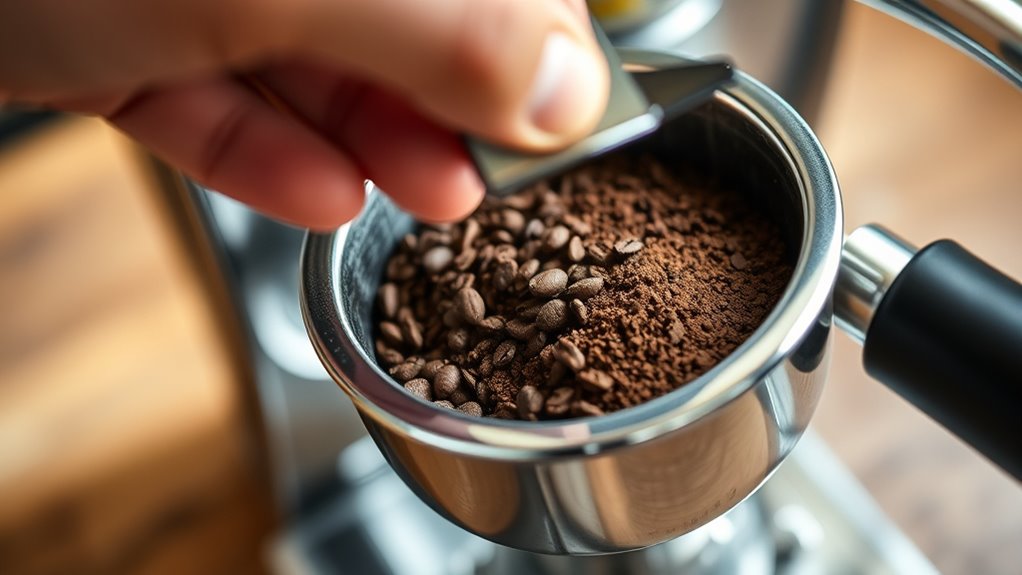
Selecting the right beans sets the stage, but grinding them correctly reveals their full potential for espresso. Use a burr grinder to guarantee a consistent, fine grind, similar to powdered sugar. This consistency is vital for ideal water flow and extraction.
Always grind your coffee just before brewing to lock in freshness and aroma. Adjust your grind fineness gradually, aiming for an extraction time between 23 and 26 seconds. This sweet spot guarantees balanced flavors.
Remember to keep your grinder clean; leftover oils and grounds can alter taste and grind consistency. Regularly calibrate your grinder to maintain consistent particle size and optimize shot quality.
Set Up Your Espresso Machine the Right Way
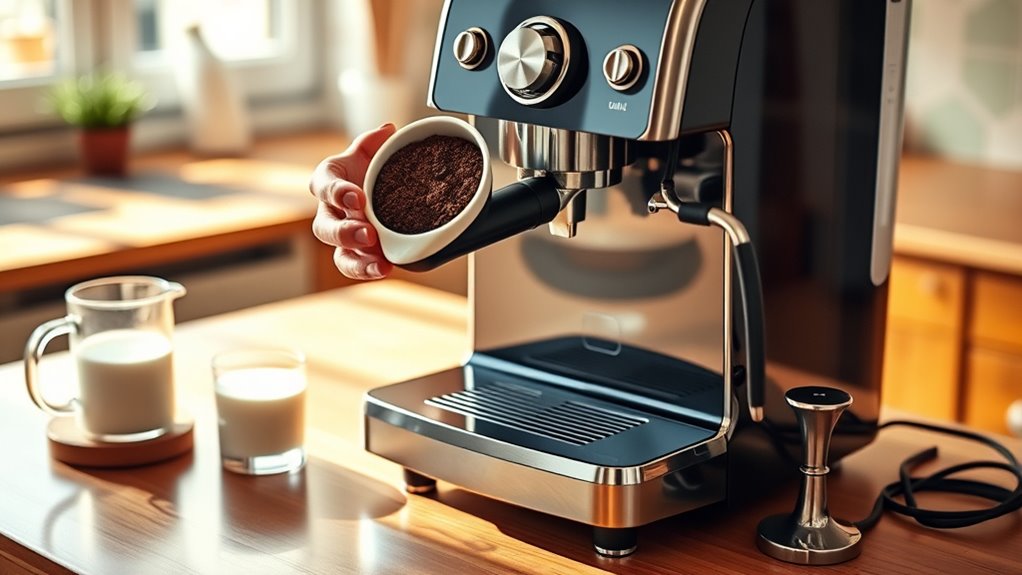
Before you start brewing, make sure your espresso machine is thoroughly cleaned and properly assembled, including the portafilter, drip tray, and water reservoir.
Fill the reservoir with fresh, filtered water, then power on the machine. Let it heat until it reaches the ideal brewing temperature of 195-205°F (90-96°C).
While it heats, check that the steam wand and any other accessories are securely attached and warming up for later use.
Set the machine’s pressure to around 9 bars to guarantee proper extraction and allow the brewing group to preheat.
Once heated, you’ll be ready to attach the portafilter securely after dosing it with grounds.
Proper setup maximizes flavor and consistency in every shot you pull. So, take your time with these steps to make sure everything is just right.
You’ll taste the difference in your espresso every single time.
Remember to use a digital scale to measure your coffee grounds and espresso yield for precise brew ratios that ensure consistent and balanced shots.
Prepare and Tamp Espresso Grounds Evenly
You’ll want to start by spreading the coffee grounds evenly in the portafilter to make sure the extraction is uniform.
Then, press down with steady pressure—around 30 pounds—using a tamper to form a smooth, level coffee bed.
This careful tamping stops channeling and helps you pull a well-balanced, flavorful espresso shot every time.
Consistent tamping pressure and technique are key to reducing shot variability and improving espresso quality through even water flow.
Distribute Grounds Uniformly
How can you assure each shot of espresso extracts evenly and tastes balanced? It starts by distributing your coffee grounds uniformly in the portafilter. Uneven grounds cause channeling, which leads to weak or bitter espresso.
To avoid this, follow these key steps:
Use a distribution tool or gently tap the portafilter to level the grounds, creating a flat surface. Make sure the grounds fill the basket evenly without overfilling or gaps. Check that the surface is smooth and level before tamping.
This helps promote consistent water flow and a better-tasting espresso every time. Maintaining a consistent tamp pressure of 20-30 pounds further ensures even extraction and shot quality.
Achieve Consistent Tamping
Although evenly distributing your coffee grounds is essential, achieving consistent tamping seals the deal for a balanced extraction. Start by using a tamper with a flat base that matches your portafilter basket’s diameter.
Apply steady, downward pressure, aiming for about 30 pounds, to create a flat, level coffee bed.
Avoid tilting or uneven force because this can cause channeling and uneven water flow during brewing.
After tamping, inspect the surface to make sure it’s smooth and even. This precision helps prevent weak spots in your puck, leading to a more uniform extraction.
Regular practice with a scale helps improve tamping consistency and reproducibility.
Ensure Proper Pressure
Why does maintaining proper pressure matter so much when pulling an espresso shot? Pressure directly affects extraction quality and crema formation. If pressure’s off, your espresso can taste weak or bitter.
To ensure proper pressure, focus on preparing and tamping your grounds evenly. Set your machine to about 9 bars for optimal extraction.
Distribute grounds evenly in the portafilter to prevent channeling.
Apply consistent, firm tamping pressure around 30 pounds, keeping the tamper level. Avoid over- or under-tamping, as uneven pressure leads to poor extraction.
By mastering these steps, you’ll create a uniform coffee bed that lets water flow evenly through the grounds.
This results in a balanced, flavorful shot every time. Proper pressure is key to unlocking your espresso’s full potential.
Using a consistent tamping pressure also helps regulate extraction and yield consistency through uniform puck density.
Understand How an Espresso Machine Works
When you use an espresso machine, it forces hot water through finely ground coffee at about 9 bars of pressure. This extracts a rich, concentrated shot.
Inside, the boiler heats water to 90-96°C (194-205°F), which is the ideal range to maximize flavor without burning the coffee.
The pump, either rotary or vibratory, creates the necessary pressure. It pushes water evenly through the coffee puck.
The group head distributes water consistently, while the portafilter holds the grounds securely.
Each component works together to maintain stable temperature and pressure. This is essential for producing that signature crema and full-bodied taste.
Understanding these mechanics helps you appreciate how precision in temperature and pressure control directly impacts the quality of every espresso you pull.
Advanced boilers equipped with PID systems regulate heat to optimize extraction and ensure consistent brewing conditions.
Pull Your First Espresso Shot
Now that you understand how your espresso machine maintains the right temperature and pressure, it’s time to pull your first shot. Start by filling the portafilter with freshly ground coffee.
Then tamp it evenly with about 30 pounds of pressure to ensure uniform extraction.
Lock the portafilter securely into place so it’s ready for brewing.
When you start the brew cycle, aim for an extraction time between 23 and 26 seconds. This should produce 36-40 mL of espresso.
Watch the espresso pour; it should flow steadily like honey and gradually develop a thick, hazelnut-colored crema on top.
Stop the shot once you reach the desired volume to keep the flavor balanced and full-bodied.
Remember these key steps:
- Tamp evenly with consistent pressure
- Lock portafilter firmly
- Extract within the ideal time frame
The fine grind size plays a crucial role in achieving the right extraction time and flavor balance.
Spot Great Crema and Why It Counts
Although it might seem like just a simple layer on top, spotting great crema can tell you a lot about your espresso’s quality. A dense, smooth, hazelnut-colored crema signals proper extraction and fresh coffee grounds.
A dense, smooth, hazelnut-colored crema reveals fresh grounds and perfect espresso extraction.
It forms from the coffee’s oils, proteins, and sugars, creating a stable, uniform layer free of large bubbles.
This thick crema isn’t just for looks. It locks in aromatic compounds and keeps your espresso warm longer.
When you see a rich, persistent crema, you know your espresso has the right balance of pressure, grind size, and tamping.
In short, crema serves as a visual cue for freshness, extraction quality, and overall richness. It lets you gauge the success of your espresso shot immediately.
The color and thickness of crema can vary depending on the roast level and type of coffee bean used.
Adjust Grind and Extraction for Better Espresso
To get the best espresso, you’ll want to adjust your grind size carefully. Finer grinds will slow down the extraction, while coarser ones speed it up.
Try to aim for an extraction time between 23 and 26 seconds—that’s the sweet spot to balance flavor and strength.
Grind Size Importance
When you adjust your grind size to a fine, consistent texture, similar to powdered sugar, you set the stage for a balanced espresso extraction. This grind size guarantees water flows evenly through the coffee, extracting ideal flavors within the perfect 23-26 second window.
If your grind is too coarse, your espresso will be weak and watery, lacking crema. Too fine, and you risk over-extraction, causing bitterness and slow flow or clogging.
To perfect your grind size, aim for a texture that allows a smooth, steady flow without resistance. Adjust grind size based on shot timing and flow rate feedback.
Also, keep an eye on crema quality as a visual cue for proper extraction. Fine-tuning your grind is key to consistently excellent espresso.
Extraction Time Control
Mastering extraction time hinges on fine-tuning your grind size and tamping technique. Adjust your grind to be finer for a shorter extraction or coarser for a longer one, targeting an ideal duration between 23 and 26 seconds.
Make certain your coffee is evenly tamped to guarantee uniform water flow and consistent extraction.
Use a timer to precisely monitor your shot and stop it once you reach 36-40 mL to avoid over-extraction.
If your shot pulls too quickly or too slowly, tweak the grind size or tamp pressure accordingly.
By closely controlling these variables, you’ll achieve balanced espresso with rich flavor and proper intensity every time.
This way, your brewing process becomes a repeatable, satisfying ritual.
Just a little attention to these details goes a long way in perfecting your espresso.
Give it a try, and enjoy the results!
Avoid Common Espresso Machine Mistakes
Although espresso machines can seem straightforward, avoiding common mistakes is essential to consistently pulling a perfect shot. To get the best results, you need to focus on key aspects that many beginners overlook.
Here are some critical pitfalls to avoid:
Using stale or pre-ground coffee instead of freshly ground beans can really impact the crema and flavor. Incorrect tamping pressure is another issue; aim for about 30 pounds of force to guarantee even extraction.
Using fresh beans and applying 30 pounds of tamping pressure ensures rich crema and balanced flavor.
Also, don’t forget to heat your machine to the ideal brewing temperature before extraction. This step is often neglected but makes a big difference.
Additionally, remember to use a fine grind size appropriate for espresso. Cleaning the group head, portafilter, and filter basket regularly is just as important.
These simple steps help prevent residue build-up and ensure your espresso tastes its best every time.
Frequently Asked Questions
How Do I Clean and Maintain My Espresso Machine Regularly?
You should descale your machine every 1-3 months. Cleaning the portafilter and steam wand after each use is important too. It keeps everything fresh and ready for the next cup.
Backflush your machine weekly to clear out any buildup. Don’t forget to rinse the reservoir regularly. This helps avoid any unwanted tastes or smells.
Also, make sure to replace water filters as recommended. Doing all this will keep your espresso machine running smoothly and deliciously every time.
Can I Use Pre-Ground Coffee Instead of Grinding Fresh Beans?
You can use pre-ground coffee, but it often lacks the fine grind and freshness needed for ideal espresso. For better flavor and crema, grind your beans just before brewing.
Make sure to tamp evenly to avoid channeling. This really helps bring out the best taste in your shot. Freshly ground coffee makes a noticeable difference!
What’s the Best Water Type for Making Espresso?
Think of water as your espresso’s silent partner. Filtered or bottled water with balanced minerals (50-150 ppm TDS) guarantees a smooth, rich shot.
Try to avoid tap water with chlorine. It dulls flavor and can harm your machine’s soul. So, choosing the right water really makes a difference!
How Do I Steam Milk for Latte Art at Home?
You’ll fill your pitcher about one-third with cold milk. Then, submerge the steam wand just below the surface and create a whirlpool. Steam the milk until it reaches 140-150°F.
After that, tap and swirl the pitcher to perfect smooth, velvety microfoam. This is what you want for great latte art. It might take a little practice, but you’ll get the hang of it!
How Long Should I Wait Between Espresso Shots?
You should wait about 20-30 seconds between espresso shots to let your machine recover pressure and temperature.
If it has a heat recovery system, 15-20 seconds usually works. Avoid rushing for the best extraction quality.
Taking your time really makes a difference in the flavor and consistency of your espresso.
Conclusion
Now that you’ve mastered the basics, your espresso journey is ready to take flight. Remember, each step—from choosing beans to perfecting your grind—is a brushstroke painting your perfect cup. Don’t be afraid to tweak and experiment; even the best baristas started exactly where you are.
Keep your machine clean and adjust your technique. Soon enough, you’ll pull shots bursting with rich crema and flavor. Your espresso adventure is just beginning. Enjoy every sip!