You should grind your espresso beans to a fine, table salt-like texture with uniform particles. This helps guarantee consistent water flow and resistance during extraction.
Aim for a 25-30 second shot time. If the flow is faster, it means under-extraction and sourness. Slower flow leads to bitterness and over-extraction.
Adjust grind size in small increments. Keep in mind bean freshness and roast level to find the right balance.
Proper grind calibration and maintenance are key to flawless espresso. There are deeper insights available if you want to perfect your approach.
What Does “Fine Grind” Mean for Espresso?
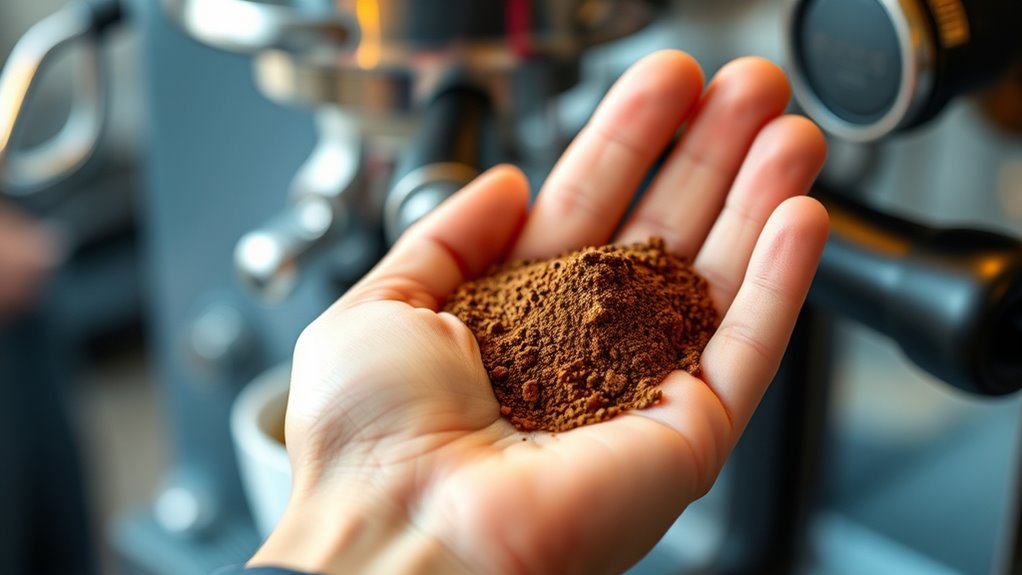
Although the term “fine grind” might seem straightforward, it specifically refers to coffee grounds that closely resemble the texture of table salt. They’re finely sized and uniform to guarantee consistent water flow under espresso’s high pressure. You need this precise particle size to create the necessary resistance for ideal extraction.
The fine grind increases surface area, which helps achieve the typical brew time of 25-30 seconds. If your grind is too fine, you risk over-extraction, which leads to bitterness. On the other hand, if it’s too coarse, your espresso will be under-extracted and weak.
Maintaining uniformity in grind size is essential because it ensures even water distribution and extraction. By controlling fineness precisely, you balance flavor, crema, and shot timing effectively.
In short, fine grinding is a technical cornerstone of espresso preparation. Adjusting grind size within the 200-400 micron range can dramatically refine extraction and flavor balance.
Why Grind Size Matters for Your Espresso Shot
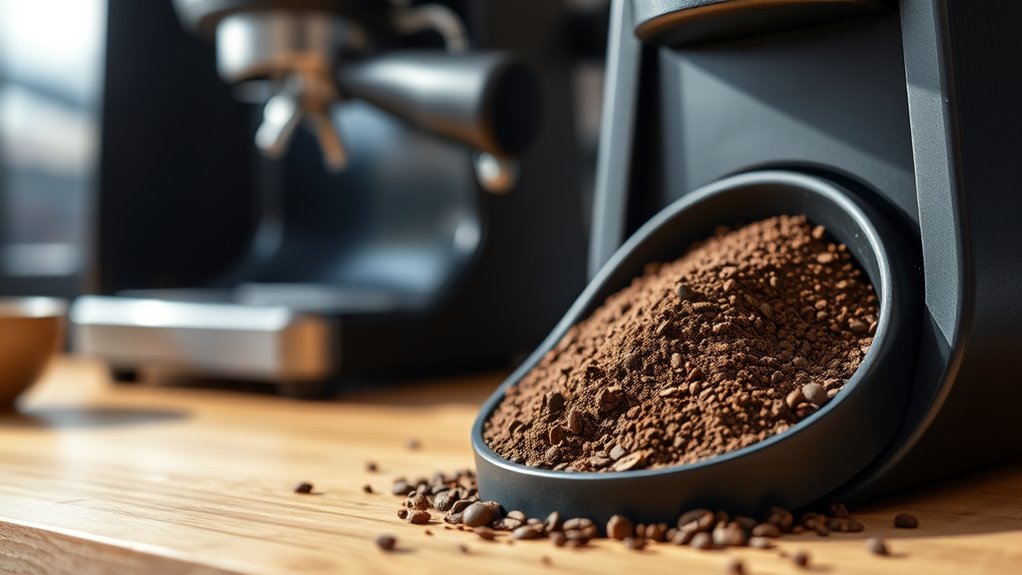
How exactly does grind size influence the quality of your espresso shot? The grind size controls extraction by regulating water flow through the coffee puck at 9 bars of pressure. A fine grind, resembling table salt, increases surface area and resistance, slowing water to extract flavor compounds thoroughly within 25-30 seconds.
If your grind is too fine, over-extraction occurs, producing bitter, harsh flavors. Conversely, a coarse grind causes under-extraction, resulting in sourness and weak crema.
By adjusting your grind size, you directly impact extraction time, flavor clarity, crema quality, and body.
Maintaining the correct fine grind ensures balanced extraction, ideal shot duration, and the rich, complex flavors that define a proper espresso. This precision is essential for achieving consistent, high-quality espresso every time.
Regularly recalibrating your grinder when switching beans or roast levels helps maintain grind size consistency and optimal extraction.
How to Judge Espresso Grind Size by Feel and Look
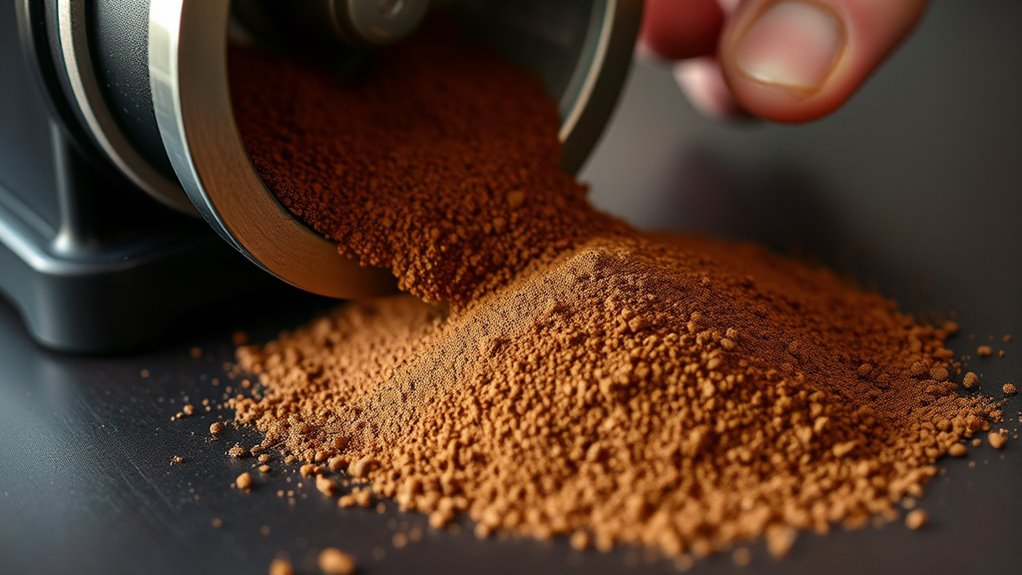
When you assess espresso grind size, focus on both texture and appearance to guarantee ideal extraction. You want grounds that resemble table salt, slightly gritty and cohesive when pressed, but not too dense to block water flow.
Here’s how to judge by feel and look:
Here’s how to judge grind quality by feel and appearance for the perfect espresso extraction.
- Texture: Press the grounds lightly. They should clump and hold shape but break apart easily under finger pressure.
- Uniformity: Inspect for consistent particle size without large chunks or powdery fines. This ensures even extraction.
- Moist Appearance: The grind should look slightly moist and crumbly. This signals a fine, uniform grind suitable for high-pressure brewing.
Mastering these sensory checks helps you dial in the perfect espresso grind. It balances flow and extraction for ideal flavor.
Give it a try and trust your senses! Remember, adjusting grind size by small increments significantly impacts extraction time and flavor balance.
How to Set Your Grinder for Consistent Fine Grounds
To achieve consistent fine grounds for espresso, you’ll need to set your grinder near its finest setting, typically toward the “finer” end of the adjustment range. Look for a powdery, salt-like texture that clumps slightly without grit. Adjust in small increments, one click or turn at a time, to refine shot timing and flow.
Regular calibration by tasting and timing shots (aiming for 25-30 seconds) guarantees precision. Uniform particle size is key to consistent extraction. Using a grind that preserves the extraction time helps maintain the bold flavor and balance seen in quality espresso.
| Step | Detail |
|---|---|
| Initial Setting | Start near finest grind setting |
| Visual Cue | Powdery, salt-like, slight clumping |
| Adjustment | Small increments (1 click/turn) |
| Calibration | Taste and time shots (25-30 seconds) |
How Grind Size Affects Extraction Time and Shot Quality
Adjusting your grinder affects not only the consistency of your grounds but also directly influences extraction time and shot quality. Fine grinds increase resistance, slowing extraction and intensifying flavor. Coarse grinds speed flow and lighten taste.
To optimize your espresso, aim for 25–30 seconds extraction time by fine-tuning grind size. Avoid over-extraction from too fine grounds, which causes bitterness and harshness. Also, prevent under-extraction due to coarse grounds, resulting in sour or weak shots.
Finer particles expose more surface area, allowing water to extract more soluble compounds and enrich flavor. By closely watching shot time and flavor cues, you can figure out if your grind is too fine or coarse. This way, you’ll have precise control over extraction and consistently high shot quality.
Consistent tamping pressure around 30 pounds is also crucial to ensure uniform resistance and optimal flow during extraction.
How to Adjust Grind Size Based on Shot Flow and Taste
You’ll start by watching how your shot flows. Ideally, you want a steady extraction that lasts between 25 and 30 seconds. While you’re at it, pay attention to how it tastes.
If your espresso tastes sour and the shot pours too quickly, that means you should tighten the grind a bit to create more resistance.
On the other hand, if it’s bitter and the shot drips slowly, try loosening the grind.
Make small adjustments each time and taste after every shot. This way, you can fine-tune your grind size just right. Using a stopwatch to monitor brew time helps ensure your shots stay within the optimal extraction window.
Shot Flow Indicators
Although dialing in your grind size might feel like a delicate art, observing your shot flow provides clear, objective cues to guide you. The flow rate directly reflects your grind setting and extraction quality.
If your shot flows too quickly, your grind is too coarse. Tighten it to increase resistance and extraction time.
A slow or choked flow signals an overly fine grind. Coarsen it slightly to prevent channeling and bitterness.
Aim for a flow starting with thick, dark drops that gradually lighten. This indicates balanced extraction pressure and timing.
Make small, incremental grind adjustments while monitoring these flow indicators. This method ensures precise control over shot dynamics. It allows you to optimize espresso extraction efficiently.
Since extraction time ideally ranges from 25 to 30 seconds, adjusting grind size to achieve this extraction time helps ensure consistent caffeine content and flavor.
Taste-Based Adjustments
When your espresso shot flows too quickly and tastes sour, grinding finer increases resistance and extraction time. This helps balance acidity and sweetness.
On the other hand, if the shot drips slowly and tastes bitter, coarsen the grind to reduce extraction and improve flow. Tasting and observing the flow lets you make precise, small grind adjustments.
Aim for a 25-30 second extraction with balanced flavor. It’s a good idea to record each change so you can refine your technique over time. Consistent timing from pump start is key for reproducible flavor and crema quality.
| Shot Flow | Taste Profile |
|---|---|
| Fast | Sour, under-extracted |
| Ideal (25-30s) | Balanced, sweet |
| Slow | Bitter, over-extracted |
| Adjust Grind | Finer for fast flow, coarser for slow flow |
This methodical approach sharpens your ability to tune grind size for the ideal espresso quality.
Grind Size Tweaks
Fine-tuning your grind size hinges on carefully observing shot flow and taste profiles. Adjust your grind in small increments, like a quarter turn on stepless grinders, and watch how the shot responds.
Here’s how to tweak effectively:
If extraction is too fast and tastes sour or underdeveloped, grind finer to increase resistance and slow the flow.
If extraction drags or tastes bitter and over-extracted, coarsen the grind to reduce resistance and speed it up.
Use visual cues such as flow rate and blonding onset to judge if you need finer or coarser grounds.
Keep meticulous records of your adjustments and shot results. This data helps you pinpoint the ideal grind for your grinder, beans, and taste preferences. That way, you ensure consistent espresso quality every time.
Remember, the crema and layered complexity characteristic of true espresso comes from precise grind size and pressure, which influences the final flavor and texture.
How Bean Freshness and Roast Affect Your Grind Settings
You’ll want to tweak your grind size depending on how fresh your beans are and their roast level. Fresh beans often need a finer grind because they hold more moisture and gas.
On the other hand, darker roasts call for a coarser grind to prevent over-extraction.
As your beans get older or if you switch up the roast profile, adjusting your grind just right helps keep your shots tasting consistent and balanced every time.
Since true espresso requires a medium-fine grind size to avoid clogging and ensure proper extraction, getting your grind right is crucial.
Impact Of Bean Freshness
Because freshly roasted beans are more porous and release CO₂ during degassing, you’ll need to adjust your grind size to optimize extraction. The high CO₂ content affects grind consistency and water absorption, which impacts extraction rates.
As beans age, their internal structure becomes denser and less soluble, so they require a coarser grind.
To manage these variables effectively, start by using a finer grind immediately after roasting to compensate for increased porosity and CO₂ release. Then, gradually coarsen the grind as beans age and degas, balancing reduced solubility and water absorption.
Make sure to monitor extraction yield and adjust your grind to keep the flavor balanced. Just remember to consider freshness-related changes separately from roast level effects.
Roast Level Adjustments
Although bean freshness considerably influences grind size, roast level plays an equally crucial role in dialing in your espresso. Dark roasts, being more porous and fragile, typically require a slightly coarser grind to prevent over-extraction and bitterness.
In contrast, light roasts are denser with lower solubility, demanding a finer grind to extract the full range of flavors effectively.
As the bean’s structure changes with age, fresher beans absorb more water, often necessitating a finer grind. Older beans, on the other hand, require a coarser grind to avoid sourness from over-extraction.
Understanding these roast-dependent physical properties allows you to adjust your grind precisely.
This way, you can optimize extraction and ensure balanced flavor, no matter the roast level or how fresh your beans are. It’s all about finding that perfect grind to bring out the best in your espresso.
Grind Size Variations
How does the freshness and roast level of your coffee beans dictate the ideal grind size? Both factors significantly influence grind settings because of changes in bean structure and moisture content. You need to adjust grind size to optimize extraction and flavor.
Consider these points:
1. Bean Freshness: Fresh beans contain more moisture and absorb water differently. Use a finer grind to maximize extraction.
As beans age and dry out, shift to a coarser grind to avoid over-extraction and bitterness.
2. Roast Level: Dark roasts are brittle and porous, so they require a coarser grind to prevent over-extraction.
Light roasts are denser and less porous, which means you’ll want a finer grind to unlock their flavor profile.
3. Continuous Adjustment: Since both freshness and roast affect water absorption dynamically, it’s important to regularly fine-tune your grind settings.
This helps maintain balance and consistency in your espresso.
When Should You Use Stepless vs. Indexed Grinder Settings?
When you need to fine-tune your espresso grind for exact extraction times or flavor nuances, a stepless grinder gives you the continuous control required to dial in precisely. It allows infinite, incremental adjustments, making it ideal for experimenting and achieving ideal shot quality.
You can tweak grind size minutely to hit specific extraction goals without being restricted by preset steps.
On the other hand, if you prioritize speed and consistency, such as in a busy café or for repeatable home use, an indexed grinder is more practical. Its fixed steps simplify adjustment and reduce trial and error, making it easier to get reliable settings each time.
Common Grind Size Mistakes and How to Fix Them
If your espresso shots taste bitter or sour, the grind size is often the culprit. Here’s how to identify and fix common grind size mistakes:
- Too Fine: This causes slow water flow and over-extraction, which leads to bitterness and can even clog your machine. Try adjusting the grind coarser little by little to improve flow and get a better balance.
- Too Coarse: This makes water pass through too quickly, causing under-extraction. The result? Sour, weak espresso. Grinding finer will help extend the extraction time and boost the flavor.
- Inconsistent Grind: When your grind has uneven particle sizes, it causes channeling and uneven extraction. To avoid this, skip blade grinders and go for a quality burr grinder instead.
Make small, regular grind adjustments based on how long the extraction takes and what your espresso tastes like.
This simple, technical approach will guarantee excellent espresso quality and consistent shots every time.
How to Maintain Your Grinder for the Best Espresso Grind
You’ll want to clean your grinder’s burrs and chute regularly to keep buildup at bay—otherwise, you might end up with stale flavors.
Also, it’s a good idea to replace the burrs after grinding around 500 to 1000 pounds of coffee. That way, you can keep your particle size consistent.
Regular Cleaning Importance
Maintaining your espresso grinder with regular cleaning is essential to preserve grind consistency and prevent stale flavors caused by residual coffee oils and particles. Without routine upkeep, oils and coffee residues accumulate in burrs and chutes. This buildup disrupts uniform particle size and compromises extraction.
To keep your grinder functioning at its best, follow these steps:
- Use rice or a dedicated grinder cleaner periodically to dislodge built-up oils and coffee remnants.
- Thoroughly clean burrs and chutes to guarantee even grind distribution and flavor clarity.
- Perform routine maintenance to extend your grinder’s lifespan and sustain peak performance.
Keeping up with these simple habits will make a noticeable difference in your coffee’s taste. Plus, it helps your grinder last longer and work more smoothly every time you brew.
Burr Replacement Schedule
Since burrs directly influence grind consistency, replacing them on schedule is crucial for extracting the best espresso. Typically, burrs last between 300 and 500 pounds of ground coffee, depending on your grinder model and how often you use it.
Keep an eye out for signs like inconsistent grind size, uneven extraction, or diminished flavor quality. These usually mean your burrs are wearing out.
It’s a good idea to regularly inspect the burrs for visible dullness, chips, or wear patterns to see how they’re holding up. Replacing them on time helps maintain a uniform particle size, which is key for ideal espresso extraction and flavor balance.
Replacement burrs usually cost between $30 and $60, so this maintenance step is both affordable and essential for keeping your grinder performing well.
Keeping your burrs sharp guarantees consistent results and preserves the quality of every shot you pull.
Frequently Asked Questions
What Type of Grinder Is Best for Achieving a Fine Espresso Grind?
You should use a stepless burr grinder for fine espresso grind precision. It gives you uniform particle size, which is essential for espresso extraction. It also helps minimize heat buildup during grinding.
Avoid blade grinders because they produce inconsistent particles. That inconsistency can ruin your espresso’s quality and flavor balance. So, sticking with a burr grinder really makes a difference.
How Does Water Temperature Influence Espresso Extraction With Fine Grounds?
Water temperature is the conductor of extraction’s symphony. If it’s too hot, you’ll over-extract bitterness. Too cool, and your espresso tastes weak.
Keep it between 198°F and 202°F for balanced, flavorful shots every time. It’s all about hitting that sweet spot to get the best from your fine grounds.
Can Grind Size Affect the Crema Quality on an Espresso Shot?
Yes, grind size directly affects crema quality. If your grind’s too fine, it creates over-extraction and dense crema. Too coarse, and you’ll get weak, pale crema.
Dial in grind size for rich, stable, golden crema. It really makes a difference in your espresso shot. Just a little adjustment can change the whole experience.
How Often Should I Recalibrate My Grinder for Consistent Espresso Grind?
You should recalibrate your grinder every 50-100 shots or about 1-2 months to keep things precise.
If you notice changes in shot timing, taste, or flow rate, adjust right away.
It really helps to log your settings so you can track what works best and keep your espresso consistent.
Does Altitude Impact the Ideal Grind Size for Espresso Brewing?
Yes, altitude impacts espresso grind size. At higher elevations, lower atmospheric pressure and boiling points affect extraction.
Conclusion
So, you want the perfect fine grind for your espresso but hate fiddling with your grinder? Ironically, dialing in your grind size is the only shortcut to consistency. Too coarse or too fine, and your shot’s ruined. No magic beans fix that.
Remember, grind size isn’t just a number; it’s your extraction’s heartbeat. Master it, maintain your grinder, and you’ll stop chasing perfection. You’ll start pulling it every time.

Pingback: Is Espresso Bitter – The Real Reason