To grind espresso beans perfectly, use a flat-burr grinder set to a gritty texture like coarse salt for consistent extraction. Adjust the grind size finely to control shot time. Aim for 25-30 seconds and keep grounds fresh, ideally 5-14 days post-roast.
Use 18-20 grams per shot, tamp evenly, and clean your equipment regularly to avoid channeling. Mastering these basics guarantees rich crema and balance.
Explore further to optimize your beans, grind, and technique for flawless espresso. It’s all about finding what works best for you and your setup.
Choosing the Best Grinder and Tools for Espresso
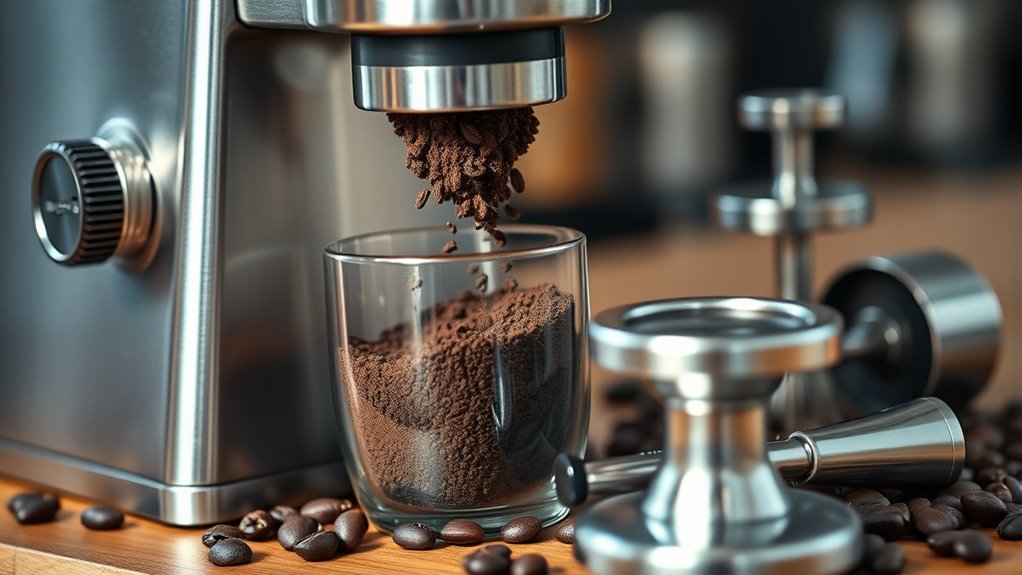
When you’re aiming for the perfect espresso, choosing the right grinder is essential because it directly affects grind consistency and shot quality. Ideally, go for a flat-burr grinder with 64 mm burrs to achieve a consistent bimodal particle distribution. This type of grind is perfect for espresso extraction.
A stepless grinder lets you make fine, precise adjustments to your grind size, which is critical for dialing in your shot. Using a precision scale with 0.1 g readability helps you accurately dose your coffee and measure yield, ensuring repeatability.
Don’t forget to clean your burrs and grinder components regularly—every 200 lbs of coffee or 2-3 months. This keeps the grind quality and flavor at their best.
Also, pair your grinder with a stable, high-quality espresso machine that has a PID controller. It helps keep temperature and pressure consistent for the best results.
Maintaining approximately 9 bars pressure during extraction is crucial for achieving the ideal espresso shot with rich crema and balanced flavor.
Finding the Perfect Espresso Grind Size and Texture
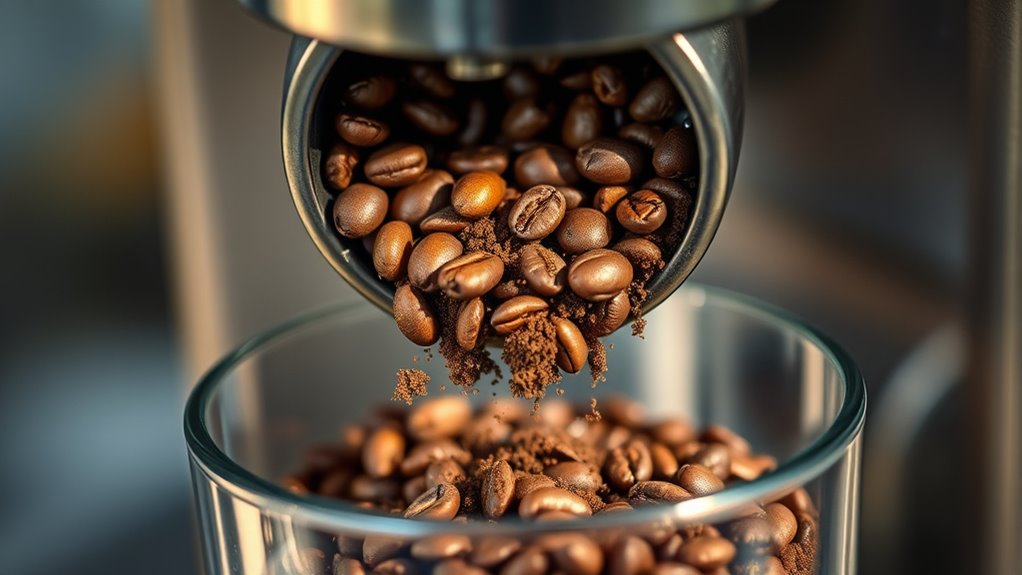
Although dialing in your grind size can feel nuanced, achieving the perfect espresso texture is key to consistent extraction. Your goal is a grind resembling gritty table salt, around 200-400 microns, that balances water flow and extraction evenly.
Here’s how to find it:
- Use a flat-burr grinder to get a consistent bimodal particle distribution and avoid channeling.
- Adjust grind size in small increments, observing shot timing and flavor changes closely.
- Aim for a 25-30 second extraction time. Finer grinds slow flow and risk over-extraction. Coarser grinds speed it up and under-extract.
- Check the texture: it should clump slightly when pressed, but not form dense clumps or powder.
Mastering these factors ensures you hit the sweet spot for espresso every time. Consistent, uniform particle size is crucial to prevent channeling and achieve richer flavor in your espresso.
Grinding and Preparing Your Espresso Step-by-Step
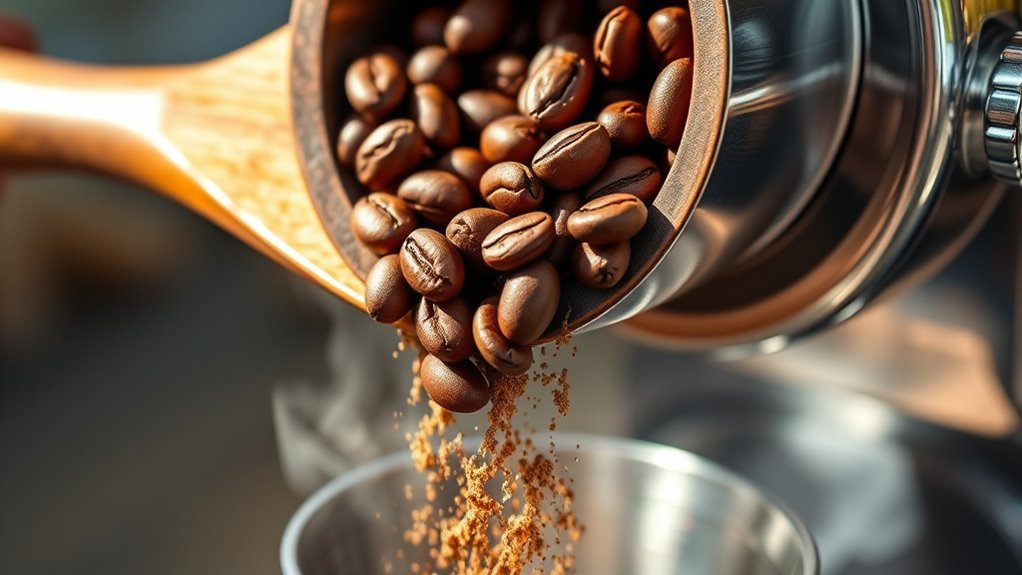
Since grinding your espresso beans is the foundation of a great shot, you’ll want to start with a fine, consistent texture resembling gritty table salt. Use a high-quality burr grinder with stepless adjustment to dial in uniform particle size.
Start with a fine, consistent grind like gritty table salt using a high-quality burr grinder.
Always grind immediately before brewing to lock in freshness and avoid oxidation.
Measure the right dose, typically between 18-20 grams, and grind directly into your portafilter to reduce mess and waste.
After grinding, evenly distribute the grounds and tamp firmly to create a smooth, level puck. This guarantees even water flow and ideal extraction.
Remember to recalibrate your grinder when switching beans or roast levels to maintain precision.
Following these steps, you’ll prepare your espresso accurately and consistently for a perfect shot every time.
For optimal extraction, use hot water just below boiling at around 185°F/85°C to dissolve the espresso grounds properly.
How to Adjust Your Grinder for a Balanced Shot
To get a balanced shot, begin by tweaking your grind size in small steps. Even tiny adjustments can change the extraction time and flavor quite a bit.
If your shot pulls too quickly, try making the grind a bit finer to slow things down. On the other hand, if it’s dragging and taking too long, coarsen the grind to speed it up.
Keep an eye on your shot time and trust your taste buds. Ideally, you want an extraction that lasts between 25 to 30 seconds, producing a rich crema and a nicely balanced flavor.
Remember that consistent timing, including pre-infusion, helps ensure reproducible extraction and flavor balance.
Grind Size Impact
When your espresso shots pull too quickly or drag on too long, adjusting the grind size can make all the difference in achieving a balanced extraction. The grind size controls water flow and extraction rate, which impacts flavor and crema quality. Here’s what you need to focus on:
- Grind finer to increase resistance and slow water flow if shots are too fast or under-extracted.
- Grind coarser to speed up flow and avoid over-extraction if shots are too slow or bitter.
- Aim for a grind texture like gritty table salt. This balance influences shot timing and taste.
- Recalibrate your grinder when changing beans or roast levels, as density and moisture affect the ideal grind.
Keep an eye on extraction time and try to hit around 25 to 30 seconds for a perfectly balanced shot. It really helps dial in the flavors you want. Understanding the impact of roast level on extraction speed and flavor highlights is crucial for making precise grind adjustments.
Adjustment Techniques
Fine-tuning your grinder is key to hitting that ideal shot time of 25 to 30 seconds and balancing flavor. If your shot pulls too quickly with sour notes, adjust the grind finer to slow extraction and enhance sweetness.
Conversely, if it drags with bitter flavors, coarsen the grind slightly to speed extraction and reduce over-extraction.
Make small, incremental changes, around 1 to 2 microns, to avoid overshooting your target. Always taste your shot after adjustments; timing and flow rate guide you, but flavor confirms success.
When switching roast levels or beans, recalibrate your grinder since bean density influences grind size needs.
Regularly clean your grinder to maintain consistent particle size and prevent stale grounds from affecting your shot quality.
This disciplined approach guarantees a balanced, flavorful espresso every time. Using a digital scale to measure espresso yield precisely supports dialing in the correct grind adjustments for consistent extraction.
Extraction Time Tuning
Although dialing in your espresso shot can feel complex, adjusting your grinder for ideal extraction time becomes straightforward once you understand the key indicators. A balanced shot typically extracts between 25-30 seconds. To achieve this, follow these steps:
If your shot pulls in under 20 seconds or tastes sour, modify your grinder finer to slow extraction.
If it takes over 35 seconds or tastes bitter, coarsen the grind to speed it up.
Keep dose and other variables consistent while making small, incremental adjustments, about a quarter turn at a time.
Recalibrate your grinder regularly when switching beans or roast levels to maintain precise timing and flavor balance.
This methodical approach ensures you consistently extract balanced, flavorful espresso. Maintaining proper extraction time is crucial to avoid over-extraction and bitterness in your shot.
Choosing the Best Coffee Beans for Espresso
To get the best espresso, you want to pick the right bean types and blends that match your taste and the kind of crema you like.
Dark roast beans are a great choice because they extract well at typical espresso temperatures, giving you a nice balance of flavor and body.
It also helps to understand how the ratio of Arabica to Robusta beans affects the bitterness and thickness of the crema.
Knowing this can guide you to the perfect blend for your cup.
For a lighter, nutty alternative with higher caffeine content, consider experimenting with white espresso beans for a unique flavor profile.
Bean Types And Blends
When selecting beans for espresso, understanding the balance between Arabica and Robusta is essential to achieving your desired flavor and crema. Arabica beans deliver stone-fruit sweetness and mild acidity, while Robusta adds crema thickness and a touch of bitterness.
Most Italian blends favor 80-85% Arabica for a smooth, balanced cup. Consider these points when choosing your beans:
- Opt for blends combining Arabica and up to 20% Robusta to enhance crema and body.
- Explore single-origin Arabica like Ethiopian Yirgacheffe or Kenyan AA for unique flavor profiles.
- Prioritize freshness—use beans within 5-14 days post-roast to maintain ideal crema and flavor.
- Avoid beans that are too freshly roasted or too old, as both affect extraction quality.
Selecting the right bean type and blend sets the foundation for perfect espresso grinding and brewing. It really makes all the difference in your cup! Regular cleaning and maintenance of your espresso machine are also crucial to preserving the flavor integrity and performance of your coffee setup, so incorporating a cleaning routine helps maintain consistency and quality.
Roast Level Importance
Because roast level directly affects solubility and extraction, choosing the right roast is essential for grinding and brewing espresso.
Dark roasts like French or Italian are ideal because their higher solubility lets you grind finer for ideal extraction.
Lighter roasts, being denser, need an even finer grind and slightly higher brewing temperatures (94-96°C) to release their flavors.
Remember, specialty espresso blends often mix Arabica and Robusta, balancing flavor and crema with tailored roast levels.
Freshness matters too; beans 5-14 days post-roast yield the best crema and flavor, regardless of roast.
Adjust your grind size and brewing temp based on roast level to achieve the perfect espresso shot every time.
This precision guarantees balanced extraction and a rich, satisfying cup.
Using espresso in cocktails like an espresso martini adds minimal calories compared to alcohol and mixers, making espresso extraction an important factor for both flavor and calorie considerations.
Choosing the Right Roast Level and Freshness for Espresso
Although many factors influence espresso quality, choosing the right roast level and guaranteeing bean freshness are foundational steps you can control.
Dark roasts, from Full City+ to French (Agtron 35-55), are ideal because they extract well at 89-92°C.
Lighter roasts need higher temps, so they’re a bit trickier to dial in.
Freshness is critical. Beans perform best 5-14 days after roasting.
Avoid beans that are under 4 days or over 6 weeks old to keep that crema quality just right.
Consider these points when selecting beans:
- Opt for dark roasts for consistent extraction and richer body.
- Use beans within two weeks of roasting for peak flavor.
- Experiment with specialty single-origin beans for unique profiles.
- Choose blends with up to 20% Robusta for thicker crema and balanced bitterness.
Mastering these guarantees your espresso starts with a solid foundation.
Fixing Common Espresso Grind Mistakes
If you want to pull consistent espresso shots, fixing common grind mistakes is essential. Start by avoiding an overly fine grind, which slows extraction and causes bitterness. A too coarse grind leads to sour, under-extracted shots.
Make sure your grind size is consistent to prevent channeling. Channeling results in uneven extraction and ruins the shot. Using a blade grinder usually produces uneven particles, so switch to a burr grinder for precision.
Regularly clean and calibrate your grinder to avoid buildup that affects grind uniformity. When adjusting, make small, precise changes of about 5-10 microns to fine-tune your shot.
Frequently Asked Questions
How Does Water Temperature Affect Espresso Extraction?
Water temperature directly impacts your espresso extraction by controlling how quickly flavors dissolve. Too hot, and it scorches the grounds, causing bitterness. Too cool, and you end up with sourness.
Can I Grind Espresso Beans in Advance and Store Them?
You can grind espresso beans in advance, but keep in mind they lose 30-50% of aroma within 15-30 minutes.
Make sure to store the grounds airtight, in a cool and opaque container. This helps slow down the loss of flavor.
For the best taste, try to use the grounds within 1-2 hours. That way, your espresso stays fresh and delicious.
What Is the Ideal Tamping Pressure for Espresso?
You should apply about 30 to 40 pounds of pressure when tamping espresso grounds. This consistent force guarantees even resistance, prevents channeling, and promotes uniform extraction.
It helps you pull a balanced, flavorful shot every time. Just remember to keep your tamping steady and even for the best results.
How Often Should I Clean My Espresso Grinder?
Wondering how often to clean your espresso grinder? You should clean it every 2-3 months or after 200 pounds of coffee. This keeps grind consistency, prevents oil buildup, and guarantees smooth operation for perfect espresso shots.
Keeping your grinder clean is key to great tasting espresso. Plus, regular cleaning helps your machine last longer. So, don’t skip it—it’s worth the effort!
Does Humidity Impact Espresso Grind Consistency?
Yes, humidity impacts your espresso grind consistency. It changes the moisture level in the beans, which can cause clumping or uneven grinding.
Because of this, you’ll need to adjust your grind size more often. Also, storing your beans in an airtight container helps keep things consistent.
This way, you can maintain a steady extraction and get the best flavor every time. It’s a small step that makes a big difference!
Conclusion
Think of grinding espresso beans like tuning a fine instrument. Each adjustment brings you closer to harmony. Just like a violinist tweaks strings for the perfect note, you’ll refine your grind size and texture to craft a balanced shot.
Remember, even a 0.1 mm change can dramatically affect flavor. With the right tools, fresh beans, and mindful adjustments, you’ll consistently pull espresso that sings with rich, vibrant flavor.
Keep practicing. Mastery is within reach.