To dial in espresso, start by choosing and securing a consistent dose, usually between 17 and 21 grams, using a precise scale. Evenly distribute the grounds and apply firm, level tamping to avoid channeling. This helps make sure your shot extracts evenly.
Next, adjust the grind size finely to target a brew time of about 25 to 35 seconds. This balances the extraction, so your espresso isn’t too sour or bitter. Measuring the yield helps control the flavor concentration.
Taste your shots to spot if they’re under-extracted or over-extracted, then tweak your parameters accordingly. By keeping track of these details, you’ll consistently pull balanced, flavorful espresso. And trust me, there’s plenty more to master beyond just this!
Why Dialling In Espresso Is Key To Great Flavor
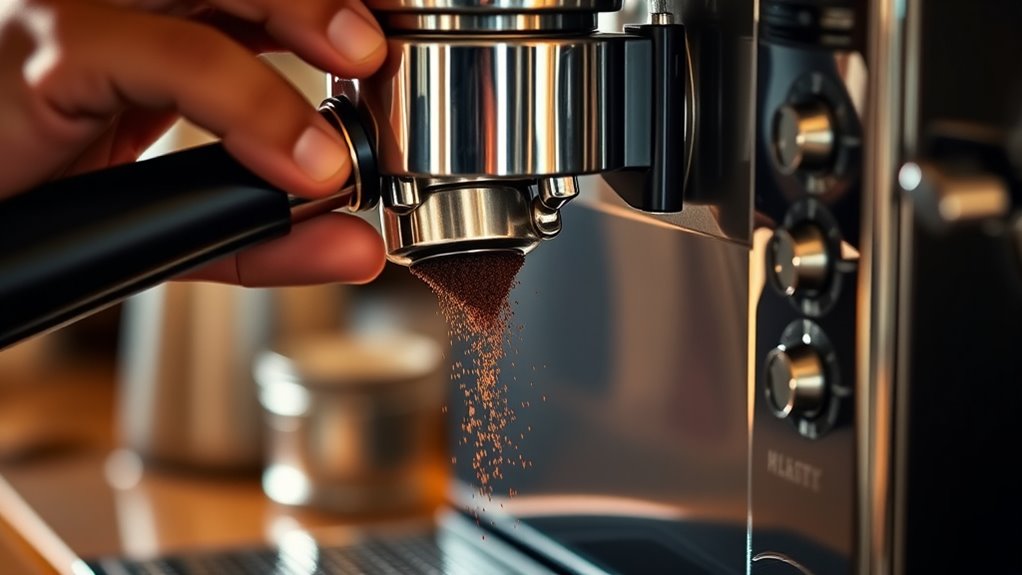
Although dialing in espresso might seem like a small step, it’s essential for revealing your coffee’s best flavor. By adjusting dose, yield, and brew time, you control extraction levels, balancing acidity, sweetness, and bitterness.
This process prevents under-extraction, which causes sourness, and over-extraction, which leads to bitterness. As you taste and tweak, you’ll notice how grind size and extraction affect flavor clarity and intensity.
Calibrating ensures each shot highlights the unique qualities of your beans, whether light or dark roast. Mastering this skill lets you customize espresso to your preference, releasing the full potential of the coffee.
Without proper dialing in, your espresso risks being inconsistent and flavorless. This step is your key to consistent, delicious shots every time. Proper timing and pre-infusion duration are crucial to achieving this consistency and flavor balance.
Choosing And Locking In Your Dose For Dialling In Espresso
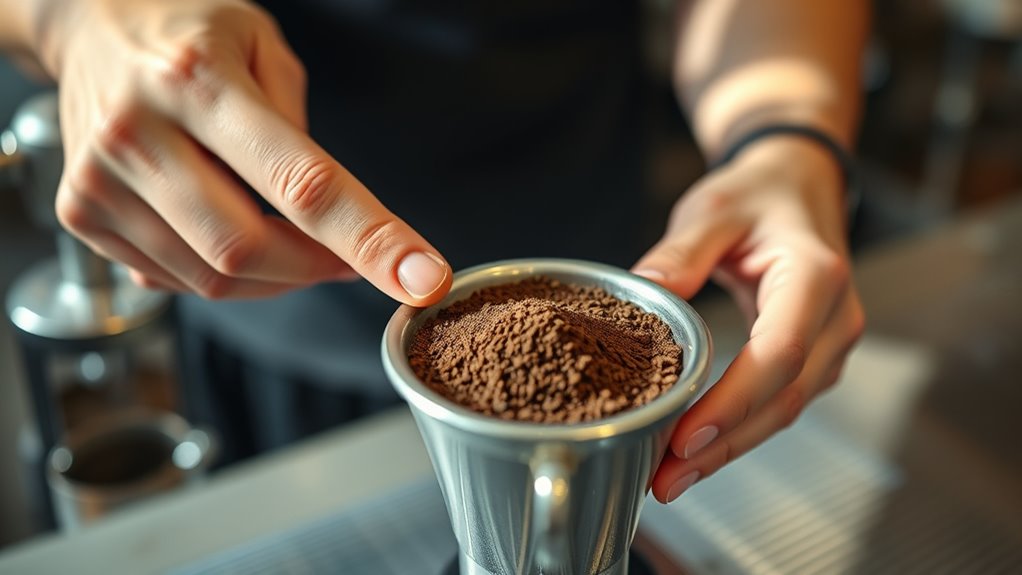
Start by choosing a dose that fits your basket size—usually somewhere between 18 and 20 grams. This helps make sure your extraction is even.
Make sure you use a precise scale to measure your dose consistently, aiming for accuracy within 0.1 grams. That way, you can keep better control over your espresso.
Once you’ve locked in your dose, stick with it. Keeping your dose fixed makes it easier to adjust other variables like grind size and shot time more effectively.
Remember, adjusting your dose controls shot strength and extraction quality, which is fundamental for achieving a balanced espresso extraction quality.
Optimal Dose Selection
When dialing in your espresso, choosing the right dose between 17 and 21 grams is essential to achieving a balanced extraction where the coffee puck isn’t too wet or too dry. Start by selecting a dose within this range using a precise digital scale, ideally measuring to 0.1 grams for accuracy.
Lock in this dose before adjusting your grind size to maintain consistent shot timing and simplify troubleshooting.
Apply consistent tamp pressure of 20-30 pounds to ensure even coffee bed density and prevent channeling.
If the shot doesn’t yield your desired flavor, adjust the dose incrementally by 0.2 grams and record each change. Tracking these adjustments helps you find the ideal dose that delivers the best flavor profile for your espresso.
Remember that increasing the dose thickens the coffee bed, which slows water flow and extends extraction time, so minor grind adjustments will be necessary to maintain balance and avoid channeling risks.
Consistency In Dose
After selecting the right dose within the 17 to 21-gram range, locking it in helps maintain consistency throughout your espresso-making process. Use a precise digital scale to measure your coffee grounds accurately, zeroing it before each dose.
Consistency is key. Dose the same weight every time to guarantee reliable extraction.
Apply the same tamping pressure and technique to keep the puck density uniform and maintain even contact with the shower screen.
If you need to adjust the dose, do so in small increments, like 0.2 grams, to fine-tune extraction without drastically changing shot time.
Once you find the ideal dose, keep it steady. This simplifies dialing in, letting you focus on adjusting grind size and yield to perfect your espresso’s flavor.
Remember that factors like extraction time also affect caffeine levels and overall espresso quality, so consider them alongside dose consistency.
Consistent Tamping And Distribution Techniques
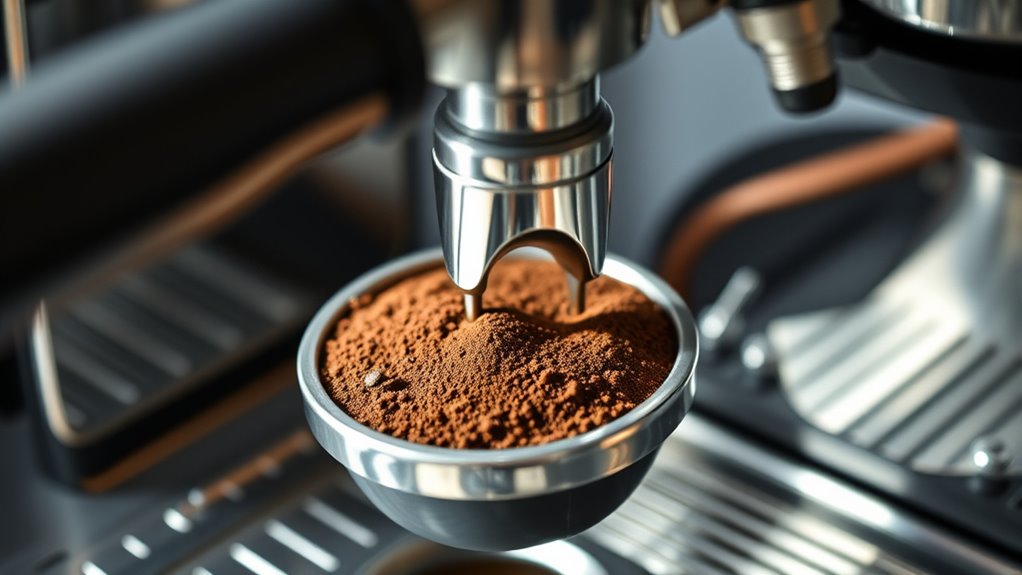
You want to make sure your coffee grounds are spread out evenly to avoid those dry spots that can mess up the extraction.
Then, apply consistent tamping pressure using a level, straight motion.
This creates a uniform coffee bed. Doing this helps prevent channeling and ensures you get a balanced, flavorful shot every time.
Regular practice with a scale helps improve tamping pressure consistency for better espresso results.
Importance Of Even Distribution
Because uneven distribution of coffee grounds leads to channeling, you can’t achieve a consistent extraction without paying close attention to how you spread and tamp your coffee. When grounds aren’t spread evenly, water flows unevenly, bypassing some areas and causing under-extraction. This results in sour or weak flavors.
Using distribution tools helps break up clumps and level the surface, setting you up for a uniform coffee bed. This uniformity works with consistent tamping pressure to promote balanced flavor development.
Regularly checking and adjusting your distribution technique is key to improving shot consistency and overall espresso quality. Maintaining uniform particle size throughout the grind also prevents channeling and ensures richer flavor extraction.
Consistent Tamping Pressure
When tamping your espresso grounds, applying consistent pressure of around 20-30 pounds guarantees uniform resistance throughout the puck. This is essential for even extraction.
Use a tamper with a textured or calibrated base to help maintain this pressure precisely.
Make certain your tamp is level and parallel to the portafilter, creating an even coffee bed that supports consistent flow.
Apply steady, controlled pressure without sudden bursts or fluctuations. This steadiness ensures reproducible results across shots.
After evenly distributing your grounds, tamp firmly and evenly to prevent uneven flow.
By focusing on consistent tamping pressure and technique, you reduce variability in extraction.
This allows you to dial in your espresso with greater accuracy and reliability every time.
Proper distribution and leveling before tamping are essential to prevent air pockets that cause uneven extraction.
Avoiding Channeling Issues
Although dialing in espresso relies heavily on grind size and dose, preventing channeling requires careful attention to how you distribute and tamp your grounds. Channeling happens when water finds paths through uneven coffee beds, causing inconsistent extraction.
To avoid this, focus on precise distribution and tamping techniques.
Use a distribution tool to spread grounds evenly before tamping. Apply consistent 20-30 pounds of pressure with the tamper held parallel. Maintain a flat, level puck by tamping with controlled, even force.
Inspect the puck visually for smoothness, avoiding cracks or gaps. Practice your distribution and tamping technique regularly to reduce variability.
With a bit of practice, you’ll notice a big difference in the quality of your espresso shots. For the best results, consider the coffee dose and extraction time to ensure an ideal taste and crema.
How To Adjust Grind Size And Brew Time
Since dialling in your espresso hinges on timing, adjusting your grind size becomes essential to hitting that ideal 25-35 second brew window. Start by using a stopwatch to monitor your shot’s brew time closely.
Dialling in espresso is all about timing—use a stopwatch and adjust grind size to hit 25-35 seconds.
If your espresso pulls too quickly, under 25 seconds, make your grind finer to increase extraction time.
Conversely, if it takes longer than 35 seconds, coarsen the grind to speed things up.
Adjust incrementally, testing each change to see how it affects shot timing and flavor. Taste your espresso after each tweak to ensure the acidity, sweetness, and bitterness align with your preference.
Keep refining your grind size until your shots consistently fall within the target brew window, balancing time and taste for the perfect espresso extraction. It’s all about finding that sweet spot where everything comes together just right.
Remember that maintaining the ideal espresso extraction ratio alongside your grind adjustments is key to achieving consistent and balanced flavor.
Choosing The Ideal Yield Ratio For Balanced Espresso
Choosing the ideal yield ratio plays a crucial role in balancing your espresso’s flavor and strength. Typically, you start with a 1:2 ratio, where the extracted espresso weighs twice the coffee dose.
Adjusting this ratio shifts the flavor profile: lower yields create more concentrated, often bitter shots, while higher yields yield lighter, more acidic flavors.
Your coffee’s roast, origin, and personal taste will guide your perfect ratio, so don’t hesitate to experiment. Track your yield ratios consistently to maintain balance across shots.
Keep these in mind when choosing your yield ratio:
- Start around 1:2 for balanced espresso
- Lower ratios (e.g., 1:1.5) increase concentration and bitterness
- Higher ratios (e.g., 1:2.5) produce lighter, more acidic flavors
- Adapt based on coffee characteristics and preference
- Record yields to guarantee reproducible results
Using a digital scale to measure yield precisely ensures consistency and accuracy in dialing in your espresso shots.
Identifying Under- And Over-Extraction By Taste
When you taste your espresso, the flavors can tell you a lot about its extraction quality. If it tastes sour, thin, or lacks body, your shot is likely under-extracted. That means not enough solubles dissolved.
On the other hand, a bitter, dry, or burnt flavor points to over-extraction. This happens when too many compounds have been pulled.
A well-extracted shot strikes a balance with sweetness, acidity, and body. Use these taste cues to adjust your grind size, dose, or yield.
| Extraction Type | Taste Characteristics |
|---|---|
| Under-Extraction | Sour, thin, lacks body |
| Over-Extraction | Bitter, dry, burnt or rubbery |
| Balanced | Sweet, acidic, full-bodied |
Tracking Your Shots To Improve Dialling In Espresso
Although dialing in espresso can feel like an art, tracking your shot parameters makes it a science. By recording key details, you create a clear picture of what works and what doesn’t. This helps you refine your technique systematically.
When you track, you can connect specific changes to flavor outcomes and troubleshoot issues efficiently. It’s all about understanding what each adjustment does.
Focus on these essentials when tracking your shots:
- Grind size and dose weight
- Brew time and yield volume
- Flavor notes and extraction balance
- Consistency across multiple shots
- Adjustments made and their impact
Regularly reviewing this data speeds up your learning curve. It helps you replicate perfect shots and avoid repeating mistakes. This methodical approach turns dialing in espresso into a repeatable, precise process.
Frequently Asked Questions
What Type of Water Is Best for Brewing Espresso?
You want filtered or bottled water with balanced minerals, especially calcium and magnesium, and a TDS of 75-150 mg/L.
Avoid hard water and distilled water to guarantee great flavor, crema, and prevent equipment buildup.
This way, your espresso will taste better and your machine will last longer.
How Does Espresso Machine Pressure Affect Extraction?
Wondering why your espresso tastes off? Machine pressure controls extraction speed and flavor balance. Too high pressure can cause bitterness, and too low results in sour shots.
You’ll get the best crema and consistency by dialing pressure to around 9 bars. It really makes a difference in your cup. Give it a try and see how your espresso improves!
Can Pre-Infusion Improve Espresso Flavor?
Yes, pre-infusion can improve espresso flavor by gently saturating the grounds at low pressure. This helps promote even extraction and reduces bitterness.
When you use it properly, you’ll get a sweeter, more balanced shot. Plus, the aroma and complexity of your espresso really come through.
It’s a simple step that can make a noticeable difference in your cup. Give it a try and taste the improvement!
How Often Should Espresso Grinder Burrs Be Replaced?
You’ll want to refresh your espresso grinder burrs every 500 to 1,000 pounds of coffee to keep things running smoothly.
Watch for uneven grinds or slower shots. They’re subtle hints your burrs need a little upgrade.
What Maintenance Keeps Espresso Machines Performing Well?
You keep espresso machines performing well by regularly descaling and cleaning group heads and portafilters daily. Backflushing with detergent is also important to maintain cleanliness and function.
Don’t forget to replace worn gaskets and screens as needed. Calibrating temperature and pressure periodically helps ensure consistent extraction quality.
These simple steps can make a big difference in how your espresso machine performs over time. Taking care of it regularly means better coffee every day!
Conclusion
Dialling in your espresso means choosing the right dose, tamping consistently, adjusting grind size, and fine-tuning brew time. It means aiming for the perfect yield ratio, recognizing under- or over-extraction by taste, and tracking every shot to learn and improve.
By mastering these steps, you’ll craft balanced, flavorful espresso every time. Stay patient, stay precise, and enjoy the process as much as the cup.