You want between 18 and 20 grams of coffee for a perfect double shot of espresso to achieve balanced extraction and rich flavor. For a single shot, 7 to 10 grams works well. Adjust your dose to match your portafilter basket size, ensuring even water flow and proper bed depth.
Remember, dose impacts grind size and flavor, so dialing it in carefully makes all the difference. Exploring these details will help you master your espresso craft.
Ideal Coffee Dose for Espresso
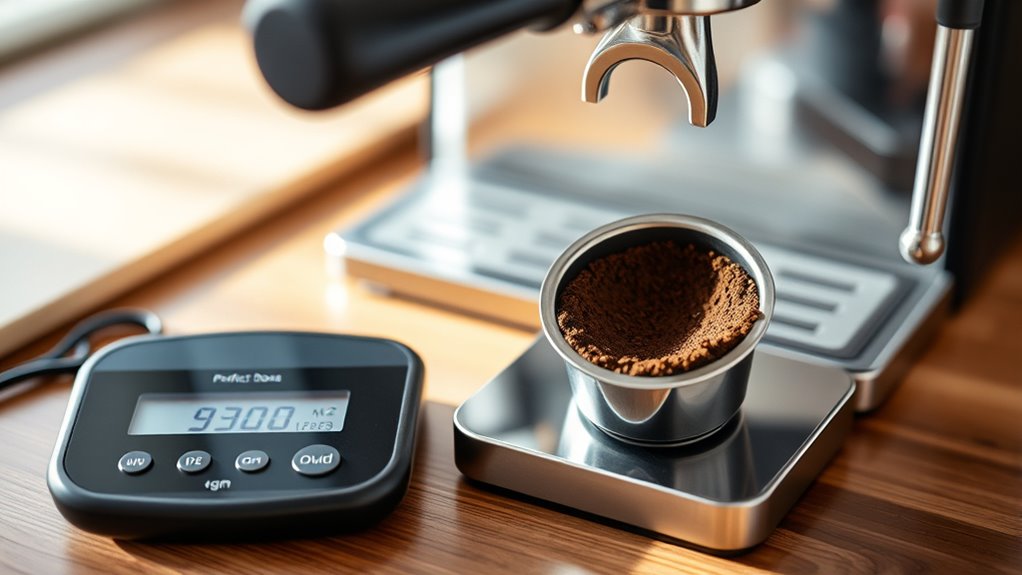
Although espresso recipes can vary, the ideal coffee dose for a standard double shot usually falls between 18 and 20 grams of coffee grounds. Using 18 grams is common and helps you achieve a balanced extraction and flavor profile.
The ideal dose for a double shot is 18 to 20 grams, ensuring balanced extraction and rich flavor.
For a single shot, you’ll typically use between 7 and 10 grams.
It’s important to match your dose to the size of your portafilter basket to maintain proper bed depth and guarantee even saturation during brewing.
Adjusting the dose within this recommended range allows you to control the shot’s strength and extraction quality.
By selecting the right dose, you set a solid foundation for pulling consistent, flavorful espresso without over- or under-extracting your coffee.
It really makes a difference in how your espresso turns out every time.
Measuring espresso yield by weight rather than volume is essential to maintain consistency and accuracy in your brewing process.
How Dose Affects Espresso Extraction and Flavor
When you adjust the dose of coffee for your espresso, you directly influence how the extraction unfolds and how the flavors develop. Too little coffee leads to under-extraction, resulting in sour, weak flavors.
Too much causes over-extraction, producing bitterness.
Proper dosing creates an ideal coffee bed depth, ensuring even water flow and preventing channeling.
If you increase the dose, you’ll generally need a coarser grind to maintain the right brew time.
Decrease the dose, and a finer grind is necessary.
The perfect dose balances flavor clarity, body, and extraction efficiency.
Typically, this is about 18-20 grams for a double shot in standard baskets.
Precise dosing impacts flavor profile, caffeine content, and consistency, so accurate measurement is essential for crafting the perfect espresso.
Increasing dose thickens the coffee bed, which slows water flow and extends extraction, helping to balance acids, sugars, and oils for a richer flavor. coffee bed thickness
How Roast Level Affects Espresso Dose and Basket Fill
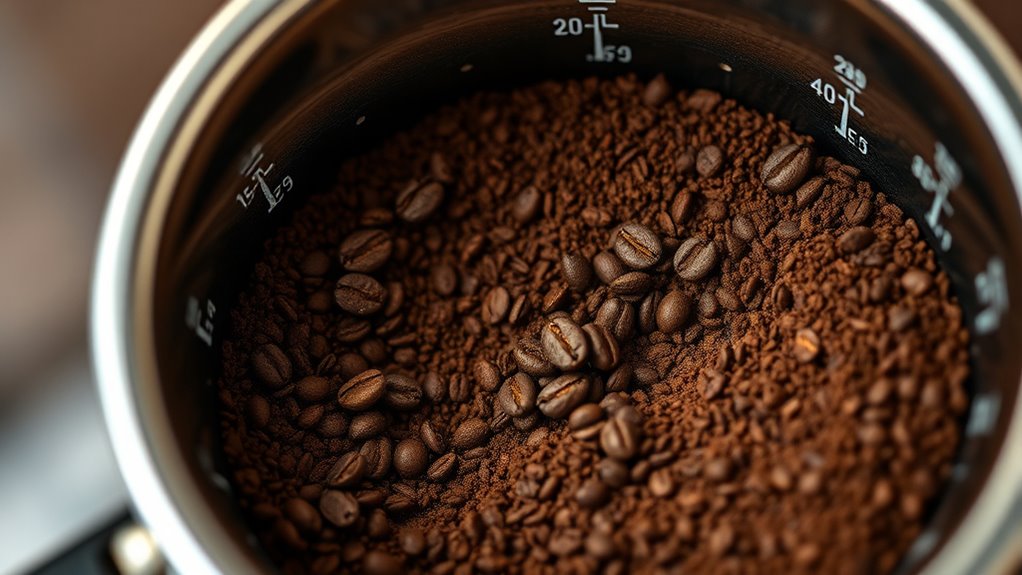
You’ll notice roast level actually changes how much coffee fits into your basket because the beans vary in density. Darker roasts tend to be denser, so they often need a bit more coffee to fill the basket just right.
On the other hand, lighter roasts are less dense, which means you’ll want to adjust your dose to avoid underfilling and keep your extraction consistent.
This is because the roasting process alters the bean’s physical characteristics, directly impacting the volume and weight of coffee needed for your espresso dose.
Roast Level Impact
Since roast level directly affects bean density, it plays a crucial role in determining how much coffee you need to dose for espresso. Darker roasts tend to be denser, meaning you’ll often need a slightly higher dose to fill your basket properly.
Conversely, lighter roasts are less dense, so the same volume will weigh less, potentially requiring you to adjust the dose downward.
The roast level also impacts how tightly the coffee packs in the basket; darker roasts usually create a more compact puck, affecting extraction dynamics.
By adjusting your dose based on roast level, you guarantee consistent basket fill and ideal extraction, which directly influences espresso flavor.
Paying attention to this helps you dial in the perfect dose every time. Additionally, maintaining precise grind size alongside roast adjustments is essential for achieving balanced extraction and optimal crema quality.
Bean Density Variations
Roast level directly influences bean density, which in turn affects how much coffee fits into your espresso basket. Darker roasts tend to be denser, so they fill the basket more compactly. This often means you need to adjust your dose downward to avoid overfilling and uneven extraction.
On the other hand, lighter roasts are less dense, which results in a looser basket fill. You might need a higher dose weight to keep things consistent. Because the same weight of coffee can take up different volumes depending on the roast level, relying only on dose weight without thinking about density can lead to inconsistent shots.
To get balanced extraction and great flavor, tweak your dose based on the roast. Aim for a consistent basket fill rather than sticking to a fixed weight alone. This way, your espresso extraction stays precise and reliable. Understanding the impact of grind size and dose adjustments is also essential for achieving the perfect shot.
How Portafilter Size Influences Your Coffee Dose
Your portafilter size plays a big role in how much coffee you should dose. It’s all about keeping the right bed depth and making sure the extraction goes smoothly.
For example, bigger baskets—like the common 58mm size—usually call for a higher dose, around 20 grams or more.
On the other hand, smaller baskets, such as 53mm, need less coffee so you don’t end up with channeling.
Using freshly ground coffee with proper extraction is essential to preserve flavor and crema, especially when preparing drinks like an Espresso Martini.
Portafilter Size Impact
How does portafilter size influence the amount of coffee you should use? Larger portafilters, like 58mm, demand more coffee, usually 20-22 grams, to maintain proper bed depth and guarantee even extraction.
Smaller ones, such as 53mm, require less, around 15-17 grams, to avoid overfilling and uneven flow. Using the same dose for different sizes risks channeling and inconsistent flavor.
| Portafilter Size | Recommended Dose (grams) | Extraction Impact |
|---|---|---|
| 58mm | 20-22 | Ideal saturation, balanced |
| 53mm | 15-17 | Prevents overfilling |
| Mixed doses | Varies | Risk of channeling, uneven |
Adjust your dose according to portafilter size to achieve consistent, high-quality espresso shots every time. Precise measurement with a digital scale is essential to maintain the correct espresso extraction ratio regardless of portafilter size.
Dose Scaling Strategies
Adjusting your coffee dose based on portafilter size guarantees consistent extraction and flavor. Larger baskets, like 58mm, need higher doses, typically 18 to 20 grams, to achieve ideal bed depth and uniform saturation. Smaller baskets, such as 53mm, require less coffee, around 15 to 17 grams, to prevent overfilling and channeling.
Using a fixed dose across different portafilter sizes messes with puck density. That leads to uneven extraction and inconsistent flavor. By scaling your dose proportionally, you keep a consistent bed depth and puck density.
This ensures even water contact during pre-infusion and extraction. Making this precise adjustment improves saturation, reduces the risk of channeling, and promotes balanced flavor profiles.
In the end, dose scaling tailored to your portafilter size is key to dialing in the perfect espresso shot every time. Additionally, using proper extraction timing can help preserve flavor balance while controlling caffeine levels in your espresso.
Adjusting Dose When Changing Your Basket Size
Whenever you change your basket size, you’ll need to modify your coffee dose proportionally to maintain the proper bed depth and guarantee even extraction.
Smaller baskets typically require around 15-17 grams, while larger baskets demand 20 grams or more to assure full saturation and prevent channeling.
Using the same dose across different basket sizes risks uneven extraction, leading to under- or over-extracted shots.
Adjusting the dose appropriately helps maintain consistent shot quality by preserving water flow and uniform coverage.
This tailored approach optimizes your espresso’s flavor profile and prevents issues caused by overfilling smaller baskets or underfilling larger ones.
Always match your dose to your basket’s dimensions for the best results every time.
Keep in mind that the caffeine content in espresso can vary depending on multiple factors, making it important to control your dose to manage your caffeine intake effectively.
How to Change Grind Size Based on Your Dose
When you change your coffee dose, you’ll want to adjust your grind size to keep the extraction balanced.
So, if you’re using a higher dose, go for a coarser grind to avoid channeling and over-extraction.
On the other hand, if your dose is lower, a finer grind helps maintain the right resistance and flow.
Even small tweaks to your grind size can really impact the quality of your shot.
Just make changes gradually and watch how it affects the results.
That way, you’ll dial in the perfect balance every time.
Remember, maintaining a consistent particle size is key to preventing uneven extraction and achieving richer flavor.
Dose Impact On Grind
The amount of coffee you use directly influences the grind size needed for a balanced espresso. Increasing the dose creates a denser coffee bed, which slows water flow. So, you’ll need to use a coarser grind to avoid over-extraction and channeling.
On the flip side, decreasing the dose means you’ll want a finer grind. This increases resistance and extraction efficiency, helping to keep things balanced. Adjusting grind size with dose changes makes sure you get proper bed saturation, flow rate, and flavor clarity.
| Dose Amount | Grind Size Needed | Reason | Effect on Flow | Extraction Outcome |
|---|---|---|---|---|
| Low (14g) | Fine | Increase resistance | Slower, steady | Balanced, efficient |
| Moderate (18g) | Medium-Fine | Ideal saturation | Moderate flow | Consistent, clear |
| High (22g) | Coarse | Prevent over-pressurization | Faster, even | Avoids channeling |
| Increasing Dose | Coarser | Counter denser coffee bed | Maintains brew time | Prevents over-extraction |
| Decreasing Dose | Finer | Improve extraction efficiency | Controls flow rate | Balanced shot |
Adjusting Grind For Extraction
Because adjusting your coffee dose changes the density of the coffee bed, you’ll need to fine-tune your grind size accordingly to maintain proper extraction.
When you increase the dose, the coffee bed deepens, so coarsening your grind slightly helps avoid over-extraction and channeling by allowing water to flow evenly.
Conversely, decreasing the dose reduces bed density, requiring a finer grind to increase resistance and maintain ideal brew time and flavor clarity.
Small adjustments, around half a grind setting, can greatly impact extraction, so make incremental changes and test.
Remember, the right grind size balances flow rate and resistance based on dose, ensuring your espresso tastes balanced, neither under-extracted nor bitter.
Fine-tuning grind size with dose changes is essential for consistently perfect espresso shots.
Grind Size And Channeling
Although adjusting your coffee dose changes the density of the coffee bed, you’ll want to change your grind size to prevent channeling and guarantee even water flow. Increasing your dose usually means you need a coarser grind to avoid over-extraction and uneven flow. On the other hand, reducing your dose calls for a finer grind to maintain proper resistance.
If the grind is too fine at a high dose, channeling happens because of uneven saturation. Conversely, too coarse a grind at a low dose leads to under-extraction and bypass. So, adjusting your grind size precisely based on dose changes is key.
This way, you can achieve balanced extraction and consistent espresso quality.
| Dose Adjustment | Grind Size Change | Resulting Effect |
|---|---|---|
| Increase Dose | Coarser Grind | Avoids over-extraction |
| Increase Dose | Finer Grind | Causes channeling |
| Decrease Dose | Finer Grind | Maintains bed resistance |
| Decrease Dose | Coarser Grind | Leads to under-extraction |
| Adjust Grind | Based on Dose | Ensures even water flow |
How to Adjust Pre-Infusion Time According to Coffee Dose
When you increase your coffee dose, you’ll need to extend the pre-infusion time to make sure the larger coffee bed gets saturated evenly.
For doses of 20 grams or more, pre-infusion often lasts until the first drop appears, which can take 10-15 seconds or even longer.
Smaller doses around 15 grams usually need shorter pre-infusion times, typically 5-8 seconds, to avoid over-saturation.
You should adjust the duration based on how deep your coffee bed is. Deeper beds require longer pre-infusion so the water spreads out evenly.
Matching the pre-infusion time to the dose properly helps ensure an even extraction and stops uneven saturation from happening.
- Small dose (~15g): 5-8 seconds pre-infusion
- Large dose (≥20g): 10-15+ seconds pre-infusion
- Adjust time for coffee bed depth for even saturation
What Channeling Is and How to Prevent It With Dose and Grind
Adjusting your coffee dose and pre-infusion time guarantees even saturation, but uneven water flow can still happen if channeling occurs.
Channeling is when water finds the path of least resistance through the coffee bed, causing uneven extraction.
To prevent this, use the correct dose to create a uniform coffee bed. Also, adjust grind size—medium-fine works best—to minimize gaps.
Tamping evenly with about 30 pounds of pressure helps form a compact puck, reducing channels from forming.
Balancing dose and grind ensures better bed saturation and smooth water flow for a balanced shot.
It’s all about getting those two just right to avoid any unwanted water paths.
Pros and Cons of Lower vs. Higher Espresso Doses
Choosing between lower and higher espresso doses can really change your shot’s flavor, texture, and how consistent the extraction is. Lower doses, usually around 7-10 grams, give you a more concentrated shot with a thinner puck and a faster extraction. But watch out—they can lead to channeling because the coffee bed is shallow.
On the flip side, higher doses, about 18-20 grams or more, create a thicker puck that helps balance the extraction and brings out richer flavors. These require you to fine-tune your grind size and tamp pressure though, or you might end up with over-extraction or a slow flow.
Each dose impacts not just flavor but also caffeine content and how easy it’s to dial in your shot. So, whether you go low or high, there are trade-offs to consider.
- Lower doses: faster extraction, risk of channeling, intense flavor
- Higher doses: richer flavor, more consistent extraction, need grind/tamp tweaks
- Dose choice affects caffeine, shot balance, and consistency
How to Find Your Perfect Espresso Dose Through Experimentation
Although finding the perfect espresso dose depends on basket size and machine compatibility, you can dial it in precisely by experimenting with small adjustments. Start by weighing your coffee grounds with a digital scale, then adjust your dose in 0.5-gram increments.
Observe how these changes affect extraction time, flavor, and crema. Taste each shot carefully to identify the lowest dose that prevents channeling and guarantees full extraction. Keep detailed notes on your dose, grind size, and results to track what works best for different beans and roast levels.
This methodical approach helps you refine your espresso recipe, balancing flavor and consistency. Over time, you’ll find the ideal dose tailored to your equipment and taste preferences, making every shot exceptional.
Frequently Asked Questions
How Does Water Temperature Impact Espresso Extraction?
You’ll find water temperature directly affects extraction; too hot, and you’ll over-extract, causing bitterness. Too cool, and under-extraction leads to sourness.
Aim for 90-96°C to balance flavors and reveal espresso’s full potential. It’s all about finding that sweet spot so your espresso tastes just right.
What Is the Ideal Tamping Pressure for Espresso?
Think of tamping like a handshake. It should be firm but not crushing.
You’ll want about 30 pounds of pressure to evenly compress the grounds. This helps ensure balanced extraction and a rich, smooth espresso shot every time.
Just remember, consistency is key. Keep your tamping pressure steady, and your espresso will thank you!
Can Different Coffee Origins Affect the Perfect Dose?
Yes, different coffee origins can affect your perfect dose. Beans vary in density, roast level, and flavor profile, so you’ll need to adjust the grams to balance extraction and achieve the best espresso taste for each origin.
It’s all about finding that sweet spot. Just a small tweak can make a big difference in flavor. So, don’t be afraid to experiment a bit with the dose depending on where your beans come from.
How Often Should Espresso Machine Parts Be Cleaned?
You might be surprised, but you should clean your espresso machine parts at least once a week. Regular cleaning guarantees excellent flavor and prevents buildup.
If you neglect it, your espresso quality will quickly suffer. Don’t skip it!
Does Water Quality Influence Espresso Flavor Consistency?
Yes, water quality directly influences your espresso’s flavor consistency. Using filtered water with balanced minerals guarantees extraction stability. It also prevents off-flavors and protects your machine.
Conclusion
Finding your perfect espresso dose is like tuning a finely crafted instrument. You adjust the strings until the flavor sings just right.
Remember, the dose is your foundation. It shapes extraction, controls channeling, and balances flavor.
Don’t be afraid to experiment with dose, basket size, and pre-infusion time. With each tweak, you’re one step closer to that flawless shot that dances on your palate and wakes your senses.
Keep dialing in and enjoy the rich rewards.

Pingback: How Many Grams Of Coffee Beans For Espresso – Perfect Dose