You’ll want about 18 to 20 grams of coffee beans for a perfect double shot of espresso, with single shots needing 7 to 10 grams. Staying within these ranges helps balance flavor and extraction.
Remember, dose size works with grind size and tamping to control your shot’s taste and quality. Using a precise scale guarantees consistency every time.
Adjusting your dose slightly can fine-tune your espresso’s profile. Keep exploring to master dialing in your ideal cup.
How Many Grams of Coffee Do You Need for Espresso?
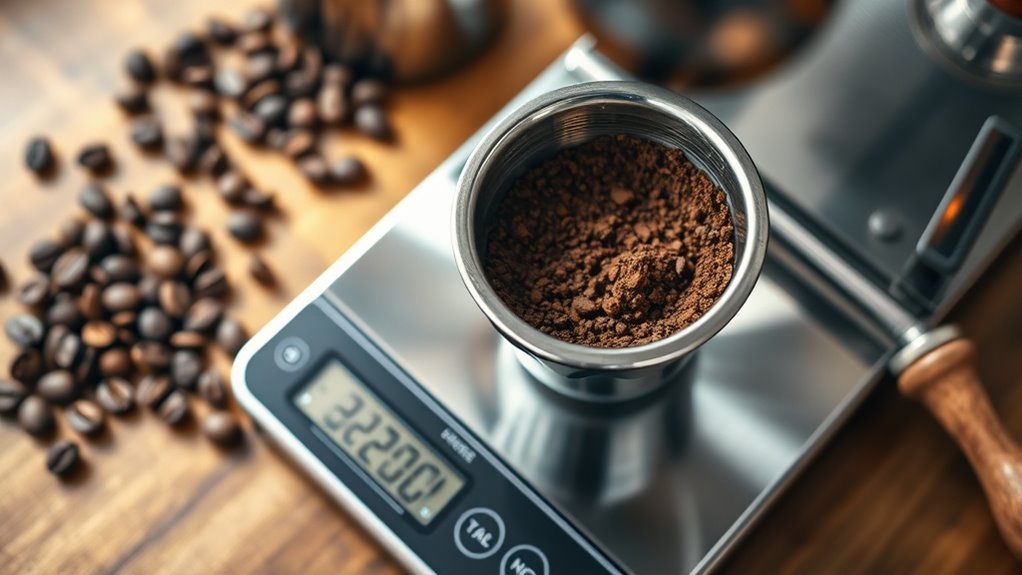
When making espresso, you’ll typically need between 18 and 20 grams of coffee beans for a double shot, while single shots usually require 7 to 10 grams. The exact amount depends on your machine and the size of your portafilter basket.
For example, a standard 58mm basket typically calls for about 18.5 grams.
That said, personal preference and equipment variations can influence this. Using too little coffee, under 15 grams, often results in weak, under-extracted espresso.
Personal taste and gear differences matter; under 15 grams usually leads to weak, under-extracted espresso.
Conversely, dosing over 20 grams risks over-extraction, which can make your espresso taste bitter.
To achieve consistent quality, use a scale that measures to the tenth of a gram.
This precision guarantees you maintain the ideal dose every time. It’s essential for balanced and flavorful espresso shots.
Keep in mind that adjusting dose also controls shot strength and extraction quality, so regular experimentation is key to finding your perfect espresso.
Why Dose Size Is Crucial for Espresso Quality
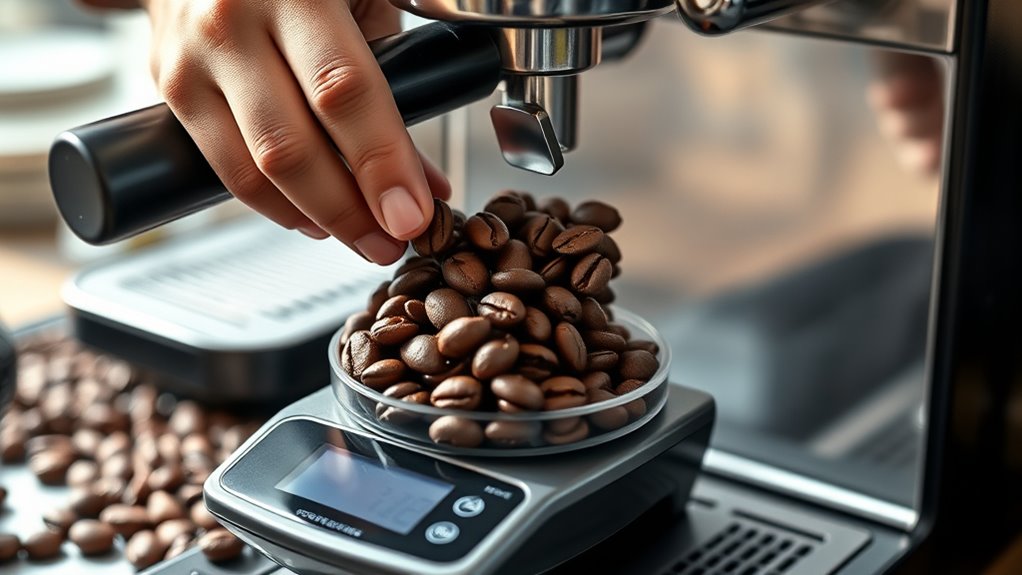
You control espresso flavor by adjusting the dose size, and this directly affects the extraction balance and taste. When you pair the right dose with the correct grind setting, it helps prevent under- or over-extraction.
That way, you get a smooth, rich shot every time.
Getting this balance right is really key. It helps you avoid those sour or bitter flavors that can ruin a cup.
Plus, it means you’ll enjoy consistent quality with each espresso you make.
Measuring espresso yield by weight rather than volume ensures greater accuracy and consistency in dialing in the perfect dose.
Dose Impact On Flavor
Although dialing in the perfect dose might seem subtle, it directly shapes the espresso’s strength, flavor balance, and overall quality. When you use too little coffee, your shot risks tasting sour and weak. Too much, and bitterness takes over.
The dose size controls how effectively flavors, sugars, and acids extract, which is essential to nailing your desired profile. It also influences brew time and flow rate, affecting the espresso’s body and crema quality.
Sticking to a precise dose, like 18-20 grams for doubles, helps you keep flavor consistent across shots. Using a burr grinder to achieve uniform particle size is crucial for even extraction and optimal espresso flavor.
Balancing Dose And Grind
Mastering the right dose size directly shapes espresso quality, but it won’t reach its full potential without matching the grind size. When you use 18-20 grams for a double shot, you create an ideal bed depth in your portafilter, ensuring even saturation and consistent extraction.
If you lower your dose, you’ll need to grind finer to maintain extraction balance and avoid sour, weak shots. Conversely, a higher dose demands a coarser grind to prevent bitterness and channeling.
This interplay between dose and grind controls extraction time and flavor clarity.
By adjusting both precisely, you balance strength, flavor, and efficiency, achieving a well-rounded espresso every time. Ignoring either factor disrupts this balance and compromises your shot quality. Regular recalibration of the grinder is essential to maintain dose consistency and ensure optimal extraction.
Avoiding Under And Overdose
When espresso shots suffer from weak, sour flavors or overwhelming bitterness, the culprit often lies in an improper dose size. Using too little coffee leads to under-extraction, producing thin crema and a flat, sour taste.
On the other hand, overdosing causes over-extraction, bitterness, and channeling, ruining the balance of your shot.
For a double shot, aim for 18 to 20 grams. This range ensures the right bed depth and uniform water saturation during pre-infusion.
Precise dosing controls water flow and extraction time, which are vital for consistent flavor and crema quality.
By avoiding under and overdose, you maintain ideal extraction parameters, resulting in a rich, balanced espresso every time. Consistent timing, including proper pre-infusion, plays a crucial role in achieving this balance and enhancing shot quality through extraction consistency.
Essential Tools and Tips for Accurate Coffee Dosing
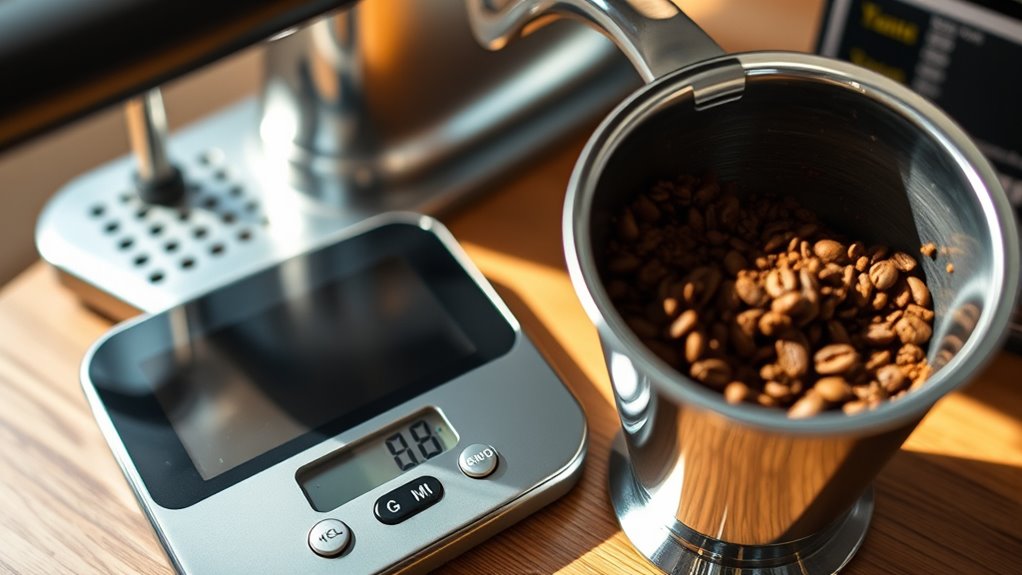
You’ll want a high-precision scale that measures down to the tenth of a gram to get your coffee dose just right every time.
Using a burr grinder is a smart move because it gives you a consistent grind size, which really makes a difference for dosing accuracy and extraction.
And here’s a handy tip: transferring your grounds with a funnel can help you avoid spills and keep your measurements spot on.
Consistent grind size and tamping pressure are essential for balancing extraction and achieving the perfect espresso shot.
Precision Scales Usage
Although dialing in your espresso grind and dose can feel complex, using a high-precision scale makes it way easier by letting you measure coffee grounds down to the tenth of a gram. Start by taring your scale with the portafilter or dosing cup before adding grounds to avoid errors.
After dosing, weigh the coffee to make sure you’ve hit your target. Usually, that’s around 7 to 10 grams for a single shot and 18 to 20 grams for a double.
Using a funnel helps prevent grounds from spilling, which keeps your measurements accurate.
Don’t forget to regularly calibrate your scale, especially after changing grind settings or after using it for a while. This keeps your measurements reliable.
With this kind of precision, you’ll get consistent espresso shots every time, making your dosing routine both efficient and easy to repeat.
Proper dosing combined with the right extraction time ensures balanced flavor and avoids bitterness or weak espresso.
Grinding Consistency Importance
Since grind consistency directly impacts extraction quality, maintaining a uniform particle size is crucial for achieving a balanced espresso shot. Using a burr grinder ensures you get a uniform grind size, which helps prevent channeling and uneven extraction.
You’ll want to adjust your grind size precisely based on taste and shot quality for the best results.
Pairing this with a high-precision scale that measures to the tenth of a gram guarantees accurate dosing every time. Knowing your portafilter basket size helps you weigh the grounds correctly, so the dose matches your machine’s requirements.
These essential tools and practices work together to maintain consistent dosing and extraction.
This way, you can fine-tune your espresso with confidence and precision, making sure each shot tastes just right. It’s all about consistency and control to get the perfect cup every time.
Additionally, understanding how grind size affects extraction enables you to optimize flavor balance and crema quality.
Coffee Transfer Techniques
Maintaining grind consistency sets the stage, but how you transfer coffee grounds into the portafilter drastically affects dosing accuracy. Use a high-precision scale that measures to the tenth of a gram to assure you hit your target dose every time. Weighing grounds directly in the portafilter or using a scale’s tare function minimizes errors and streamlines the process.
Try using a funnel to transfer grounds from the grinder to the portafilter to reduce spillage and loss. Burr grinders help by producing uniform particles that dose more precisely.
After dosing, make sure to apply proper distribution and tamping techniques to create an even puck density. This ensures consistent extraction and espresso quality.
Mastering these transfer steps guarantees your espresso shot starts with the perfect dose. It’s all about those little details that make a big difference! For enhanced flavor complexity, consider incorporating espresso powder into your coffee routine, as it provides a nuanced coffee essence that elevates taste.
How Grind Size and Dose Interact to Affect Espresso Extraction
When you adjust the dose of coffee beans for your espresso, you also need to tweak the grind size to get the right extraction. The way these two work together controls extraction time, flavor balance, and flow resistance.
Here’s how they interact:
- Increasing the dose while keeping the same grind size slows down extraction. So, you should coarsen the grind to keep the flow steady.
- A finer grind increases resistance. This helps when you lower the dose because it extends the contact time.
- When you reduce the dose, you’ll want a finer grind to avoid under-extraction and keep the flavor balanced.
- But be careful—too fine a grind with a high dose can cause channeling and bitterness from over-extraction.
To maintain consistency, it’s important to make small incremental adjustments of about 1-2 microns when tuning your grind size.
Recommended Dose Ranges for Different Basket Sizes
Although basket sizes vary, each one has an ideal dose range that helps you achieve balanced extraction and flavor.
Each basket size has a perfect dose range for balanced flavor and optimal extraction.
For a standard 58mm basket, you’ll typically use 18-20 grams for a double shot. You can push beyond 20 grams for a richer, fuller espresso.
Smaller 53mm baskets generally require 14-17 grams to extract effectively.
If you’re pulling a single shot, doses usually fall between 7-10 grams, depending on your basket size and machine.
Adjusting within these ranges lets you fine-tune flavor and consistency.
Sticking to these recommended doses ensures your espresso isn’t under-extracted or over-extracted.
This way, you get a well-balanced, satisfying shot every time.
How Roast Level Influences Your Espresso Dose
Since roast level directly impacts bean density, you’ll need to adjust your espresso dose accordingly to achieve the best extraction. Darker roasts are denser, so you’ll often use a slightly higher dose to compensate for their weight.
Conversely, lighter roasts are less dense, requiring you to reduce the dose to prevent overfilling the basket.
Here’s how roast level influences your dosing:
- Darker roasts pack more weight into the same volume, increasing dose weight.
- Lighter roasts occupy more volume per gram, so dose less by weight.
- Adjusting dose maintains proper coffee bed depth for even saturation.
- Correct dosing prevents inconsistent extraction caused by uneven basket fill.
Adjusting Dose to Solve Common Espresso Problems
If you want to fix common espresso issues like sourness, bitterness, or channeling, adjusting your coffee dose is key. Increasing your dose generally boosts extraction consistency and flavor richness but requires a coarser grind to avoid over-extraction.
Lowering the dose often causes under-extraction, producing sour or weak espresso, so you’ll need a finer grind to improve saturation.
Dose adjustments also help solve channeling by ensuring the coffee bed isn’t too shallow or deep. This promotes even water flow and better extraction overall.
For typical baskets, aim for 15-17 grams in smaller baskets and around 20 grams or more in larger ones to prevent extraction problems.
Make small, 0.5-gram changes to fine-tune shot quality. This helps balance extraction time, flavor, and crema perfectly.
It’s all about experimenting a little until you find what works best for your setup.
How Espresso Dose Affects Caffeine Content
Adjusting your espresso dose not only influences flavor and extraction but also impacts the caffeine content in your shot. When you increase the coffee dose, the total caffeine rises proportionally because caffeine concentration per gram remains consistent.
Here’s what you need to know:
A typical single shot with 7–10 grams contains about 63 mg of caffeine. Doubling the dose to 18–20 grams roughly doubles caffeine to 125 mg. The caffeine content per gram stays stable, so more coffee means more caffeine overall.
Roast level, bean origin, and brewing parameters affect caffeine more than dose alone. Keep in mind, using more coffee increases total caffeine intake, but the caffeine concentration in the espresso liquid stays similar.
Adjust dose carefully to balance caffeine and flavor.
How to Experiment With Dose for Your Ideal Espresso Flavor
When you want to find your ideal espresso flavor, start by testing doses within the standard range, which is 7 to 10 grams for a single shot or 18 to 20 grams for a double shot. Use a precise scale to measure doses, adjusting in small increments of about 0.5 to 1 gram.
Note how changes affect extraction time, flavor, and crema. Higher doses usually yield richer, fuller-bodied espresso, while lower doses create lighter, more delicate shots. Keep detailed notes to help you refine your ideal dose depending on the bean and roast.
| Dose (grams) | Extraction Time (seconds) | Flavor Notes |
|---|---|---|
| 7 | 25 | Light, bright |
| 8.5 | 27 | Balanced, fruity |
| 10 | 30 | Rich, full-bodied |
Try to experiment methodically for the best results.
Frequently Asked Questions
What Is the Best Water Temperature for Brewing Espresso?
You should brew espresso at 90-96°C (194-205°F). This temperature range extracts flavors ideally without bitterness or sourness. Staying within it helps you achieve balanced, rich espresso every time.
Don’t exceed 96°C to avoid over-extraction. Keeping the temperature steady is key to getting the best taste from your coffee. It’s all about finding that sweet spot where the flavors shine.
How Does Tamping Pressure Affect Espresso Extraction?
Tamping pressure is the gatekeeper of espresso extraction. If you press too hard or too light, water flows unevenly, causing under or over-extraction.
You’ll want firm, even pressure to release balanced flavors in every shot. Getting it just right makes all the difference in your espresso.
Can Espresso Shots Be Double or Triple Pulled From One Dose?
You can pull double shots from one dose by doubling the volume extracted, but triple shots often over-extract and taste bitter.
It’s best to adjust grind and dose for quality rather than stretching a single dose too far. Trust me, dialing in your grind and dose makes a world of difference. Keep it simple and focused on flavor!
How Long Should an Espresso Shot Ideally Take to Pull?
An espresso shot should take about 25-30 seconds to pull, like a perfectly timed sprint.
If it’s too fast or slow, you’re missing flavors. So, adjust grind size or tamp pressure to dial it in.
What Are Common Causes of Bitter Espresso Besides Dose Size?
You’ll find bitterness often comes from over-extraction, too hot water, old or dark roasted beans, and improper grind size.
Also, avoid letting your espresso sit too long, which can intensify unpleasant bitter flavors.
These things tend to sneak up on you, but once you know what to watch out for, it’s easier to fix. Just a few tweaks can make your espresso taste smoother and less bitter.
Conclusion
Getting your espresso dose right is key to opening the perfect shot. For example, Sarah, a home barista, tweaked her dose from 18g to 20g on a 58mm basket and transformed her espresso from sour to balanced and rich.
By adjusting your dose alongside grind size and roast level, you’ll dial in that ideal flavor and extraction every time. Keep experimenting. Small changes make a big difference in your espresso quality.