You’ll find espresso’s story begins in 1884 when Angelo Moriondo patented the first rapid-steam coffee machine, introducing quick brewing with steam pressure. Luigi Bezzera refined this in 1901 by enhancing extraction efficiency using a steam-driven piston. Desiderio Pavoni then commercialized the concept in 1905, revealing the first machines at the 1906 Milan World Exhibition.
Early models operated around 1.5 bars of pressure, evolving through safety and technology improvements to today’s high-pressure espresso systems. Following this, you’ll uncover how innovation shaped espresso into a symbol of Italian craftsmanship and culture.
The Origins of Espresso Machines in Italy
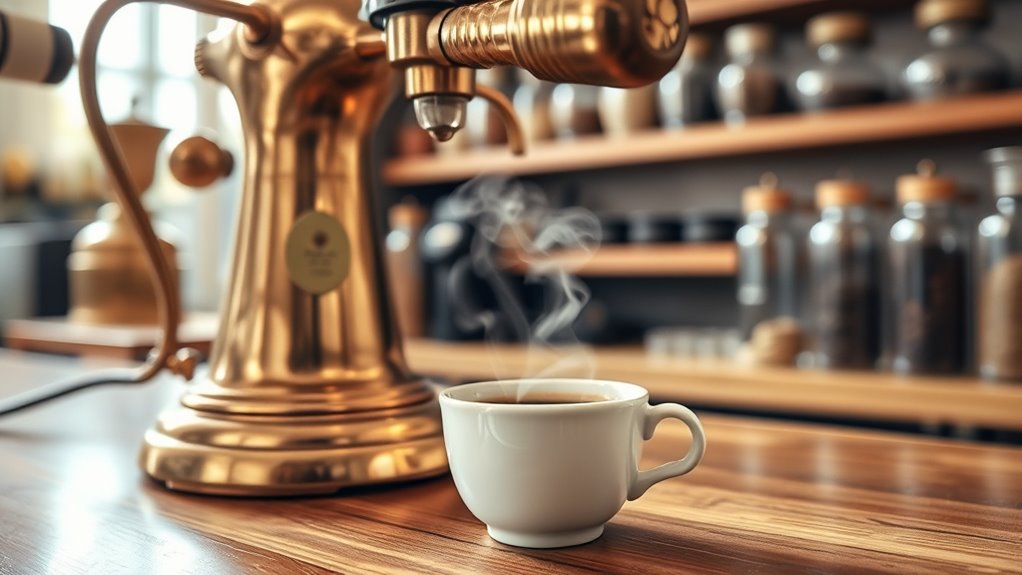
Although espresso machines have become synonymous with Italian coffee culture, their origins trace back to early 20th-century Milan, where inventors laid the groundwork for this technology. You’ll find that the earliest espresso machines emerged here, starting with Luigi Bezzera, who patented key improvements in 1901. His designs focused on using steam pressure to brew coffee quickly, though the result was a weaker, mocha-like beverage.
By 1905, Desiderio Pavoni acquired Bezzera’s patent rights and began producing commercial machines in Milan, turning innovation into industry. These early machines were large and bulky, resembling fire hydrants, but they marked a critical step.
Importantly, Milan workshops spearheaded the shift from steam-based to high-pressure machines, reaching about nine bars, which considerably improved coffee extraction and set a new standard for espresso brewing. This period also saw the introduction of the portafilter and multiple brew heads, essential components that enhanced speed and efficiency in espresso preparation.
Angelo Moriondo’s Patent and Its Impact on Coffee Making
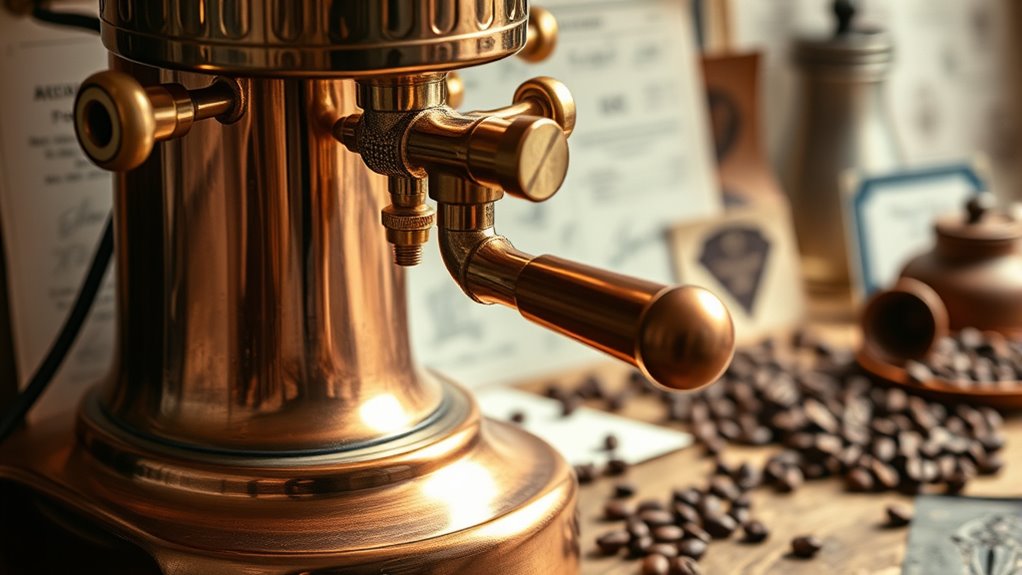
Before Milan’s innovations in espresso machines took hold, Angelo Moriondo secured a patent on May 16, 1884, for a “new steam machinery for the economic and instantaneous confection of coffee beverage.” His invention laid the first technical foundation for rapid coffee brewing by employing steam pressure to extract flavor efficiently.
Angelo Moriondo’s 1884 patent pioneered rapid coffee brewing using steam pressure for efficient flavor extraction.
Moriondo’s machine introduced a groundbreaking approach that influenced future espresso designs.
Here’s why Moriondo’s patent matters:
- It was the first documented machine enabling quick coffee production.
- The device used steam pressure to brew coffee instantaneously.
- Moriondo showcased his invention at the 1884 Turin General Exposition.
- This innovation established the principle of efficient, instant coffee-making.
This early method of forcing hot water through coffee grounds under pressure laid the groundwork for the modern understanding of espresso extraction.
Luigi Bezzera’s Improvements to Espresso Technology
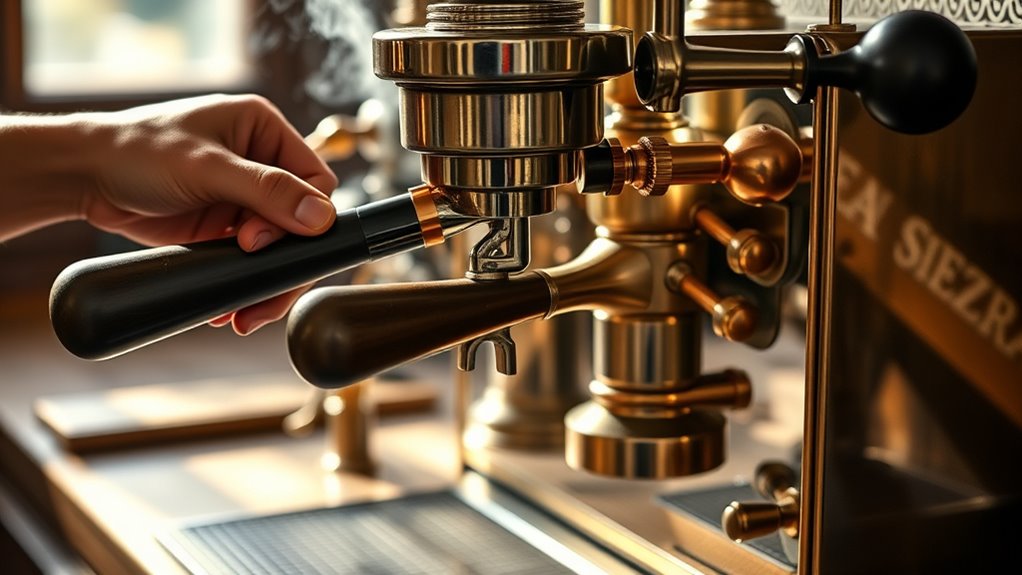
When Luigi Bezzera took on the challenge of improving espresso machines in 1901, he patented several key enhancements that transformed the brewing process. You’ll notice his primary innovation was adding a steam-driven piston, which considerably increased pressure and sped up coffee extraction.
This allowed the machine to produce hotter, more concentrated coffee, closer to what we now call espresso.
Bezzera didn’t start from scratch; he refined earlier designs, making espresso brewing faster and more efficient for practical, commercial use.
His improvements laid the foundation for modern espresso machines by enhancing functionality and reliability.
As you trace the evolution, Bezzera’s work stands out for making espresso preparation both quicker and more consistent. It really set the stage for future advancements in espresso technology.
His 1901 patent featured a machine forcing hot water through coffee under steam pressure, marking a significant technical leap in espresso brewing.
Desiderio Pavoni and the Commercial Launch of Espresso Machines
Building on Luigi Bezzera’s technical advancements, Desiderio Pavoni took decisive steps to bring espresso machines into commercial production. In 1905, he purchased the patent rights and founded La Pavoni to manufacture these machines.
By the 1906 Milan World Exhibition, Pavoni introduced the La Pavoni Id Ali Ideal, marking the first commercial espresso machine.
Here’s what you should know about Pavoni’s launch:
- Early machines resembled large fire hydrants and used steam pressure of about 1.5 bars.
- The coffee produced was weaker and mocha-like compared to modern espresso.
- Pavoni added safety features like pressure release valves to prevent explosions.
- Mass production by La Pavoni made espresso widely available commercially in Italy.
This commercial leap really set the stage for espresso’s popularization. It made espresso accessible to many more people and paved the way for the espresso culture we know today. However, modern espresso’s signature characteristics rely on high-pressure extraction around 9 bars, which greatly differs from these early steam-driven models.
Early Espresso Machines: What They Got Right and Wrong
You’ll notice that early espresso machines, built in small workshops around Milan, relied on steam pressure of about 1.5 bar. That limited their ability to produce true espresso.
Their bulky, industrial designs—often called “fire hydrants”—show just how challenging it was for engineers to balance function and safety.
It wasn’t until high-pressure pumps and improved valves came along that these machines could consistently deliver the rich, concentrated shots we expect today.
Maintaining steady machine pressure was crucial for achieving the balanced extraction and rich flavor that defines modern espresso.
Steam Pressure Limitations
Although early espresso machines aimed to harness steam pressure to brew coffee, their reliance on around 1.5 bars of steam limited their ability to produce authentic espresso. You’ll find that this low pressure produced weaker, mocha-like coffee rather than the rich, concentrated espresso we expect today.
These machines pushed water through grounds using steam, but the pressure often fluctuated, causing inconsistent extraction and safety concerns. They looked bulky, like large fire hydrants, lacking the technology for higher pressure.
Here’s what you need to know about these steam pressure limitations:
- Early machines used about 1.5 bars of steam pressure.
- This pressure was insufficient for true espresso extraction.
- Inconsistent pressure led to uneven flavor and safety risks.
- The shift to 9-bar pressure systems dramatically improved quality.
Regular maintenance, including descaling procedures, is essential to ensure consistent pressure and optimal machine performance.
Early Design Challenges
While early espresso machines marked a significant step toward espresso brewing, their designs faced numerous challenges that limited their effectiveness and safety. You’d find these machines, like Angelo Moriondo’s, built from copper and brass, manually operated, and resembling fire hydrants. Steam pressure hovered around 1.5 bars, which was too low for true espresso, so they ended up making weak, mocha-like coffee.
Safety was a big concern, with risks of explosions due to poor pressure control. Luigi Bezzera improved functionality, but consistency and efficiency still lagged. Plus, limited mass production in small workshops slowed innovation quite a bit. Understanding the importance of alcohol content in espresso-based drinks helps appreciate how the beverage evolved alongside advancements in espresso preparation.
| What They Got Right | What They Got Wrong |
|---|---|
| Durable materials | Low steam pressure |
| Manual operation | Safety risks from pressure |
| Early functional design | Inconsistent coffee quality |
Transition To High Pressure
The limitations of early espresso machines, especially their low steam pressure and inconsistent coffee quality, pushed inventors in Milanese workshops to rethink brewing methods. Early models, often called “fire hydrants,” operated around 1.5 bar and produced weak, mocha-like coffee.
The breakthrough came when they increased operating pressure to about nine bars, creating a richer, more authentic espresso with thick crema.
This progression wasn’t simple. Safety concerns emerged as pressure rose, but innovations like pressure release valves addressed these risks.
Key developments during this progression include:
- Moving from steam-based to high-pressure systems in early 20th-century Milan.
- Enhancing coffee concentration and crema quality.
- Overcoming technical and safety challenges.
- Establishing high-pressure extraction as espresso’s defining method.
You can see how this shift shaped espresso’s future. Mastering the right pressure and temperature balance was crucial to producing the signature espresso flavor and crema that define the beverage today.
Milan’s Influence on Espresso Machines and Coffee Culture
Because Milan hosted pioneering inventors like Luigi Bezzera and Desiderio Pavoni in the early 1900s, it became the cradle of the first commercial espresso machines. You’ll find that Milan’s 20-30 specialized workshops played a vital role in refining and producing these machines, turning prototypes into viable products.
As espresso machines spread across Milan, traditional cafes gave way to efficient espresso bars, especially in bustling spots like Piazza del Duomo and Galleria Vittorio Emanuele II. This shift really changed how people consumed coffee.
Speed and theatricality became central, making espresso both accessible and social.
Milan’s unique blend of elegance and innovation didn’t just transform local coffee culture; it set global trends, emphasizing efficiency and style in both brewing and social interaction. By understanding Milan’s influence, you get why espresso rose beyond a simple drink to become a cultural phenomenon. The espresso’s distinctive crema formation under high pressure contributed significantly to its texture, flavor, and appeal, helping to define its unique identity.
From Steam to High Pressure: The Technological Leap in Espresso Machines
You start with the early espresso machines, often nicknamed “fire hydrants.” These guys relied on about 1.5 bar of steam pressure and ended up producing a pretty weak, mocha-style coffee.
Then, over in Milan’s workshops, inventors made a big leap. They switched to high-pressure systems running around nine bars, and that completely changed the game for espresso extraction.
This shift set the stage for the rich, concentrated shots we all know and love today and sparked a wave of ongoing improvements in machine design.
The introduction of electric pumps enabled precise control of pressure and temperature, revolutionizing espresso quality and consistency.
Steam-Based Machine Origins
Although early espresso machines relied on steam pressure of about 1.5 bar, they only produced a weaker, mocha-style coffee rather than true espresso. These machines, developed in Milan, looked bulky and functioned more like fire hydrants. They lacked the pressure needed to extract the rich flavors espresso demands.
You should know that the shift from steam to high pressure was pivotal, but this stage laid the groundwork. Here’s a clear timeline to understand steam-based origins:
- Early designs used steam pressure around 1.5 bar, producing weak coffee.
- Machines resembled large, cumbersome devices without precision.
- Milan’s workshops began refining designs for better control.
- Inventors like Giorgio Rancilio started experimenting with pressure, setting the stage for future innovation.
Transition To High Pressure
Building on the early steam-based machines that operated around 1.5 bars of pressure, inventors in Milan recognized the limitations these devices imposed on coffee quality. These “fire hydrants” produced weak, mocha-style coffee lacking depth.
In response, early 20th-century innovators pushed the pressure boundary to approximately nine bars, a significant technological leap. This increase allowed extraction of a concentrated espresso shot topped with rich crema, a hallmark of modern espresso.
Milan’s workshops spearheaded this evolution, driven by growing demand for superior coffee.
Key Milestones in 20th Century Espresso Machine Development
When espresso machines first appeared at the 1906 Milan World Exhibition, they marked a pivotal shift in coffee preparation. You can trace the key milestones of 20th-century espresso machine development through these advances:
- Luigi Bezzera’s 1901 patent introduced improvements that refined espresso extraction.
- Desiderio Pavoni acquired Bezzera’s patent in 1905 and founded La Pavoni, launching the first commercial machines.
- Initial “fire hydrant” machines used low steam pressure (~1.5 bar), producing weaker coffee resembling mocha.
- Milanese workshops gradually transitioned machines to high-pressure systems (~9 bars), greatly enhancing espresso quality.
These events highlight the evolution from rudimentary steam-based devices to more efficient, high-pressure espresso machines. It really set the foundation for modern espresso brewing.
Modern Espresso Machines: Innovations and Italy’s Lasting Legacy
As espresso machines progressed beyond their early steam-based origins, they embraced high-pressure systems operating around nine bars. This allowed you to brew authentic espresso with rich flavor and crema. Italy’s small workshops, especially in Milan, played a pivotal role in refining this technology throughout the 20th century.
Innovations like the pressure release valve enhanced safety and efficiency, making machines more reliable and easier to use. By the late 20th and early 21st centuries, automatic settings and diverse designs emerged. These changes allowed you to achieve consistent results with minimal effort.
Italy’s legacy persists globally, shaping espresso culture with an emphasis on speed, theatrical presentation, and precise extraction. Today, modern espresso machines reflect a tradition of craftsmanship paired with cutting-edge technology. This ensures every shot meets high standards.
Frequently Asked Questions
When Was Sabrina Carpenter’s “Espresso” Released?
You’ll find Sabrina Carpenter’s “Espresso” was released in 2024. This track quickly gained massive streaming success, contributing to her Grammy-nominated album. It marked a significant milestone in her career’s timeline and recognition.
Pretty impressive, right? It definitely helped cement her status as a rising star in the music industry.
How Popular Is the Song “Espresso” on Streaming Platforms?
You’ll find “Espresso” ranks as the #300 most streamed song on Apple Music, with over 1.9 million views on X.
This shows its strong, sustained popularity and impressive global reach across streaming platforms. Pretty cool, right? It’s definitely making waves out there.
What Milestone Did “Espresso” Achieve on Apple Music?
You’ve witnessed “Espresso” shatter records by climbing to the #300 most streamed song ever on Apple Music. This achievement, announced July 3, 2025, highlights its immense, enduring popularity and streaming dominance over time.
It’s pretty amazing when you think about it. Not many tracks reach that level of success, so “Espresso” really stands out. Fans just can’t get enough of it!
Who Wrote and Performed the Song “Espresso”?
You’ll find that Sabrina Carpenter wrote and performed “Espresso.” She teamed up with producers and songwriters to bring the song to life.
What Genre Does Sabrina Carpenter’s “Espresso” Belong To?
You’ll find Sabrina Carpenter’s “Espresso” gracefully dances within pop’s vibrant domain, blending contemporary and electronic flavors. Its smooth vocals and rhythmic beats craft a modern sound that subtly evolves.
It really showcases her versatile artistry throughout the track. The way the music flows keeps you hooked from start to finish. It’s a fresh take on pop that feels both current and personal.
Conclusion
You’ve seen how espresso evolved from Angelo Moriondo’s 1884 patent to today’s cutting-edge machines. Each step has refined coffee’s essence in its own way. Luigi Bezzera’s enhancements and Desiderio Pavoni’s commercial vision really turned espresso into a cultural icon, especially in Milan.
From steam pressure to high-pressure innovation, espresso machines transformed brewing forever. It’s amazing to think about how these developments shaped every shot we enjoy today. So, with such a rich history behind it, can you imagine enjoying espresso without the legacy of these Italian pioneers?