If you’re drinking Nespresso espresso, know it uses centrifugal force, not the high-pressure extraction traditional espresso requires. This means the crema you see isn’t formed by true emulsification of oils and CO₂, resulting in a milder, less complex flavor.
While Nespresso offers convenience and consistency, it sacrifices the depth and rich sensory experience authentic espresso delivers. Understanding these differences can help you better appreciate what’s behind your cup and how brewing methods impact quality.
What Is Nespresso Espresso and How Does It Work?

How does Nespresso espresso differ from traditional espresso brewing? When you use a Nespresso machine, especially the Vertuo line, you rely on capsules and a unique centrifusion technology that spins the capsule to extract coffee, rather than the conventional 9-19 bars of pressure typical in espresso machines.
Nespresso’s Vertuo uses capsule spinning and centrifusion instead of traditional high-pressure espresso extraction.
This method generates crema through centrifugal force, not the natural emulsification high-pressure extraction achieves.
The capsules contain pre-measured grounds for convenience and consistency but may not fulfill all criteria of authentic espresso. While Nespresso visually mimics espresso, its brewing pressure and process often result in a cup lacking the depth and richness found in traditional espresso.
This distinct approach prioritizes ease and uniformity over replication of classic espresso characteristics. So, you get a quick and consistent coffee experience, but it mightn’t have all the qualities you’d expect from a classic espresso shot. For true espresso, the high pressure of around 9 bars pressure is essential to achieve the characteristic crema and flavor profile.
What Defines Authentic Espresso?
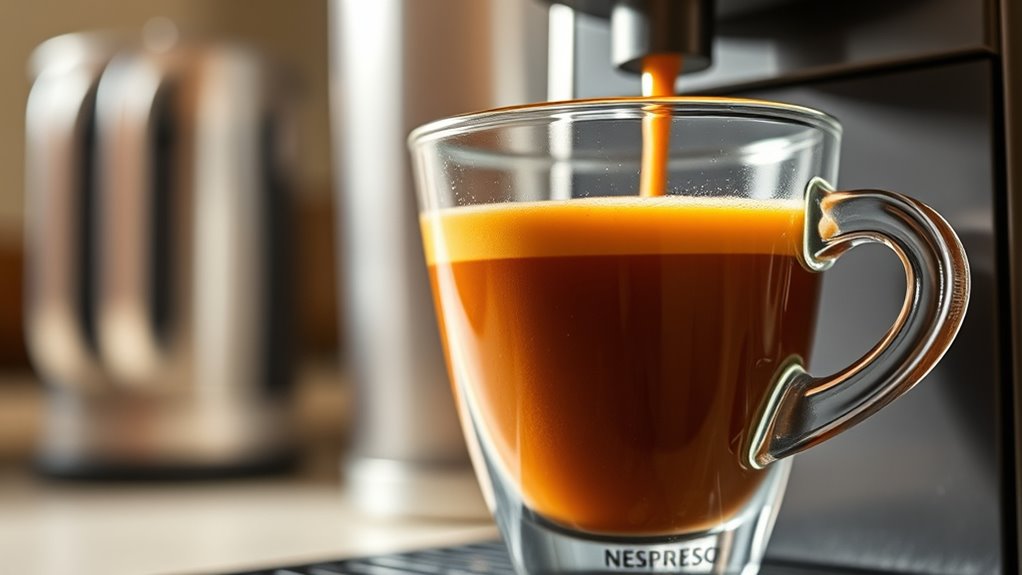
You need to understand that authentic espresso follows strict standards. For example, it requires a high-pressure extraction—around 9 bars—to produce that concentrated shot we all love.
Now, have you noticed the crema? That golden foam layer on top is a good sign. It shows the brewing was done properly and that rich oils are present.
Achieving this requires proper control over extraction time to ensure balanced flavor and crema development.
Espresso Standards Explained
Although many coffee preparations claim to be espresso, authentic espresso adheres to strict standards involving finely ground coffee doses of 7 to 9 grams and extraction under approximately 9 bars of water pressure. You must understand that these parameters aren’t arbitrary. They’re vital for extracting the concentrated flavors espresso is known for.
The International Coffee Organization and INEI specify exact water temperature, pressure, and coffee dosage to maintain consistency. When you brew espresso under these conditions, you guarantee ideal flavor extraction and the formation of crema, which is a key indicator of quality.
Deviations in pressure or coffee amount, as seen in many capsule systems like Nespresso, undermine authenticity. So, if you want true espresso, you need precise control over grind size, dose, pressure, and temperature. It really makes all the difference.
Crema’s Role Defined
Understanding the standards for pressure and dosage naturally leads to examining crema, a hallmark of authentic espresso. You should know that genuine crema forms from emulsified oils and CO₂ released during high-pressure extraction, creating a delicate, velvety foam.
This crema’s density and persistent froth signal that the coffee’s oils and aromatic compounds have been properly extracted, reflecting precise pressure, temperature, and grind size control.
However, you must recognize that Nespresso’s crema results from spinning and infusion, not the authentic high-pressure process. So, the mere presence of crema doesn’t confirm true espresso.
It can be artificially generated or produced differently.
To define authentic espresso, you need to assess crema quality alongside extraction methods. Don’t rely solely on its appearance.
Factors such as brew temperature and pressure also critically influence the formation and quality of authentic crema.
Pressure And Extraction
How exactly does pressure influence the quality of an authentic espresso shot? You need around 9 bars of pressure to force hot water through finely ground coffee, extracting rich flavors and creating that dense, concentrated espresso.
This pressure emulsifies coffee oils and CO₂, producing the signature crema, a key indicator of proper extraction.
Nespresso machines, especially Vertuo models, often use spinning or infusion methods instead of maintaining this critical high pressure, which means they can’t replicate authentic espresso’s texture or crema quality.
Without precise control over pressure, temperature, and extraction time, you’ll miss the complex flavors and aromas true espresso offers.
Nespresso capsules brewed at lower pressures inevitably fall short of the genuine espresso profile you expect.
Pressure and extraction define authenticity.
For optimal flavor extraction, a machine delivering consistent pressure between 15-20 bars, like those with a 20-bar pump system, is ideal.
How Does Nespresso’s Extraction Differ From Traditional Espresso?
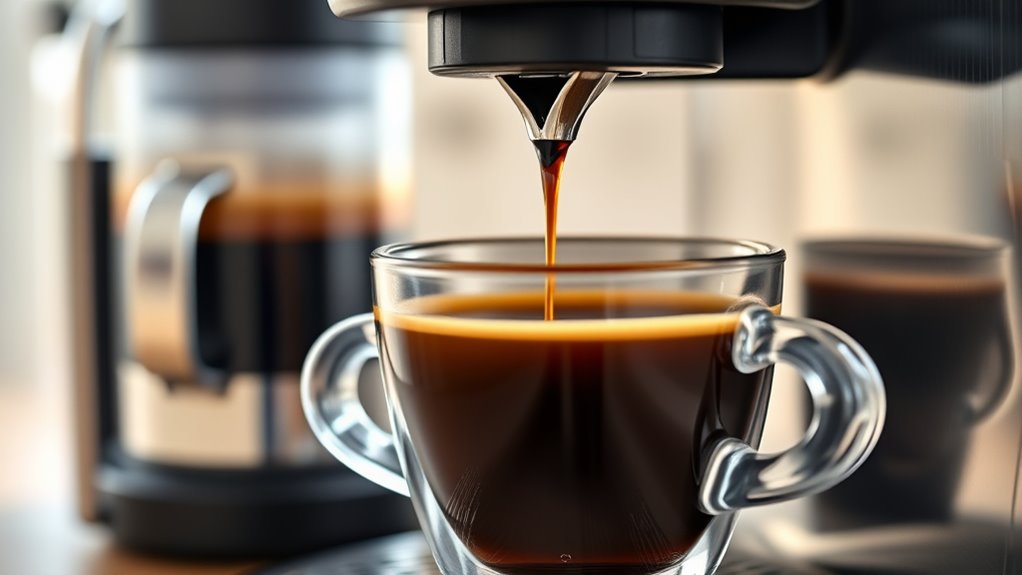
When you compare Nespresso’s extraction method to traditional espresso, you’ll notice a fundamental difference in pressure application and brewing mechanics.
Traditional espresso machines force hot water through tightly packed grounds at around 9-10 bars of pressure, extracting a rich, full-bodied shot with complex flavors.
In contrast, Nespresso’s Vertuo machines rely on centrifugal force, spinning the coffee capsule to infuse rather than applying high pressure.
Although Nespresso claims pressures near 19 bars, the mechanics differ markedly, resulting in a less intense extraction.
This method doesn’t replicate the same interaction between water, coffee oils, and CO₂, which is essential for authentic espresso’s depth and texture.
Is Nespresso’s Espresso Crema Authentic?
While Nespresso’s spinning extraction creates a distinctive crema-like layer, it doesn’t match the authentic crema produced by traditional espresso machines. You should understand that traditional crema forms when natural oils emulsify with CO₂ under high pressure, resulting in a delicate, velvety foam.
Nespresso, however, relies on spinning and infusion, producing a thicker, less nuanced layer that lacks this complexity. The foam you see is more an artificial illusion than a true indicator of quality.
Taste and Quality: Nespresso vs. Traditional Espresso
You’ll probably notice that Nespresso’s flavor is milder and not as complex as traditional espresso. This mainly comes down to differences in brewing pressure and extraction techniques.
Also, the crema you get from Nespresso doesn’t have that rich, velvety texture you find in authentic espresso, which comes from the natural oils in the coffee.
If you understand how things like grind size, tamping, and pressure affect the taste, it becomes clearer why traditional espresso usually offers a bolder and more layered experience.
For the best espresso flavor and crema, it’s important to use a high-quality espresso machine that can deliver the right pressure and temperature during brewing.
Flavor Profile Differences
Although Nespresso offers convenience and consistency, it doesn’t quite capture the full flavor complexity of traditional espresso. When you brew authentic espresso, high-pressure extraction highlights natural oils and crema, creating a rich, full-bodied taste with deeper intensity.
Nespresso’s infusion process, however, produces a milder, more uniform flavor, lacking the nuanced layers you get from adjusting grind size, tamping, and brewing time.
As a result, you’ll notice traditional espresso delivers a vibrant aroma and a lingering aftertaste, which many coffee enthusiasts appreciate.
While Nespresso capsules try to replicate these flavors, they generally fall short of the depth and richness achieved through manual high-pressure brewing.
If you prioritize intricate flavor profiles, traditional espresso offers a more satisfying sensory experience.
Crema Authenticity Explained
Beyond flavor complexity, the quality of crema plays a significant role in defining authentic espresso. When you examine Nespresso versus traditional espresso, the differences become clear.
Authentic crema results from high-pressure extraction, creating a delicate foam rich in natural oils and CO₂ emulsification.
Nespresso’s crema, however, is produced by spinning and infusion, lacking true pressure and serving mostly as a visual illusion. You can distinguish genuine crema by considering the velvety texture and rich oil content that signal proper extraction.
Also, real crema carries a complex aroma and flavor profile. Achieving true crema requires precise grind size and tamping, which capsules don’t replicate. Nespresso’s crema lacks these qualities, revealing its inauthenticity despite resembling the real thing visually.
Brewing Technique Impact
When comparing Nespresso and traditional espresso, the brewing technique fundamentally shapes the taste and quality you experience. Traditional espresso uses high-pressure extraction, around 9 bars, to emulsify oils and produce authentic crema. This directly influences flavor complexity and texture.
You control grind size, tamping, and extraction time, fine-tuning the shot’s profile.
In contrast, Nespresso machines, particularly Vertuo models, rely on centrifugal spinning or infusion, creating crema-like foam without true emulsification. This simplified process lacks precise pressure and temperature control, which limits flavor development and mouthfeel complexity.
Studies confirm Nespresso’s crema lacks the emulsified oils and CO₂ bubbles essential for authentic aroma and body.
Additionally, factors like extraction pressure and water temperature significantly affect the caffeine concentration in espresso shots, which Nespresso machines may not optimize as effectively as traditional methods.
Nespresso vs. Espresso Machines: Cost, Convenience, and Control
While Nespresso machines offer a more affordable and convenient option for espresso lovers, they trade off the level of control you get with traditional espresso machines. You’ll find that Nespresso machines typically cost under a few hundred pounds, while high-end espresso machines can reach thousands.
Convenience is unmatched with Nespresso’s quick, one-touch operation, contrasting with the skill and time required for manual espresso machines.
However, control over brewing variables differs markedly. Nespresso limits adjustments like pressure and grind size, simplifying the process but reducing customization. Traditional machines allow precise tuning to craft personalized flavor profiles.
Capsule costs accumulate over time, often making fresh beans with traditional machines more economical if you drink espresso frequently. Choosing between them depends on whether you value convenience or control more.
Additionally, using freshly ground beans just before brewing is crucial to maximize espresso aroma and crema, which is rarely achievable with capsule machines.
Is Nespresso Suitable for Serious Espresso Enthusiasts?
If you prioritize convenience over control, Nespresso machines can deliver a satisfying espresso-like experience. However, if you’re a serious espresso enthusiast, you’ll find Nespresso falls short.
These machines, especially Vertuo models, don’t achieve the high-pressure extraction essential for true espresso, limiting the richness and crema authenticity.
Vertuo models lack the high-pressure extraction needed for authentic espresso richness and genuine crema.
While some capsules mimic espresso’s appearance, they lack the natural oils and emulsification produced by traditional methods. You won’t have control over grind size, tamping, or pressure, which are critical for crafting nuanced espresso.
Serious aficionados prefer manual or semi-automatic machines because they allow customization and skill development.
In short, Nespresso suits casual drinkers who value simplicity. But if you’re after depth, complexity, and genuine espresso craftsmanship, it probably won’t meet your exacting standards.
Nespresso’s brewing method involves capsule puncturing and spinning rather than the traditional high-pressure extraction used in authentic espresso.
Frequently Asked Questions
What Is the Environmental Impact of Nespresso Capsules?
You contribute to energy use and carbon emissions when using Nespresso capsules, which are aluminum-based. Though recycling programs exist, many capsules still reach landfills. This causes pollution and resource waste compared to traditional brewing methods.
It’s kind of a trade-off. The convenience of Nespresso comes with an environmental cost. So, thinking about how you dispose of the capsules really matters.
Can Nespresso Machines Be Used for Other Coffee Drinks?
Don’t worry if you think Nespresso only makes espresso; you can brew lattes, cappuccinos, or even larger coffees with compatible capsules and accessories.
While it’s a bit limited compared to full espresso machines, its versatility still lets you enjoy a variety of drinks easily. So, you’re not just stuck with espresso shots.
With the right tools, your Nespresso can do a lot more than you might expect!
How Does Nespresso Handle Coffee Bean Sourcing and Ethics?
You’ll find Nespresso sources beans through its AAA Sustainable Quality Program, focusing on ethical, direct trade with farmers. They aim for 100% responsible sourcing by 2025, promoting transparency, sustainability, and environmental initiatives.
That said, they do face some criticisms. But overall, their efforts show a real commitment to improving the coffee supply chain.
What Maintenance Is Required for Nespresso Machines?
You need to descale your Nespresso machine every 300 uses. It helps keep your coffee tasting great and the machine running smoothly.
Also, clean the drip tray and capsule container weekly. Don’t forget to wipe the exterior regularly to keep it looking nice.
Replace water filters as advised by the manufacturer. And make sure to clear the coffee outlet from time to time. This way, your machine stays in top shape and delivers the best flavor every time.
Are There Any Health Benefits or Risks Linked to Nespresso Coffee?
You’ll find antioxidants in Nespresso coffee, which may reduce inflammation. But watch out for potential aluminum exposure from the capsules. Also, some flavored varieties have added sugars.
It’s best to drink it in moderation to keep caffeine-related risks like anxiety or sleep issues at bay. Just enjoy your coffee without going overboard!
Conclusion
When you choose Nespresso, you’re embracing convenience and consistency, but not the full ritual of authentic espresso. Its extraction method and crema differ from traditional craft, making it a modern shortcut rather than a true barista’s brew.
Think of it as a digital clock in a sundial era—efficient but lacking the nuanced mastery. If precision and control matter most, traditional espresso machines will always hold the edge for serious enthusiasts like you.