Yes, espresso is truly Italian, born from Italy’s inventive spirit and rich coffee culture dating back to the early 1900s. You’ll find its roots in Luigi Bezzera’s steam-driven machine and Achille Gaggia’s 1947 piston design that perfected pressure and crema.
Italy’s espresso evolved through technological breakthroughs and regional customs, emphasizing speed, precision, and social ritual. If you want to understand how these elements combine to shape espresso today, there’s much more to uncover about its fascinating journey.
What Is Espresso?
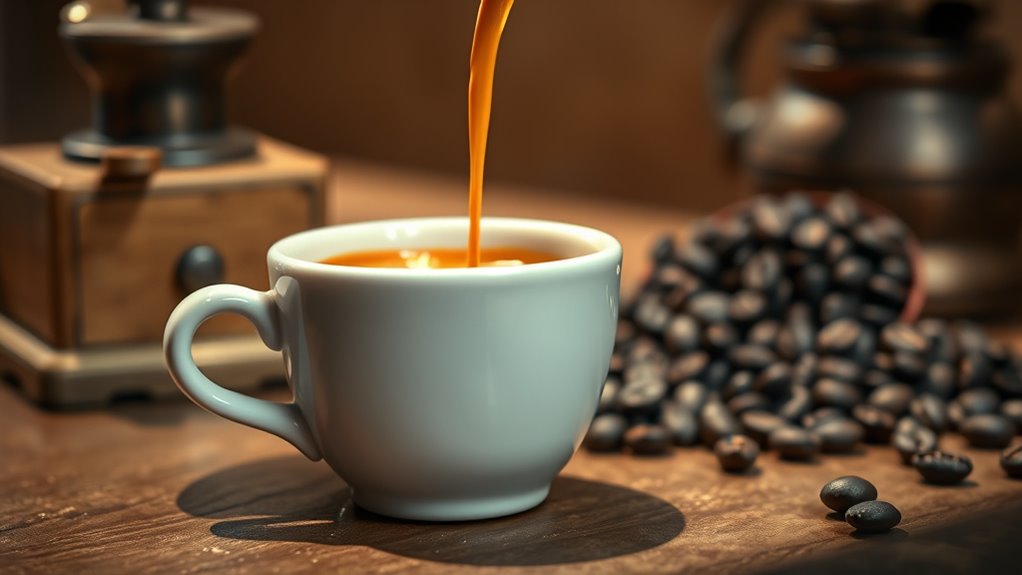
What exactly makes espresso stand out among coffee beverages? You’ll find it’s the method: forcing hot water through finely-ground coffee under about 9 bars of pressure. This process extracts a concentrated shot of roughly 25–30 ml in just 25–30 seconds.
The rapid extraction captures a rich, intense body and complex flavors, along with a distinct layer of crema that other brewing methods can’t replicate.
As a result, espresso offers a robust taste profile that’s both aromatic and full-bodied.
Understanding this concentrated brewing technique helps you appreciate why espresso serves as the foundation for many popular coffee drinks like cappuccinos and lattes.
It’s this precision and intensity that define espresso’s unique identity in the world of coffee.
Espresso’s development was driven by innovations such as Gaggia’s lever machine, which increased pressure and improved flavor extraction.
Why Is Espresso Italian?
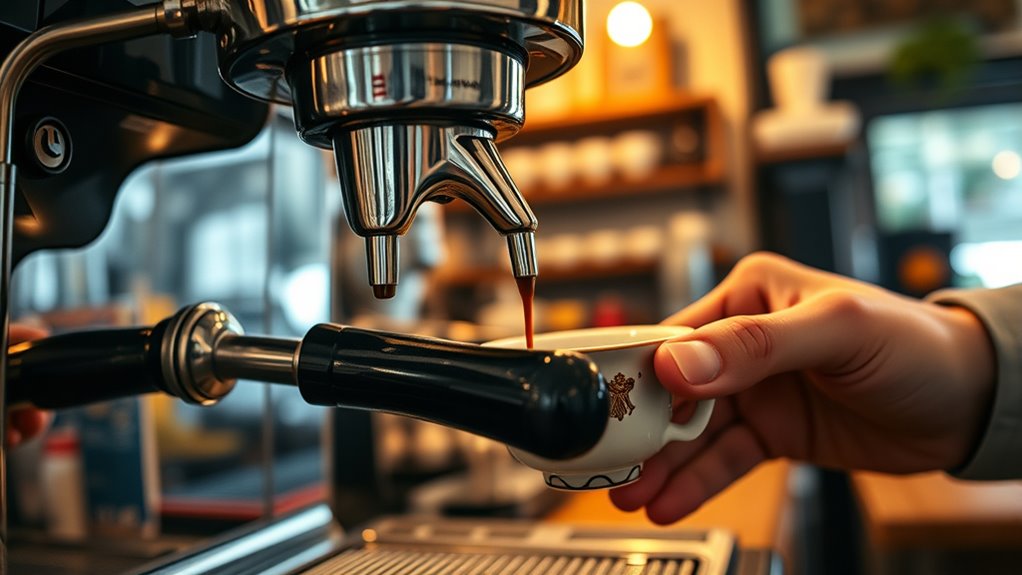
Why does espresso carry such a distinctly Italian identity? You’ll find that its roots lie deeply embedded in Italy’s early 20th-century innovation, developing high-pressure extraction methods that transformed coffee preparation.
Espresso’s distinctly Italian identity stems from early 20th-century innovations in high-pressure coffee extraction.
The very word “espresso” is Italian, meaning “express” or “fast,” highlighting its swift brewing process.
Italy’s advancements, especially Achille Gaggia’s 1947 espresso machine, introduced key features like crema and intense flavor concentration. These innovations really set espresso apart from other coffee styles.
Beyond technology, Italian culture shapes espresso’s identity through precise terminology, ritualistic preparation, and social customs that revolve around espresso consumption.
This cultural context, combined with Italy’s pioneering technical developments, cements espresso as an Italian icon. Its global popularity is inseparable from Italy’s historical and cultural crafting of this unique coffee experience.
Proper timing of the espresso shot, typically between 25-30 seconds, is essential in achieving the consistent flavor and crema that define the Italian espresso tradition.
How Did Espresso Originate in Italy?
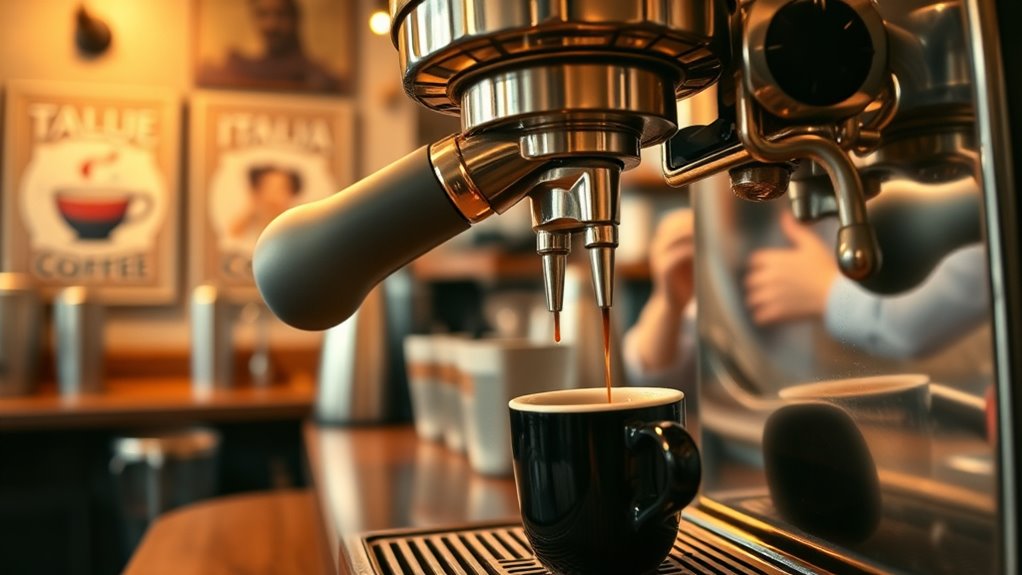
How did espresso come to be such a defining feature of Italian coffee culture? It started in the early 20th century when Italy’s industrial growth demanded faster coffee preparation.
Innovators like Luigi Bezzera patented machines around 1901 that used pressurized hot water to rapidly extract coffee, marking a shift from slow brewing methods.
This technological leap aligned perfectly with Italy’s evolving social culture, where quick yet quality coffee became essential in bustling urban settings.
The term “espresso” itself, meaning “express,” highlights this speed.
Later, Achille Gaggia’s 1947 piston-driven machine refined espresso further by producing a rich crema, elevating taste and quality.
Moriondo’s 1884 patent laid the foundational principles of using steam power to reduce brewing time significantly.
Who Invented the First Espresso Machine?
You’ll find that Luigi Bezzera’s 1901 invention marked the true beginning of the espresso machine. He used steam pressure to brew coffee quickly and efficiently.
What’s cool is that his design introduced key components like groupheads and portafilters—things that are still essential in espresso machines today.
Not long after, Desidero Pavoni stepped in and refined this innovation. He worked together with Bezzera to bring the “Ideale” machine to commercial markets.
This collaboration really set the foundation for the modern espresso technology we know and love.
Today, proper cleaning and maintenance of espresso equipment are critical, especially when using oily dark roasts that can affect machine performance.
Early Espresso Machine Origins
Although the concept of espresso brewing dates back to the late 19th century, the first Italian espresso machine was patented by Angelo Moriondo in 1884. He introduced a steam-driven system designed to speed up coffee preparation.
This early machine operated at high temperatures but low pressure, which meant it took roughly 45 seconds to extract coffee—similar to filter brewing.
Italy’s industrial progress fueled the development of faster coffee-making devices, emphasizing efficiency. Moriondo’s invention laid the foundation, but the machine’s steam-driven mechanism limited the extraction quality and speed.
Understanding these origins helps us see how espresso machines evolved from simple steam pressure devices to more refined apparatuses. This set the stage for later innovations that better harnessed pressure to produce the espresso we recognize today. Notably, Luigi Bezzera’s 1901 improvements introduced steam pressure enhancements that significantly advanced espresso technology.
Luigi Bezzera’s Innovations
Since the late 19th century laid the groundwork, Luigi Bezzera took espresso brewing a significant step further by inventing the first patented espresso machine around 1901. He designed a device that used steam pressure to force hot water through finely ground coffee, producing a concentrated, rich beverage efficiently.
Bezzera’s machine featured multiple groupheads and a portafilter, innovations that formed the mechanical basis for today’s espresso machines. His focus on accelerating brewing time without compromising quality was groundbreaking.
Though his initial invention was raw, it marked a pivotal moment in coffee technology, firmly rooting the espresso tradition in Italy.
Understanding Bezzera’s contributions helps you appreciate how modern espresso’s rapid preparation and signature flavor began with his patented steam-driven design. It’s pretty amazing to think how much of what we enjoy today started with his early work.
His invention laid the foundation for the high-pressure brewing method that produces espresso with its distinctive crema and concentrated flavor.
Bezzera and Pavoni Collaboration
While Angelo Moriondo secured the initial patent for the Italian espresso machine in 1884, it was Luigi Bezzera who made critical advancements around 1901 by integrating steam pressure and multiple group heads to enhance brewing speed and concentration.
You should understand that Bezzera’s innovations alone weren’t enough to popularize espresso. His collaboration with Desidero Pavoni proved pivotal.
Pavoni took Bezzera’s prototype and transformed it into a commercially viable product, launching the “Ideale” in 1905.
This partnership didn’t just improve the machine’s design. It established a business model and production scale that spread espresso culture across Italy.
Pavoni’s efforts also helped coin and popularize the term “espresso,” cementing its place in Italian identity.
Regular maintenance, including descaling of the machine, was essential to preserve its performance and ensure consistent coffee quality.
How Have Espresso Machines Evolved Over Time?
You’ll notice that espresso machines began with simple steam pressure designs back in the early 1900s. From there, they quickly evolved thanks to some key innovations.
For example, Gaggia introduced a high-pressure piston system, and Faema brought in the semi-automatic electric pump.
These advances didn’t just make brewing faster and better in quality. They also gave users more control over the extraction process, which was a big deal at the time.
Fast forward to today, and espresso machines have taken that legacy even further.
Now, they come equipped with precise automation and consistent pressure. It’s really a reflection of over a century’s worth of technological progress in making that perfect cup.
One of the most important breakthroughs was the introduction of the Faema E61 group head, which allowed for stable temperature and pressure control during extraction.
Early Machine Innovations
Although espresso machines have become sleek and automated today, their origins reveal a fascinating journey of mechanical innovation driven by the quest for faster, richer coffee extraction. You’ll find that Angelo Moriondo’s 1884 patent marked the beginning, employing steam and boiling water to speed brewing.
Then, in 1901, Luigi Bezzera refined this by introducing pressurized hot water, drastically cutting extraction time.
Achille Gaggia’s 1947 hand-pumped piston machine revolutionized espresso with its creation of crema, delivering a more concentrated shot.
Finally, the 1961 Faema E61 brought electric pumps into play, enabling semi-automatic control over pressure and temperature.
These early machines gradually evolved from manual, slow processes to more efficient, user-friendly designs, setting the foundation for the advanced espresso technology you see today.
Modern machines also integrate precise control over variables like pressure and temperature, essential for consistent, high-quality extraction.
Key Technological Advances
How did espresso machines evolve from their early steam-powered origins to the sophisticated devices we use today? Initially, around 1901, Italian machines relied on steam pressure, taking about 45 seconds to brew coffee. This produced a drink similar to filter coffee.
Then, in 1947, Achille Gaggia revolutionized the process by introducing a piston mechanism that generated 8-10 atmospheres of pressure. This yielded the signature rich crema and transformed espresso quality.
The 1961 Faema E61 further advanced technology with its electric pump, enabling consistent pressure control and faster extraction. Over time, pressure increased from roughly 3 bars to 9 bars, while brewing times considerably decreased.
Innovations in hydraulic systems and piston designs systematically enhanced efficiency, reliability, and flavor extraction. This marked a clear technological progression from slow, rudimentary devices to more refined espresso machines.
Modern espresso machines are carefully calibrated to optimize extraction time and pressure, which directly influences the caffeine content and flavor intensity of the coffee.
Modern Espresso Designs
Why did espresso machines shift from purely manual operations to more automated systems? The need for consistency, speed, and ease of use drove this evolution.
Early machines, like Luigi Bezzera’s 1901 model, relied on high heat and low pressure, making extraction slow and less precise.
Achille Gaggia’s 1947 piston machine introduced crema but still demanded manual effort.
The real leap came in 1961 with the Faema E61, which integrated an electric pump for steady 9-bar pressure and semi-automatic control.
Key milestones in modern design include:
- Manual piston mechanisms creating crema (1947)
- Introduction of electric pumps for pressure precision (1961)
- Semi-automatic control improving user consistency (1961)
- Transition to automated systems enhancing café efficiency
You see how these innovations made espresso brewing more accessible and reliable today.
What Defines Traditional Italian Espresso?
When you order a traditional Italian espresso, you expect a meticulously crafted shot extracted under about 9 bars of pressure within 25 to 30 seconds. This precise process guarantees a concentrated, full-bodied coffee with a rich crema layer, a hallmark of proper extraction.
You’ll receive a small 25–30 ml serving, emphasizing quality over quantity. The grind is finely tuned, ranging from dark to lighter roasts depending on regional preferences, highlighting Italy’s diverse coffee palate.
Specialized machines deliver this quick, intense brew, reflecting the technique and speed integral to its identity.
Drinking it quickly, often standing at a bar, is part of its traditional enjoyment. It links the espresso not just to flavor but to Italy’s social and daily rituals.
How Does Italian Coffee Culture Shape Espresso?
Although espresso has become a global symbol of Italian coffee, its unique character is deeply rooted in Italy’s cultural rituals and social habits. When you experience Italian espresso culture, you notice how quick, precise preparation transforms into a daily social ritual.
Specific terminology and shot volumes reflect a tradition of craftsmanship. Coffee bars function as community hubs, where you drink espresso standing up. The emphasis on taste and presentation shapes your social interaction and expectations.
This culture doesn’t just shape how espresso is made; it influences how you perceive and value it. The ritualistic, communal nature guarantees that quality, speed, and social connection remain inseparable. It defines espresso as more than a beverage. It’s an integral element of Italian daily life and identity.
What Are Italy’s Regional Espresso Variations?
Italy’s espresso culture reveals itself not only in shared rituals but also through rich regional distinctions that shape how coffee is roasted, prepared, and enjoyed.
In southern Italy, you’ll find a preference for darker roasts, producing bold, intense espresso. Northern regions favor lighter roasts, offering more nuanced flavors.
For example, Veneto locals often choose macchiato, while Lombardy residents lean toward cappuccino. Tuscany stands out with its stronger, more concentrated espressos, contrasting Emilia-Romagna’s milder, milk-based drinks.
Furthermore, regional customs influence additions like spirits. Caffè Corretto’s local variations reflect these preferences.
These differences aren’t arbitrary but deeply tied to local traditions and social customs, giving you a layered understanding of how geography and culture intricately shape Italy’s diverse espresso landscape.
Frequently Asked Questions
How Does Espresso Differ From Other Coffee Brewing Methods?
You get espresso by forcing hot water through finely ground coffee under high pressure quickly, producing a thick, concentrated shot with crema.
This is unlike slower methods like drip or French press, which yield lighter, less viscous brews.
What Are the Health Benefits of Drinking Espresso?
Drinking espresso can supercharge your brain with caffeine, boosting alertness and concentration. You’ll benefit from antioxidants and essential minerals. Plus, it may help reduce the risk of certain diseases.
When enjoyed in moderation, espresso can also enhance your metabolism and physical performance. This happens through increased adrenaline and improved muscle function. So, a little espresso can go a long way in keeping you sharp and energized!
Can Espresso Be Made With Beans From Other Countries?
Yes, you can make espresso with beans from any country. The key is roasting and preparation techniques, not origin.
Using quality beans from Ethiopia, Colombia, or Brazil can produce authentic espresso with unique flavor profiles. It’s all about how you bring out those flavors during the roast and brew. So, don’t worry too much about where the beans come from—focus on quality and technique.
How Should Espresso Be Stored to Maintain Freshness?
You should store espresso beans in an airtight container. Keep them cool and dark to prevent exposure to oxygen, heat, and light. This helps maintain their freshness and flavor.
Grind the beans just before brewing for the best taste. Try to avoid storing them in the fridge or freezer because that can affect the flavor negatively.
What Are Common Espresso-Based Drinks Outside Italy?
You’ll find popular espresso-based drinks like lattes, cappuccinos, and macchiatos outside Italy, each adapted regionally.
You’ll also enjoy mochas, flat whites, Americanos, and iced versions. These drinks reflect local tastes and climate preferences, making each one a little different depending on where you are.
Conclusion
So, you’ve learned that espresso isn’t just Italian; it’s practically Italy’s liquid identity crisis. From a clever machine invention to regional quirks, espresso is Italy’s caffeinated masterpiece wrapped in tradition and obsession.
Next time you sip that tiny, bitter cup, remember: you’re drinking centuries of meticulous Italian pride, debate, and maybe a dash of national stubbornness. Espresso isn’t just coffee; it’s a cultural phenomenon that’s as complex as your grandma’s Sunday gossip. Cheers!