You’ll find that the espresso machine’s invention started with Angelo Moriondo’s steam-driven brewer in 1884. Then, Luigi Bezzera came along in 1901 with a design that introduced portafilters and faster brewing.
Achille Gaggia changed the game in 1938 by using a high-pressure lever system that created rich crema. After that, the Faema E61 appeared in 1961, setting the standard with 9-bar pump pressure and temperature control.
Later on, innovations added dual boilers and precise temperature regulation. These developments really shaped the modern espresso experience. And honestly, there’s so much more behind each step to explore.
What Is an Espresso Machine? Basics and Components
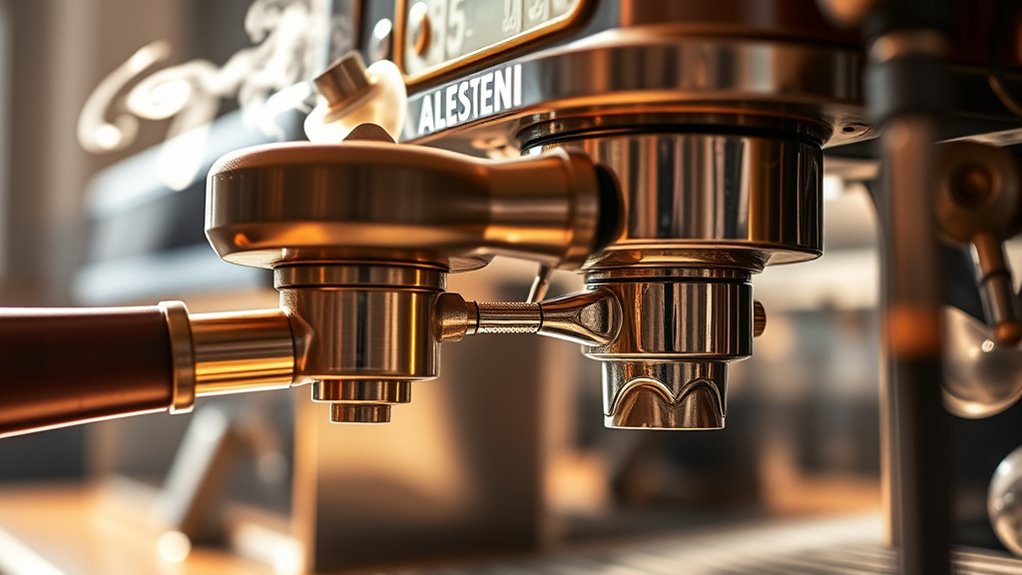
Although espresso machines come in various designs, they all operate on the same basic principle: forcing hot water through finely-ground coffee under high pressure to brew a strong, concentrated shot. You’ll find several core components working together to make this possible.
First, the boiler heats water to the ideal temperature.
Then, the pump or piston mechanism generates the necessary pressure, usually around 9 bars.
You’ll lock the portafilter, which holds the tamped coffee grounds, into the grouphead; this guarantees even water flow through the grounds.
Many modern machines also include temperature controls and pressure gauges for precision.
Finally, the steam wand helps froth milk if you want a cappuccino or latte.
Each part plays a vital role in delivering your perfect espresso. Proper extraction time control is essential for achieving balanced flavor and crema development.
Angelo Moriondo’s Steam-Driven Coffee Innovation (1884)
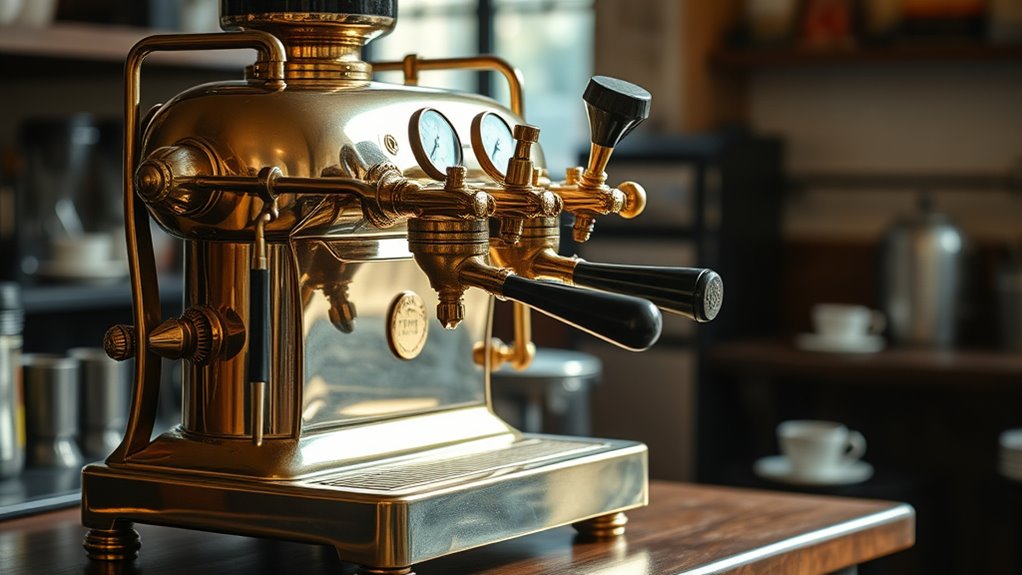
When Angelo Moriondo patented his steam-driven coffee machine on May 16, 1884, in Turin, Italy, he laid the groundwork for modern espresso technology. His invention, known as the “New steam machinery for the economic and instantaneous confection of coffee beverage,” introduced a system that controlled steam and water independently to brew coffee.
Unlike later machines, Moriondo’s device functioned as a bulk brewer, designed to prepare coffee in larger quantities rather than individual servings. Only a few units were ever built, and these primarily served as promotional tools in his establishments instead of being mass-produced.
While Moriondo’s machine wasn’t the espresso maker you might recognize today, it was a pivotal early step in the evolution of espresso technology. It emphasized speed and efficiency in coffee preparation, setting the stage for what was to come. This innovation preceded Luigi Bezzera’s 1901 patent, which introduced the high-pressure brewing method essential for modern espresso machines.
Luigi Bezzera’s Breakthrough: The First Espresso Machine (1901)
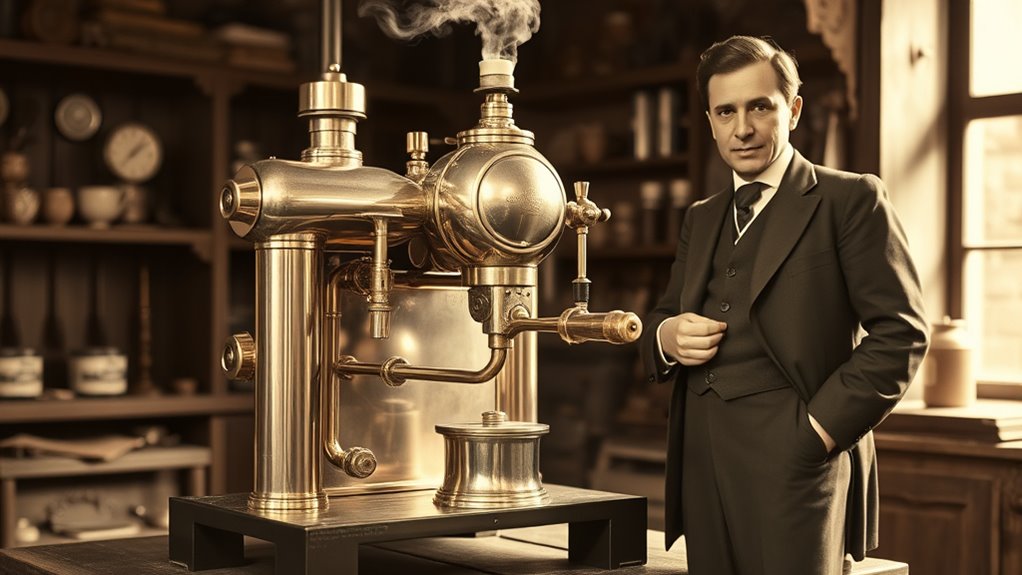
Building on Angelo Moriondo’s foundational concept of using steam to brew coffee, Luigi Bezzera took a significant leap forward in 1901 by patenting what’s recognized as the first true espresso machine. His goal was to reduce coffee preparation time to meet the demands of busy cafes.
Bezzera’s machine used steam pressure to force hot water quickly through finely ground coffee, producing a concentrated shot. It featured a portafilter and multiple brew heads, allowing operators to make several individual servings simultaneously.
This design marked a clear improvement in efficiency and consistency compared to earlier methods.
Bezzera’s 1901 patent set a critical precedent, influencing the development of espresso technology and paving the way for future innovations in coffee brewing machinery. It was a game changer that shaped how we enjoy espresso today. Understanding the importance of grind size consistency helps appreciate how later machines improved extraction quality for better espresso flavor.
Achille Gaggia and the Birth of High-Pressure Espresso (1938)
Back in 1938, Achille Gaggia completely changed the way espresso was brewed. He invented a spring-piston lever that boosted the pressure from around 2 bars to almost 10 bars. Pretty impressive, right?
This wasn’t just about making things faster—though it did speed up the extraction time.
More importantly, it created that rich, velvety crema on top of the espresso, which is now a signature part of its flavor and texture.
This jump in pressure was a real game-changer. It paved the way for the modern high-quality espresso machines we know and love today.
The high pressure and brief extraction introduced by Gaggia’s machine also contributed to the espresso’s characteristic lower acidity compared to drip coffee.
Lever Mechanism Innovation
Although espresso machines had existed for decades, Achille Gaggia transformed the brewing process in 1938 by inventing a spring-piston lever mechanism capable of producing 8 to 10 bars of pressure. This innovation replaced the lower-pressure steam systems, which often resulted in burnt, bitter flavors.
Gaggia’s design empowered baristas to manually control pressure, ensuring a consistent extraction. This leap marked the shift from steam-driven to high-pressure piston machines, which became essential for authentic espresso.
Key impacts included generating high pressure for better flavor extraction, allowing manual operation with consistent shot quality, and setting the standard for modern espresso machine design.
Gaggia’s lever mechanism laid the groundwork for today’s high-pressure espresso machines used worldwide. It really changed the way we make espresso, making it better and more reliable.
The importance of maintaining approximately 9 bars pressure in modern espresso machines traces back to Gaggia’s innovation, as this pressure level optimizes flavor extraction and crema formation.
Crema Formation Breakthrough
When Achille Gaggia introduced his spring-piston lever in 1938, he didn’t just improve pressure levels, he fundamentally changed how espresso’s signature crema formed.
This lever increased pressure to 8-10 atmospheres, which was a big jump from earlier machines. The high-pressure system extracted oils and emulsified coffee compounds, producing a richer, more stable crema that was hard to get before.
Before Gaggia’s innovation, steam-based machines often caused burnt, bitter flavors. His mechanism let baristas control pressure precisely, making sure espresso shots were consistent and higher quality.
This breakthrough in crema formation was a pivotal moment in espresso history, laying the groundwork for modern high-pressure machines.
Thanks to Gaggia, espresso’s texture and flavor profile were transformed and set new standards worldwide. It’s amazing how one invention changed the way we enjoy espresso today.
The consistent application of approximately 9 bars pressure during extraction is essential to produce the thick texture and rich aroma characteristic of espresso crema.
Increased Brewing Pressure
How did Achille Gaggia transform espresso brewing in 1938? He introduced a spring-piston lever that boosted brewing pressure from 1.5-2 bars to 8-10 bars. This leap in pressure allowed you to extract a richer espresso topped with thick crema, enhancing both flavor and texture.
Before Gaggia, steam-driven machines produced burnt, bitter notes due to lower pressure. But his design changed that. His innovation shifted espresso machines from steam-driven to high-pressure piston systems, standardizing the espresso shot you enjoy today.
Key impacts include higher pressure extraction producing crema-rich, flavorful espresso, reduction of burnt and bitter flavors common in earlier machines, and establishing the foundation for modern high-pressure espresso brewing.
Thanks to Gaggia, espresso gained the quality and consistency you now expect, and this innovation also contributed to espresso’s cultural significance, as seen in traditions like the espresso martini garnish.
The Faema E61: Introducing Pump-Driven Espresso Machines (1961)
Why did the Faema E61, introduced in 1961, become a game-changer in espresso machine history? It was the first to use a motorized gear pump, delivering consistent 9-bar pressure, which dramatically improved shot quality. Before this, lever machines required manual pressure, causing inconsistency.
The E61 also incorporated a heat exchanger and a saturated group, enhancing temperature stability during brewing. These innovations replaced unreliable manual levers with an electric pump, ensuring repeatable, high-quality espresso extraction.
The design set a new standard and deeply influenced modern espresso machine development. Today, the Faema E61 remains iconic, marking the shift toward pump-driven systems that dominate the industry. Maintaining consistent pressure and temperature control is crucial for achieving balanced espresso extraction and flavor in every shot.
Temperature Control Advances and Dual Boiler Espresso Systems
Although the Faema E61’s pump-driven design marked a major leap, the 1970s brought another breakthrough with La Marzocco’s introduction of dual boiler espresso machines equipped with PID controllers. This innovation allowed you to brew and steam at the same time while keeping temperature control super precise. That really helped make espresso shots more consistent.
Dual boilers separate brewing and steaming processes, so both temperatures stay stable. PID controllers use smart algorithms to keep water temperature within ±0.5°C, which stops fluctuations during extraction.
Key advancements include:
- Separate boilers for brewing and steaming, ensuring temperature stability.
- PID controllers that regulate water temperature with high precision.
- Saturated groups that maintain portafilter temperature, reducing extraction variability.
These advances made a big difference, improving espresso quality and efficiency in both commercial and home settings during that time. Precise temperature control is critical because it directly impacts the extraction dynamics and flavor profile of espresso shots.
How These Innovations Shaped Modern Espresso Machines
You’ll see how Achille Gaggia’s 1946 lever mechanism first raised brewing pressure to 14 bar, which created the iconic crema that defines espresso today.
Then, in 1961, Ernesto Valente introduced the high-pressure pump and the E61 group head. These innovations brought precise temperature and pressure control, completely changing how consistent espresso machines could be.
Finally, in the 1970s, dual boilers and PID controllers came into play. This allowed for steaming and brewing at the same time, while keeping temperatures stable for even better espresso quality.
These advancements built upon earlier methods, such as Gaggia’s lever-operated piston that replaced steam with high-pressure extraction for richer espresso.
Pressure Advancements Impact
As espresso technology evolved, pressure advancements played a crucial role in shaping modern machines. In 1938, Achille Gaggia’s spring lever machine boosted pressure to 8-10 bars, creating the rich crema that defines espresso today.
By the 1960s, electric pumps standardized pressure at about 9 bars, delivering consistent results in both commercial and home settings.
You’ll notice that maintaining precise pressure is essential; even slight deviations can cause under- or over-extraction, affecting flavor and crema quality.
Key impacts include:
- Faster brewing times and improved shot consistency
- Development of advanced machine types like HX and dual boiler systems
- Ability to achieve concentrated flavors and authentic crema with stable pressure
These innovations transformed how you experience espresso, making every shot reliably excellent.
Temperature Control Evolution
When espresso machines first relied on single boilers, controlling brewing temperature and steam pressure at the same time was pretty challenging.
In the 1970s, La Marzocco introduced dual boilers. This let you manage brewing and steaming temperatures separately, which really boosted espresso quality.
Around that time, saturated group heads came into play. They kept the portafilter temperature steady, so you got a more uniform extraction and better crema.
Then in the 1980s, PID controllers arrived. These keep the water temperature precise and stable during extraction, which is a game changer.
Later on, thermoblocks and advanced electronic controls made temperature stability even better and cut down heat-up times.
All these improvements turned espresso machines from simple gadgets into precise tools.
Now, you can consistently pull high-quality shots with just the right flavor and crema.
Knowing this history helps you appreciate the tech behind the espresso machines we use today.
Frequently Asked Questions
What Types of Coffee Beans Are Best for Espresso?
You’ll want to choose Arabica beans for balanced flavor and lower acidity, often blended with Robusta for more caffeine and thicker crema.
Opt for medium to dark roasts, freshly roasted within a month, to get the best espresso. It really makes a difference in taste and texture.
Freshness is key, so always check the roast date before buying. That way, your espresso will be rich and flavorful every time.
How Does Grind Size Affect Espresso Flavor?
Grind size is your espresso’s heartbeat. Too fine, and bitterness creeps in. Too coarse, and it’s weak and sour.
You’ll want a precise, powdered sugar-like grind to release rich, balanced flavors with perfect crema. Getting that just right makes all the difference.
Can Espresso Machines Make Other Coffee Drinks?
Yes, you can make various coffee drinks with espresso machines. First, pull a shot, then use steam wands or frothers to add milk or foam.
Super-automatic models even offer preset recipes for lattes or cappuccinos. It’s pretty convenient and lets you enjoy different drinks without much hassle.
What Maintenance Is Required for Espresso Machines?
You’ll want to wash the wand and wipe the portafilter after every use. Flush filters frequently and fix faulty seals as soon as you notice them.
Also, be sure to filter your water to keep things running smoothly. And don’t forget to descale your machine regularly to fight fouling and help you get flavorful, flawless espresso extraction every time.
Why Is Water Quality Important in Espresso Brewing?
You need good water quality because it extracts pure flavors and develops crema through minerals. It also helps prevent scale buildup in your machine.
Balanced pH protects your machine from corrosion, which means your espresso machine can keep a consistent temperature. Plus, it extends the lifespan of your machine. So, taking care of your water really pays off in the long run!
Conclusion
As you trace the espresso machine’s journey, from Moriondo’s steam whispers to Bezzera’s pioneering pulse, Gaggia’s high-pressure breakthrough, and Faema’s pump-driven heartbeat, you witness a symphony of innovation. Temperature mastery and dual boilers fine-tune the melody, crafting the espresso you savor today.
Each invention layers like notes in a rich espresso shot, blending history’s steam, pressure, and precision into the perfect cup that fuels your daily rhythm. It’s amazing how these breakthroughs came together to create something so essential to our mornings. Every sip tells a story of passion and progress.