To grind beans for perfect espresso, start with fresh beans roasted 5–14 days ago. Use a flat-burr grinder with precise, micrometric adjustments, aiming for a gritty texture like coarse salt. Adjust grind size based on roast: finer for dense light roasts, coarser for dark roasts.
Dial in shot timing around 25–30 seconds by tweaking grind size incrementally. Always weigh your dose and tamp evenly. Master these basics, and you’ll reveal espresso’s fullest flavor and balance. There’s more to refine beyond this, but this is a solid place to start.
Choosing the Best Coffee Beans for Espresso
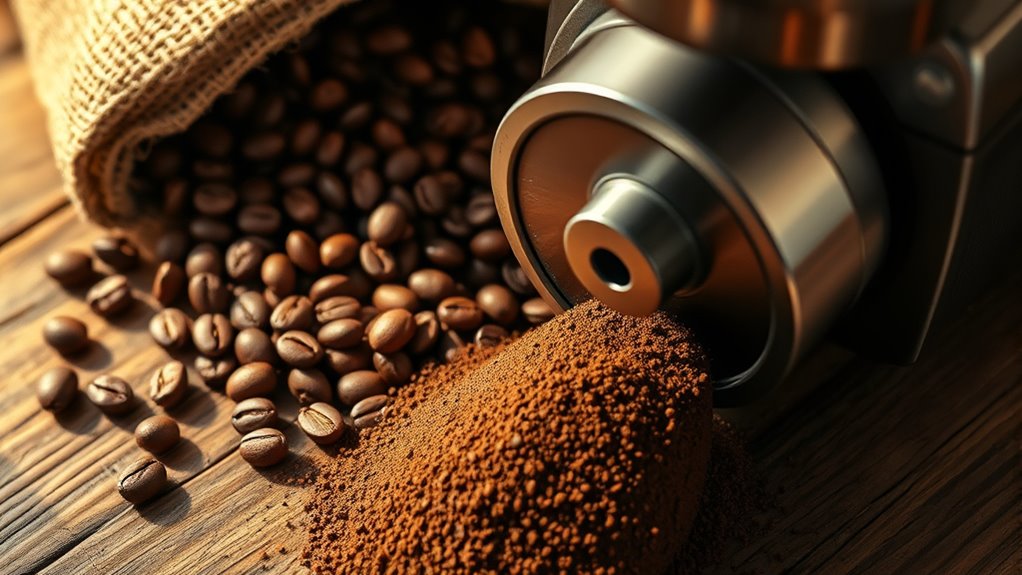
When you’re choosing beans for espresso, balancing flavor and crema is key. That’s why most blends combine Arabica and Robusta varieties. Arabica offers softer acidity and stone-fruit sweetness, while Robusta boosts crema thickness and adds bitterness.
Typical Italian espresso blends contain about 80-85% Arabica, delivering a rich, balanced profile. Specialty single-origin beans like Ethiopian Yirgacheffe or Kenyan AA can introduce unique sweetness and bright acidity.
But they often lack the crema or intensity Robusta provides.
Freshness matters immensely. You want beans roasted between 5 and 14 days ago. Avoid using beans younger than 4 days or older than 6 weeks to maintain ideal flavor and crema.
Selecting the right blend and ensuring freshness sets the foundation for excellent espresso extraction. It really makes all the difference in your cup. Dark roasting enhances the oils and flavor that contribute to crema production and the overall espresso experience.
How Roast Level Affects Your Espresso Grind
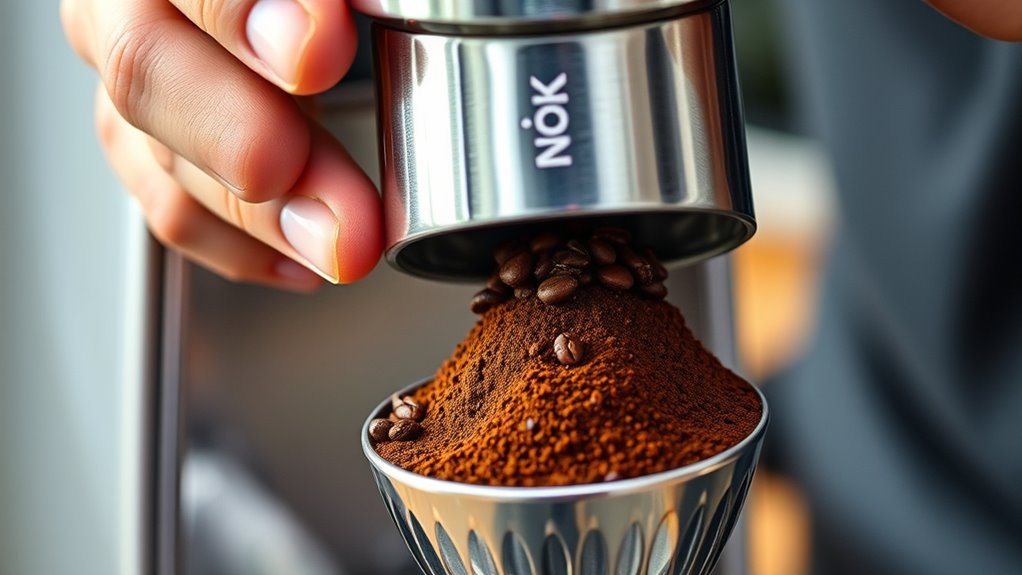
Because roast level directly influences bean density and solubility, adjusting your grind size is vital for achieving the perfect espresso extraction. Dark roasts are less dense and more soluble, so you’ll want to grind them slightly coarser to avoid over-extraction and bitterness.
Light roasts, being denser with a more intact cellular structure, require a finer grind to ensure adequate extraction.
Medium roasts fall in between, needing moderate grind adjustments depending on flavor and extraction time. Typically, shifting your grind size by 1-2 steps on your grinder will help you dial in the perfect shot when switching roast levels.
Maintaining the proper extraction time within 25-40 seconds depending on roast level is crucial to balancing flavor and avoiding undesirable taste profiles.
Why Coffee Freshness Matters for Espresso Flavor
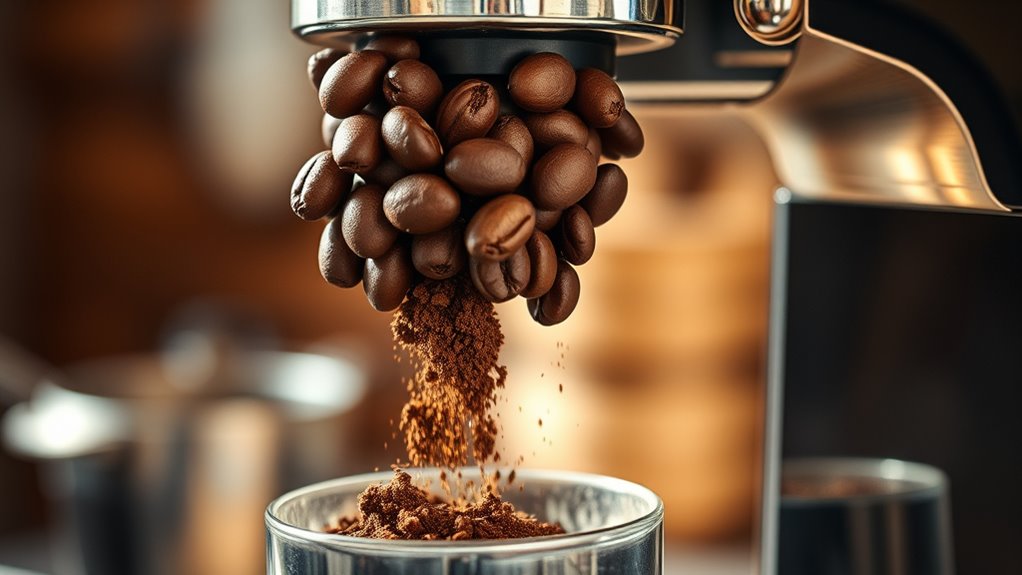
Even the best espresso grind won’t release its full potential if your beans aren’t fresh. Freshness directly affects flavor, crema, and extraction quality. When your beans are at their peak, usually between 5 and 14 days post-roast, you get vibrant flavors and a rich crema.
Fresh espresso beans, ideally 5 to 14 days post-roast, unlock vibrant flavors and a rich, perfect crema.
Beans younger than 4 days can taste overly acidic. On the other hand, those older than 6 weeks lose essential aromatic compounds, resulting in dull espresso.
Here’s why freshness matters:
- Fresh beans have higher moisture and intact cells, giving you consistent grind and ideal extraction.
- Stale beans cause clogging and uneven water flow, leading to flat, muted espresso.
- Properly aged beans balance acidity and sweetness, ensuring a flavorful shot every time.
Maintaining proper machine maintenance alongside fresh beans is vital for achieving the best espresso quality.
Keep freshness top of mind to reveal the full espresso experience. It really makes all the difference.
How to Choose the Right Grinder for Consistent Shots
To get consistent espresso shots, you’ll want the right grinder type and burr size.
For example, 64 mm flat burrs are perfect because they help create a uniform particle distribution.
It’s also a good idea to look for a burr grinder that has stepless, micrometric adjustments.
This way, you can fine-tune your grind size with precision, making it easier to dial in your shots exactly how you like them.
And don’t forget—regular calibration and maintenance are key.
Keeping your grinder in top shape will ensure your shots stay balanced and flavorful every single time.
Grinder Types Explained
When you want consistent espresso shots, choosing the right grinder is essential because it directly affects grind size uniformity and flavor extraction. Different grinder types offer unique advantages, so knowing their characteristics helps you pick the best one.
- Flat-burr grinders: With 64 mm burrs, they create a bimodal particle distribution. This is ideal for consistent extraction and balanced flavor.
- Conical burr grinders: These produce fewer fines, which results in a sweeter, more nuanced espresso profile. Perfect for those who value complexity.
- Stepless grinders: They allow precise, incremental grind size adjustments. This gives you better control over shot consistency compared to stepped models.
Avoid blade grinders. They produce uneven particles that cause channeling and inconsistent shots. Focus on control, durability, and consistency to optimize your espresso flavor. Regularly cleaning your grinder every 2-3 months prevents oil buildup and maintains grind consistency.
Burr Size Importance
Because burr size directly affects particle consistency, choosing a grinder with larger burrs, such as 64 mm flat burrs, gives you better control over grind uniformity and extraction stability. Larger burrs produce a more consistent particle size, reducing channeling and uneven extraction that smaller burrs or blade grinders often cause.
Flat burrs, especially larger ones, create a bimodal particle distribution that further enhances shot stability. With bigger burrs, you can make the fine adjustments necessary for espresso’s precision.
This means your grinder’s burr size isn’t just about speed; it’s about achieving the uniform grind essential for consistent, balanced shots.
Opting for a grinder with larger burrs sets you up to extract espresso that’s reliably rich and flavorful every time. Choosing the right grinder also complements the machine’s pressure system, ensuring optimal flavor extraction and crema quality.
Precision And Adjustments
Choosing a grinder with larger burrs sets the stage, but fine-tuning those burrs is what locks in consistency for every shot. To achieve precision, you want a burr grinder with micrometric or stepless adjustments. This lets you make small, exact changes to the grind size.
Regular calibration is key because variations in beans, roast, and humidity will affect extraction. Focus on these three essentials:
- Micrometric or stepless adjustment: Enables precise, incremental grind changes for consistent particle size.
- Calibration routine: Adapt grind size regularly to match bean and environment changes.
- Consistent dosing and tamping: Minimize variability to maintain reliable espresso quality.
Choosing the right grinder with these features ensures you dial in the perfect shot every time.
What Grind Size Works Best for Espresso
Although dialing in the perfect grind size might seem tricky, aiming for a texture similar to gritty table salt, around 200 to 400 microns, will set you on the right path for espresso.
Too fine a grind slows water flow, causing over-extraction and bitterness. On the other hand, a coarser grind speeds it up, resulting in sour, under-extracted shots.
Using a flat-burr grinder helps produce a consistent bimodal particle distribution, which ensures even extraction and richer flavor.
A flat-burr grinder creates a consistent bimodal grind for balanced extraction and enhanced espresso flavor.
You’ll want to fine-tune your grind size in small increments, adjusting based on shot timing and taste.
Remember to recalibrate your grind whenever you switch beans or roast levels. This keeps your extraction balanced and your espresso tasting its best every time.
Consistent, uniform particle size also prevents channeling, ensuring an even extraction and fuller flavor.
How to Feel and Test Your Grind Texture
When you rub your espresso grounds between your fingers, you should feel a gritty texture similar to coarse sand or kosher salt rather than a powdery or overly coarse sensation. This tactile check helps verify your grind is just right.
To test your grind texture effectively, pinch a small amount and observe if the grounds clump slightly but don’t form a dense, compact mass. Break the clump apart; it should crumble easily, indicating balanced particle size.
Avoid grounds that feel too fine and powdery, as they slow water flow and cause bitterness. On the other hand, grounds that are too coarse can lead to sour, weak shots.
Regularly calibrate your grinder and adjust settings in small increments to maintain consistent extraction and optimal flavor from your espresso grind.
How to Adjust Your Grind for Perfect Shots
Now that you can feel and test your grind texture, it’s time to fine-tune your grind size to pull the perfect espresso shot. Start by observing your shot timing. Aim for 25 to 30 seconds for balanced extraction.
If your shot flows too fast, under 20 seconds, make your grind finer to increase resistance and improve flavor extraction. On the other hand, if the shot drags beyond 35 seconds, coarsen the grind to let water pass more easily.
Use the flow rate, taste, and timing as your key indicators to adjust precisely. Remember to recalibrate your grinder whenever you switch beans, change roast levels, or clean your equipment.
These small, deliberate adjustments guarantee consistent, delicious shots every time. It’s all about paying attention and tweaking as you go.
Keep in mind that factors like brew method and bean type can also influence caffeine extraction and overall shot quality.
Preparing Your Coffee Dose and Tamping Correctly
To achieve a perfect espresso shot, you need to prepare your coffee dose with precision and tamp it correctly. Start by weighing about 18 grams of coffee for a double shot to match your portafilter basket capacity exactly. Grind immediately before brewing to preserve freshness and avoid oxidation.
Precision in dosing and tamping is key to a perfectly fresh and balanced espresso shot.
Next, use distribution techniques like tapping or the Weiss Distribution Technique (WDT) to break up clumps and spread grounds evenly in the basket.
Finally, tamp with consistent pressure, around 15-20 kg, making sure the puck is level and firm. Avoid tilting your tamper or uneven tamping, as this causes channeling and uneven extraction.
Follow these steps to ensure a balanced, rich, and smooth espresso every time. It’s also important to understand how dose impacts extraction to fine-tune your shot quality.
- Weigh and grind fresh coffee
- Distribute grounds evenly
- Tamp firmly and level
Shot Timing and Tasting to Calibrate Your Grind
After preparing and tamping your coffee dose with care, it’s time to focus on shot timing and tasting to fine-tune your grind.
Aim for an extraction time between 25 to 30 seconds. Use a timer to track this precisely.
If your shot pulls too fast, your grind is likely too coarse. Make it finer. If it runs too slow, your grind is too fine. Adjust it coarser.
Taste is your best guide. A sour, under-extracted shot signals a coarse grind, while bitterness points to over-extraction and a fine grind.
Observe the crema too. A rich, caramel color indicates proper extraction, while thin, pale crema suggests under-extraction.
Record your timing and tasting notes to dial in your grind consistently and craft the perfect espresso every time.
For best results, maintain a consistent tamping pressure between 20-30 pounds to promote even extraction.
Common Espresso Grind Mistakes and How to Fix Them
If your grind is too coarse or too fine, you’ll end up with weak or bitter shots because the extraction gets all thrown off. It’s a common issue, and it really makes a difference in how your espresso tastes.
Also, if the coffee isn’t evenly distributed in the portafilter, you might get channeling. That basically means the water finds easy paths through the grounds, which leads to inconsistent flavors and uneven flow.
So, how do you spot these mistakes? Pay attention to the taste and the flow of your shot. If it’s running too fast or too slow, or if the flavor seems off, your grind size or distribution might be the culprit.
To fix it, try adjusting the grind size a little at a time and make sure to distribute the grounds evenly before tamping. With a bit of practice, you’ll get that balanced, delicious espresso every time.
Grind Size Errors
When your espresso shots taste sour or bitter, the grind size is often the culprit. Getting the grind just right ensures balanced extraction and rich flavor. Here’s what to watch for:
Grinding too coarse leads to fast water flow, under-extraction, and sour, weak espresso.
Grinding too fine slows extraction, causing bitter flavors and potential channeling from increased resistance.
Inconsistent grind size from a poor grinder creates uneven extraction, resulting in unpredictable shot quality and weak crema.
Avoid these errors by adjusting your grind size in small increments regularly. This fine-tuning helps prevent over- or under-extraction, ensuring each shot is consistently delicious.
Distribution Problems
Although grind size plays a crucial role, uneven distribution of coffee grounds in your portafilter can equally sabotage your espresso shot. When grounds clump or aren’t spread evenly, water finds the easiest path, causing channeling and uneven extraction.
This leads to weak, inconsistent espresso. To fix this, level your grounds before tamping to create a uniform puck. The Weiss Distribution Technique (WDT), stirring the grounds gently after dosing, breaks up clumps and promotes even density.
Use a bottomless portafilter to see if your shot flows evenly. Visible channeling spots signal distribution issues. By focusing on proper distribution and tamping, you guarantee water flows uniformly through your coffee bed.
This improves extraction and delivers that rich, balanced espresso shot you’re aiming for every time.
Frequently Asked Questions
Can I Use Pre-Ground Coffee for Espresso at Home?
You can use pre-ground coffee for espresso, but you won’t get the freshest flavor or perfect crema. Grinding beans just before brewing gives you better control and a richer, more balanced espresso shot every time.
It’s all about freshness and control. When you grind your own beans, you get to decide the coarseness and unlock more aroma and flavor. Pre-ground coffee might be convenient, but it can lose some of those qualities over time.
How Often Should I Clean My Espresso Grinder?
You should clean your espresso grinder every 2-3 months or after grinding about 200 pounds of coffee. Regular cleaning keeps flavors fresh and maintains grind consistency.
It also helps extend your grinder’s lifespan. So, don’t skip this essential step!
Does Water Temperature Affect Espresso Grind Settings?
Water temperature doesn’t change grind size directly, but it does affect extraction speed. If the water’s hotter, you’ll want to use a coarser grind. If it’s cooler, go for a finer grind.
Try to keep the temperature steady, and you’ll keep your grind consistent too. It’s all about balancing the variables to get that perfect shot.
Can Grind Size Impact Espresso Machine Maintenance?
Yes, your grind size directly affects maintenance. Too fine clogs filters and strains seals, while uneven grinds cause inconsistent flow, increasing wear.
Adjusting grind regularly helps prevent pressure surges, reducing damage and keeping your machine running smoothly. It’s a small step that makes a big difference in how your espresso machine performs over time.
Is It Better to Grind Beans Immediately Before Brewing?
Yes, you should grind beans immediately before brewing to preserve freshness and maximize flavor. Grinding right before guarantees vibrant aroma, ideal extraction, and a rich crema.
This way, you get the best espresso experience every time you pull a shot. It really makes a difference in taste and quality. So, don’t wait—grind just before you brew!
Conclusion
Mastering your espresso grind is like tuning a fine instrument. Each adjustment brings you closer to harmony in your cup. By choosing the right beans, grind size, and tamping technique, you control flavor, extraction, and balance.
Remember, consistency is key. Small tweaks make a big difference. So, embrace the process and experiment confidently.
Enjoy the rich symphony of flavors that only a perfectly ground espresso can deliver. Your perfect shot awaits.