You can’t make true espresso with a French press because it doesn’t generate the necessary 9 bars of pressure or use the finely ground coffee that’s essential for authentic espresso extraction. French press brewing relies on coarse grounds steeped at low pressure, creating a full-bodied but less concentrated brew without crema.
Espresso’s high-pressure process rapidly extracts intense flavors and oils, producing a thick, syrupy shot. Understanding these technical distinctions helps explain why these methods yield fundamentally different coffee experiences and benefits.
So, while a French press makes great coffee, it just can’t replicate what an espresso machine does. Each method has its own vibe and flavor profile, and that’s what makes coffee so interesting!
Why a French Press Can’t Make Espresso
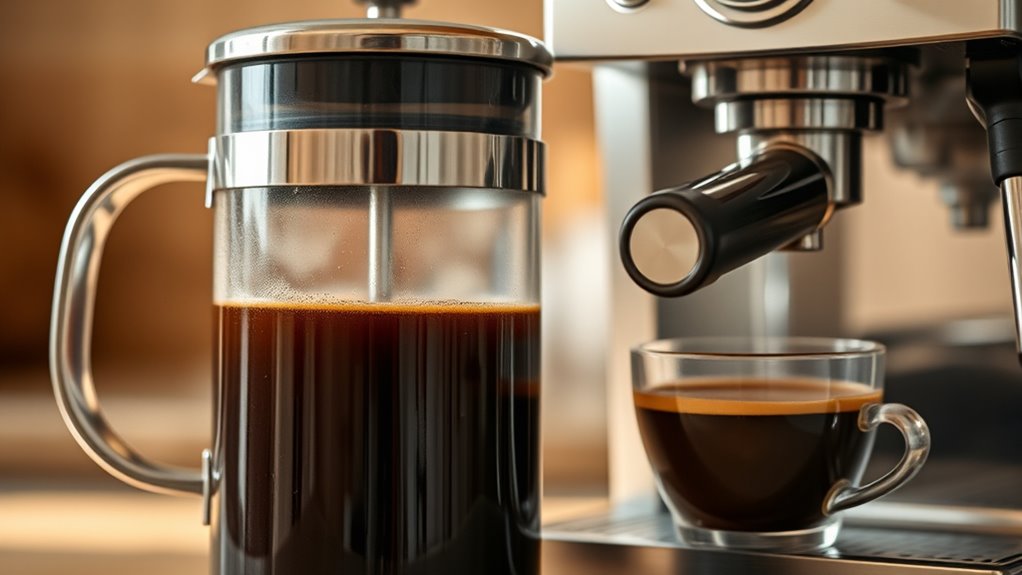
Although a French press can brew robust coffee, it can’t make espresso because it lacks the high pressure, around 9 bars, needed to extract the concentrated flavors and crema characteristic of espresso.
You rely on immersion brewing in a French press, where coarse coffee grounds steep in hot water without pressure application.
Espresso demands finely ground coffee and a high-pressure pump or piston mechanism to force water through tightly packed grounds.
Since a French press doesn’t have this specialized equipment, it can’t generate the essential pressure.
So, the brew you get is full-bodied but lacks espresso’s trademark intensity and crema.
Understanding these mechanical and grind size limitations clarifies why a French press, despite its strengths, can’t replicate true espresso extraction.
Additionally, without pressure, the extraction ratio that influences caffeine concentration and shot strength cannot be achieved.
Brewing Differences: French Press vs. Espresso
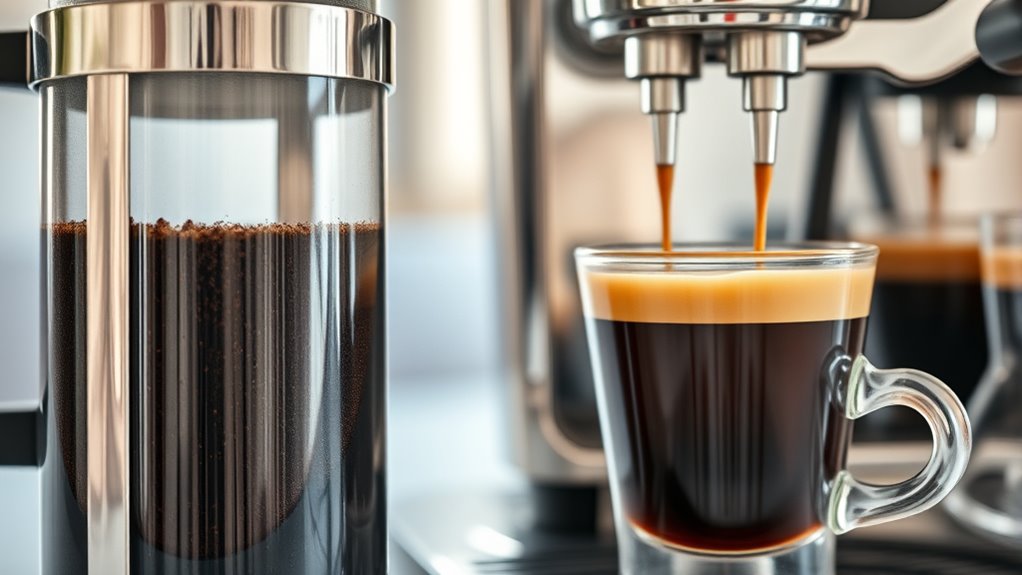
When comparing brewing methods, you’ll notice that a French press relies on full immersion of coarsely ground coffee without pressure, extracting flavors over several minutes. Espresso, on the other hand, forces hot water through finely ground coffee at around 9 bars of pressure in under 30 seconds.
This fundamental difference really shapes the coffee’s texture, strength, and flavor profile.
French press uses coarse grounds and 4–8 minutes of steeping. Espresso employs fine grounds and high pressure, about 9 bars.
The French press extraction is immersion-based, while espresso is percolation-based.
Espresso yields a concentrated shot with crema, whereas French press produces a full-bodied, textured brew without crema.
The brewing time contrasts sharply too: French press is slower, and espresso is rapid and intense.
Understanding these distinctions makes it clear why a French press can’t replicate espresso’s unique characteristics.
It’s all about the method and pressure involved, which give espresso its signature punch.
Additionally, espresso extraction requires precise control of factors like extraction time to achieve consistent flavor and crema quality.
Why Pressure Matters More for Espresso
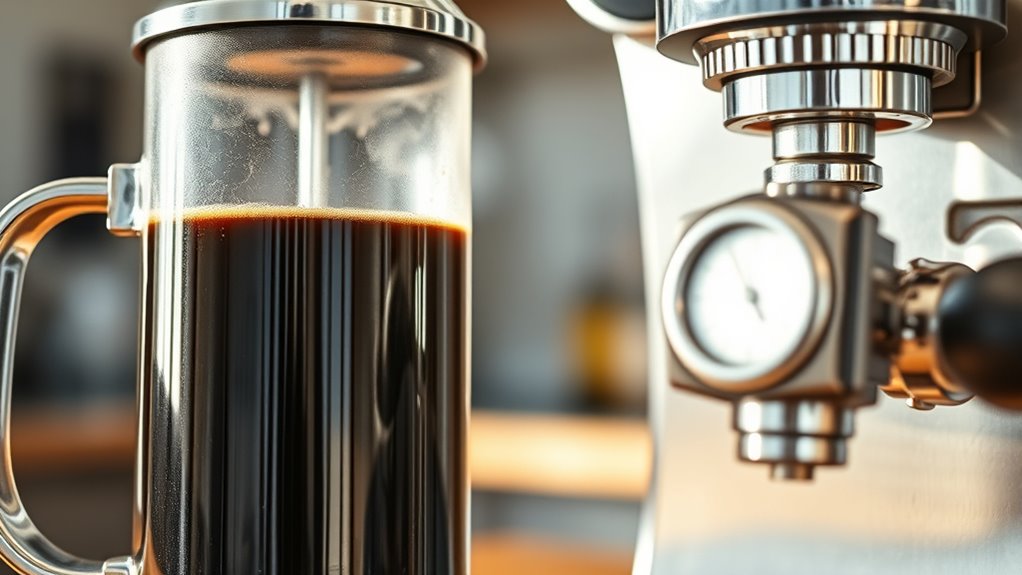
You need about 9 bars of pressure to push hot water through finely ground coffee. This is what pulls out those concentrated flavors that make espresso so special.
Plus, that pressure speeds up the extraction process and creates crema—the creamy, golden layer on top—that you just don’t get with methods like the French press.
When you understand how these forces work differently, it’s clear why pressure is key to making a true espresso.
Maintaining a consistent 9-bar pressure during extraction is essential for achieving the rich flavor and crema characteristic of espresso.
Pressure’s Role Explained
Since espresso extraction depends on approximately 9 bars of pressure to force hot water through finely ground coffee, the role of pressure is critical in achieving its signature intensity and crema. This high pressure rapidly emulsifies coffee oils, creating a concentrated shot with a rich crema layer. Without it, you miss essential chemical and physical reactions that define true espresso.
Pressure’s impact includes forcing water through compact coffee grounds efficiently, extracting soluble compounds quickly and uniformly, emulsifying coffee oils to generate crema, enhancing flavor concentration and mouthfeel, and preventing over-extraction by controlling flow rate.
A French press lacks this pressure, relying on immersion, so it can’t replicate espresso’s characteristic texture or intensity. Understanding pressure clarifies why a French press falls short of producing authentic espresso. Proper grind size and pressure together ensure optimal espresso extraction and crema development.
Impact On Extraction
How does pressure fundamentally alter the extraction process in espresso compared to a French Press? Pressure forces hot water through finely ground coffee at about 9 bars, rapidly dissolving oils and solubles. This creates the rich crema and intense flavor espresso is known for.
Without this, a French Press relies on immersion and gravity. That results in a less concentrated extraction and no crema.
Pressure extraction is essential for achieving the signature flavor and smoothness that whipped cream complements in espresso con panna.
| Aspect | Espresso (High Pressure) | French Press (No Pressure) |
|---|---|---|
| Extraction Speed | ~25-30 seconds | 4-5 minutes |
| Oil Emulsification | High, creates crema | Minimal, no crema |
| Flavor Profile | Intense, concentrated | Mellow, nuanced |
| Texture | Thick, syrupy | Light, smooth |
Pressure speeds up extraction efficiency. No French Press can match this.
Comparing Brewing Forces
Why does pressure play such a critical role in espresso brewing compared to a French press? Pressure forces hot water through finely ground coffee at about 9 bars. This extracts concentrated flavors and creates that signature crema.
On the other hand, a French press uses immersion and gravity without any added pressure. This results in a full-bodied but less intense brew.
The pressure difference is key because it:
- Extracts coffee oils and soluble solids efficiently
- Emulsifies fats, which helps form the crema
- Enhances flavor concentration and mouthfeel
- Controls extraction time precisely under high pressure
- Sets espresso’s texture and strength apart from French press coffee
Without this force, a French press can’t replicate espresso’s defining characteristics. Instead, it produces a weaker, crema-free beverage that’s fundamentally different. Moreover, espresso brewing requires maintaining a precise extraction ratio to achieve its distinctive flavor and body, something that immersion methods like the French press cannot control as effectively.
Grind Size Differences: French Press vs. Espresso
Although both French press and espresso rely on ground coffee, the differences in grind size are essential to their brewing outcomes. You need a coarse grind, resembling sea salt, for a French press to guarantee proper extraction and prevent clogging or over-extraction.
If the grind is too fine, the coffee becomes cloudy and gritty, and pressing the plunger grows difficult.
In contrast, espresso requires a very fine grind, similar to powdered sugar, to maximize surface area for high-pressure extraction. Using a coarse grind in espresso leads to under-extraction, weak flavor, and poor crema.
The grind size directly affects extraction time and overall coffee quality. Adjusting grind size controls shot quality and flavor consistency, making it crucial to match grind size precisely to the brewing method.
Flavor and Texture: French Press vs. Espresso
The grind size not only influences extraction but also shapes the flavor profile and mouthfeel you experience. With a French press, you get a slow infusion that yields a full-bodied, velvety texture and a cloudy appearance due to oils and fine particles passing through the metal filter.
In contrast, espresso’s rapid, high-pressure extraction produces a concentrated, syrupy consistency topped with a rich crema. Here’s what you should note:
- French press emphasizes nuanced, earthy, and fruity flavors
- Espresso delivers bold, intense caramel and roasted notes
- French press texture is smooth and oily
- Espresso mouthfeel is thick and viscous
The crema on espresso adds a unique tactile layer absent in French press coffee.
These differences highlight why a French press can’t replicate espresso’s distinctive flavor and texture. It’s all about how the coffee is brewed and the experience you’re after. Accurate espresso preparation also relies on precise yield measurement to achieve its characteristic balance and strength.
Caffeine: French Press vs. Espresso
You’ll find that a standard 8-ounce cup of French Press coffee contains about 95mg of caffeine. On the other hand, a single 1-ounce shot of espresso has roughly 63mg.
The difference comes down to how each one is brewed.
With the French Press, the coffee steeps for a longer time, which pulls out more caffeine overall. Espresso, however, uses pressure to extract a more concentrated dose of caffeine in a smaller amount of liquid.
Knowing this can help you understand why they affect you differently and what that means for your health.
It’s pretty interesting once you think about how brewing methods change the caffeine content!
Additionally, espresso’s high-pressure extraction pulls more solids and oils, contributing to its bold, full-bodied profile.
Caffeine Content Comparison
How does the caffeine content in French press coffee compare to that in espresso? You’ll find that an 8 oz French press brew contains about 95 mg of caffeine, while a 1 oz espresso shot has roughly 63 mg.
Despite espresso’s higher caffeine concentration per ounce due to rapid, high-pressure extraction, the larger volume of French press coffee results in greater total caffeine per serving.
The extended steeping time in French press brewing extracts more caffeine from grounds than espresso’s quick process. Here’s a precise comparison:
- French press: ~95 mg caffeine per 8 oz serving
- Espresso: ~63 mg caffeine per 1 oz shot
- Espresso has higher caffeine concentration per ounce
- French press provides more caffeine overall per typical serving
- Extraction time influences caffeine yield considerably
It’s important to note that a double espresso shot contains roughly twice the caffeine of a single shot, with an average of 120-140 mg caffeine, making it a potent energy boost.
Health Implications Differences
Although both French press coffee and espresso deliver caffeine, their different extraction methods and serving sizes really influence their health effects. You’ll find that a French press yields about 95mg of caffeine per 8-ounce cup, while espresso delivers roughly 63mg in just 1 ounce.
Because of the larger volume and longer steeping time, French press coffee often results in higher caffeine intake per serving.
Also, the French press’s immersion brew keeps more cafestol, which is a compound linked to increased cholesterol. Espresso’s high-pressure extraction tends to reduce cafestol levels.
So, when you think about health impacts, it’s good to consider both your usual serving size and how often you drink it.
French press coffee might increase caffeine and cafestol intake more than espresso. This could potentially affect cardiovascular health if you consume it excessively.
Just something to keep in mind when choosing your brew!
Pros and Cons: French Press vs. Espresso Machine
Since a French press can’t generate the 9 bars of pressure essential for true espresso extraction, it falls short in producing the same intensity and crema-rich shot that an espresso machine delivers.
You’ll notice the French press excels in simplicity and affordability but lacks the pressure-driven precision of an espresso machine.
Conversely, espresso machines provide rapid extraction and concentrated flavor but require more skill and investment.
Consider these key pros and cons:
- French press offers a full-bodied, rich brew with immersion steeping
- Espresso machine produces a quick, intense shot with crema
- French press is affordable and easy to use
- Espresso machines demand fine grind and maintenance
- French press lacks the high-pressure extraction, limiting espresso authenticity
Understanding these factors helps you grasp their functional and sensory differences.
How to Choose Between French Press and Espresso
When deciding between a French press and an espresso machine, you need to consider the fundamental differences in brewing methods, pressure requirements, and flavor profiles.
A French press uses immersion brewing with a coarse grind, which results in a full-bodied, velvety coffee. However, it doesn’t use the 9 bars of pressure essential for authentic espresso extraction.
A French press brews full-bodied coffee without the high pressure needed for true espresso extraction.
If you want genuine espresso characterized by intense flavor and crema, you have to use an espresso machine designed to generate high pressure rapidly with a fine grind.
While a French press can produce a strong, concentrated brew, it can’t replicate espresso’s crema or intensity.
Frequently Asked Questions
Can I Use a French Press to Make Espresso-Style Drinks?
You can use a French press to make espresso-style drinks, but it won’t produce true espresso. It lacks the necessary pressure, so expect a strong coffee without crema or the authentic espresso extraction characteristics.
That said, it’s a handy way to get a rich, bold cup if you don’t have an espresso machine. Just keep in mind, the texture and flavor won’t be quite the same as a real espresso shot.
What Equipment Is Essential for Making Real Espresso?
You need a pump-driven espresso machine, portafilter, tamper, finely ground espresso coffee, and a high-quality burr grinder. Precise temperature control and pressure around 9 bars are essential to extract authentic espresso with crema.
Getting these right really makes a difference. The burr grinder helps you get that perfect grind size every time, which is super important. And don’t forget, the tamper makes sure the coffee is packed just right for the best extraction.
How Long Does It Take to Brew Espresso Versus French Press Coffee?
Espresso brews in 25-30 seconds using 9 bars of pressure. French press coffee, on the other hand, takes 4-8 minutes steeping with coarse grounds.
You’ll notice espresso’s rapid extraction really stands out compared to the French press’s slower, full-immersion process. It’s a big difference in how the coffee flavors develop.
Can I Froth Milk With a French Press for Lattes?
You can froth milk with a French press by heating it to 60-65°C and pumping the plunger rapidly. This creates light, bubbly foam.
It won’t match the dense, creamy microfoam from specialized frothers, but it works well enough for lattes. Give it a try and see how you like the texture!
Is It Possible to Mimic Espresso Crema With a French Press?
You can mimic espresso crema by vigorously shaking or aerating French Press coffee, but you won’t replicate its chemical structure or texture. The necessary high-pressure emulsification process simply can’t occur in a French Press.
Conclusion
You can’t squeeze a true espresso out of a French Press. It’s like trying to catch lightning in a bottle. The French Press relies on immersion and coarse grounds, while espresso demands high pressure and fine grind for that rich crema and intense flavor.
If you want precision and punch, go for an espresso machine. But if you prefer simplicity and smoothness, the French Press has its own merits. Choose based on what your taste buds really need.