You’ll find about 120 to 170 mg of caffeine in a Nespresso double espresso, depending mainly on capsule size and bean type. Larger capsules with Robusta beans deliver more caffeine than smaller Arabica-based ones. Roast level and flavoring have minimal effect.
Brew volume influences caffeine concentration but not total caffeine. Extracting a double shot properly guarantees consistent caffeine intake. If you want to understand how variables like brew settings and capsule choice impact caffeine, there’s more to explore.
How Much Caffeine Is in a Double Espresso Nespresso Shot
A double espresso Nespresso shot contains between 120 to 170 mg of caffeine, depending on the capsule type and size you choose. Typically, a double shot equals two standard single espresso capsules, each averaging around 60 mg of caffeine. So, doubling that gives you a reliable baseline.
However, caffeine content isn’t fixed; it varies by capsule family and blend. Most capsules contain 60 to 80 mg per shot. To precisely gauge your caffeine intake, you should consult the specific capsule’s caffeine details, as product lines differ.
This variability means your double espresso’s caffeine load hinges on the exact capsule you use. So, relying on general estimates can lead to inaccuracies. Checking capsule specifications guarantees your caffeine consumption aligns with your expectations.
Keep in mind that a double shot’s caffeine content approaches the recommended daily limit of 400 mg, so moderation and awareness of safe caffeine consumption are important.
Why Capsule Size Matters More Than Flavor for Caffeine
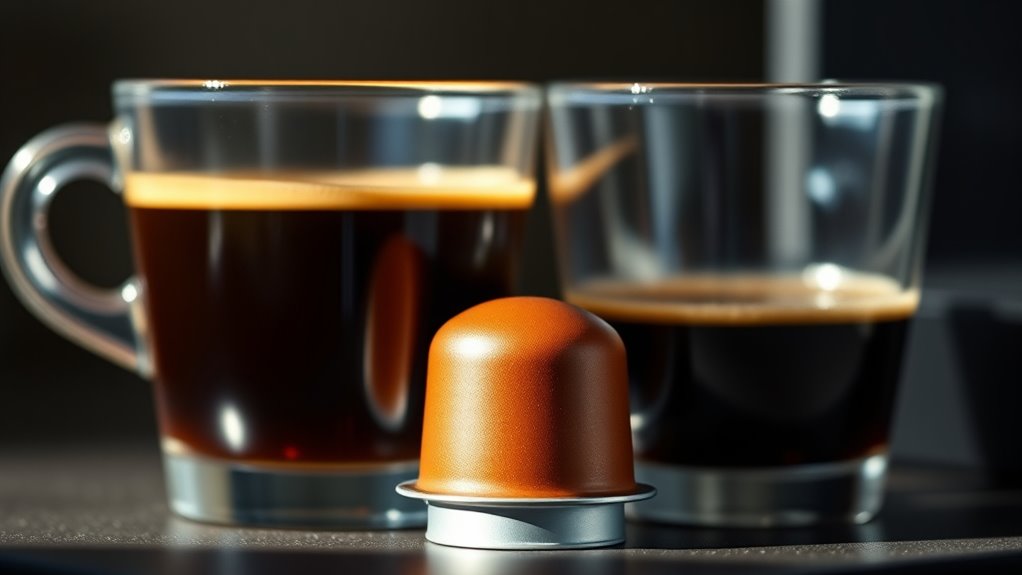
You’ll notice that the size of the capsule really impacts how much caffeine you get in your cup. That’s because bigger capsules hold more coffee grounds.
Now, you might think that a stronger flavor means more caffeine, but that’s not always the case. Dark roasts can taste bolder but often have less caffeine than lighter roasts.
Espresso capsules typically contain finely ground coffee designed for high-pressure extraction, which influences the caffeine content per shot.
Capsule Size Impacts Caffeine
How exactly does capsule size affect the caffeine content in your Nespresso double espresso? Capsule size directly controls the amount of coffee grounds used, which in turn determines the caffeine level.
A double espresso capsule typically contains 14-18 grams of coffee, delivering roughly 120-170 mg of caffeine depending on the exact volume. This contrasts with smaller capsules, such as single espresso shots, which have 60-80 mg of caffeine due to their reduced coffee quantity.
Since caffeine content correlates strongly with the coffee dose and extraction potential, capsule size is the primary factor influencing caffeine levels, not the flavor or roast. Additionally, espresso’s higher caffeine concentration per ounce is due to its high-pressure extraction method, which intensifies the caffeine content in each shot.
Flavor Less Influential
Although flavor variations might seem considerable, they’ve minimal impact on the caffeine content of Nespresso capsules. The caffeine level primarily depends on the capsule size and the amount of coffee grounds it contains, not on flavorings or roast profile.
For example, a double espresso capsule typically delivers between 60 and 80 mg of caffeine, a range attributable to its volume rather than to whether it’s hazelnut, vanilla, or a standard roast.
Flavor additives don’t substantially alter caffeine concentration. So when you want to estimate your caffeine intake accurately, focus on capsule size instead of flavor.
Choosing a larger capsule size reliably increases your caffeine dose, making size a more precise and evidence-based factor than flavor for gauging caffeine content in Nespresso capsules.
Additionally, consistent extraction pressure and precise temperature control are essential factors in ensuring the caffeine is optimally extracted from the capsule during brewing, which affects the final caffeine content in your cup, as explained in pressure and temperature control.
Brew Volume Correlation
Understanding why capsule size matters more than flavor for caffeine content requires looking at the relationship between brew volume and caffeine levels. Larger capsules, like double espresso ones containing 14-18 grams of coffee, hold way more grounds than smaller capsules. This directly boosts the caffeine extracted during brewing since caffeine amount is tied to the coffee mass used.
Brew volume shows this clearly—bigger capsules make larger volumes with higher caffeine content, no matter the flavor intensity. Flavor alone doesn’t reliably tell you caffeine levels because it depends on the roast profile and extraction, not how much coffee is inside. Additionally, maintaining the proper extraction time during brewing helps ensure that caffeine and flavor compounds are optimally extracted from the coffee grounds.
How Brew Volume Affects Caffeine in Double Espresso Nespresso
When you increase the brew volume in a double espresso, the total caffeine content stays nearly the same.
But the concentration per milliliter actually goes down.
So, a bigger shot ends up tasting milder, even though you’re still getting the same amount of caffeine.
It’s really the extraction time and the capsule’s dose that mainly decide how much caffeine you get—not just how big your espresso is.
Makes sense, right?
Brew Volume And Caffeine
How does changing the brew volume affect the caffeine content in your double espresso Nespresso? Increasing the brew volume dilutes the caffeine concentration per ounce but doesn’t change the total caffeine amount, which stays around 120-170 mg for a standard double espresso.
This is because the caffeine depends primarily on the coffee grounds used, not how much water you add. When you extend the volume by adding water, you get a milder, less concentrated flavor, but the overall caffeine delivered remains consistent.
So, doubling the brew volume without altering the capsule or grounds reduces caffeine potency per ounce but doesn’t increase or decrease the total caffeine in your drink.
Understanding this helps you adjust your espresso strength without affecting caffeine intake. Factors such as coffee amount and bean type play a crucial role in determining the total caffeine content in espresso beverages.
Double Espresso Size Impact
Adjusting the size of your double espresso directly influences the caffeine content you consume. When you increase the brew volume, the total caffeine generally rises, especially if you use more coffee grounds. However, caffeine concentration per ounce decreases as the volume grows.
That means a larger drink can feel milder despite containing more caffeine overall.
| Brew Volume (oz) | Approximate Caffeine (mg) |
|---|---|
| 2 (Standard) | 120–170 |
| 3 | 140–190 |
| 4 | 160–210 |
This table shows how increasing volume elevates total caffeine. If you keep the coffee dose constant but add water, caffeine content stays similar but concentration drops.
Using more grounds with larger volumes boosts caffeine proportionally. So, it really depends on how you prepare your double espresso.
Extraction Time And Strength
Why does the brew volume affect your double espresso’s strength but not its total caffeine content? When you increase the brew volume, the caffeine concentration per ounce decreases, making the espresso taste milder. However, the total caffeine remains roughly 120–170 mg, as it’s primarily determined by the coffee dose, not extraction time or volume.
Longer extraction times or larger volumes dilute caffeine concentration but don’t extract substantially more caffeine. Conversely, shorter, concentrated shots deliver more caffeine per ounce, enhancing perceived strength without increasing total caffeine.
What Coffee Bean Types Mean for Caffeine Levels in Nespresso
What impact do different coffee bean types have on the caffeine levels in your Nespresso double espresso? Arabica beans, which make up most Nespresso capsules, contain about 1.2–1.5% caffeine. This means you get a moderate amount of caffeine per capsule.
Arabica beans in Nespresso capsules offer a moderate caffeine boost with 1.2–1.5% caffeine content.
On the other hand, Robusta beans have a much higher caffeine concentration, around 2.2–2.7%. That’s nearly double the caffeine compared to Arabica. So, if you choose a Nespresso capsule with Robusta or a blend, your espresso’s caffeine content goes up quite a bit.
The difference in caffeine because of the bean type is bigger than other factors like the roast level. So, picking the right bean is key if you want a stronger caffeine kick.
When you grab your capsule, just know that Robusta-based options will give you a more potent caffeine experience in your double espresso.
Does Roast Level Affect Caffeine in Your Double Espresso?
Although roast level influences the flavor and aroma of your double espresso, it has minimal impact on its caffeine content. Caffeine remains stable through roasting, so lighter roasts contain only about 1-2% more caffeine by volume than darker roasts.
The key difference lies in bean density. Darker roasts are less dense, which slightly reduces caffeine per scoop. But this difference isn’t enough to affect your double espresso’s overall caffeine level.
| Roast Level | Caffeine Stability | Density Effect |
|---|---|---|
| Light | High | Higher density |
| Medium | High | Moderate density |
| Dark | High | Lower density |
| Difference | ~1-2% caffeine | Slight caffeine drop |
| Impact | Minimal caffeine change | Negligible effect |
Roast level’s influence on caffeine is negligible compared to capsule size and coffee dose. So, don’t stress too much about roast when it comes to caffeine. For best espresso results, ensure proper coffee grind size and tamping pressure as these factors significantly influence extraction and flavor quality.
How Caffeine Varies Among Nespresso Capsule Varieties
While roast level plays a minor role in caffeine content, the variety of Nespresso capsules you choose has a more significant impact. Nespresso double espresso capsules typically contain 120 to 170 mg of caffeine, with variation driven primarily by the coffee bean type.
Nespresso double espresso caffeine varies mainly by coffee bean type, ranging from 120 to 170 mg.
Robusta-based capsules tend to have higher caffeine levels than those made from Arabica beans.
Additionally, the capsule line matters. Original and Vertuo series differ in caffeine content due to distinct brewing methods and capsule sizes.
Flavored or specialty capsules, like chocolate or vanilla, generally match the caffeine levels of their standard counterparts but can show slight variation.
Understanding the extraction process and its impact on concentration helps explain these caffeine differences.
Tips to Control Caffeine With Nespresso Brew Settings
Because the volume and duration of your brew directly affect caffeine extraction, you can control your intake by adjusting your Nespresso machine’s settings. Start by selecting a smaller shot size, like ristretto, which limits caffeine compared to standard or lungo brews.
Reducing extraction time also decreases caffeine release, producing a milder beverage.
Adjusting brew volume is key. Larger volumes extract more caffeine, so keep it minimal if you want less.
Additionally, customizing brew temperature and flow rate influences extraction efficiency. Lower temperatures and slower flow rates generally reduce caffeine extraction.
Always consult your capsule’s recommended parameters to predict caffeine levels accurately.
Why Reusing Nespresso Capsules Reduces Caffeine and Flavor
Adjusting your Nespresso machine’s settings can help manage caffeine extraction, but reusing capsules introduces a different challenge. When you reuse a Nespresso capsule, the first extraction has already removed most soluble compounds, including a significant portion of caffeine.
As a result, your second brew contains less than half the caffeine compared to the initial shot. This depletion leads to inconsistent caffeine levels, making it difficult to predict the stimulant effect each time.
Also, the flavor profile weakens considerably. The second extraction produces a thinner, less robust coffee because the soluble content has been diminished.
For precise caffeine intake and consistent flavor, it’s best to use each Nespresso capsule only once, as intended. This way, you ensure ideal extraction of both caffeine and taste.
Maintaining proper extraction time within 25-30 seconds is essential to maximize flavor and caffeine content in each brew.
Comparing Caffeine: Nespresso Double Espresso vs Regular Coffee
If you want to understand how much caffeine you’re getting from your Nespresso double espresso compared to a regular cup of coffee, it’s important to take into account both concentration and total volume.
A Nespresso double espresso typically contains 120 to 170 mg of caffeine, depending on the capsule and brewing variables.
In contrast, a standard 12 oz cup of drip coffee usually has about 144 mg of caffeine.
Although the double espresso is more concentrated per ounce, the total caffeine in a full cup of regular coffee can match or slightly exceed it.
Espresso’s caffeine absorbs faster, producing a quicker stimulant effect, while regular coffee’s larger volume leads to slower caffeine absorption over time.
Understanding these nuances helps you choose based on your desired caffeine impact.
Frequently Asked Questions
How Long Does Caffeine From a Double Espresso Nespresso Last?
Caffeine from a double espresso Nespresso lasts about 3 to 5 hours, peaking within 30 to 60 minutes. Your metabolism, age, and sensitivity influence this.
Usually, roughly half the caffeine is metabolized in 4 to 6 hours. So, it sticks around for a good while but not forever. It all depends on how your body handles it.
Can Pregnant Women Safely Drink Double Espresso Nespresso?
You shouldn’t drink double espresso Nespresso often while pregnant because its caffeine content nears recommended limits.
Exceeding caffeine risks miscarriage and low birth weight, so it’s really important to keep an eye on how much you’re consuming.
It’s a good idea to chat with your doctor about what’s safe for you and your baby. Or, you could choose decaf options to stay on the safe side.
What Are the Health Risks of Too Much Caffeine From Nespresso?
Too much caffeine from Nespresso can cause sleep problems, anxiety, increased heart rate, dehydration, and digestive issues.
You might also face dependency or elevated blood pressure, especially if you consume more than 400 mg daily or are pregnant.
How Does Double Espresso Nespresso Caffeine Affect Sleep Patterns?
Coincidentally, the caffeine in your double espresso Nespresso disrupts sleep by reducing REM cycles and increasing awakenings. You’ll notice heightened alertness within minutes, so avoid it 4-6 hours before bed to protect your sleep quality.
It’s pretty wild how quickly caffeine kicks in, right? Just a quick heads-up: sipping that late in the day can really mess with your night’s rest. So, if you want better sleep, try to keep that espresso for earlier hours.
Are There Decaf Options for Double Espresso Nespresso Capsules?
Yes, you can find decaf options for double espresso Nespresso capsules, but they’re often single-shot pods. To make a double decaf espresso, you usually need two capsules, so check product details carefully before buying.
It’s a bit of a workaround, but it gets the job done. Just keep an eye out when you shop to make sure you’re getting what you want.
Conclusion
When it comes to your double espresso Nespresso, caffeine content depends more on capsule size and brew volume than just the flavor. Understanding the types of beans and roast levels can help you get it right without having to guess.
Remember, reusing capsules waters down both caffeine and taste. So, it’s best to stick to fresh pods for consistent results.
Like threading a needle, fine-tuning your brew settings lets you control caffeine levels precisely. This way, your coffee always delivers the kick you need every time.