You’ll want to aim for around 9 bars of pressure to pull a balanced, flavorful espresso with rich crema and smooth texture. Staying between 7 and 11 bars is ideal. Too low leads to weak, watery shots, while too high causes bitterness and harshness.
Most machines run near 9 bars, making it the industry sweet spot for consistent quality. If you keep exploring, you’ll discover how pressure impacts extraction and ways to fine-tune your espresso’s taste.
What Is Espresso Pressure and Why It Matters
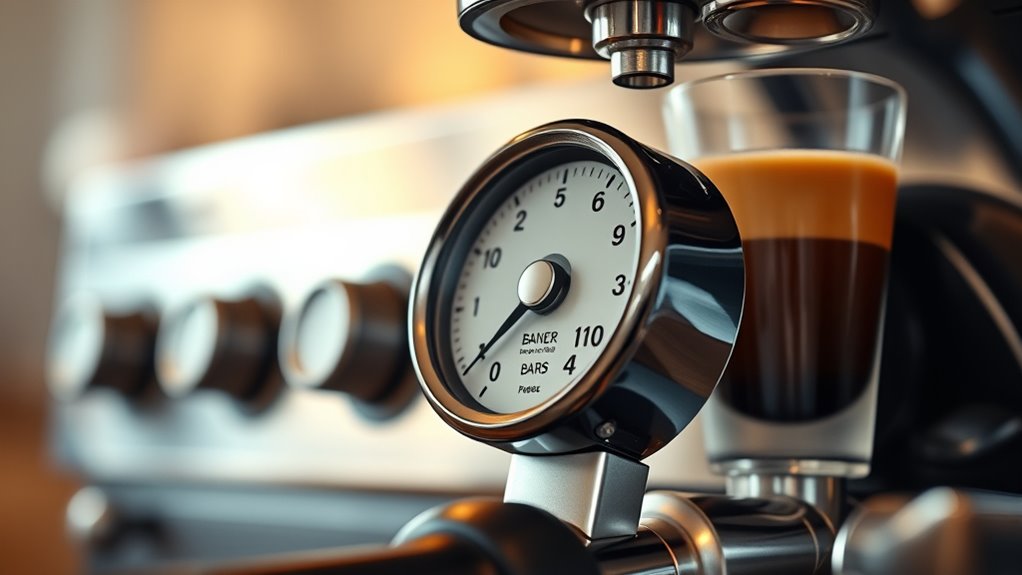
Although many factors affect your espresso’s flavor, pressure plays a crucial role in extracting the perfect shot. Espresso pressure, measured in bars, controls how quickly water passes through the coffee grounds. This pressure influences the extraction of flavors and oils that define your espresso’s aroma, texture, and taste.
If the pressure is too low, under-extraction occurs, leaving your coffee watery and weak. Too much pressure, on the other hand, forces over-extraction, resulting in bitterness. Most commercial machines operate around 9 bars, striking a balance between these extremes.
By maintaining consistent pressure during brewing, you guarantee a rich crema and a well-rounded flavor profile. Understanding and controlling pressure helps you brew espresso that’s both vibrant and satisfying every time.
It’s really about finding that sweet spot to enjoy every cup. Proper machine pressure is essential for balancing extraction and achieving rich, full-bodied shots.
Ideal Bars of Pressure for Espresso
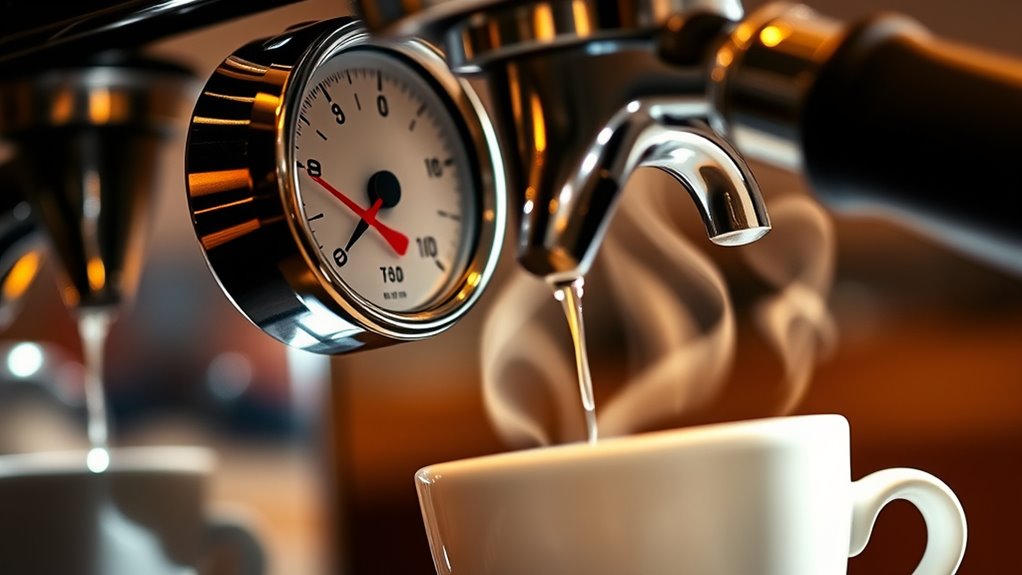
You’ll want to aim for an espresso pressure between 7 and 11 bars to get the best extraction.
Sticking close to 9 bars usually helps balance flavor, crema, and overall quality just right.
If the pressure falls outside this range, your shots might end up weak or bitter.
Maintaining consistent pressure is crucial as it influences extraction stages and ultimately the flavor balance of your espresso.
Optimal Pressure Range
When extracting espresso, keeping the pressure within the range of 7 to 11 bars plays a crucial role in achieving the perfect shot. Most commercial machines are set to around 9 bars, which hits the ideal spot for flavor and crema.
If the pressure climbs above 11 bars, you risk over-extraction, resulting in bitterness and a harsh taste.
On the other hand, pressure below 7 bars often produces weak, under-extracted espresso that lacks body and richness.
To get consistently balanced extraction and a creamy texture, aim to maintain pressure close to 9 bars throughout the brewing process.
This essential range ensures your espresso delivers vibrant flavors and a satisfying mouthfeel every time.
Additionally, maintaining stable brew temperature within the ideal range complements pressure control to achieve optimal extraction balance.
Pressure Effects on Extraction
How does pressure influence the quality of your espresso shot? Pressure directly affects how well your espresso extracts flavors, oils, and aromas from the coffee grounds.
When you maintain pressure around 9 bars, you hit the sweet spot. Your espresso will have a balanced flavor, rich body, and a thick, creamy crema.
If the pressure rises above 11 bars, you risk over-extraction. This often produces bitterness and harsh notes.
On the other hand, pressures below 7 bars typically lead to under-extraction, resulting in weak, watery espresso and thin crema.
Keeping pressure within the ideal range guarantees you capture the essential compounds that make espresso enjoyable.
Additionally, maintaining consistent pressure supports stable extraction time and yield, which are crucial for achieving a balanced espresso profile.
Why 9 Bars of Pressure Is the Sweet Spot for Espresso
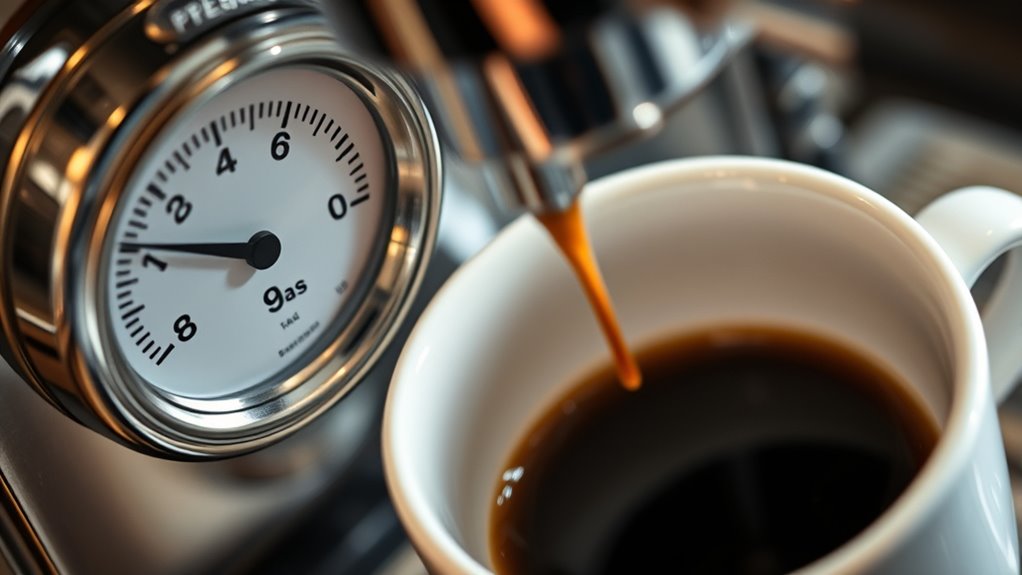
Although espresso machines can operate at various pressures, 9 bars stands out as the sweet spot because it perfectly balances extraction and flavor development.
At this pressure, water emulsifies coffee oils effectively, creating that rich, velvety crema you expect from a quality shot.
Industry standards and extensive testing confirm that 9 bars consistently deliver the best combination of flavor, aroma, and texture.
When you use a machine calibrated to this pressure, you’re ensuring your espresso won’t suffer from common issues like under- or over-extraction.
That’s why most commercial machines aim for 9 bars.
It’s the ideal pressure point to produce a balanced, flavorful espresso shot every time, giving you a satisfying experience with every cup you pull.
Maintaining 9 bars pressure also helps optimize the extraction time, which is crucial for achieving the ideal caffeine content and flavor profile.
How Low and High Pressure Affect Extraction and Flavor
Even slight deviations from the ideal pressure can dramatically change your espresso’s taste and texture. When pressure drops below 7 bars, your shot tends to under-extract, resulting in a weak, watery brew with muted flavors and thin crema.
On the other hand, pushing pressure above 11 bars often leads to over-extraction. This produces bitter, harsh notes and an overly dark, thick crema.
Moving from low to the perfect 9 bars enhances flavor complexity and crema by emulsifying oils effectively.
However, going too high speeds extraction but sacrifices flavor nuance and risks uneven extraction because of rapid flow resistance.
Proper preparation with fresh espresso and rich crema enhances flavor and texture, allowing the coffee’s natural taste to shine, especially in drinks like the espresso macchiato.
How Pressure Affects Extraction Time and Flow Rate
You’ll notice that when you increase the pressure, the flow rate usually speeds up. But sometimes, it can actually slow down extraction if the coffee bed resists the water flow.
Higher pressure often means longer extraction times because the water has to push through those compacted grounds.
Adjusting pressure is crucial, especially for different roast levels like blonde espresso, which requires precise calibration to preserve delicate flavors.
Pressure Impact On Flow
When you increase the pressure during espresso extraction, the flow rate doesn’t always speed up like you might expect. Instead, it often slows down because of greater resistance in the coffee bed.
At pressures around 12 bars, the coffee bed saturates quickly but then creates more resistance, causing the flow to slow.
Fresh coffee especially shows this early resistance, while stale coffee tends to respond with a more predictable increase in flow under higher pressure.
This dynamic means that higher pressure doesn’t guarantee faster flow. Rather, it can extend extraction time by impeding water movement after initial saturation.
Optimal espresso extraction typically occurs at about 9 bars of pressure, balancing flow rate and flavor intensity.
Extraction Time Variations
How exactly does pressure influence the time your espresso takes to extract? When you increase pressure, extraction time generally lengthens because the coffee bed saturates faster. Then the flow slows as resistance builds.
At very high pressures like 12 bars, this uneven flow can lead to longer, inconsistent shots. On the other hand, using lower pressures around 6 bars speeds up flow, which shortens extraction time but risks under-extraction and weaker flavors.
Notably, stale coffee reacts differently. Its reduced CO₂ causes the flow rate to rise predictably with pressure changes. To hit the ideal 25-30 second extraction window, you need to balance pressure carefully.
Adjusting pressure helps you manage flow rate and resistance so your espresso extracts evenly. This way, you get the best flavor profile every time. Maintaining the machine temperature around 200°F/93°C is also crucial for consistent extraction results.
Rotary vs. Vibrating Pumps: What’s the Difference for Pressure?
Although both rotary and vibrating pumps serve the essential role of generating pressure for espresso extraction, they differ markedly in performance and control.
Rotary pumps are larger and quieter, and they maintain stable pressure, which is critical for precise espresso shots. You can easily adjust their pressure using a screw or control valve, giving you fine-tuned control over extraction.
Vibrating pumps, on the other hand, are smaller and more affordable but usually have fixed pressure settings. They operate at higher frequencies, causing pressure spikes that can lead to inconsistent extractions.
If you want to modify a vibrating pump’s pressure, you’ll often need DIY solutions.
Ultimately, if consistent pressure and adjustability matter to you, a rotary pump offers superior control for crafting quality espresso. It’s all about what kind of espresso experience you want.
Additionally, pairing your pump with a PID control system on your espresso machine helps maintain stable brewing temperatures that complement consistent pressure for optimal extraction.
How to Measure Your Espresso Machine’s Brew Pressure
First, find the pressure dial on your espresso machine. Take a moment to learn how to read its bars accurately. It’s pretty straightforward once you get the hang of it.
Also, it’s helpful to know what kind of pump your machine uses—whether it’s rotary or vibrating. This makes a big difference in how the pressure behaves during extraction.
This knowledge will help you keep a close eye on your brew pressure. You’ll be able to make the right adjustments.
That way, you can pull the perfect shot every time.
Pressure Dial Interpretation
When you check the pressure dial on your espresso machine, you’re looking for a reading close to 9 bars. That signals ideal extraction pressure. The dial shows the current pressure in bars, so you can easily track if your machine is operating within the best range.
To interpret it correctly, just watch the needle’s position relative to the marked pressure levels during brewing.
Keep in mind:
Make sure the dial is calibrated for accurate readings. Aim for around 9 bars during the extraction phase. Some machines let you adjust the dial to fine-tune pressure.
A stable pressure dial means consistent espresso quality. But if the needle suddenly fluctuates, it might be time for some maintenance.
Pump Type Identification
How can you tell what type of pump your espresso machine uses? Start by checking the manufacturer’s specifications or user manual. They usually state whether the machine has a rotary or vibrating pump.
Rotary pumps are larger, quieter, and common in commercial or high-end home machines. Vibrating pumps are smaller, louder, and typically found in budget models.
If your machine allows brew pressure adjustments via a screw or regulator, it likely uses a rotary pump.
Conversely, vibrating pumps usually don’t offer straightforward pressure tweaks without DIY mods or external regulators.
You can also identify the pump type by inspecting the internal components or contacting the manufacturer’s support.
Knowing your pump type helps you understand how to measure and adjust brew pressure effectively for the best espresso extraction.
Adjusting Brew Pressure on Rotary Pump Machines
Although rotary pump machines come preset to around 9 bars of pressure, you can fine-tune this setting to match your espresso preferences by adjusting a dedicated screw or valve. To do this, load a fresh shot, start the extraction, and carefully turn the adjustment screw clockwise or counterclockwise until the pressure gauge shows your desired level.
Rotary pumps usually allow adjustments between 7 and 11 bars, giving you flexibility for ideal extraction.
Keep these points in mind: adjust only while the machine is running and brewing. Make small incremental turns to avoid overshooting pressure.
Use a quality pressure gauge for accurate readings and regularly monitor pressure to maintain consistency. Remember, proper pressure enhances both flavor and machine longevity.
This straightforward control helps you dial in the perfect espresso every time.
Why Adjusting Pressure on Vibrating Pump Machines Is Tricky
Rotary pump machines let you easily tweak brew pressure to suit your taste, but vibrating pump machines don’t offer the same convenience. Vibrating pumps typically come with fixed pressure regulators set around 9 bars by the manufacturer and aren’t designed for easy adjustment.
If you want to change the pressure, you’ll face challenges. Modifying internal parts or installing external regulators is often necessary, which can be complex and may void warranties.
Since these pumps rely on the vibrating mechanism’s amplitude rather than adjustable settings, achieving precise pressure control is tricky.
Unlike rotary pumps, you don’t have a simple dial or control to fine-tune pressure. So, if you have a vibrating pump machine, expect limited options for pressure adjustments without undertaking significant DIY modifications.
Using Grind Size and Dose to Optimize Pressure
When you adjust grind size and coffee dose, you directly influence the resistance the water encounters during extraction. This resistance, in turn, affects the pressure your machine can achieve.
A finer grind increases resistance, helping the machine hit perfect pressure, while a coarser grind lowers it, risking under-extraction.
Similarly, increasing the dose boosts resistance but might require you to tweak grind size to keep pressure steady. Balancing these variables ensures your espresso machine maintains consistent pressure and produces a well-extracted shot.
Finer grind equals higher resistance and pressure. A larger dose enhances resistance, affecting pressure. Coarse grind causes under-pressure and weak extraction.
Finding the right grind-dose combo stabilizes pressure for ideal extraction. Keep an eye on flow rate and shot time to fine-tune your adjustments and get that perfect espresso every time.
Frequently Asked Questions
Can Water Temperature Impact the Ideal Espresso Pressure?
Yes, water temperature affects espresso pressure. If your water’s hotter, you might need less pressure to avoid over-extraction.
Cooler water often requires higher pressure or finer grounds to extract flavors properly and balance your shot.
It’s all about finding the right combo so your espresso tastes just right.
How Does Altitude Affect Espresso Brewing Pressure?
Altitude lowers the atmospheric pressure, so your espresso machine must pump harder to extract flavors properly. Think of it like climbing a mountain. You’ll need to adjust pressure and temperature to keep your shot rich and balanced.
It’s all about making sure the espresso tastes just right, no matter where you are. A little tweak here and there can make a big difference in your cup.
Are There Espresso Beans That Require Different Pressure Settings?
Yes, some espresso beans need different pressure settings. You’ll want to lower pressure for oily or dark roasts to avoid bitterness. Using gentler pressure for light roasts helps preserve delicate flavors.
It’s all about adjusting based on each bean. That way, you get the best taste every time. Just experiment a little and find what works!
Does Pressure Influence the Crema’s Texture and Appearance?
Absolutely, pressure shapes your crema’s texture and look. Too high, and it’s bitter and coarse; too low, pale and weak.
Nail the right pressure, and you get that rich, glossy, velvety crema you crave. It really makes all the difference in your espresso experience.
Can Pressure Adjustments Fix Channeling Issues During Extraction?
You can’t fix channeling just by adjusting pressure. Focus on even tamping and distributing grounds first.
Pressure tweaks might help slightly, but the real solution lies in preparing a uniform coffee bed for consistent extraction.
Getting that foundation right makes all the difference in avoiding channeling during your shot.
Conclusion
Dialing in the perfect espresso pressure is like tuning a musical instrument. You want just the right tension to hit the sweet spot. Around 9 bars of pressure usually release the richest flavors, balancing extraction time and flow rate perfectly.
Adjusting pressure can be tricky, especially on vibrating pumps. But you can fine-tune grind size and dose to optimize your shot. Mastering this pressure dance ensures every espresso sings with bold, balanced flavor.