Yes, espresso does have calories, typically 1 to 3 calories per 1-ounce shot. This is because of the natural oils and proteins extracted from the beans.
The calorie count goes up as the serving size increases and can vary a bit depending on the brewing style. For example, ristretto has fewer calories, while lungo has a bit more.
Even though espresso is concentrated, its calories per ounce are pretty similar to drip coffee. If you want to understand how brewing factors, additives, and nutrient content play roles, there’s more useful information ahead.
How Many Calories Are in a Shot of Espresso
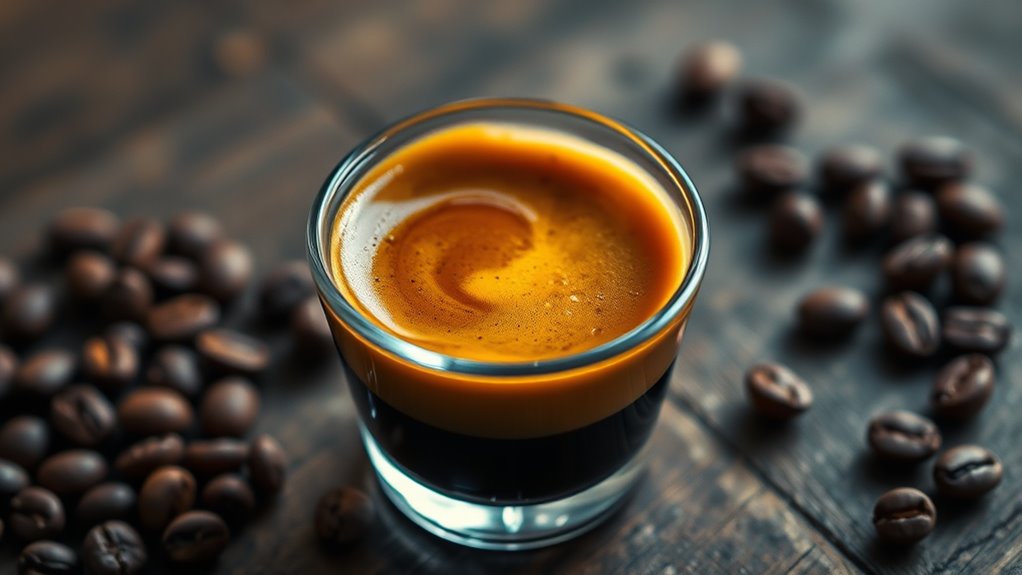
Although espresso is known for its rich flavor and concentrated caffeine, it contains surprisingly few calories. A standard 1-ounce (30 mL) shot of plain espresso has only about 1 to 3 calories. These calories come from tiny amounts of natural oils and protein naturally present in the coffee beans.
Espresso delivers rich flavor and caffeine with just 1 to 3 calories per ounce.
If you prefer a double shot, which is roughly 2 ounces, you’ll consume around 2 to 6 calories, depending on how it’s prepared.
Even variations like ristretto or lungo adjust the calorie count only slightly, generally keeping it under 5 calories per shot.
This makes espresso an excellent low-calorie choice when you drink it plain, whether you’re mindful of calorie intake or just want a strong, flavorful coffee without added calories.
It’s a great way to enjoy coffee without worrying about adding much to your daily calorie count.
Additionally, the aeration and flavor development process used in shaken espresso can enhance its smoothness and texture without adding calories.
How Coffee Oils and Proteins Add Calories to Espresso
You’ll notice that the tiny bit of fat from coffee oils in a shot of espresso adds about 1 calorie. That’s because of the natural fats found in the beans.
Proteins also add roughly 1 calorie per 6-ounce serving, although in a single shot, their amount is pretty minimal.
The precise grind size used in brewing can influence the extraction of these oils and proteins, subtly affecting the calorie content and flavor profile.
Coffee Oils Caloric Role
When you savor an espresso shot, the tiny amount of coffee oils extracted from the beans adds a small but measurable calorie count, roughly 1 calorie per 1-ounce serving. These oils come from the natural fats within coffee beans, which vary by roast level and bean type.
Darker roasts and stale beans often contain more surface oil due to oil migration, slightly increasing the calorie content.
Although the fat content is minimal, about 0.1 grams per shot, it contributes to the overall caloric value in concentrated espresso. While minor, this oil-derived energy can add up if you consume multiple shots.
Understanding this helps you appreciate how even trace coffee oils play a subtle but real role in espresso’s calorie profile. Additionally, the coffee-to-water ratio in espresso influences not only flavor and caffeine content but also the concentration of these coffee oils.
Protein Contribution Calories
How exactly do proteins contribute to the calorie content in your espresso? The answer lies in trace amounts of proteins and coffee oils naturally present in the brew. These proteins amount to about 0.1 grams per shot, which translates to roughly 0.4 calories. That’s an almost negligible figure.
Here’s how this impacts your espresso:
- You get approximately 0.1 grams of protein per shot, contributing minimal calories.
- Coffee oils add around 1 calorie for every 0.1 grams of fat, which is similarly low.
- The combined effect of proteins and oils keeps the calorie count in espresso extremely low, regardless of brewing method.
For the best extraction of these components, ensure the machine is properly preheated and use the correct portafilter preparation to maintain flavor and consistency.
How Serving Size Influences Espresso Calories
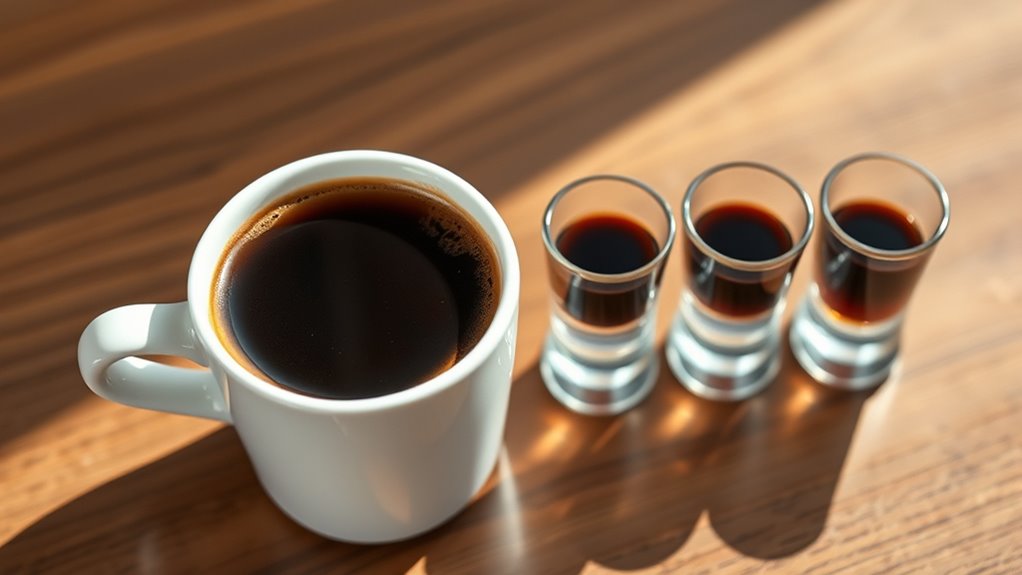
Although espresso is famously low in calories, the amount you pour directly impacts its caloric content. A standard single shot (1 oz) contains about 1-3 calories, mainly from trace fats and proteins.
When you double the serving size to a double shot (2 oz), the calories roughly double to 2-6.
If you opt for a triple shot (3 oz), expect about 3-9 calories. This linear scaling means each additional ounce adds a small, predictable amount of calories.
Despite this increase, espresso’s calorie count remains very low due to its small volume.
Keep in mind, larger espresso-based drinks have more calories, but those come primarily from added ingredients, not the espresso itself.
Espresso also contains trace amounts of oils and polyphenols, which contribute to its nutritional profile despite the low calorie content.
How Different Brewing Styles Affect Espresso Calories
You’ll notice that different brewing styles subtly change espresso’s calorie content because of variations in water volume and extraction time.
For example, ristretto shots use less water and a shorter extraction time, so they end up with fewer calories.
On the other hand, lungo shots extract more oils and nutrients, which slightly increases the calorie count.
Knowing how these factors influence calories can help you make smarter choices based on your brewing method.
The extraction time and pressure used during brewing play a crucial role in determining the concentration of dissolved solids, which affects the overall calorie content.
Brewing Methods Impact
Since different brewing methods alter water volume and extraction time, they also cause slight variations in the calorie content of your espresso.
For example, a ristretto shot has about 2 calories due to its concentrated extraction, while a lungo shot contains around 5 calories because it uses more water and extracts more oils and soluble compounds.
When you choose your brewing method, consider these subtle impacts:
- Ristretto offers a lower-calorie, intense shot with minimal oils.
- Traditional espresso balances concentration and calorie content.
- Lungo uses more water, increasing calories slightly from extra oils.
These differences stem from how pressure, water volume, and extraction affect the natural oils and compounds in your coffee.
That’s what makes each method uniquely flavorful and caloric.
It’s important to note that extraction time plays a key role in determining how much flavor and oils are drawn out, directly influencing the calorie count.
Extraction Time Effects
How does extraction time influence the calorie content of your espresso? Longer extraction times can pull more coffee oils and soluble compounds into your shot, slightly increasing its calorie content.
For example, ristretto shots, extracted quickly, contain fewer oils and marginally fewer calories compared to lungo shots that brew longer.
Extended extraction also draws out trace amounts of fats and proteins, adding small calorie increments. Your brewing style, like pressure, grind size, and extraction time, affects how efficiently these compounds dissolve.
Despite these variations, the overall calorie difference remains minimal. Whether you prefer a short, intense ristretto or a longer, milder lungo, espresso’s calorie content stays very low.
To maintain consistency in these subtle differences, controlling extraction time precisely is essential.
Water Volume Variations
Although espresso shots differ primarily by water volume, these variations subtly influence their calorie concentration. When you choose between ristretto, standard, or lungo, you’re adjusting how much water extracts the coffee’s oils and compounds. This slightly affects calorie density but doesn’t change total calories all that much.
Here’s what you need to know:
- Ristretto uses about 0.75 oz of water, producing a concentrated shot with roughly 2 calories.
- Standard espresso typically involves 1 oz, maintaining minimal calories close to 3.
- Lungo uses around 2 oz, resulting in about 5 calories due to more water extraction.
Despite these differences, the overall calorie content remains very low since the proteins and oils are present in trace amounts. The presence of emulsified oils and proteins in the crema contributes to the slight calorie content in espresso shots.
How Espresso Calories Compare to Drip Coffee
While espresso is much more concentrated than drip coffee, its calorie content per ounce remains only slightly higher due to trace fats and oils. A single ounce of espresso typically has 1 to 5 calories, whereas drip coffee ranges between 2 and 9 calories per 8-ounce cup.
Despite the difference in serving size, the calorie density per ounce is comparable, with espresso’s concentration of proteins and oils contributing to its marginally elevated count.
Since drip coffee is served in larger volumes, its total calories per serving might be higher, but per ounce, the difference is minimal.
Both espresso and drip coffee are very low-calorie beverages, so when consumed plain, you can expect a similar calorie impact regardless of your choice between the two. It’s pretty much a tie when it comes to calories!
However, the brewing method used for espresso, involving high pressure and finely ground coffee, results in a more concentrated extraction of compounds, which slightly influences its calorie content.
How Additives Like Milk and Sugar Affect Espresso Calories
When you add milk or sugar to your espresso, the calorie content can rise quickly, sometimes more than doubling the original amount. A tablespoon of whole milk adds about 9 calories, and a teaspoon of sugar tacks on roughly 16 calories. Flavored syrups can increase calories dramatically, depending on how much you use.
To keep calories lower, consider these options: choose low-fat or plant-based milk alternatives to reduce calorie intake. Limit sugar and syrup quantities to avoid unexpected calorie spikes. And remember, additives can turn a low-calorie espresso into a high-calorie beverage.
Understanding these factors helps you control your espresso’s calorie content effectively. That way, your coffee experience stays enjoyable and aligned with your nutritional goals.
Why Espresso Calories Matter for Weight Management
Since espresso contains only about 1 to 5 calories per ounce, it offers a low-calorie option that fits well into a weight management plan. Because those calories come mainly from trace fats and natural oils, a single shot barely impacts your daily intake.
This makes espresso ideal if you want a flavorful, energizing drink without adding significant calories.
However, it’s important to consume it plain, without sugar, cream, or flavorings, since those additions can quickly raise the calorie count and undermine your goals. The small serving size also helps you control calorie intake, supporting balanced nutrition.
Espresso’s Nutrient Density: More Than Just Calories
You might be surprised to learn that a single shot of espresso packs a pretty impressive nutrient punch. For example, it gives you about 31% of your daily biotin and 14% of niacin.
But it’s not just about the vitamins. Espresso also contains over 800 phytochemicals, including chlorogenic acids, which are powerful antioxidants.
All these nutrients work together to support your energy metabolism and keep your immune system strong. So, espresso is definitely more than just a low-calorie pick-me-up.
Nutrient Profile Overview
How can espresso deliver so much nutritional value in such a small, low-calorie serving? Despite containing only about 20 calories per 1.5-ounce shot, espresso boasts an impressive nutrient density, earning a Nutrivore Score of 2304. This classifies it as a super nutrient-dense food, offering more than just energy.
Consider these key benefits of espresso’s nutrient profile: It provides 31% of your daily value of vitamin B7 (biotin), essential for energy metabolism and healthy hair. It’s rich in polyphenols, especially chlorogenic acids, which support your body with antioxidant properties. Its concentration of essential nutrients and phytonutrients promotes overall health without adding significant calories.
With espresso, you get a potent nutritional boost in a tiny, flavorful package.
Key Vitamins And Antioxidants
Although espresso contains only about 20 calories per shot, it delivers a remarkable concentration of key vitamins and antioxidants that support your health beyond basic energy needs.
Each 1.5-ounce serving provides around 31% of your daily vitamin B7 (biotin), which helps with energy metabolism and promotes healthy hair and nails. You also get about 14% of the daily value of vitamin B3 (niacin), essential for cell repair and skin health.
Espresso is rich in polyphenols, especially chlorogenic acids, offering roughly 196.8 mg of antioxidants per shot. These antioxidants help neutralize harmful free radicals in your body.
Plus, phytonutrients like kahweol and cafestol add to espresso’s health benefits.
All in all, espresso is nutrient-dense despite its low calorie content. This nutrient profile really shows that it’s valuable beyond just giving you a quick energy boost.
Tips to Enjoy Espresso Without Adding Calories
When aiming to enjoy espresso without adding calories, choosing a plain, unsweetened shot is your best option. It contains only about 1-5 calories per ounce.
Keeping your espresso calorie-free means avoiding sugar, syrups, and high-calorie creamers that quickly increase intake.
If you prefer some creaminess, use low-fat or plant-based milk in small amounts to keep calories low. Consider drinking it black or with a splash of water to savor the true flavor without additives.
Also, watch your portion size. Stick to a single or double shot to control calories.
Here are three tips to keep your espresso enjoyable and calorie-conscious:
- Choose plain espresso shots without sweeteners or creamers.
- Add only a small splash of low-calorie milk alternatives if needed.
- Limit yourself to one or two shots per serving.
Common Myths About Espresso Calories
Despite its small size, espresso often sparks misconceptions about its calorie content that can confuse even seasoned coffee drinkers. Many believe espresso has zero calories, but a typical 1-ounce shot contains about 1-3 calories, mainly from trace fats and natural oils.
You might assume its concentrated flavor means higher calories, yet it stays under 10 calories per serving.
Another common myth is that dark roasts pack considerably more calories due to higher oil content; however, the difference is minimal. People also tend to overlook the small amounts of protein and oils contributing these trace calories.
Frequently Asked Questions
Does Espresso Have Any Vitamins or Minerals?
Yes, espresso contains tiny amounts of vitamins like B2 and B3, plus minerals such as magnesium, potassium, and manganese. However, these nutrients are minimal, so you shouldn’t rely on espresso as a significant vitamin or mineral source.
It’s more about the flavor and boost than the nutrition when you’re sipping espresso. So, enjoy it for the taste and energy kick!
How Does Espresso Affect Hydration Levels?
Espresso minimally affects your hydration because its caffeine content causes only a mild diuretic effect. Drinking moderate amounts won’t dehydrate you, especially if you balance it with water or other hydrating beverages throughout the day.
Can Espresso Impact Blood Sugar Levels?
You might be surprised, but plain espresso barely impacts your blood sugar due to minimal carbs and calories.
However, adding sugar or cream can spike levels. Also, caffeine may temporarily raise glucose through adrenaline release.
Is Espresso Safe to Drink During Pregnancy?
You can safely drink espresso during pregnancy if you limit caffeine to under 200 mg daily, which is about three shots.
Avoid added sugars or creams, and always check with your healthcare provider to make sure it’s right for you. It’s better to be safe and get personalized advice.
How Does Espresso Consumption Influence Sleep Patterns?
Like a Victorian clock striking midnight, espresso can disrupt your sleep by blocking adenosine receptors. This reduces sleepiness and delays when you actually fall asleep.
Drinking it late often shortens your total sleep time. It can also fragment your sleep cycles, making rest less refreshing. So, if you want a good night’s sleep, it might be best to skip that late espresso.
Conclusion
You might be surprised to learn that a single shot of espresso contains just 1 to 2 calories, mainly from natural oils and proteins. This low calorie count makes espresso a smart choice if you’re watching your weight, especially compared to higher-calorie coffee drinks.
Understanding these facts helps you enjoy espresso without guilt while making informed decisions about your daily caffeine intake and overall nutrition. Keep it simple, and savor the benefits!

Pingback: Is Espresso Good For You – Health Facts
Pingback: Do Chocolate Covered Espresso Beans Have Caffeine – Facts