You’ll find more caffeine in a standard cup of brewed coffee than in a single espresso shot, mainly because brewed coffee is served in larger volumes despite espresso’s higher caffeine concentration per ounce. Espresso packs 60-80 mg per ounce with about 64 mg in a typical shot, while an 8 oz cup of coffee often contains 95-120 mg.
Your total caffeine intake depends on serving size and consumption habits. Understanding these factors can clarify which choice better suits your caffeine needs. So, it really comes down to how much you drink and what kind of caffeine boost you’re looking for.
Key Differences in Caffeine Between Espresso and Drip Coffee
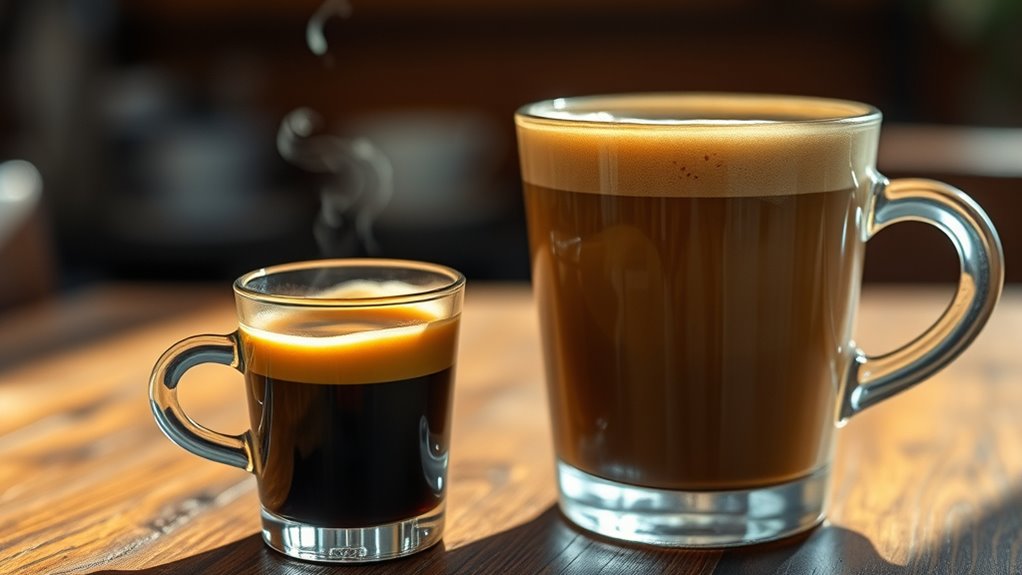
Although espresso is more concentrated, with about 60-80 mg of caffeine per 1 oz shot, drip coffee typically delivers more total caffeine because of its larger 8 oz serving size, which contains roughly 95-120 mg.
When you compare these beverages, it’s clear that total caffeine depends on volume and the amount of coffee grounds used, not just concentration. The misconception that espresso has more caffeine comes from its intensity per ounce.
But since a standard drip coffee serving is much larger, it ultimately contains more caffeine overall.
Understanding this helps you make informed choices based on your caffeine needs rather than assumptions about concentration alone. So, when deciding between espresso and drip coffee, think about total caffeine intake, which usually favors drip coffee because of its larger volume.
Additionally, the espresso dose plays a crucial role in determining the strength and flavor profile of the shot, which indirectly influences caffeine extraction and perception.
How Caffeine Concentration Varies Between Espresso and Coffee
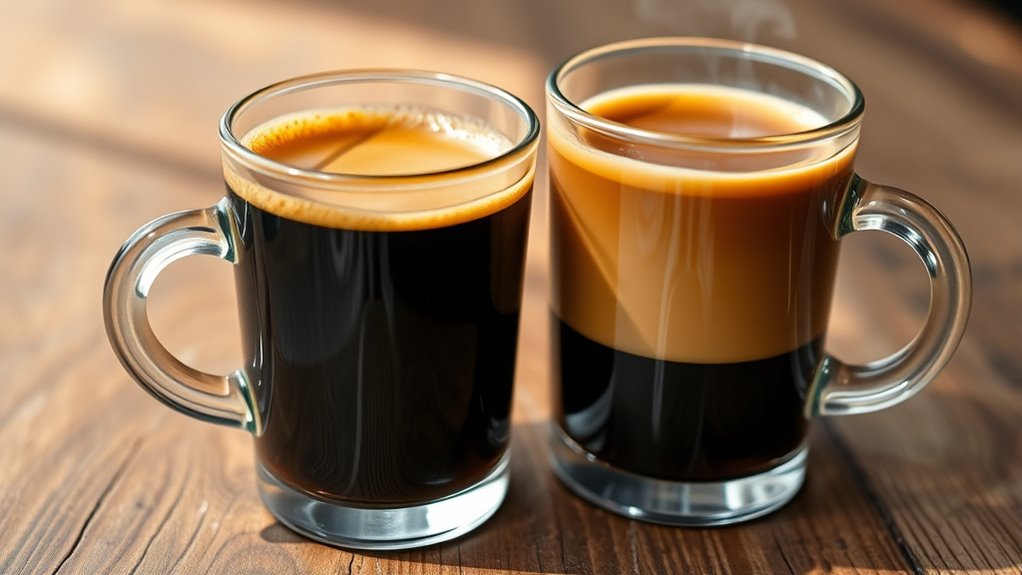
You’ll find that espresso packs about 40-80 mg of caffeine per ounce, which is way higher than the 10-15 mg per ounce you get in brewed coffee.
But because espresso servings are so small, the total caffeine usually ends up being less than what you’d get from an 8-ounce cup of coffee.
It’s a good example of how both caffeine concentration and the amount you drink work together to shape your actual caffeine intake.
The extraction time of espresso plays a crucial role in determining its flavor and caffeine content.
Caffeine Per Ounce
How much caffeine do you get in each ounce of espresso compared to brewed coffee? Espresso packs approximately 40-80 mg of caffeine per ounce, making it markedly more concentrated than brewed coffee, which contains about 10-15 mg per ounce.
This difference stems from espresso’s brewing method, which uses high pressure and a short extraction time to efficiently extract caffeine.
In contrast, brewed coffee employs a longer steeping process with lower pressure, resulting in less caffeine per ounce. Factors like grind size and extraction time also influence caffeine concentration.
Understanding this helps you recognize why espresso feels stronger, despite its smaller serving size.
This precise caffeine per ounce data clarifies the concentration disparity without considering total intake, which depends on serving volume.
Additionally, espresso shots in larger drinks like a Venti can be customized to increase caffeine content and maintain flavor despite dilution from ice, highlighting how preparation affects overall caffeine levels and taste balance in coffee beverages such as the Venti espresso.
Serving Size Impact
Understanding caffeine concentration per ounce sets the stage for examining how serving size shapes your total caffeine intake from espresso and coffee.
Espresso packs 40-80 mg of caffeine per ounce, far surpassing brewed coffee’s 10-15 mg per ounce. However, since a typical espresso shot is just 2 ounces, your total caffeine intake hovers around 126 mg.
Meanwhile, an 8-ounce cup of drip coffee, with a lower concentration, can deliver between 95 and 120 mg of caffeine.
This means volume plays a critical role. Larger coffee servings often provide comparable or greater caffeine than espresso despite its higher concentration.
Starbucks uses the Mastrena, a fully automated espresso machine designed to maintain consistent caffeine extraction and flavor quality in every shot.
Concentration Versus Volume
Although espresso contains considerably more caffeine per ounce than brewed coffee, the total caffeine you consume depends largely on the beverage’s volume. When comparing caffeine content, focus on these key points:
- Espresso delivers about 40-80 mg of caffeine per ounce, while brewed coffee has 10-15 mg per ounce.
- A standard 2 oz espresso shot contains roughly 64 mg of caffeine, less than an 8 oz cup of brewed coffee, which ranges from 95-120 mg.
- The caffeine concentration affects how quickly caffeine enters your system, with espresso providing a rapid intake, while brewed coffee offers a slower, prolonged release.
Understanding the difference between concentration and volume helps you accurately assess your caffeine intake from either beverage. A doppio espresso contains roughly double the caffeine of a single espresso shot, providing a more potent caffeine dose for those seeking extra intensity.
Comparing Total Caffeine in Espresso Shots and Coffee Cups
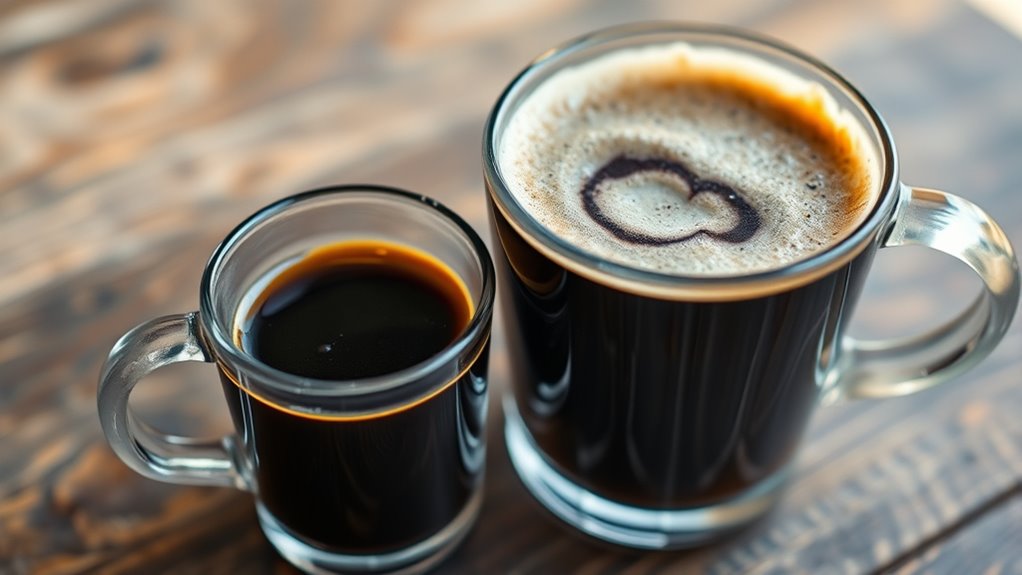
When you compare espresso and coffee, it’s important to think about both the serving size and how much caffeine is packed into each ounce.
A single 2-ounce shot of espresso has more caffeine per ounce than an 8-ounce cup of brewed coffee.
But because the coffee cup is bigger, it usually ends up giving you more total caffeine.
Espresso typically contains about 63 mg of caffeine per shot, which can vary based on bean type and preparation.
Serving Size Impact
Because caffeine content depends largely on serving size, comparing espresso shots to coffee cups reveals key differences in total intake. While espresso is more concentrated, its small 2 oz servings limit total caffeine compared to an 8 oz coffee cup. Understanding serving size impact helps you gauge your caffeine consumption accurately.
Consider these points:
- A standard 8 oz drip coffee contains about 95-120 mg of caffeine, which is more than a single 2 oz espresso shot’s 64 mg.
- Drinking multiple espresso shots can increase caffeine intake, but a large coffee generally still provides more caffeine overall.
- Total caffeine depends on volume, not just concentration, so serving size is the main factor in total caffeine intake.
- The caffeine content variation also depends on bean type, roast level, and extraction time, which can influence the actual caffeine in each serving.
Concentration Versus Volume
Understanding how caffeine concentration interacts with serving size clarifies why espresso and brewed coffee differ in total caffeine content.
Espresso packs about 60-80 mg of caffeine per ounce, while brewed coffee has 8-15 mg per ounce. Despite espresso’s higher concentration, its smaller volume means it often delivers less total caffeine than a typical cup of coffee.
Your total caffeine intake depends more on volume than concentration alone. Drinking a larger cup of brewed coffee usually results in consuming more caffeine overall, even though espresso is denser.
The rapid absorption of caffeine in espresso contributes to a quicker energy boost compared to brewed coffee.
| Beverage Type | Caffeine Content (mg) |
|---|---|
| Espresso (1 oz) | 63 |
| Brewed Coffee (8 oz) | 95 |
| Espresso (2 oz) | 126 |
| Brewed Coffee (12 oz) | 142 |
| Brewed Coffee (16 oz) | 190 |
How Brewing Changes Your Coffee’s Caffeine
Although brewing methods vary widely, each one changes how much caffeine ends up in your cup by influencing extraction factors like time, temperature, grind size, and coffee quantity. You can control caffeine content quite a bit by adjusting these variables.
- Brewing time: Longer times, like in cold brew, extract more caffeine overall. Espresso’s short 20 to 30 second extraction limits total caffeine, even though it has a high concentration.
- Grind size and pressure: Finer grinds in espresso help caffeine extract quickly and efficiently under pressure. But the short extraction time keeps the total caffeine amount lower.
- Temperature and coffee amount: Hot water near boiling helps caffeine dissolve better. And using more coffee grounds increases caffeine in a pretty straightforward way.
Knowing these factors lets you customize your brew’s caffeine level just the way you like it, whether you want a quick espresso or a slow drip. Fresh espresso is especially important because it provides essential oils and crema that contribute to the coffee’s rich flavor and texture.
Why Espresso Feels Stronger Than Coffee
The way espresso delivers caffeine differs a lot from regular coffee, which changes how strong it feels to you. Espresso’s caffeine concentration is much higher per ounce, and you drink it in small, quick shots. This fast intake causes a sharp boost in alertness, making it feel stronger.
Plus, espresso’s intense aroma and bold flavor really add to that feeling of power. The brewing process uses high pressure and fast extraction, packing caffeine into a concentrated shot. The caffeine content in a double shot typically ranges from 70 to 120 mg, providing a more potent caffeine dose than a standard coffee serving.
| Factor | Impact on Perception |
|---|---|
| Caffeine Concentration | 40-80 mg/oz, higher intensity |
| Serving Size | Small shots, rapid consumption |
| Aroma and Flavor | Bold, intense, enhancing strength |
| Extraction Method | High pressure, quick extraction |
| Alertness Onset | Fast spike, feels stronger |
All these things together make espresso feel stronger than drip coffee.
Roast Level’s Impact on Espresso and Drip Coffee Caffeine
While many assume that darker roasts pack less caffeine than lighter ones, research shows roast level has minimal effect on caffeine content in both espresso and drip coffee. Caffeine remains stable through roasting, so darker roasts don’t lose significant caffeine despite prolonged heat exposure.
Roast level minimally affects caffeine; darker roasts retain nearly the same caffeine despite longer roasting.
Instead, caffeine content depends more on the coffee bean variety and the brewing method. Consider these points:
- Dark roast beans are less dense but contain nearly the same caffeine per bean as light roasts.
- The caffeine concentration is primarily set by bean type, such as Arabica or Robusta, not roasting.
- Brewing variables and coffee quantity impact caffeine in your cup far more than roast level.
How Drinking Speed Influences Caffeine’s Effect on You
Because you absorb caffeine more quickly when drinking espresso shots rapidly, you experience a sharper and faster rise in alertness compared to sipping larger amounts of coffee slowly. This rapid intake leads to a swift spike in caffeine concentration in your bloodstream, intensifying stimulant effects.
Conversely, when you consume coffee gradually, caffeine enters your system more steadily, resulting in sustained energy without abrupt peaks.
Drinking espresso quickly can also increase the risk of side effects like jitters or heart palpitations due to the sudden caffeine surge.
Slower sipping allows your body to metabolize caffeine more evenly, reducing the likelihood of anxiety or energy crashes.
Ultimately, the speed at which you drink directly influences how caffeine affects your alertness and physiological responses.
Which Coffee Should You Choose for More Caffeine?
If you want more caffeine, choosing your coffee type wisely matters. Though espresso is more concentrated, a standard 8 oz drip coffee typically contains 95-120 mg of caffeine, which is more than a single 64 mg shot of espresso.
Choosing coffee wisely matters—an 8 oz drip has more caffeine than a single espresso shot.
So, to get the most caffeine, it’s better to focus on the volume and brewing strength rather than just picking espresso.
Here’s the deal: larger servings of drip coffee provide more total caffeine than one espresso shot.
You can also increase the caffeine by using more coffee grounds during brewing—it really makes a difference.
And if you want even more caffeine, having multiple espresso shots can match or even beat the caffeine in one big cup of drip coffee.
How to Maximize Your Caffeine Intake
To maximize your caffeine intake, you’ll want to focus on key factors like the amount of coffee grounds used and brewing methods that extract higher caffeine levels. Increasing the quantity of coffee grounds directly raises caffeine content, so using more coffee or larger servings is effective.
Brewing methods such as cold brew and French press extract more caffeine compared to drip coffee, making them smart choices. You can also increase caffeine by consuming multiple espresso shots throughout the day.
Additionally, optimizing grind size and brewing time enhances caffeine extraction efficiency. Fine-tuning these variables ensures each cup delivers more caffeine without necessarily increasing volume.
Frequently Asked Questions
Does Caffeine Content Vary Between Coffee Bean Origins?
You won’t see much caffeine variation between coffee bean origins since Arabica and Robusta beans’ caffeine levels stay fairly consistent.
Instead, bean type and processing methods primarily determine caffeine content, not geographic origin or growing conditions. So, where the beans come from doesn’t really change how much caffeine you get. It’s more about the kind of bean and how it’s handled afterward.
Can Decaf Espresso Have More Caffeine Than Regular Coffee?
Yes, decaf espresso can have more caffeine per ounce than regular coffee. But usually, regular coffee has more total caffeine because you drink more of it.
Sometimes, if you have multiple shots of decaf espresso, it might actually have more caffeine than a small cup of regular coffee. It’s not super common, but it can happen.
How Does Milk or Cream Affect Caffeine Absorption?
Milk or cream can slow caffeine absorption by up to 30%. This happens because the fat in dairy delays gastric emptying, and the proteins in milk bind to caffeine.
You’ll still get the same amount of caffeine, but the stimulant effect hits you more gradually. So, it’s like your caffeine buzz is spread out over a longer time instead of coming all at once.
Are Caffeine Effects Different for Espresso Versus Coffee Drinkers?
Yes, you’ll notice espresso’s caffeine hits you quicker and sharper due to rapid consumption, while coffee provides a steadier, prolonged effect.
Your mood, tolerance, and drinking pace also shape how caffeine impacts you physically and mentally. It’s pretty interesting how the same caffeine can feel so different depending on how you drink it.
Does Caffeine Content Change With Espresso Machine Types?
You won’t see significant caffeine differences between espresso machine types if you use the same coffee amount. Extraction consistency matters more than machine style.
That said, high-end machines may slightly optimize caffeine content through stable pressure and temperature. But honestly, the difference is usually pretty small. So, focus more on how well the machine extracts rather than its brand or type.
Conclusion
Choosing between espresso and drip coffee for caffeine is like picking a sharp arrow versus a broad net. You get a quick, concentrated hit with espresso, or a steadier, larger dose with drip coffee.
Understanding brewing methods, roast levels, and serving sizes helps you target your caffeine needs precisely. So, think about how fast you want your boost and how much caffeine you need.
Then select your coffee accordingly to maximize both enjoyment and alertness. It’s all about matching your caffeine fix to your mood and schedule.