You start by grinding fresh coffee beans finely, measuring about 16-19 grams for a double shot. Distribute and tamp the grounds evenly with firm pressure. Then, secure the portafilter into an espresso machine set to deliver at least 9 bars of pressure.
Brew by forcing hot water through the coffee for 25-30 seconds. Watch for a steady, syrupy, golden flow with rich crema. Stop extraction when you see blonding near the end. Mastering this reveals the full espresso experience.
What Makes Espresso So Special?
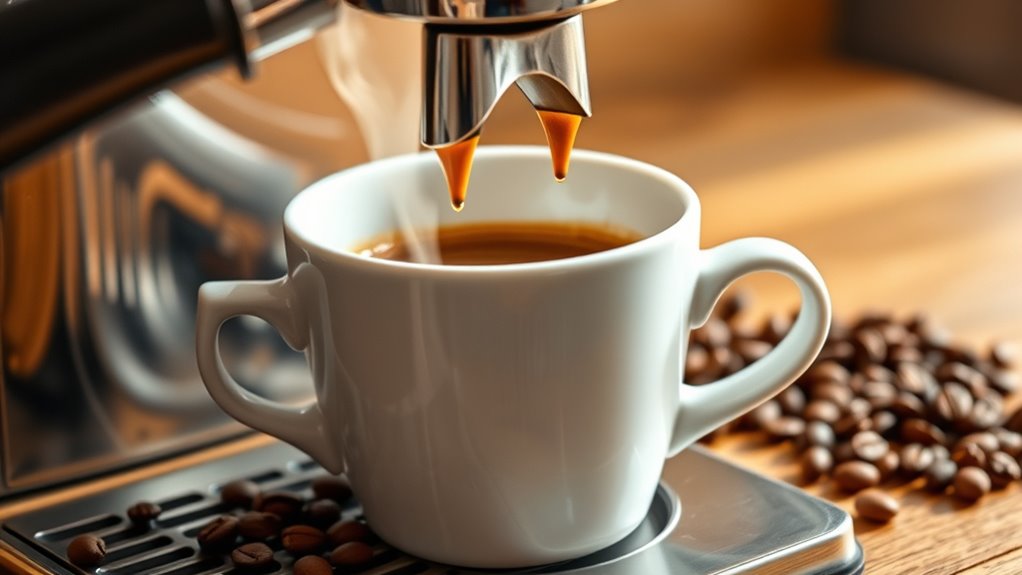
While many coffee drinks rely on simple brewing methods, espresso stands out because it forces hot water through finely ground coffee at high pressure, usually 9 bars or more. This intense pressure extracts a concentrated shot bursting with a balanced blend of sweetness, acidity, and bitterness, all wrapped in a rich, velvety texture.
Espresso’s high-pressure extraction crafts a rich, balanced shot with sweetness, acidity, and velvety texture.
You’ll notice the distinctive golden crema forming on top. This thin, aromatic layer enhances both flavor and aroma, setting espresso apart from other brews.
The fine grind and quick extraction time, typically 25 to 30 seconds, deliver that signature intensity.
To get it just right, you need fresh coffee beans, precise tamping, and exact temperature control. Mastering these elements turns espresso brewing into an art, producing a complex, unforgettable coffee experience.
Proper pressure extraction is essential to develop the characteristic crema and rich flavor that define a quality espresso shot.
Essential Equipment for Espresso Brewing
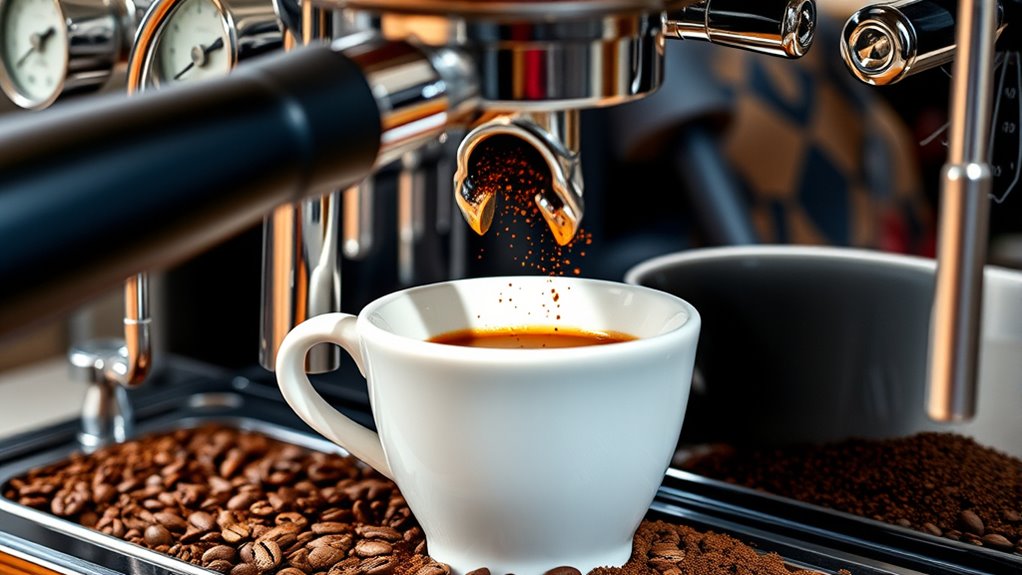
Because espresso demands exact pressure and grind consistency, having the right equipment is essential to achieving that perfect shot. First, you’ll need an espresso machine with a pump that delivers at least 9 bars of pressure. This ensures proper extraction.
Next, invest in a high-quality burr grinder, preferably with flat burrs 55mm or larger, to achieve consistent, fine grounds. A tamper applying around 30 pounds of pressure compresses the coffee grounds evenly in the portafilter.
To dial in your shot, use a digital scale and timer for precise dosing, usually 18 grams for a double. Keep an eye on the extraction time closely.
Optional tools like puck screens, distribution devices (WDT), and cleaning supplies help improve shot consistency and maintain your machine’s performance.
Maintaining a consistent extraction time of 25-30 seconds ensures balanced flavor and crema development in your espresso.
Grinding and Dosing Your Espresso Beans
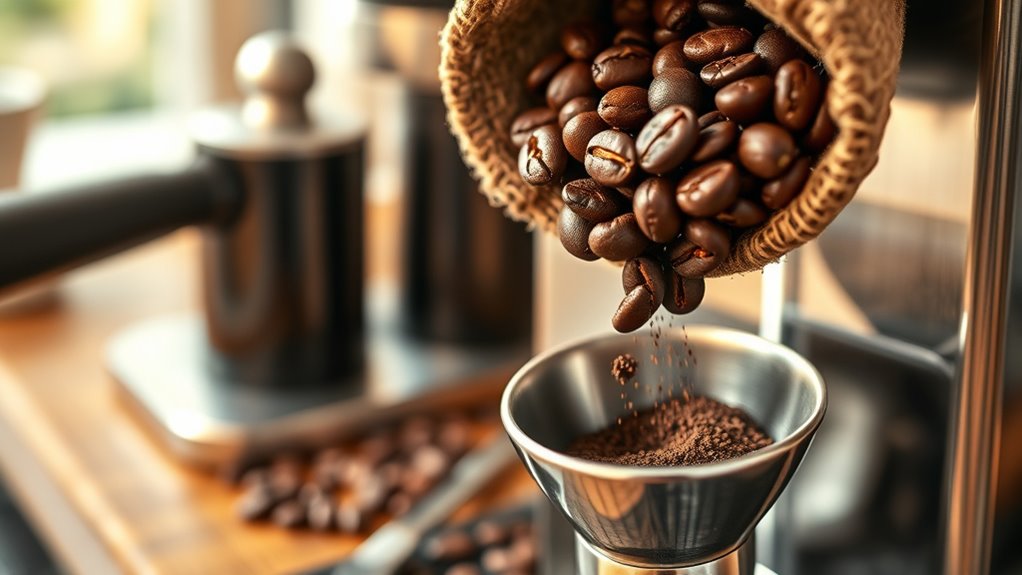
You’ll want to grind your espresso beans just before brewing to keep all that freshness and CO2 locked in. Aim for a fine, powdery texture—that’s key for a great shot.
Then, measure out 16 to 19 grams on a scale. Getting this right every time helps ensure your dosing is consistent, which means a more balanced extraction.
Before you tamp, take a moment to evenly distribute and fluff the grounds. This little step makes a big difference by promoting uniform water flow and stopping any channeling from happening.
Adjusting the grind size within the ideal range of 200-400 microns can dramatically improve shot timing and flavor balance.
Optimal Grind Size
Although dialing in your grind size can feel tricky at first, getting it just right is essential for a balanced espresso shot. Aim for a grind as fine as powdered sugar or table salt. This fineness allows the necessary pressure buildup and ideal extraction.
If your grind’s too coarse, your shot will under-extract, tasting weak, sour, or watery. On the flip side, grinding too fine leads to over-extraction, resulting in bitterness and sluggish flow.
Remember, freshness matters. Grind your beans immediately before brewing to preserve CO2 and aromatic compounds that enrich flavor.
Mastering this fine balance ensures your espresso delivers rich, complex flavors with every pull, setting the foundation for an exceptional shot. Using a burr grinder is recommended to achieve consistent and uniform grounds, which is critical for optimal extraction.
Accurate Coffee Dosing
How much coffee you dose plays a crucial role in crafting a balanced double shot of espresso. Aim for 16 to 19 grams of grounds to guarantee accuracy.
Grind your coffee immediately before brewing with a burr grinder set to a fine, consistent texture, like confectionary sugar. This preserves freshness and maximizes extraction.
Once ground, distribute the coffee evenly in the portafilter. Use a WDT tool or a similar method to break up clumps and prevent channeling, which can ruin extraction.
Tamp the grounds with about 30 pounds of even pressure, creating a uniform puck that allows water to flow properly through the coffee bed.
Paying close attention to these steps guarantees a well-dosed, flavorful espresso every time. It might take some practice, but it’s worth it for that perfect shot. Just keep at it!
Adjusting the dose slightly can help balance extraction time and flavor, ensuring you avoid over- or under-extraction.
Freshness and Timing
Because freshness directly impacts flavor and crema, grinding and dosing your espresso beans just before brewing is essential. When you grind immediately, you preserve the CO2 and aromatic compounds that give your espresso its vibrant taste and rich crema.
Use a scale to measure 16-19 grams for a double shot, ensuring consistency every time. Your grind size should be fine, like powdered sugar, to enable proper extraction within 25-30 seconds.
Always brew within 7 to 30 days of the roast date. Stale beans lead to flat or sour shots.
Proper brewing techniques—including precise grind size and extraction time—are key to achieving the ideal caffeine content and flavor balance in your espresso.
Leveling and Tamping for Even Extraction
When you level and tamp your coffee grounds correctly, you set the foundation for an even extraction that brings out the best flavors in your espresso.
Start by evenly distributing the coffee bed using tools like the Weiss Distribution Device or the Weiss Distribution Technique (WDT) to avoid uneven tamping.
Begin by evenly spreading the coffee grounds with the Weiss Distribution Device or WDT to ensure an even tamp.
Next, use a level tamper and apply firm, consistent pressure, about 30 pounds, across the entire surface. This ensures uniform puck density and avoids tilting or uneven compression.
Immediately after tamping, check that the coffee surface is flat and level to promote even water flow.
Finally, tamp quickly and decisively to maintain the coffee bed’s integrity and prevent disturbing the grounds before brewing.
Mastering these steps is essential for balanced, flavorful espresso shots. It might take some practice, but once you get the hang of it, your espresso will taste noticeably better.
Consistent tamping pressure also helps regulate extraction and yield consistency through uniform puck density, which is key to achieving the ideal espresso yield.
Brewing Your Espresso Shot
Once you’ve prepared your coffee puck with care, it’s time to brew your espresso shot with precision. Begin by dosing 16-19 grams of freshly ground coffee into the portafilter. Use a WDT tool to guarantee even distribution.
Level the coffee bed swiftly, then tamp firmly with about 30 pounds of pressure to create a uniform puck. Lock the portafilter securely into the machine without disturbing the tamped grounds.
Start the extraction immediately, aiming for a 25-30 second shot time. Watch for a steady, golden syrup-like stream as the espresso flows.
This process produces a rich, velvety crema with a balanced aroma, signaling a well-extracted shot ready to serve. Precision at each step ensures your espresso’s flavor and texture shine.
Regular maintenance and descaling of your espresso machine help preserve consistent extraction quality and machine performance.
Key Visual Cues When Pulling Espresso
When you’re pulling your espresso, keep an eye out for a steady, golden stream that flows smoothly without any swirling. It’s all about that nice, consistent flow.
You’ll also want to notice the color changes—from a rich caramel at the beginning to a blonding near the end. These shifts tell you a lot about how well your extraction is going.
And don’t forget to watch the flow rate and the texture of the crema. These little details help make sure you’re nailing that perfect shot every time.
Espresso Stream Characteristics
Although pulling the perfect espresso shot requires skill, you can gauge your success by closely observing the espresso stream. A well-extracted shot flows steadily in a thick, syrup-like stream resembling warm honey. The color should be a rich golden amber, lasting about 25 to 30 seconds.
Watch for a smooth, continuous flow without twirling or dancing. That signals even pressure and tamping. Near the end, you might notice blonde or blonding, which means the extraction is almost complete.
Consistent observation of these visual cues helps you fine-tune variables like grind size and tamping pressure for optimal flavor balance.
| Stream Characteristic | Visual Cue | Meaning |
|---|---|---|
| Thick, viscous flow | Honey-like texture | Proper extraction |
| Steady, continuous | No twirling or dancing | Even pressure and tamping |
| Golden amber color | Rich, consistent tone | Ideal extraction timing |
Visual Extraction Indicators
Because the visual cues during extraction reveal so much about your espresso’s quality, paying close attention to the stream is essential. You want to see a steady, thin, golden stream that gradually thickens as the shot develops. If the stream twirls or dances, it’s a sign of channeling or uneven extraction, which you’ll want to avoid.
A well-pulled shot produces rich, caramel-colored crema that coats your cup evenly and lingers. Around 25-30 seconds, watch for “blonding.” This is when the stream lightens, signaling the end of ideal extraction. The flow should remain consistent without sputtering or bursts.
Irregularities usually mean uneven water distribution or improper tamping. Mastering these visual indicators helps you dial in espresso that’s balanced and flavorful every time. It might take a bit of practice, but once you get the hang of it, you’ll notice the difference in every shot.
Keep an eye on those little details—they really matter! Additionally, since espresso contains only about 1 calorie per shot, focusing on extraction quality enhances flavor without adding unwanted calories.
When to Stop Your Espresso Shot
If you want to nail the perfect espresso shot, you’ll need to stop the extraction at just the right moment. Watch for a steady, syrupy stream lasting about 25-30 seconds for a double shot. The color should be rich, caramel, or golden. This shows proper extraction.
Use a timer to maintain consistency, aiming for 25 to 35 seconds depending on your taste preference. Pay close attention to the flow rate and crema. These tactile cues help you decide the ideal stop time.
Stop the shot before it starts blonding or turning pale and watery, which signals under-extraction. By combining timing with keen observation, you’ll consistently pull shots that balance strength and flavor perfectly every time.
Serving and Enjoying the Perfect Espresso
Once your espresso shot is pulled, serving it immediately is essential to preserve the rich crema and full flavor. Pour it into a preheated cup to maintain heat and protect the delicate crema longer.
Serve espresso immediately in a preheated cup to preserve its rich crema and vibrant flavor.
Before sipping, give the espresso a gentle swirl or stir to evenly distribute the crema, enhancing texture and flavor consistency.
Take a moment to taste the espresso on its own first. This lets you appreciate its aroma, body, and flavor profile fully.
If you prefer milk-based drinks, add steamed milk or foam carefully. Keep proper ratios to balance the intensity without overpowering the espresso’s character.
Frequently Asked Questions
How Do Different Coffee Bean Origins Affect Espresso Flavor?
You’ll notice espresso flavors shift with bean origins. Ethiopian beans bring fruity brightness, Colombian ones offer nutty balance, and Sumatran beans add earthy depth.
These distinct profiles come from unique climates, soils, and altitudes shaping each bean’s taste. It’s pretty cool how where a bean grows can change its whole flavor. Just a little difference in environment makes a big difference in your cup.
Can I Use Pre-Ground Coffee for Espresso?
Using pre-ground coffee for espresso is like painting with dull colors. You’ll miss vibrant flavors and crema.
You can use it, but grinding fresh just before brewing guarantees the best extraction and aroma. It also gives you a richer, more balanced shot every time.
How Often Should I Clean My Espresso Machine?
You should clean your espresso machine daily by wiping key parts. Deep clean it weekly with backflushing. And don’t forget to descale every 1-3 months.
Regular maintenance keeps your espresso tasting great. Plus, it helps your machine run smoothly. It’s worth the effort to enjoy better coffee every day!
What Is the Ideal Water Temperature for Brewing Espresso?
You want your water between 198°F and 205°F for espresso. Dark roasts need slightly cooler temps around 188°F to 194°F.
Keeping temperature consistent guarantees balanced extraction. This helps preserve acidity, sweetness, and bitterness in every shot you pull.
How Does Altitude Impact Espresso Extraction?
Wonder how altitude affects your espresso? At higher elevations, water boils at lower temperatures. This speeds up extraction and risks under-extraction.
You’ll need to adjust your grind, dose, or brewing time to keep that rich flavor and balanced crema. It’s all about making sure your espresso stays delicious no matter where you are.
Conclusion
Now that you know the art behind each espresso shot, you hold the key to revealing its rich, bold character. Like a symphony, every step from grinding to tamping to brewing must harmonize perfectly.
Master these details, and you’ll craft espresso that sings with flavor and balance. So, embrace the process, trust your instincts, and enjoy the rewarding dance of making espresso that’s nothing short of a masterpiece in a cup.