You can trace espresso back to Angelo Moriondo’s 1884 steam-powered machine, which first used pressurized water to brew coffee quickly. Luigi Bezzera improved it in 1901 by adding the portafilter and multiple brew heads for speed and consistency.
Desiderio Pavoni then commercialized these machines, making them more widely available. Achille Gaggia revolutionized espresso in 1938 with a high-pressure lever that created the signature crema.
This brief history sets the stage for understanding how espresso became a global cultural icon. It’s pretty fascinating how these innovations built on one another, isn’t it?
Early Espresso Origins and First Coffee Machines
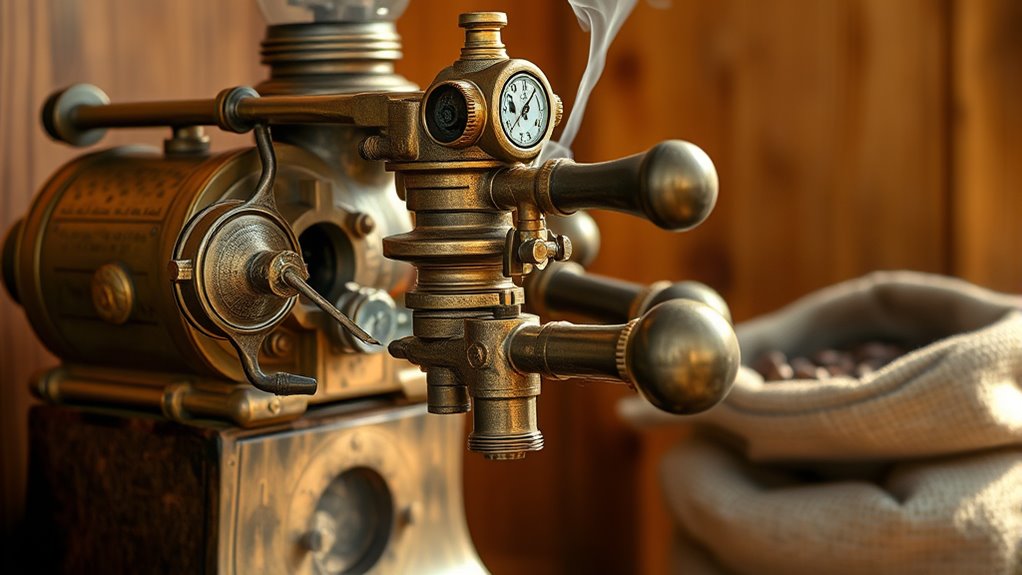
Although espresso as it’s recognized today evolved over time, the journey began in 1884 when Angelo Moriondo from Turin, Italy, patented the first espresso machine. You’d find his invention quite large and bulky, using steam power to push hot water through coffee grounds.
This design aimed to cut brewing time by about 90%, making coffee preparation much faster than before.
Moriondo showcased his machine at the Turin General Exposition, where it earned a bronze medal for innovation. Despite its breakthrough, the machine wasn’t mass-produced or widely adopted.
Moriondo himself faded from espresso’s evolving history.
Still, his early work laid the foundation for future developments in espresso machines. It marked a key moment in coffee’s technological progress. And that’s how the espresso story really got started.
This initial concept would eventually evolve into the sophisticated process of espresso extraction, where pressure, temperature, and grind size play vital roles in flavor development.
Angelo Moriondo’s 1884 Espresso Machine Patent
You know, Angelo Moriondo actually patented the very first espresso machine back in 1884. He used steam power to speed up the brewing process quite a bit.
His machine was pretty bulky and worked by forcing water and steam through coffee grounds to make a quick cup.
It wasn’t something that got produced on a large scale, though. Still, his invention really laid the groundwork for all the espresso machines that came after.
Regular maintenance like descaling is essential to keep modern espresso machines functioning properly and to preserve the quality of the coffee.
Early Espresso Innovation
How did espresso machines first come into existence? Angelo Moriondo’s 1884 patent marks the earliest known design resembling modern espresso machines. He created a bulky device powered by steam, designed to speed up coffee preparation by forcing steam and water through coffee grounds.
Moriondo showcased this innovative machine at the Turin General Exposition, where it earned a bronze medal for its ingenuity. Despite its clear potential to revolutionize café service by reducing brewing time, Moriondo’s machine was never mass-produced or widely adopted.
Over time, his contribution faded from coffee history. Still, his invention laid essential groundwork for later espresso machine developments. It marked the first step toward the efficient, espresso-focused brewing methods you enjoy today. Understanding the importance of freshness and grind size is crucial for optimizing the espresso experience that evolved from these early innovations.
Moriondo’s Steam Mechanism
When Angelo Moriondo patented his espresso machine in 1884, he introduced a steam-powered mechanism that fundamentally changed coffee brewing. His invention aimed to speed up the extraction process by using steam pressure to force hot water through coffee grounds.
Moriondo’s machine was bulky and not mass-produced, but it laid essential groundwork for future espresso technology. Here’s what made his design notable:
- It combined steam and water to extract coffee quickly, reducing brewing time considerably compared to traditional methods.
- It operated with steam pressure, marking a shift from simple drip coffee to pressurized extraction.
- Although large and cumbersome, it was the first documented attempt to mechanize espresso brewing.
This early approach contrasts with modern techniques that use precise control over extraction time and pressure to enhance flavor and quality.
You can see how this early step set the stage for the espresso machines we understand today.
Luigi Bezzera’s Innovations and the Single-Shot Espresso
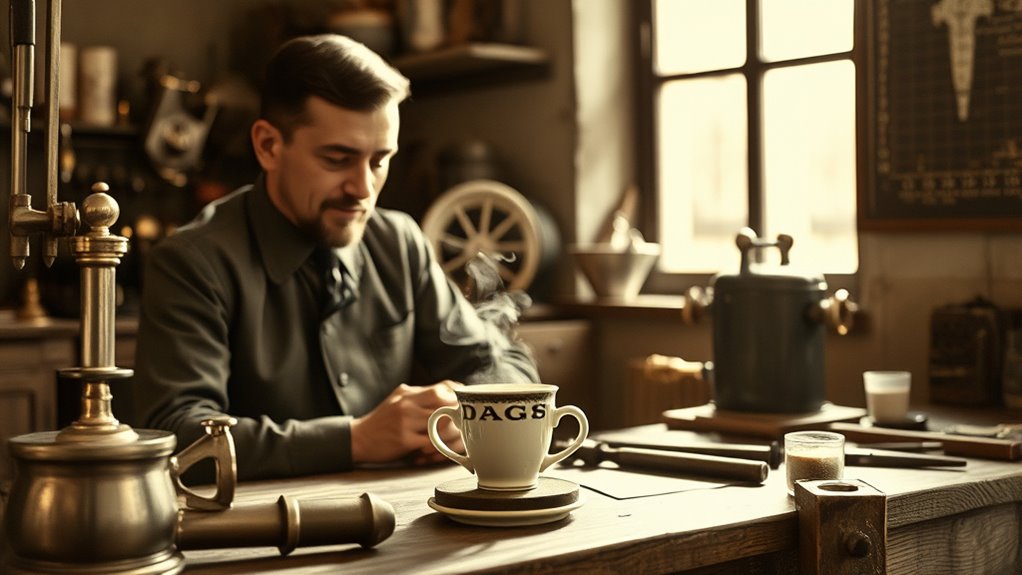
So, back in 1901, Luigi Bezzera came up with the first practical espresso machine. He introduced some clever features like the portafilter and multiple brew heads, which helped speed up how quickly coffee could be made.
Basically, his design used steam pressure to push hot water through finely-ground coffee. This was a big deal because it laid the groundwork for what we now know as the single-shot espresso.
This innovation really changed the game for coffee brewing. It focused on making coffee quickly while packing in a concentrated flavor, and it helped shape the modern espresso machines we use today.
The importance of controlling extraction time was a key factor in developing the consistent flavor profiles that define espresso.
Bezzera’s Key Innovations
Although espresso machines existed before him, Luigi Bezzera revolutionized coffee brewing by patenting the first practical espresso machine in 1901. It was designed specifically to produce quick, single shots of coffee.
His innovations focused on speed and efficiency, setting the stage for modern espresso.
Bezzera’s key contributions include introducing the portafilter, which made coffee tamping and extraction easier. He also added multiple brew heads to the machine, allowing for faster preparation of several shots.
Plus, he streamlined the process to consistently produce concentrated coffee rapidly.
These advancements not only increased brewing speed but also guaranteed consistency. This made espresso a quick, reliable beverage.
In fact, the term “espresso” likely comes from Bezzera’s emphasis on fast, “express” coffee brewing. It really marked a turning point in coffee history.
His work laid the foundation for the precise control of grind size and pressure that defines espresso extraction today.
Single-Shot Espresso Design
Building on Bezzera’s earlier improvements, the single-shot espresso design focused on delivering individual servings quickly and consistently. In 1901, Luigi Bezzera invented the first single-shot espresso machine to produce coffee faster.
He introduced a portafilter and multiple brew heads, which let you brew several shots efficiently.
Each single shot typically used about 7 grams of ground coffee, ensuring a precise portion size. Bezzera emphasized using high pressure to extract a concentrated, flavorful espresso shot, setting a new standard.
This design made it possible for cafes to serve espresso one shot at a time without sacrificing speed or quality.
Thanks to his innovation, the single-shot espresso became the foundation for the modern espresso you enjoy today. It really changed the way coffee was served, making it quicker and more consistent. And that’s something coffee lovers everywhere can appreciate. The process of forcing hot water through finely ground coffee at high pressure was key to achieving the signature espresso extraction.
Impact on Coffee Brewing
When Luigi Bezzera patented his practical espresso machine in 1901, he revolutionized coffee brewing by introducing a method that used steam pressure to force hot water through finely ground coffee. This innovation changed how you experience coffee in three key ways:
First, speed. Bezzera’s single-shot design with a portafilter cut brewing times dramatically. That meant you could enjoy your coffee much faster than with traditional drip methods.
Next, concentration. The single-shot espresso emphasized a rich, intense flavor by extracting coffee under high pressure.
Finally, foundation. His method established the high-pressure extraction principle that defines modern espresso machines. It’s the basis for the espresso you know and love today.
This high-pressure extraction process creates the signature velvety crema that distinguishes real espresso from other coffee types.
Desiderio Pavoni’s Role in Commercializing Espresso Machines
Since Luigi Bezzera developed the initial espresso machine patents, Desiderio Pavoni recognized their potential and purchased them around 1905-1906.
You’ll see that Pavoni didn’t just stop at acquiring the technology; he branded his machine as “Pavoni’s Espresso” and promoted it for producing fast, high-quality coffee.
To enhance safety and functionality, he introduced key features like the pressure release valve and steam wand.
Thanks to Pavoni’s marketing efforts, espresso quickly gained popularity across Italy and Europe in the early 20th century.
His company played a pivotal role in transforming espresso from a technical novelty into a widely accessible commercial product.
This made espresso a staple in cafes and households beyond its original invention.
His innovations laid the groundwork for the precise pressure extraction process that defines modern espresso brewing.
Achille Gaggia’s High-Pressure Espresso Innovation
Although early espresso machines relied on steam pressure, Achille Gaggia revolutionized the process in 1938 by inventing a lever-operated espresso machine that increased extraction pressure from about 1.5-2 bars to 8-10 bars.
Achille Gaggia transformed espresso in 1938 by boosting pressure from 2 to 10 bars with a lever machine.
This shift allowed you to extract richer, crema-topped espresso, a defining trait of authentic coffee.
Gaggia’s design used a spring piston mechanism, enabling baristas to manually pull shots with consistent, high pressure. His machine marked a key technological breakthrough, moving espresso brewing away from steam systems to high-pressure extraction.
Here’s what Gaggia’s innovation achieved for you:
- Raised pressure to 8-10 bars for superior extraction
- Produced a thicker, aromatic crema layer
- Established the foundation for modern espresso machines
This invention set the standard for quality espresso brewing you enjoy today. Pretty amazing how one idea changed the way we make espresso, right? Descaling regularly is essential to maintain these machines’ performance and ensure consistent pressure during extraction, preventing mineral buildup from affecting the espresso quality.
Major Espresso Machine Breakthroughs
You’ll notice that Achille Gaggia’s 1947 spring-piston lever boosted pressure to 8-10 bars, which actually created the very first true crema.
Then, fast forward to 1961, when Ernesto Valente introduced the electric pump, making espresso machines more consistent with a steady 9-bar pressure.
These breakthroughs really changed the game, moving espresso from simple steam-powered methods to precise, high-pressure brewing.
Piston Mechanism Innovation
How did espresso machines evolve from steam-powered devices to the high-pressure brewers we know today? The answer lies in Achille Gaggia’s 1947 piston mechanism innovation. This breakthrough replaced steam with a spring-loaded piston, significantly increasing pressure from 1-2 bars to 8-10 bars.
Here’s why it mattered: Gaggia’s piston system generated authentic espresso with crema by applying higher pressure. Baristas gained manual control by pulling a lever to extract shots precisely.
This mechanism marked a shift from steam power and set the stage for modern espresso machines.
You can see how Gaggia’s invention revolutionized espresso brewing, making it more consistent and flavorful. This piston mechanism remains the foundation of high-pressure espresso technology used worldwide today.
Electric Pump Emergence
What transformed espresso machines from manual to automated marvels? In 1961, Ernesto Valente invented the electric pump, revolutionizing espresso brewing. His pump consistently delivered about 9 bars of pressure, which is essential for ideal extraction.
Before this, you relied on manual lever systems. They were less efficient and pretty inconsistent. Valente’s innovation gave you precise control over water flow, producing uniform, high-quality shots every time.
This breakthrough marked a major shift in espresso machine design. It made brewing easier and way more reliable.
| Feature | Manual Lever System | Electric Pump System |
|---|---|---|
| Pressure Consistency | Variable, user-dependent | Steady at ~9 bars |
| User Effort | High | Minimal |
| Espresso Quality | Inconsistent | Uniform and superior |
The Development and Importance of Crema
Why does crema top a perfect espresso shot, and why has it become such a critical marker of quality? Crema is a dense, golden foam formed by emulsified oils and air. It’s created when high-pressure water forces carbon dioxide from coffee grounds. This process stabilizes tiny bubbles as foam, typically about 1-2 mm thick.
Crema, a dense golden foam from emulsified oils and air, signals a perfectly extracted espresso shot.
You should recognize crema’s importance for these reasons:
- It signals proper extraction, confirming the espresso was brewed under ideal conditions.
- It contains aromatic compounds and oils that enhance flavor and aroma, enriching your espresso experience.
- Its emergence became a key quality indicator after Giovanni Gaggia’s mid-20th-century innovations, revolutionizing espresso brewing.
Understanding crema helps you appreciate how science and craftsmanship combine in every espresso shot. It’s more than just a pretty topping — it’s the mark of a well-made espresso.
Regional Variations in Espresso Machine Designs
Crema’s presence on your espresso highlights the skill behind the machine’s design, which varies substantially across regions. In Italy, traditional lever and piston machines like the Brik and Gaggia stand out, offering manual control that suits darker southern roasts brewed under intense pressure and short extraction times.
Northern Italy prefers lighter roasts, adjusting grind and machine settings accordingly.
Across the Atlantic, North America emphasizes pump-driven, semi-automatic machines, relying on electric pumps for consistent pressure.
Italian machines also feature ornate Art Deco designs, contrasting with the more utilitarian look favored elsewhere.
Meanwhile, Japan has innovated compact, highly automated espresso machines, integrating precise temperature control and grinders.
Each design reflects local preferences, balancing tradition, technology, and aesthetics to craft the perfect espresso experience.
Global Spread of Espresso Culture
How did espresso travel from a local Italian tradition to a global coffee phenomenon? It began in early 20th-century Italy, where espresso quickly became central to daily life.
Then, Italian immigrants carried their passion abroad, exporting both culture and espresso machines worldwide.
Italian immigrants spread espresso culture globally, bringing both their passion and machines to new lands.
In the mid-1900s, American and European coffee bars embraced espresso, sparking broader interest.
Later, major chains like Starbucks introduced espresso-based drinks globally, accelerating its reach.
Here’s how espresso culture spread:
- Italian immigrants and machine exports planted the roots internationally.
- Mid-century coffee bars in the US and Europe popularized espresso outside Italy.
- Global chains standardized espresso-based drinks, making them widely accessible.
Today, espresso shapes coffee culture globally.
It’s adapting through regional variations in preparation and consumption, which makes it even more interesting.
How Early Inventors Shape Today’s Espresso Culture
Although espresso culture has evolved markedly over the decades, it still rests firmly on the innovations of early Italian inventors. Angelo Moriondo and Luigi Bezzera developed the first espresso machines, establishing the technological foundation for modern espresso.
In 1947, Achille Gaggia revolutionized espresso with his spring lever machine, introducing high-pressure extraction and the signature crema. Gaggia’s innovations standardized the espresso shot at 8-10 bars, setting the benchmark for brewing techniques worldwide.
The 20th century saw mechanization advance further with electric pumps, making espresso preparation consistent and more accessible to you and enthusiasts everywhere. These pioneers not only shaped the machine technology but also cemented Italy’s identity as the authentic espresso birthplace, influencing the global espresso culture you experience today.
Frequently Asked Questions
What Type of Coffee Beans Are Best for Espresso?
You’ll want Arabica beans for balanced flavor and acidity, combined with some Robusta for body and crema. Choose medium to dark roasts, and use freshly roasted beans within weeks.
Also, prefer high-altitude grown beans for complexity. This combo really brings out the best in your espresso.
How Do Espresso Machines Differ From Regular Coffee Makers?
You’ll notice espresso machines use high pressure to force hot water through finely ground coffee quickly, producing a concentrated shot with crema.
On the other hand, regular coffee makers rely on gravity and coarser grounds for a lighter, slower brew.
What Is the Ideal Water Temperature for Brewing Espresso?
Think of water temperature as espresso’s heartbeat. It should be between 90°C and 96°C.
You’ll extract rich flavors, avoid bitterness, and guarantee your shot’s crema stays perfect by keeping it consistent within this precise range.
Sticking to this sweet spot makes all the difference in your espresso’s taste and texture.
How Often Should Espresso Machines Be Cleaned?
You should clean your espresso machine daily by rinsing the brew group, portafilter, and baskets. This helps keep everything fresh and ready for your next cup.
Descale it every 1 to 3 months to prevent buildup and keep your machine running smoothly. Also, deep clean internal components periodically to maintain performance and hygiene.
Doing these simple steps will make sure your espresso tastes great and your machine lasts longer. It’s easier than you might think once you get into the habit!
Can Espresso Be Made Without a Machine?
You can’t squeeze a lemon without a press, just like you can’t make true espresso without a machine.
Manual methods like Moka pots or AeroPress mimic espresso, but they don’t have the precise pressure and control needed for that authentic taste.
Conclusion
You’ve seen how Moriondo sparked the first espresso machine, how Bezzera refined single shots, how Pavoni brought machines to cafés, and how Gaggia elevated pressure and crema. You’ve watched designs evolve regionally and espresso culture spread worldwide.
Each step built on the last, shaping the espresso experience you enjoy today. Understanding this history helps you appreciate every rich sip, every creamy layer, and every steaming cup crafted with innovation and tradition combined.

Pingback: Where Did Espresso Originate – Full History