You’ll find that espresso originated in early 20th-century Italy, where Luigi Bezzera invented the first machine in 1901. This invention introduced rapid, high-pressure coffee brewing, which was a game changer for coffee lovers.
The process evolved through Achille Gaggia’s 1947 piston machine, which created the crema, that delicious layer on top of the espresso. Then came Ernesto Valente’s 1961 pump-driven design, improving consistency and making espresso more reliable.
Italian cafés played a big role in fostering espresso culture, helping it spread across Europe and later to America. Plus, regional roasting variations added even more character to the espresso experience.
When you look into these developments, you start to see the complex history behind today’s global espresso tradition. It’s pretty fascinating how something so simple has such a rich story!
The Origins of Espresso Coffee in Italy
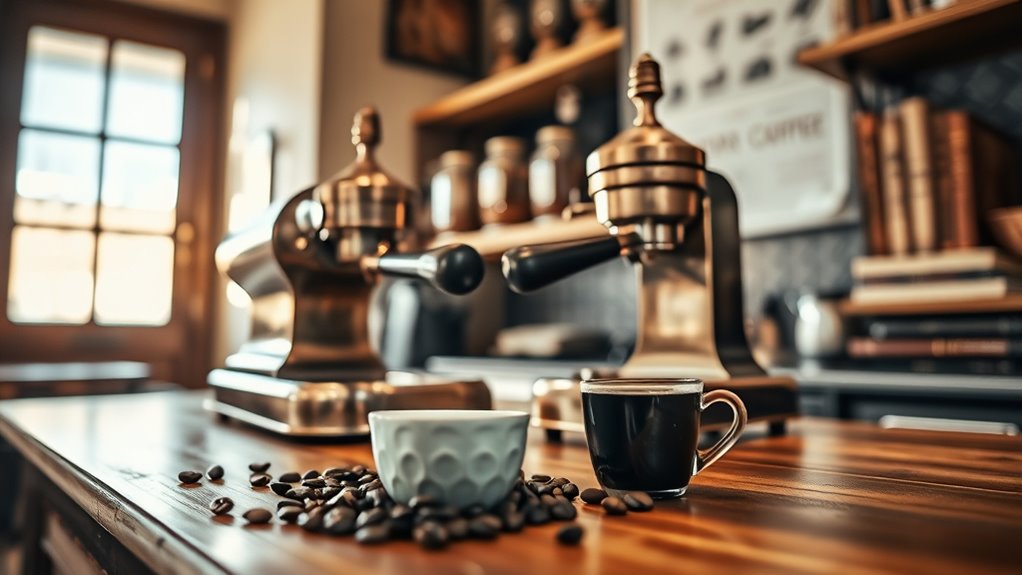
Although espresso coffee is now enjoyed worldwide, it originated in early 20th-century Italy as a solution for busy urban cafés seeking a faster brewing method. You’ll find that the term “espresso,” meaning “pressed out” in Italian, directly relates to the technique of forcing hot water through coffee grounds under pressure.
This approach was a significant shift from traditional brewing methods, emphasizing speed without compromising flavor. Italy’s rich coffee culture provided fertile ground for such innovation, as cafés needed efficient ways to serve high-quality coffee quickly.
Technological advancements there, especially in machine design, played a critical role in refining this method. They ultimately shaped espresso into a distinctive beverage. Understanding this origin helps you appreciate how espresso became a foundational element of modern coffee culture. Early pioneers like Luigi Bezzera introduced the portafilter and multiple brew heads, which were crucial in speeding up espresso production and defining its modern form.
Luigi Bezzera’s Early Espresso Innovations
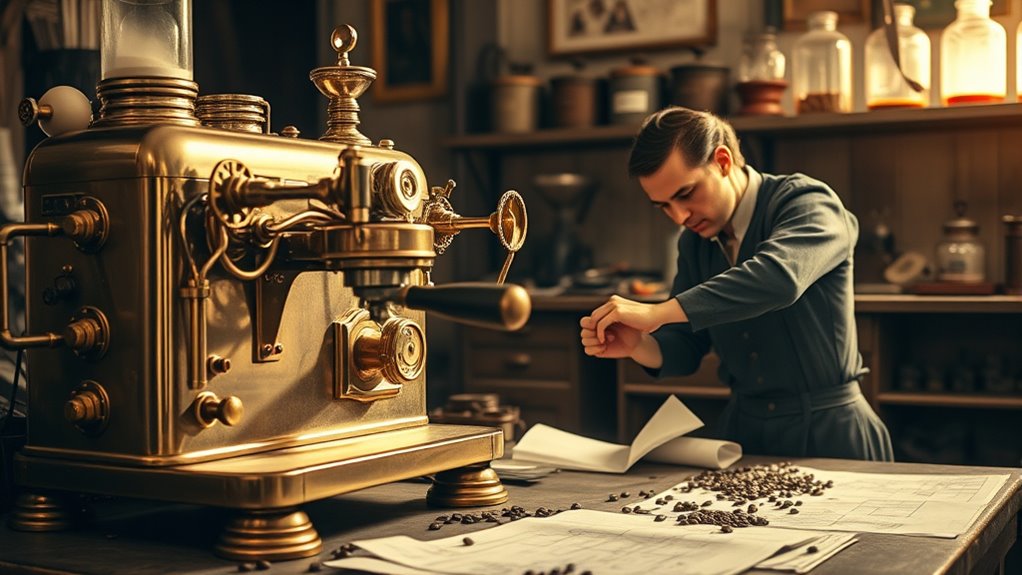
When you examine the early development of espresso machines, Luigi Bezzera’s 1901 patent stands out as a pivotal moment. He designed a machine that forced hot water through coffee grounds under steam pressure, markedly speeding up brewing.
Bezzera’s “Ideale” incorporated multiple boilers and portafilters, enabling several espresso shots to be made simultaneously, which really boosted efficiency. His use of a lever mechanism to generate steam pressure was innovative and marked a technical leap from traditional methods.
While the machine relied on steam pressure rather than the high-pressure extraction seen later, it laid essential groundwork for espresso technology. By focusing on rapid, concentrated coffee production, Bezzera’s early designs set the stage for future refinements in espresso machines. This innovation ultimately contributed to the development of espresso shots with high caffeine content that provide a rapid, concentrated caffeine boost.
How Pressure Revolutionized Espresso Machines
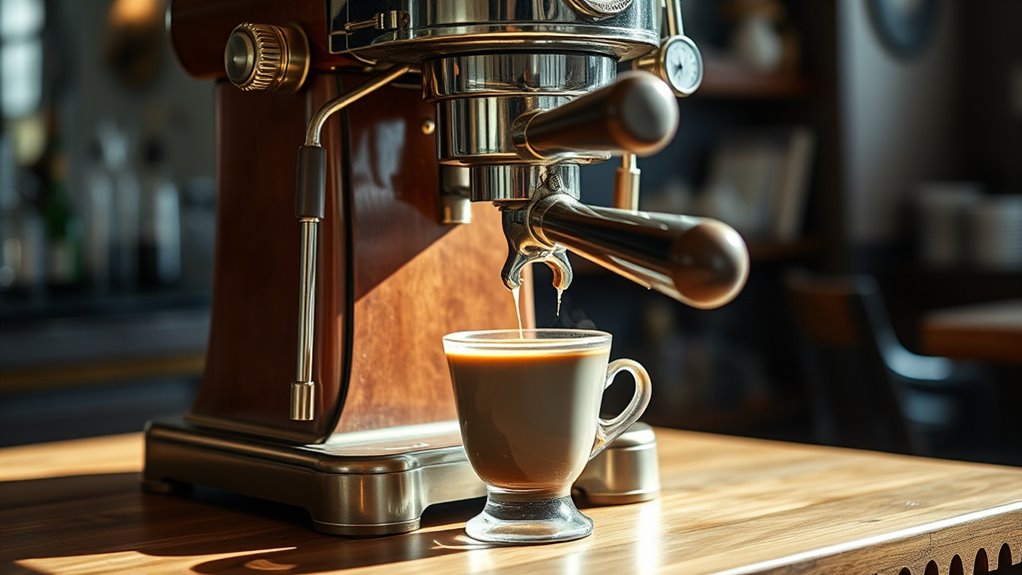
You’ll notice that early espresso machines relied on steam pressure capped at about 2 bars. This actually limited flavor extraction and crema formation quite a bit.
Then, in 1947, Gaggia came along with a lever machine that used piston-driven pressure. This was a game-changer because it dramatically increased the force and improved espresso quality.
After that, electric pumps became the norm, standardizing pressure at 8-10 bars. Thanks to this, consistent, high-quality espresso became possible all around the world.
Regular cleaning and maintenance, including descaling procedures, are essential to preserving the machine’s pressure and performance over time.
Early Steam Pressure Limits
Since early espresso machines relied on steam pressure capped at around 1.5 to 2 bars, they struggled to produce a quality brew. You’d notice these machines extracted coffee under insufficient pressure, resulting in a burnt, bitter taste.
The low-pressure environment hindered proper extraction, preventing the development of the rich crema that defines espresso today.
This limitation meant the espresso was weak and lacked depth.
Key points to understand:
- Steam pressure maxed at 2 bars limited extraction efficiency
- Coffee often tasted burnt and overly bitter
- Crema, the signature espresso foam, was absent
- Flavor concentration was shallow due to weak pressure
This early pressure ceiling set the stage for future breakthroughs in espresso technology. It showed just how important pressure is to making great espresso. Proper machine pressure is crucial for balancing extraction and producing rich, full-bodied shots.
Gaggia’s Piston Innovation
Although earlier espresso machines were limited by low steam pressure, Achille Gaggia’s 1947 piston-based design revolutionized the brewing process by generating 8 to 10 bars of pressure. His spring-loaded lever mechanism forced hot water through coffee grounds with unprecedented force, standardizing the pressure needed for ideal extraction.
This innovation enhanced the espresso’s quality by producing a richer crema and a more concentrated flavor profile.
The higher pressure extracted oils more effectively, resulting in thicker, more aromatic espresso with greater body. Gaggia’s piston design marked a pivotal shift from steam-based systems to high-pressure, lever-operated machines, establishing the foundation for the modern espresso brewing method.
By introducing consistent pressure control, he transformed espresso preparation into a precise, repeatable process.
This change markedly advanced both the technology and sensory experience of espresso. It wasn’t just about making coffee anymore; it was about crafting a better cup every time. Gaggia really set the stage for what espresso machines would become.
The innovation also highlighted the importance of grind size and pressure in achieving optimal espresso flavor and crema quality.
Electric Pump Advancements
When electric pumps entered espresso machines in the 1960s, they transformed pressure control by delivering a consistent 9 bars essential for ideal extraction. Ernest Valente’s 1961 Faema E61 pioneered this shift, replacing manual levers with an electric pump that guaranteed precise, steady pressure.
This innovation eliminated the variability of steam-driven and piston systems, standardizing shot quality across machines.
You can now rely on machines that consistently optimize extraction, whether for commercial or home use, thanks to this advancement.
Key impacts include:
- Reliable 9-bar pressure delivery for uniform extraction
- Precise pressure control replacing manual methods
- Catalyst for automatic and semi-automatic espresso machines
- Global accessibility of high-pressure espresso technology
This revolutionized espresso brewing, making shot consistency the industry norm. Proper maintenance, including routine descaling procedures, is essential to preserve this consistent pressure and ensure optimal machine performance.
Inventors Behind Today’s Espresso Machines
If you want to understand the origins of today’s espresso machines, you need to look at the key inventors who transformed the brewing process. Luigi Bezzera’s 1901 patent introduced the first machine producing quick, concentrated espresso. This set a new standard for coffee lovers everywhere.
Achille Gaggia took things further in 1947 by implementing a lever piston. This increased pressure to 8-10 bars and improved the quality of the crema. It was a real game-changer for espresso making.
Then came Ernesto Valente in 1961 with his invention of the electric pump. This ensured consistent water pressure, which standardized extraction and boosted reliability.
Thanks to Gaggia’s innovations, we got the foundation for modern piston-driven, lever-operated machines still popular today.
The combined efforts of Bezzera, Gaggia, Valente, and others like Pavoni deeply shaped espresso machine design. They focused on precision engineering to optimize flavor and consistency in espresso preparation.
It’s pretty amazing how their work still influences our coffee rituals now.
The precise brewing parameters they helped establish, such as extraction time and pressure, are crucial for achieving the ideal espresso shot.
How Espresso Spread Across Europe
You’ll notice that espresso’s rise across Europe was driven largely by the expansion of cafés that embraced Italian culture and coffee traditions.
Italian espresso machines introduced new brewing techniques, which reshaped the coffee experience in cities like Paris and London.
This fusion of technology and social habits helped espresso become a symbol of modern European life.
The transition from steam-powered to pump-driven machines was crucial in improving espresso quality and consistency, further boosting its popularity across the continent.
Expansion Through Cafés
As espresso machines like Gaggia’s lever-driven model emerged in 1947, European cafés quickly jumped on these innovations. They started standardizing brewing methods, which really helped improve the quality. You’d notice how espresso soon became a regular thing in cities like Paris, London, and Berlin after World War II.
Its fast preparation and bold flavor fit perfectly with the fast-paced urban lifestyle. Because of that, espresso quickly became part of people’s daily routines. Cafés turned into social spots, drawing in artists, writers, and intellectuals. This really helped cement espresso’s cultural importance.
By the 1950s and 1960s, espresso was more than just a drink—it was a symbol of modern life across Europe.
Post-war urban cafés embraced espresso as a cultural staple. Standardized brewing made the taste more consistent. And espresso’s speed matched the way society was evolving.
Plus, café networks helped spread espresso culture across borders. Today, options like decaf espresso allow people to enjoy this cultural staple with reduced caffeine intake.
Influence of Italian Culture
Because Italian cafés pioneered the quick, concentrated coffee method that evolved into espresso, they played an essential role in shaping European coffee culture. The invention of the modern espresso machine by Luigi Bezzera and Achille Gaggia solidified Italy’s position as espresso’s birthplace.
Italian culture’s focus on social rituals and efficient urban living accelerated espresso’s adoption across Europe.
You’ll notice that Italian brewing techniques and serving styles influenced coffee traditions in France, Germany, and Austria. The image of the Italian barista skillfully pulling espresso shots became a powerful symbol of craftsmanship, spreading to European coffeehouses.
This cultural transmission shaped regional coffee habits, making espresso not just a beverage but a social experience deeply rooted in Italian cultural values and technological innovation. Modern espresso machines, like the Mastrena espresso machine, continue to build on this legacy by automating precision extraction while maintaining quality.
Espresso’s Growth in America
Although espresso originated in Italy, its arrival in America owes much to Italian immigrants who brought both the drink and the machines in the late 19th and early 20th centuries. At first, espresso machines were expensive and mostly found in upscale cafes and Italian-American neighborhoods.
The 1980s coffee boom really changed things. It put espresso right at the center of specialty coffee culture. Big chains like Starbucks jumped on the trend, making espresso-based drinks popular across the country.
Nowadays, espresso is a key part of American coffee culture. You can find all kinds of espresso beverages just about anywhere. It’s come a long way from those early days in exclusive cafes.
Regional Roasting Styles and Their Impact
Espresso’s popularity in America and beyond highlights the importance of roasting styles, which vary widely across regions and profoundly shape the drink’s flavor.
Espresso’s global appeal showcases how diverse roasting styles deeply influence its unique flavors.
In Italy, southern regions like Naples prefer darker roasts, producing bold, smoky espresso. Meanwhile, northern areas such as Milan favor lighter roasts, resulting in more acidic and aromatic profiles.
These traditional preferences create distinct regional identities within Italy’s coffee culture.
Beyond Italy, you’ll find a broader spectrum of roasting levels, including medium and light, reflecting global influences and shifting tastes.
Roasting choices also respond to factors like climate, bean origin, and cultural traditions.
All of these affect espresso’s flavor, aroma, and body.
Understanding these regional roasting differences helps you appreciate how espresso’s character is shaped by both geography and history.
It’s pretty fascinating when you think about how much goes into that perfect cup!
Espresso’s Rise as a Global Coffee Icon
When Luigi Bezzera invented the first espresso machine in 1901, he set in motion a transformation that would elevate coffee from a simple beverage to a cultural icon. You can trace espresso’s rise through technological innovation and cultural diffusion.
Achille Gaggia’s 1947 lever-driven machine introduced crema, redefining espresso’s quality and appeal.
After World War II, espresso symbolized modernity across European capitals. Italian immigrants then brought espresso to America, where it became central to the coffee renaissance of the late 20th century.
Today, espresso embodies craftsmanship and social ritual worldwide.
1901: Bezzera’s pressurized water machine speeds brewing
1947: Gaggia’s crema innovation
Post-WWII: Espresso spreads in European cities
1980s-90s: Espresso popularized in America by Italian immigrants
Frequently Asked Questions
What Is the Ideal Water Temperature for Brewing Espresso?
You should use water heated between 90°C and 96°C for brewing espresso. Staying within this range guarantees balanced extraction, preserving ideal flavors and aroma without bitterness or sourness.
This way, you’ll get a rich, full-bodied shot every time. It’s all about hitting that sweet spot in temperature to bring out the best in your coffee.
How Does Grind Size Affect Espresso Taste?
Grind size directly affects espresso taste by controlling extraction. Finer grinds increase flavor but can risk bitterness from over-extraction. On the other hand, coarser grinds cause sourness because of under-extraction.
What Are the Main Differences Between Espresso and Drip Coffee?
Imagine espresso as a sprint. It’s quick, intense, and concentrated. Drip coffee, on the other hand, is like a marathon—slow and steady.
You’ll notice espresso uses a fine grind and high pressure. It also has a thick crema and bold flavor. Drip coffee contrasts with a coarser grind and relies on gravity to brew. Its taste is milder.
Both have their own charm, depending on what you’re in the mood for. Want something strong and fast? Go espresso. Prefer a gentler, longer sip? Drip’s your friend.
Can Espresso Be Made Without an Espresso Machine?
You can’t make true espresso without an espresso machine because it requires high pressure extraction. Alternatives like a Moka pot create strong coffee, but they don’t replicate espresso’s crema or precise texture accurately.
How Long Should a Perfect Espresso Shot Take to Pull?
You should pull a perfect espresso shot between 25 to 30 seconds. This timing balances extraction, avoiding sourness from under-extraction and bitterness from over-extraction. It ensures ideal flavor, aroma, crema, and body in your espresso.
Getting the timing right is key. Too fast, and your shot might taste sour. Too slow, and it could turn bitter. So, aim for that sweet spot to enjoy the best cup every time.
Conclusion
You’ve seen how espresso’s evolution echoes through eras, engineers, and espresso enthusiasts alike. From Luigi Bezzera’s bold breakthroughs to brewing brilliance spreading beyond borders, espresso’s enduring essence energizes every espresso experience. Recognizing regional roasting’s role reveals rich, robust roots shaping modern methods.
As you savor each sip, remember espresso’s intricate innovation and international influence. It’s more than a mere morning ritual. It’s a meticulously mastered marvel making moments memorable worldwide.