You should set your espresso grind size very fine, similar to powdered sugar, around 200-400 microns. Use a high-quality burr grinder with micro-adjustments for the best results. This precise fineness helps optimize extraction time, usually about 25-30 seconds.
That balance is key because it avoids bitterness or sourness while pulling great flavor. You’ll want to adjust incrementally based on how long your brew takes and how it tastes. Don’t forget to consider factors like roast level and tamp pressure as you fine-tune your grind.
Mastering these settings will help you get consistent, rich espresso shots every time. There’s plenty more to explore if you want to refine your technique and choose the right equipment. Keep experimenting and you’ll find what works best for you.
What Grind Size Works Best for Espresso?
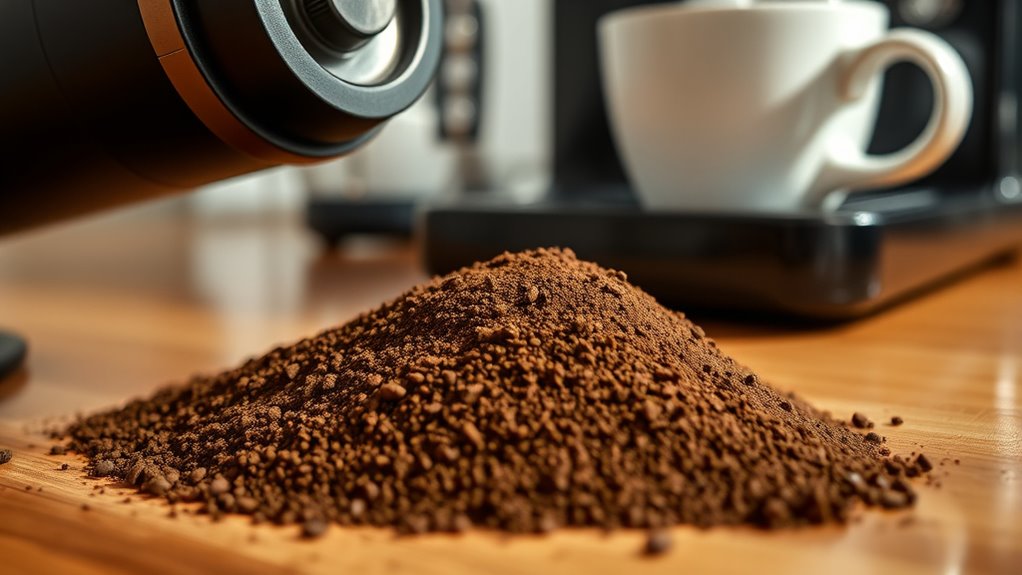
When dialing in your espresso, you’ll want a grind size that’s very fine, similar to powdered sugar or fine table salt. This helps achieve the necessary pressure and extraction. Consistency is key; uniform particle size prevents channeling, which can cause uneven extraction.
Set your burr grinder between levels 1 and 3 for most espresso machines, then fine-tune in small increments. Going too fine risks over-extraction, producing bitter, harsh flavors. On the other hand, too coarse leads to under-extraction and weak, sour shots.
Adjusting grind size by even a fraction can make a noticeable difference in extraction time and shot quality. Focus on finding a balance that lets water flow steadily under pressure. This ensures ideal solute extraction without clogging or rapid flow.
Precise grind control is essential for brewing a technically sound espresso. It might take some practice, but dialing it in just right really pays off. Maintaining grind size within the ideal 200-400 microns range helps achieve balanced extraction and flavor clarity.
How Grind Size Impacts Espresso Flavor and Extraction
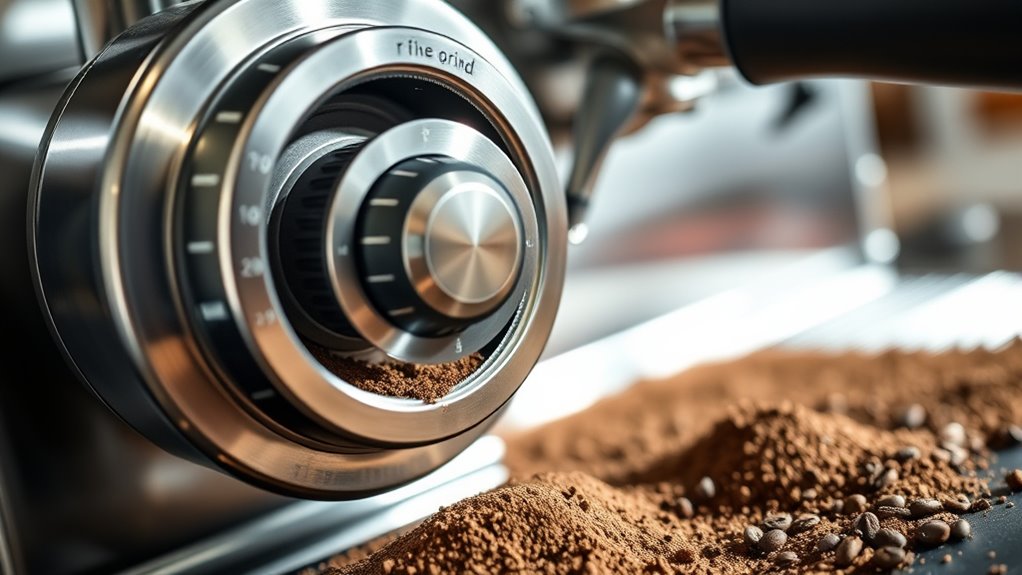
Mastering the right grind size directly influences how water interacts with coffee grounds during extraction, shaping your espresso’s flavor profile and intensity. When you adjust grind size, you control extraction speed and flavor balance.
Finer grounds increase surface area, accelerating extraction for richer, more intense espresso. However, too fine causes over-extraction, producing bitterness and harshness. Coarser grinds slow extraction, resulting in sour, weak, or watery espresso with less body.
Finer grounds speed extraction for richer espresso, but too fine leads to bitterness; coarser grinds cause sour, weak flavors.
The ideal grind resembles powdered sugar or table salt, striking a balance between extraction time and flavor.
Key impacts of grind size on espresso:
- Finer grind = faster extraction, richer flavor
- Too fine = over-extraction, bitterness
- Coarser grind = under-extraction, sourness
- Small adjustments cause significant flavor changes
Precise grind control is essential for *ideal* espresso quality. Adjusting grind size also helps maintain consistent extraction times within the optimal 25-30 seconds to ensure balanced flavor and crema quality, as explained in the grind guide.
Why Consistent Grind Size Improves Espresso Flavor
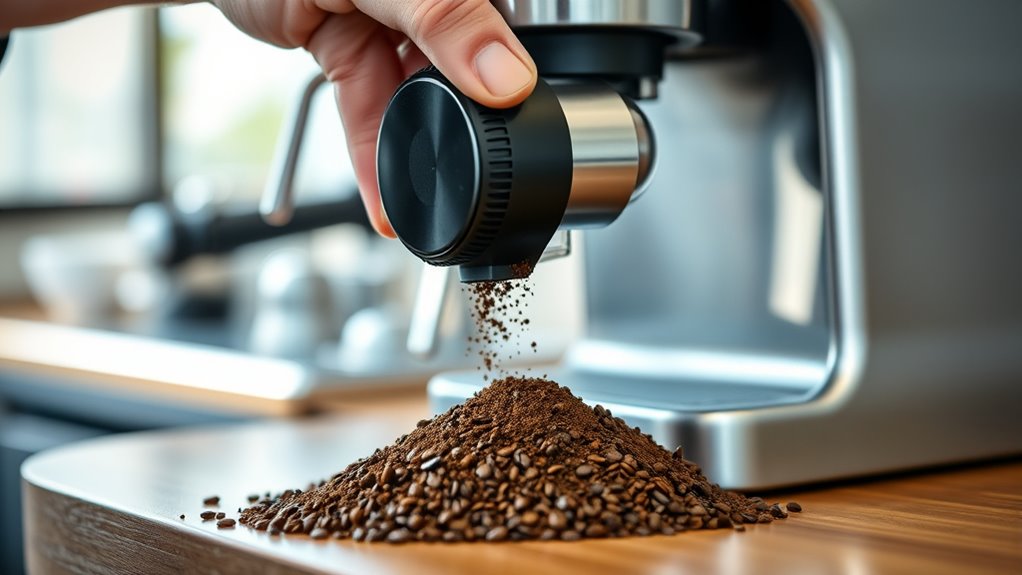
You get a balanced espresso by keeping your grind size consistent. This uniformity ensures a steady extraction rate from start to finish.
When your grind size changes, the extraction can become uneven, leading to unpredictable flow and flavors that don’t quite hit the mark.
Regularly cleaning your grinder every 2-3 months helps maintain grind consistency and ensures optimal espresso flavor.
Uniform Particle Size
Although many factors influence espresso quality, achieving a uniform particle size in your grind plays a crucial role in flavor consistency. When your grounds are evenly sized, extraction occurs uniformly, avoiding over-extraction of fines and under-extraction of coarser particles.
This balance directly affects the taste and aroma of your espresso. Here’s why uniform particle size matters:
- Ensures even extraction to prevent bitterness or sourness.
- Reduces channeling, promoting balanced flow through the puck.
- Stabilizes flow rate for consistent brew times and flavor profiles.
- Enhances crema formation, improving espresso’s visual and aromatic quality.
Proper grind size adjustment also helps maintain the ideal extraction time, which is essential for balanced flavor development.
Stable Extraction Rate
Achieving uniform particle size leads directly to a stable extraction rate, which considerably impacts espresso flavor. When you maintain a consistent grind size, you guarantee even water flow through the coffee bed, preventing channeling and uneven extraction.
This stability helps you avoid over-extraction, which causes bitterness, or under-extraction, which results in sourness. Consistent grind settings make brew time predictable, allowing you to replicate shots with balanced flavor profiles.
Fine-tuning grind size is essential for precise control over extraction dynamics, ultimately improving espresso quality. Measuring espresso yield by weight rather than volume is crucial for maintaining consistent extraction and accurately adjusting grind size.
| Grind Size Consistency | Extraction Impact |
|---|---|
| Uniform particles | Stable extraction rate |
| Consistent settings | Predictable brew time |
| Fine tuning | Minimized channeling |
| Even water flow | Balanced flavors |
| Reduced fluctuations | Reproducible shots |
Best Grinders for Precise Espresso Grind Control
When dialing in espresso, selecting a grinder that offers precise control over grind size is essential for consistent extraction. Burr grinders stand out because they produce uniform, fine particles that are vital for espresso.
Here are some top options to consider:
Explore these top grinders to achieve precise espresso grind control and perfect extraction.
- Baratza Sette 270Wi, an electric burr grinder with stepless adjustment and real-time weight-based dosing.
- Comandante MK3, a manual burr grinder known for consistent particle size and fine-tuned control.
- Fellow Ode, a manual grinder that provides excellent grind size precision for home espresso setups.
- Baratza Encore ESP, a budget-friendly electric burr grinder capable of fine grind settings suitable for entry-level espresso.
Each grinder’s micro-adjustment capabilities let you tailor grind size to your espresso machine and bean profile. That way, you get ideal extraction and balanced flavor every time. Using a burr grinder is especially important because it ensures consistent, uniform grounds that maximize flavor extraction and crema quality.
Calibrate Your Grinder for Consistent Espresso Shots
You’ll want to calibrate your grinder by adjusting the grind size until your espresso shot extracts in about 25 to 30 seconds. This helps ensure you get the ideal flow and flavor.
Try to use a consistent coffee dose, somewhere around 18 to 20 grams. Then, make small, precise adjustments — usually about a quarter turn — to fine-tune the extraction just right.
And don’t forget, whenever you switch beans, it’s a good idea to recalibrate. Different beans have unique characteristics that can change the perfect grind setting.
Also, keep in mind that espresso beans are typically roasted darker, which affects how they extract compared to lighter roasts, so roasting process plays a key role in grind calibration.
Grinder Calibration Basics
Although dialing in your espresso grinder can seem complex, calibrating it precisely is essential for consistent shot quality. You need to adjust the burrs to achieve a grind resembling powdered sugar or fine table salt. Start with a baseline setting, then pull test shots to evaluate flow rate, extraction time, and taste.
Adjust the grind incrementally, one or two clicks while the grinder runs, to maintain uniform particle size. Focus on these calibration basics:
- Use a consistent baseline setting for initial tests.
- Make small adjustments based on extraction results.
- Record settings and outcomes for repeatability.
- Recalibrate with any bean, roast changes, or burr wear.
This systematic approach ensures reliable espresso extraction every time. Just remember, taking it step by step makes the process much easier than it seems! Understanding how grind size influences extraction balance is key to dialing in your espresso perfectly.
Fine-Tuning Techniques
Since consistent espresso extraction hinges on precise grind size, fine-tuning your grinder involves making small, incremental adjustments, typically one or two notches, while the burrs are running to guarantee uniform particle distribution. After each tweak, pull a test shot using a consistent dose, usually 18-20 grams for a double, and measure extraction time, targeting 25-30 seconds with balanced flavor.
Adjusting while the grinder runs ensures burrs settle properly, avoiding inconsistent particle sizes. Record each grind setting alongside shot results to build a calibration profile tailored to your beans, roast, and machine.
This methodical approach lets you pinpoint the ideal grind for consistent, repeatable espresso shots. In the end, this process helps you refine your extraction precision and elevate overall shot quality. It might take a bit of patience, but dialing in your grinder just right makes a noticeable difference in every cup. Maintaining consistent tamp pressure alongside grind adjustments is also crucial for even extraction and shot quality.
How Roast Level Influences Espresso Grind Settings
When adjusting your espresso grind settings, it’s important to understand how roast level affects bean density and solubility. Darker roasts are less dense and more soluble, so you’ll want to use a slightly coarser grind to avoid over-extraction.
Adjust grind size according to roast level—coarser for dark roasts to prevent over-extraction, finer for lighter roasts.
Lighter roasts, being denser, require a finer grind for balanced flavor extraction.
The cellular structure and surface oils vary with roast, which influences extraction dynamics. Keep these points in mind:
- Dark roasts have fragile, oily surfaces and grinding too fine can lead to over-extraction.
- Lighter roasts need a finer grind to effectively penetrate the dense beans.
- Adjusting grind size helps optimize extraction time for consistent espresso shots.
- Making grind adjustments based on roast level helps maintain ideal flavor profiles.
Maintaining consistent pressure at approximately 9 bars pressure is also crucial to achieve optimal extraction and crema quality.
Adjust Grind Size for Your Espresso Machine
Fine-tuning your grind size is key to matching your espresso machine’s specific extraction characteristics. Start with a medium-fine grind, then adjust incrementally in small steps to dial in the perfect setting.
Use shot timing and taste as your primary guides. If your shot pours slowly with a bitter flavor, grind finer. If it runs too fast and tastes sour, coarsen the grind.
Target an extraction time between 25 and 30 seconds for balanced results. Remember, your machine’s pressure and bean type influence the ideal grind, so recalibrate regularly.
Keep detailed notes of grind settings, extraction times, and flavor profiles. This systematic approach helps you replicate your preferred grind size and consistently achieve the best espresso from your specific equipment.
Troubleshoot Over-Extracted and Under-Extracted Espresso
Although dialing in your grind size can be straightforward, you’ll sometimes encounter over-extracted or under-extracted espresso shots that require targeted troubleshooting.
Over-extraction happens when your grind is too fine, yielding a bitter, harsh flavor with a dry mouthfeel. Under-extraction occurs with a grind too coarse, producing sour, weak espresso lacking body.
To troubleshoot, follow these steps:
- Check brew time: over 30 seconds indicates over-extraction; under 20 seconds signals under-extraction.
- Observe flow rate: syrupy and slow suggests over-extraction; fast and watery implies under-extraction.
- Adjust grind size coarser to fix over-extraction.
- Make grind finer to correct under-extraction.
Use these precise cues to refine your grind and achieve balanced extraction.
Fine-Tune Grind Size Based on Your Taste Preferences
Adjusting your grind size based on taste preferences requires careful observation and incremental changes. If your espresso tastes sour or under-extracted, you need to make the grind finer to increase surface area and extraction.
Fine-tune your grind size carefully—finer for sour shots, coarser for bitter—to perfect your espresso extraction.
Conversely, if it’s bitter or over-extracted, coarsen the grind to reduce soluble extraction.
Make small adjustments of about 0.1 to 0.2 on your grinder’s scale to precisely dial in the flavor. After each tweak, taste the espresso to see if it’s more balanced, sweeter, or smoother.
Keep track of your grind settings alongside tasting notes to build a personalized profile that consistently delivers your ideal shot.
This systematic approach helps you tailor grind size effectively. It optimizes flavor extraction based on your unique palate.
Frequently Asked Questions
How Does Humidity Affect Espresso Grind Size?
Humidity softens your beans, which can cause a finer, uneven grind and clumping. This affects how your espresso extracts, so it’s something to watch out for.
You’ll want to adjust your grinder to a coarser setting to compensate. That way, you keep your extraction consistent and avoid any bitterness or sourness.
Also, storing your beans airtight really helps. It keeps moisture levels steady and makes sure your grind size stays reliable no matter the humidity.
Can Water Temperature Influence the Ideal Grind Setting?
Yes, water temperature can influence your ideal grind setting. Increasing temperature by 5°C can speed extraction by up to 10%. So, you’ll need a slightly coarser grind to avoid over-extraction and maintain balanced flavor.
It’s all about finding the right balance. If the water’s too hot, the coffee might taste bitter. Adjusting the grind helps keep things just right.
What Is the Best Grind Size for Espresso in High Altitude Areas?
You should use a slightly coarser grind, adjusting one to two steps coarser than sea level settings. This helps counteract the faster extraction caused by lower pressure and more porous beans.
Doing this ensures a balanced flavor without over-extraction. Just a small change can make a big difference when you’re brewing at high altitudes.
How Often Should I Clean My Grinder for Consistent Espresso?
You should clean your grinder every 1 to 2 weeks to maintain consistent grind size and flavor. This helps keep your espresso tasting great and your machine running smoothly.
For a deeper clean, do a monthly session where you remove the burrs. Use grinder-specific brushes during this process to get into all the nooks and crannies.
Doing this will keep your espresso extraction performing at its best. It might sound like a bit of work, but it really pays off in the cup!
Does Bean Origin Affect the Preferred Espresso Grind Size?
Absolutely, bean origin dictates your espresso grind’s degree. Dense, high-elevation beans demand a finer grind for flawless flavor extraction.
On the other hand, lighter roasts or lower-altitude beans call for slightly coarser settings. This helps balance brightness and body perfectly. It’s all about matching the grind to the bean’s unique characteristics.
Conclusion
To nail the perfect espresso grind size, you must treat your grinder like a trusted watchmaker tuning a delicate clock. Consistent, precise adjustments directly impact flavor and extraction, ensuring every shot is balanced.
Remember, grind size isn’t static. It shifts with roast, machine, and your palate. Calibrate regularly, troubleshoot with care, and fine-tune based on your taste.
Master this, and your espresso will rival the classics, brewed with modern precision.