You’ll find plain espresso shots contain just 1 to 3 calories, making them a very low-calorie choice. The calories come mainly from the coffee solids, with minimal contribution from crema. Adding milk, sugar, or flavored syrups quickly raises the count.
Milk adds about 18 calories per ounce, sugar adds 16 per teaspoon, and syrups can add 20 to 50+ calories per pump. Different shot styles and sizes have little calorie variation if unsweetened. Keep exploring for a full understanding of espresso’s calorie details and benefits.
How Many Calories Are in a Shot of Espresso
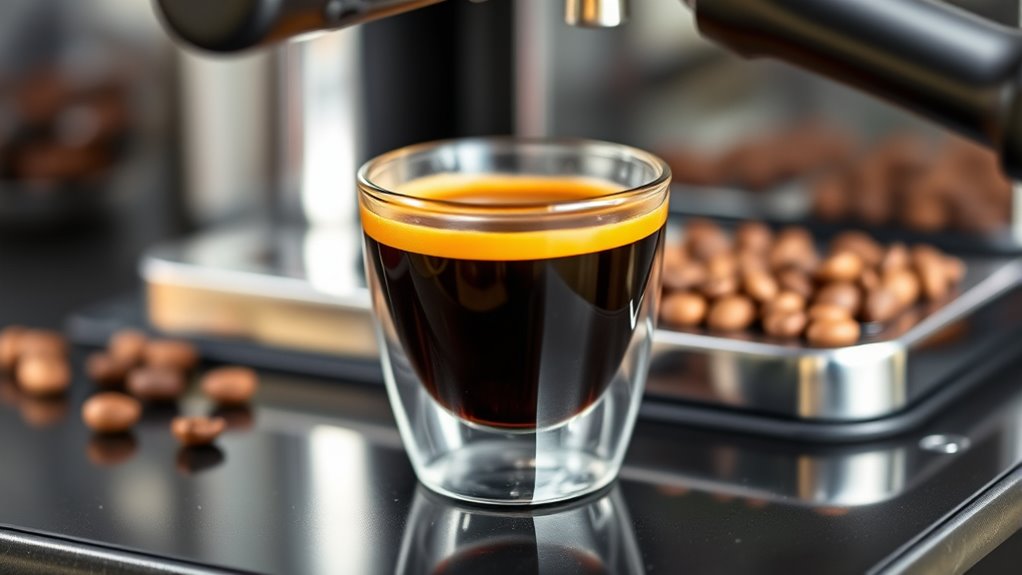
How many calories does a single shot of espresso contain? Typically, it ranges between 1 to 3 calories. These calories mainly come from dissolved coffee solids and tiny amounts of oils extracted during brewing.
The crema on top, despite its rich appearance, doesn’t add significant calories. The exact number can vary slightly based on factors like the brewing method and the type of coffee bean used.
Still, the overall caloric impact remains minimal. Additives like milk, sugar, or flavored syrups, however, can significantly increase the calorie content of espresso beverages, so it’s important to consider any additional ingredients when tracking intake.
What Adds Calories to Your Espresso?
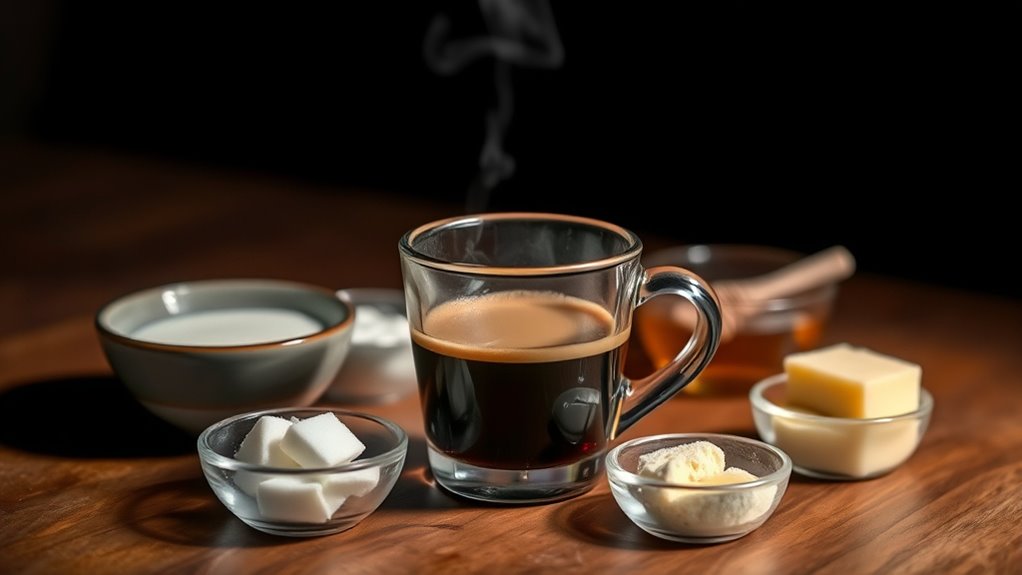
Although a plain shot of espresso contains minimal calories, adding ingredients like sugar, milk, and flavored syrups can quickly increase its calorie content. Each addition contributes differently, so it’s important to know what you’re adding.
A plain espresso is low in calories, but added sugar, milk, and syrups can raise its calorie count quickly.
Here are key calorie contributors to watch out for:
- Sugar and syrups: One teaspoon of sugar adds about 16 calories. Flavored syrups often contain added sugars, which boost calories even more.
- Milk and cream: Especially full-fat versions, these add significant calories to your espresso.
- Toppings: Whipped cream, chocolate shavings, or caramel drizzles add extra calories beyond the espresso shot.
Also, larger portion sizes or multiple espresso shots increase calories proportionally.
Understanding the role of milk frothing can help you better control the texture and volume of milk added, impacting the overall calorie count.
Knowing these factors helps you control your espresso’s calorie intake more effectively.
How Milk and Sugar Change Espresso Calories
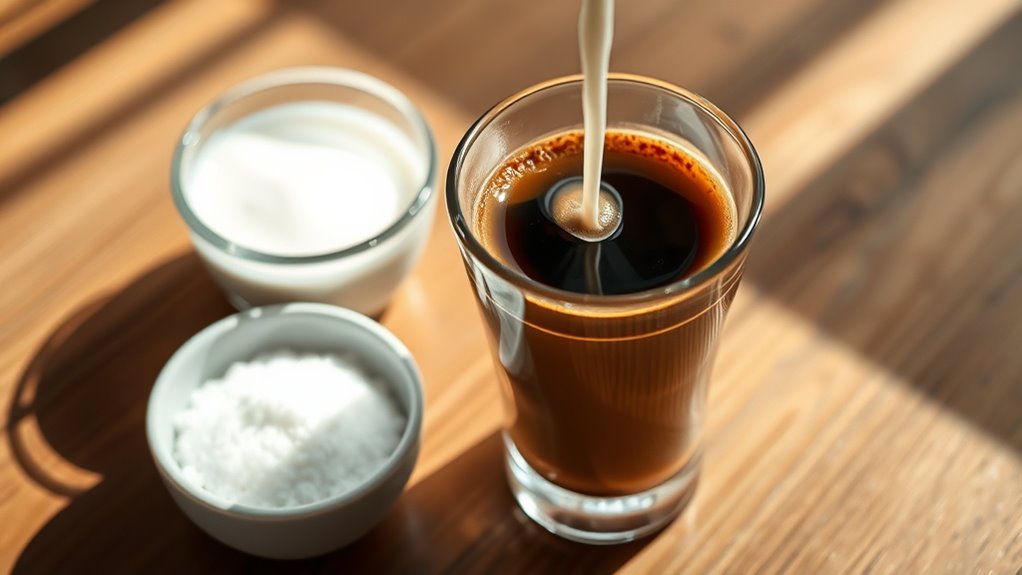
When you add just a teaspoon of sugar to your espresso, you’re actually adding about 16 calories. That’s interesting because it’s more calories than the espresso itself has.
Now, if you use whole milk, you’re looking at roughly 18 calories per ounce. So even a small splash can bump up the calorie count quite a bit.
Put milk and sugar together, and your simple, low-calorie espresso can quickly turn into a much richer, higher-calorie drink. It’s something to keep in mind if you’re watching your overall daily calorie intake.
Because espresso is a concentrated shot, the serving size is small, which naturally keeps its calorie content low compared to larger coffee servings.
Milk’s Calorie Contribution
Why does adding milk and sugar to your espresso matter for calorie counting? Because these additions considerably increase the total calories beyond the espresso shot itself.
Milk’s calorie content varies depending on its fat level, which directly impacts your drink’s overall caloric load.
Consider these points: Whole milk adds about 9 calories per fluid ounce, while skim milk contributes roughly 8 calories per ounce.
Even small amounts of milk can substantially raise the calorie count compared to black espresso.
Using more milk can quickly surpass the calories of the espresso shot, making your drink less calorie-friendly.
Understanding milk’s calorie contribution helps you make informed choices, especially if you’re monitoring your calorie intake or aiming for lighter coffee options.
When preparing espresso-style coffee using a French press, adjusting the coffee-to-water ratio can influence the strength and flavor of the drink, which in turn affects its calorie density.
Sugar’s Impact On Calories
Milk adds a noticeable number of calories to your espresso, but sugar can increase the calorie count even more quickly. Each teaspoon of sugar (about 4 grams) adds roughly 16 calories, which may seem small but adds up if you use multiple spoons.
While milk contributes around 20 calories per ounce, sugar’s impact is more concentrated per serving size.
Keep in mind that flavored syrups can add between 20 to 50+ calories per pump, which can really bump up the total.
Cream or whipped toppings are even more calorie-dense, often adding 50 or more calories per tablespoon.
Understanding how sugar and milk alter espresso’s calorie content helps you manage intake precisely without sacrificing flavor or enjoyment.
Because espresso is served in small volumes compared to brewed coffee, its caffeine concentration per ounce is much higher despite the lower total caffeine content.
Combining Milk And Sugar
How much do sugar and milk together affect your espresso’s calorie count? Adding just a teaspoon of sugar boosts calories by about 16.
An ounce of whole milk adds roughly 18 calories. When combined, these can easily double your espresso’s caloric content.
Think about this: using cream or full-fat milk raises calories quite a bit compared to skim or plant-based milk. Flavored syrups add 20 to 50 or more calories per pump, which can really add up.
Portion size matters too. Usually, larger amounts of milk and sugar outweigh the calories in the espresso itself.
Regular maintenance like descaling your espresso machine ensures optimal performance, which can also influence the quality and consistency of your espresso shots.
How Espresso Calories Vary by Shot Type and Size
Espresso shots contain only a few calories each, but the exact amount depends on the shot type and size. A single shot of plain espresso typically has about 1-3 calories, varying slightly with volume and preparation.
When you opt for a double shot, expect roughly 2-6 calories, as the calorie count scales with the number of shots pulled.
Different shot styles like ristretto and lungo differ in extraction and volume but still maintain similarly low calorie levels if served without additives. This minimal calorie content is because espresso is mainly water and dissolved coffee solids, lacking significant fats, proteins, or sugars.
The extraction time, typically between 25-30 seconds for most shots, can impact the flavor but does not significantly alter the calorie content due to the small amount of dissolved solids in espresso. This extraction time is critical for achieving balanced taste and crema development.
How Espresso’s Calories Compare to Other Coffee Drinks
Although a plain shot of espresso contains just 1 to 3 calories, many popular coffee drinks pack considerably more because of added ingredients. When you compare espresso to other coffee beverages, the calorie content goes up mainly due to milk, sugar, and flavorings rather than the coffee itself.
Here’s how espresso stacks up: drip or brewed coffee has 2 to 9 calories per 6-ounce cup, which is slightly higher than espresso because of dissolved solids.
Lattes and cappuccinos usually have 100 or more calories, depending on the type of milk and portion size.
Flavored or sweetened drinks like frappuccinos and caramel macchiatos can contain hundreds of calories from added sugars and toppings.
Knowing these differences helps you make smarter choices based on your calorie goals while still enjoying your favorite coffee drinks. Consuming espresso plain, without sugar or cream, maintains its low-calorie advantage.
How Espresso Benefits Your Nutrition Beyond Calories
Because it contains antioxidants like chlorogenic acids, a shot of espresso does more than just provide a quick caffeine boost. It supports cellular health and helps reduce oxidative stress. Espresso is rich in polyphenols, which play a vital role in neutralizing free radicals.
Beyond antioxidants, it supplies significant amounts of B-vitamins, including niacin (B3) and riboflavin (B2). These are essential for energy metabolism and neurological function.
The caffeine content stimulates your central nervous system, enhancing mental alertness and physical performance.
Additionally, bioactive phytochemicals found in espresso may improve mood and cognitive function.
Thanks to its low-calorie profile, you gain these nutritional advantages without adding unnecessary calories. So, espresso is a smart choice for both your energy needs and overall well-being.
A double shot of espresso typically delivers around 126 mg of caffeine, providing a substantial boost for alertness and energy.
Easy Ways to Estimate Espresso Calories
When you want to know the calorie content of your espresso, it’s important to take into account not just the shot itself but also any added ingredients like sugar, milk, or syrups. A plain espresso shot contains only 1 to 3 calories, but extras can quickly raise that number.
To estimate calories accurately, focus on these key steps:
- Use nutrition labels from cafés or trusted online calculators tailored to espresso drinks.
- Measure added ingredients precisely with a kitchen scale or measuring spoons to avoid guesswork.
- Consider the calorie content of toppings and mix-ins, since they contribute the bulk of calories beyond the espresso shot.
Keep in mind that a standard espresso shot is about 30 ml and contains roughly 60 mg of caffeine, which can influence your choice of espresso size.
Enjoy Espresso Without Extra Calories
You’ll find that a plain shot of espresso has just 1 to 3 calories, making it one of the lowest-calorie drinks out there.
The trick to keeping it light is to skip adding milk, sugar, or flavored syrups because those can really bump up the calorie count.
Espresso Calorie Content
A single shot of plain espresso contains only about 1 to 3 calories, mostly from dissolved coffee solids and trace oils. The calorie content stays low because espresso is brewed coffee with minimal added ingredients. Even the crema, the foam atop espresso, doesn’t add noticeable calories.
When you order double shots, ristretto, or lungo without extras, the calorie count remains similarly low. So, you’re pretty safe keeping it light if you skip the sugar or milk.
Keep in mind these key points about espresso calories:
- Calorie content mainly depends on serving size and any additions like sugar or milk.
- The natural oils and solids in coffee contribute to the minimal calories.
- Variations in espresso style (double shot, ristretto, lungo) don’t substantially change calories unless you add ingredients.
This means you can enjoy espresso’s rich flavor without worrying about calorie intake. It’s a great choice if you want something flavorful but low in calories.
Low-Calorie Beverage Benefits
Because plain espresso contains only 1 to 3 calories per shot, you can enjoy its bold, rich flavor without adding significant calories to your diet. This makes espresso an excellent choice if you’re mindful of calorie intake or managing your weight.
Beyond low calories, espresso delivers antioxidants and nutrients that support overall health without compromising your diet.
| Benefit | Calories per Shot | Nutritional Impact |
|---|---|---|
| Low Calorie | 1–3 | Minimal calorie addition |
| Antioxidants | N/A | Supports cellular health |
| Weight Management | Low | Fits calorie-controlled diets |
| Rich Flavor | N/A | Satisfies taste cravings |
| Nutrient Dense | Minimal | Provides essential compounds |
Choose plain espresso to maximize these benefits effectively. It’s a simple way to enjoy great taste while keeping your diet on track.
Avoiding Added Calories
Although espresso itself contains minimal calories, adding sugar, flavored syrups, or high-calorie creamers can quickly increase your drink’s calorie content.
To keep your espresso low-calorie, focus on these key strategies:
Drink plain, unsweetened espresso, which contains only about 1-3 calories per shot.
Substitute heavy cream with low-fat or plant-based milk to cut down added calories.
Avoid toppings like whipped cream, chocolate shavings, or caramel sauce that can add hundreds of calories.
Keeping it simple is the best way to enjoy your espresso without the extra calories.
Frequently Asked Questions
Does Espresso Contain Any Vitamins or Minerals?
Yes, espresso contains small amounts of vitamins like B3 and trace minerals such as magnesium, potassium, and iron. While these amounts are modest, they contribute slightly to your daily vitamin and mineral intake.
How Does Espresso Affect Hydration Levels?
Espresso won’t flood your body like a waterfall, but it won’t dehydrate you either. Its high water content offsets caffeine’s mild diuretic effect, so drinking espresso moderately actually helps maintain your hydration levels.
Can Espresso Calories Vary by Coffee Bean Origin?
Yes, espresso calories can vary slightly by coffee bean origin due to differences in oil content and chemical composition. Beans like Robusta have more oils, which may increase trace calories compared to Arabica or beans from different regions.
It’s a small difference, but it’s there. So, if you’re counting every calorie, the type of bean might matter a bit. Otherwise, it won’t make a huge impact on your espresso’s calorie count.
What Impact Does Espresso Have on Metabolism?
Espresso boosts your metabolism by stimulating your central nervous system with caffeine. This increases your energy expenditure by 3-11% for hours. Pretty impressive, right?
It also enhances fat oxidation and calorie burning, especially when you’re exercising. But keep in mind, the effects can vary depending on your sensitivity to caffeine and how much you usually drink.
Are There Calorie Differences Between Espresso and Decaf?
Picture a tiny calorie whisper. Espresso and decaf share nearly the same 1-3 calories per shot. You won’t notice a difference since caffeine barely affects their minimal caloric content.
Most of the calories come from coffee’s natural oils and solids. So whether you choose espresso or decaf, the calorie count stays pretty much the same. It’s a small detail that won’t impact your daily intake.
Conclusion
A single shot of espresso contains just about 3 calories, making it an incredibly low-calorie choice for coffee lovers. When you add milk or sugar, those numbers rise quickly, so it’s important to be mindful of extras.
By understanding how different ingredients and shot sizes affect calories, you can enjoy espresso without unwanted additions. Keep this in mind to make informed, healthier choices and savor your espresso guilt-free.