To calibrate your espresso machine, start by cleaning and maintaining your grinder and brewer. Precisely measure your coffee dose, usually 16-18g, and adjust your grind size to hit a 25-30 second extraction. Use a scale to set a consistent shot yield around 45-60ml.
Keep your brew temperature between 90-96°C and pressure near 9 bars for balanced flavor. Taste critically and tweak settings as needed. Keep refining these steps to master espresso calibration.
It might take a few tries, but once you dial it in, your espresso will taste amazing every time. Just be patient and enjoy the process!
Gather Tools for Espresso Calibration
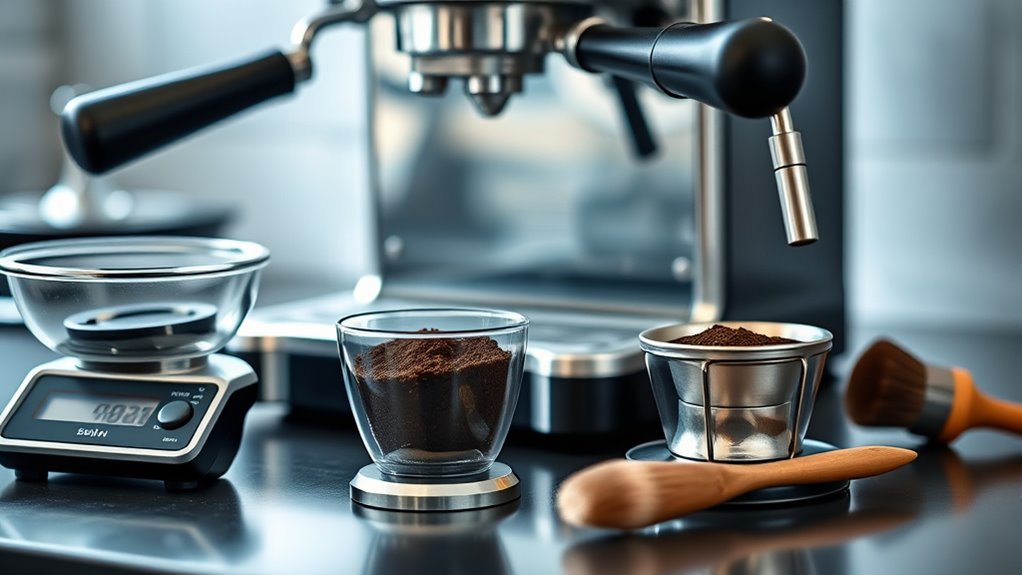
Before you begin calibrating your espresso machine, gather all essential tools to guarantee accuracy and efficiency throughout the process. Start with a calibrated digital scale that measures to at least 0.1 grams. Precision here is critical for dose and yield tracking.
Gather essential tools like a precise digital scale to ensure accurate espresso machine calibration and consistent results.
Next, secure a calibration or test weight matching your typical coffee dose to verify the scale’s accuracy. You’ll also need a reliable timer or stopwatch to measure extraction time precisely during brewing adjustments.
Prepare a clean, dry cloth or brush to wipe the portafilter, basket, and grinder components before calibration. This ensures no residue affects measurements.
Finally, have a sample of freshly roasted coffee beans ready, along with a flavor wheel or tasting notes. That way, you can rigorously assess extraction quality and fine-tune your espresso to perfection.
Also, ensure you monitor and adjust your extraction time carefully, aiming for the optimal window to achieve balanced flavor and crema.
Clean Your Grinder and Machine
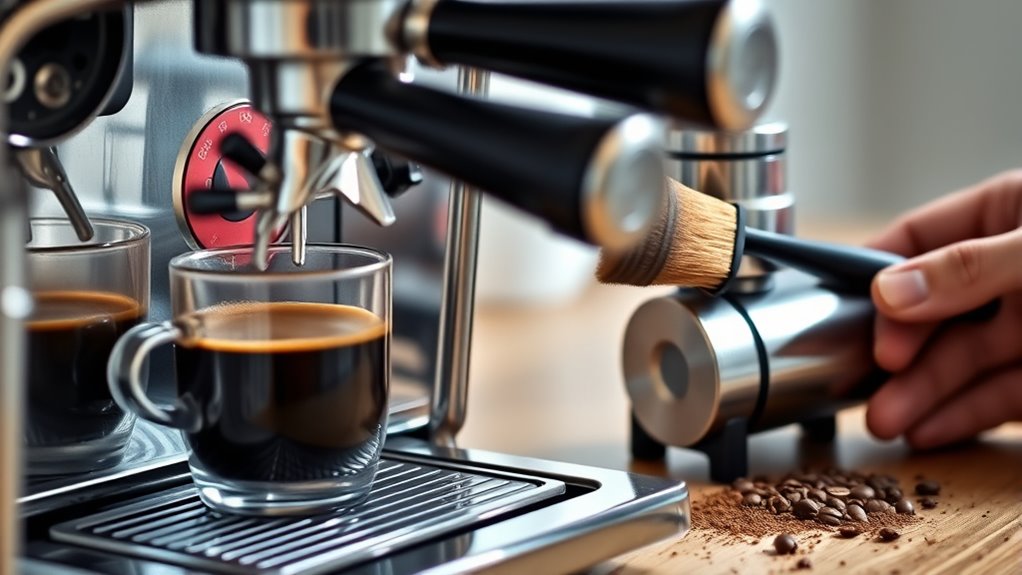
With your tools ready and coffee dose measured, the next step is to guarantee your grinder and espresso machine are impeccably clean. Start by brushing the grinder burrs and chamber to remove residual grounds and oils. These can really mess with your grind consistency.
Use cleaning tablets or a descaling solution on the group head, portafilter, and water pathways to sanitize and remove mineral buildup. Make sure to rinse all parts thoroughly with clean water to get rid of any cleaning residue that might taint future shots.
Don’t forget to purge the steam wand and clean the drip tray and water reservoir. This helps prevent mold and mineral deposits that can impair function.
For ideal performance, schedule a deep cleaning at least once a month or more often if your machine gets heavy use. Clean equipment means precise calibration and superior espresso quality.
Regular cleaning and maintenance are essential to maintaining consistent extraction time and flavor in your espresso.
Measure and Adjust Your Coffee Dose for Consistent Shots
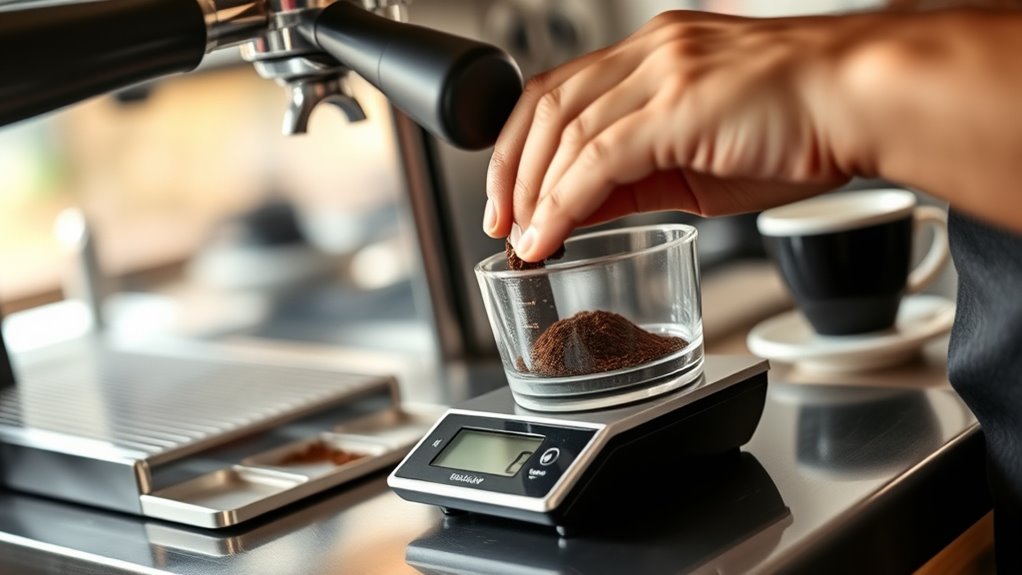
Although dialing in your grind is essential, accurately measuring and adjusting your coffee dose is just as important for consistent espresso shots. Use a digital scale to weigh your grounds precisely, aiming for 16-18 grams for a double shot.
Make sure to distribute the coffee evenly before tamping with 15-20 kg of pressure. This helps guarantee uniform extraction.
Record your dose weight and adjust by increments of 0.5 grams if your shots pull too fast or too slow. Consistency in dosing is key to stable flavor and extraction time.
Don’t forget to calibrate your scale regularly to keep your measurements accurate.
Regular maintenance such as descaling your espresso machine helps maintain optimal water flow and brewing temperature, which is crucial for consistent shot quality.
| Dose Weight (g) | Tamping Pressure (kg) | Shot Outcome |
|---|---|---|
| 16.0 | 15 | Under-extracted |
| 16.5 | 17 | Balanced |
| 17.0 | 20 | Slightly over-extracted |
| 18.0 | 20 | Over-extracted |
Dial In the Grind Size to Control Extraction Time
When your espresso extraction time falls outside the ideal 25-30 second range, you need to dial in your grind size precisely.
If your shot drags beyond 30 seconds, adjust the grinder to a finer setting to speed up extraction. Conversely, if it pulls in under 18 seconds, coarsen the grind to prevent under-extraction and sour flavors.
Maintain a consistent dose, around 18 grams, and steady tamp pressure to isolate grind size’s effect on timing.
Keep your dose steady at 18 grams and apply consistent tamp pressure to accurately adjust grind size.
After each adjustment, purge the grinder thoroughly to avoid old grounds skewing results.
Record extraction times meticulously, fine-tuning the grind incrementally until you consistently hit that 25-30 second sweet spot.
This precise calibration balances flavor and strength and helps you access the full potential of your espresso machine.
Keep in mind that factors like brew pressure and extraction technique also influence caffeine concentration in your espresso.
Set Your Shot Yield and Keep It Consistent
You want to set a precise shot yield—usually between 45 to 60ml for a double shot—to make sure your flavor stays consistent. It’s a good idea to use a calibrated scale to measure each shot.
Then, program your machine to stop automatically once it hits your target weight. Sticking to this yield every time helps you get better control over extraction and ensures your espresso quality is always spot on.
Using a consistent yield ratio is key to balancing acidity, sweetness, and bitterness in your espresso.
Importance Of Consistent Yield
Since consistent yield directly influences espresso strength and flavor, setting and maintaining a precise shot volume—typically 45-60ml for a double shot—is critical. By locking in this volume, you guarantee each extraction produces uniform strength and flavor. This helps avoid the pitfalls of over- or under-extraction that introduce bitterness or sourness.
Consistency also allows you to accurately tweak other variables like grind size and tamp pressure, knowing yield remains stable. Using volumetric tools or programmable machines helps you achieve exact, repeatable shot volumes every time.
Over time, tracking your yield builds a reliable baseline. This empowers you to replicate and refine your espresso quality with confidence. Without consistent yield, calibrating your machine and dialing in your shot becomes guesswork rather than precision craft. Additionally, understanding the typical caffeine content in a double shot can help you balance flavor intensity with desired caffeine levels.
Programming Machine For Yield
Maintaining a consistent shot yield demands programming your espresso machine to target a precise volume or weight, usually between 45-60ml for a double shot. Start by setting your machine to stop extraction automatically once it reaches the desired yield. This helps ensure minimal variability.
Use a calibrated scale to measure each shot’s weight accurately during testing. Then adjust the machine’s programming as needed. Always maintain the same dose and grind size when programming your yield to preserve flavor and extraction consistency.
Make it a habit to regularly verify and recalibrate this setting to compensate for changes in grind size, coffee freshness, or machine performance. By precisely programming your machine for yield, you lock in repeatable, high-quality shots.
This way, every espresso extraction becomes a technical success driven by exact parameters. Using a digital scale under the cup is essential for accurately measuring yield and eliminating variability caused by crema or cup weight.
Adjust Espresso Temperature and Pressure
Although dialing in your espresso machine’s grind and dose is essential, fine-tuning the temperature and pressure settings is just as important to get the ideal extraction. Keep the espresso temperature between 90°C and 96°C (194°F to 204°F) by using a precise thermometer or your machine’s built-in gauge. Adjust the boiler or grouphead temperature carefully so you stay within this important range.
Fine-tuning temperature and pressure, alongside grind and dose, is crucial for perfect espresso extraction.
This helps ensure balanced flavor and maximum solubility.
Calibrate the pressure to around 9 bars during extraction by regularly checking and tweaking the pressure valve or pump settings. Consistent pressure is key for developing rich crema and drawing out nuanced flavors.
If the temperature or pressure fluctuates, you risk under- or over-extracting your espresso, which really hurts the quality.
Maintaining proper water mineral content is also crucial, as it works together with temperature and pressure to produce clean, nuanced shots.
Taste and Evaluate Your Espresso for Flavor Balance
You need to check out your espresso’s flavor profile by noticing how the sweetness, acidity, and bitterness balance each other. Take a moment to really pay attention to any sour or bitter hints—these often point to extraction problems. Understanding the role of pressure and extraction is key to achieving the perfect flavor balance in your espresso.
Flavor Profile Assessment
How do you pinpoint the perfect balance of sweetness, acidity, bitterness, and body in your espresso? Begin by tasting your shot critically, focusing on flavor harmony. Use a flavor wheel or detailed tasting notes to identify distinct flavor characteristics, ensuring you detect any subtle nuances or off-flavors.
Make sure to evaluate aroma, mouthfeel, and aftertaste consistently to develop a detailed sensory profile. Document your observations meticulously after each shot, and compare patterns to understand how variables impact flavor.
This data guides precise calibration adjustments. You can alter grind size, dose, extraction time, or temperature to refine your espresso’s profile. Keep in mind that factors such as extraction ratio influence caffeine concentration and shot strength, which can also affect the flavor balance.
Identifying Taste Imbalances
When tasting your espresso, pinpointing whether it leans too sour, bitter, or flat is essential for identifying flavor imbalances. A balanced shot combines sweetness, acidity, and bitterness with a bright, clean finish.
If your espresso tastes too sour, it’s likely under-extracted. Try a finer grind or longer extraction. Conversely, bitterness signals over-extraction, so coarsen the grind or shorten the extraction time.
Tracking flavor notes alongside brew variables sharpens your calibration precision.
| Taste Imbalance | Probable Cause |
|---|---|
| Sour | Under-extraction |
| Bitter | Over-extraction |
| Flat | Insufficient extraction or stale beans |
| Sweet | Balanced extraction |
| Burnt | Over-extraction, high temperature |
Use this guide to adjust your machine for the perfect flavor equilibrium.
Troubleshoot Calibration Issues
Although calibrating an espresso machine demands precision, troubleshooting common issues can quickly restore ideal performance. First, check if your shot extracts too fast or slow. Adjust grind size or tamp pressure accordingly.
Use a calibrated scale to verify yield matches your target. Tweak grind or dose if it doesn’t.
Inspect the pressure gauge to confirm it hits the recommended 9 bars during extraction. Recalibrate if readings are off.
Test water temperature with a thermometer and make sure it stays between 195°F and 205°F. Adjust temperature settings when necessary.
Finally, clean and descale regularly to prevent blockages or scale buildup. These issues can cause inconsistent pressure and extraction problems.
Frequently Asked Questions
How Often Should I Replace the Espresso Machine’s Water Filter?
You should replace your espresso machine’s water filter every 1 to 3 months or after 50-100 gallons, depending on water hardness and usage.
Keep an eye out for reduced flow, discoloration, or changes in taste. These signs help ensure your machine stays at peak performance.
If you notice any of these issues, it’s probably time to swap the filter. Regular changes keep your espresso tasting great and protect your machine.
Can I Use Pre-Ground Coffee Instead of Grinding Fresh Beans?
You can use pre-ground coffee, but it’s like painting with fewer colors. You’ll lose freshness, aroma, and precise grind control.
For maximum espresso, grind fresh beans just before brewing. This way, you get the full flavor and crema potential.
What Type of Water Is Best for Espresso Machines?
You should use filtered or softened water with 50-100 ppm mineral content and a balanced pH near 7. This helps protect your espresso machine from damage and keeps the flavor just right.
Avoid distilled or hard water to prevent corrosion and scale buildup. These can really shorten the life of your machine and mess with how your espresso tastes.
Taking care with your water choice means your espresso machine will last longer and brew better coffee every time. It’s a small step that makes a big difference!
How Do I Descale My Espresso Machine Properly?
You descale your espresso machine by running a vinegar-water or commercial descaling solution through it without a portafilter.
Then, flush it thoroughly with clean water multiple times to remove any residue. This helps keep your machine performing at its best.
Doing this regularly ensures your espresso maker lasts longer and keeps making great coffee.
Is It Necessary to Warm up the Machine Before Brewing?
You might think it’s optional, but you absolutely need to warm up your espresso machine. Without it, temperature swings ruin your shot’s flavor and crema.
Take 15 to 30 minutes to preheat everything. This way, you get a flawless extraction every time. Trust me, it’s worth the wait!
Conclusion
Now that you’ve calibrated your espresso machine with precision, you’re ready to pull shots worthy of a Victorian coffeehouse. Remember, consistency is your compass. Keep your grind, dose, and yield steady.
Don’t forget to fine-tune temperature and pressure to discover the perfect flavor balance. Calibration isn’t a one-time ritual. It’s a continuous journey toward espresso excellence.
Stay passionate, stay precise, and savor each cup as if it were brewed by the masters of old.