You can’t make true espresso in a French press because it doesn’t generate the necessary high pressure to extract crema and rich flavors.
However, you can brew a bold, concentrated coffee by using a very fine grind, adjusting your coffee-to-water ratio, and pressing slowly.
While it won’t have espresso’s signature texture or complexity, it offers a robust alternative that many enjoy.
Keep exploring, and you’ll discover how to optimize this method and even other home-brew options.
What Is Espresso?
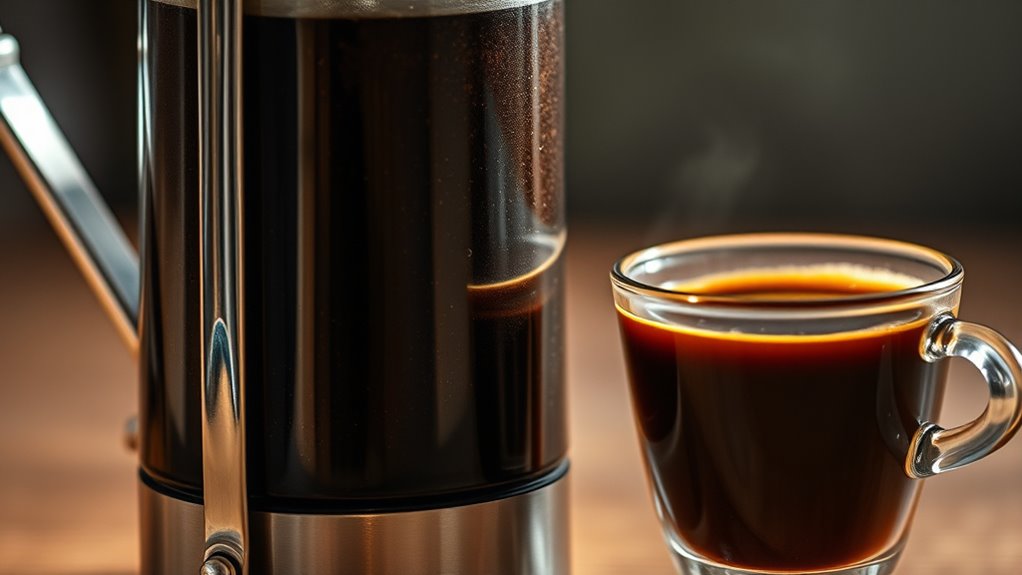
What makes espresso stand out from other coffee drinks? It’s the method that defines it. Hot water is forced through finely-ground coffee beans at about 9 bars of pressure, all in roughly 30 seconds. This intense process extracts a rich, full-bodied flavor that’s impossible to replicate with standard brewing methods.
You get a thick, creamy layer called crema on top, which signals a perfectly pulled shot. Because espresso packs so much strength into just a small 1-ounce serving, it demands precision.
Traditional espresso machines are designed to control pressure, temperature, and extraction time with exactness, ensuring consistent results every time.
When you savor espresso, you’re tasting concentrated coffee crafted through science and art. It really makes for a unique and powerful experience.
Achieving the right extraction time is crucial to balancing flavor and crema in every shot.
French Press vs. Espresso Machine: Brewing Differences
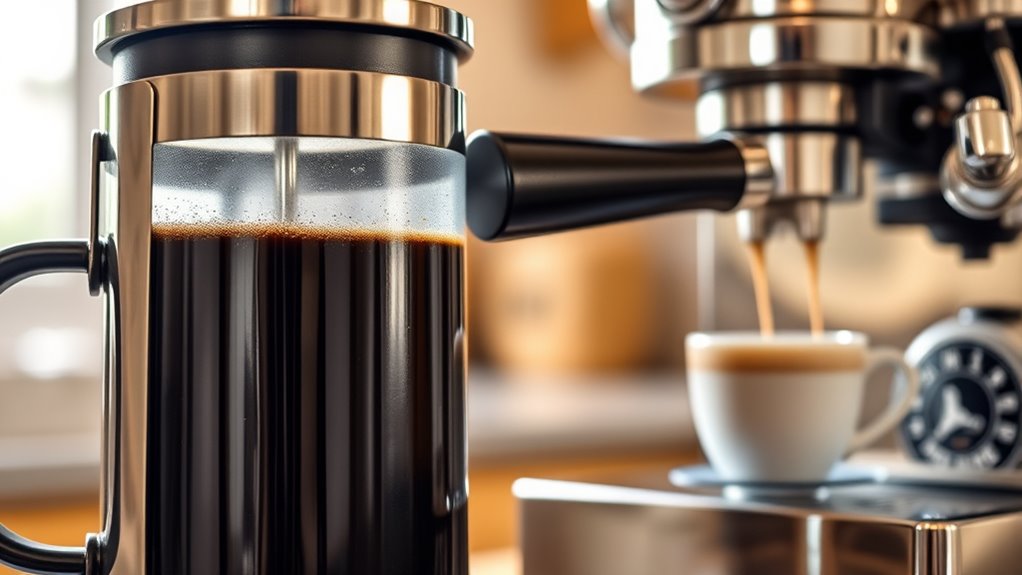
When you use a French press, you’re basically steeping coarse grounds in hot water.
On the other hand, an espresso machine forces water through fine grounds using intense pressure.
This difference is pretty important because it changes the grind size you need and also affects how bold and textured your coffee ends up.
Once you understand how pressure versus steeping changes the flavor and body, it’s easier to see why these two methods give you such different results.
Espresso machines use high-pressure extraction to yield a more concentrated and caffeine-rich shot compared to the steeping method of a French press.
Pressure vs. Steeping
Although both methods brew coffee, the fundamental difference between a French press and an espresso machine lies in pressure versus steeping.
When you use an espresso machine, hot water is forced through coffee grounds at a minimum of 9 bars of pressure, extracting intense flavors and producing that signature thick crema. This process takes about 30 seconds and yields a concentrated, rich shot.
In contrast, a French press relies on immersion steeping, where coarsely ground coffee soaks in hot water for 3 to 6 minutes without any additional pressure.
This method produces a full-bodied, robust brew but lacks the pressure-driven crema and concentrated texture unique to espresso.
Understanding this pressure differential clarifies why a French press can’t replicate true espresso’s distinct flavor and mouthfeel.
Additionally, espresso’s texture and flavor are enhanced by aeration and microbubbles introduced through shaking, which cannot be achieved with French press brewing.
Grind Size Impact
Because grind size plays an essential role in extraction, understanding its impact is key when comparing French press and espresso brewing. Espresso machines demand a very fine grind, almost like powdered sugar, to maximize extraction under pressure.
In contrast, a French press uses a coarser grind to avoid grounds slipping through the mesh filter and to allow proper steeping.
Here’s what you need to keep in mind:
- Fine grinds in a French press cause over-extraction, bitterness, and difficulty pressing.
- Coarser grinds enable full-bodied coffee and clean separation of grounds.
- Grind size controls extraction time: finer grounds extract quickly; coarser grounds need longer steeping.
Adjusting grind size thoughtfully is essential if you want to approach espresso-like flavors using a French press. It’s all about finding that balance to get the best cup possible. Additionally, maintaining consistent particle size helps ensure even extraction and better flavor clarity regardless of brewing method.
Flavor And Texture Differences
Adjusting grind size influences more than just extraction; it shapes the very flavor and texture of your brew. When you use a French press, the coarser grounds and steeping method preserve oils, delivering a full-bodied, rich mouthfeel with robust chocolate, nutty, and earthy notes.
In contrast, espresso machines force hot water through finely ground, tamped coffee under high pressure, creating a thick, creamy texture and intense, concentrated flavors often bittersweet or tangy. You won’t get that signature crema foam from a French press since it lacks the pressure needed to emulsify oils.
Also, French press coffee carries some sediment, adding heft, whereas espresso’s smooth, velvety consistency feels more viscous and refined. Understanding these differences helps you appreciate the distinct sensory experiences each brew offers. Additionally, controlling the water temperature in espresso extraction is crucial for balancing acidity, bitterness, and sweetness, which is less of a factor in French press brewing.
Can You Really Make Espresso in a French Press?
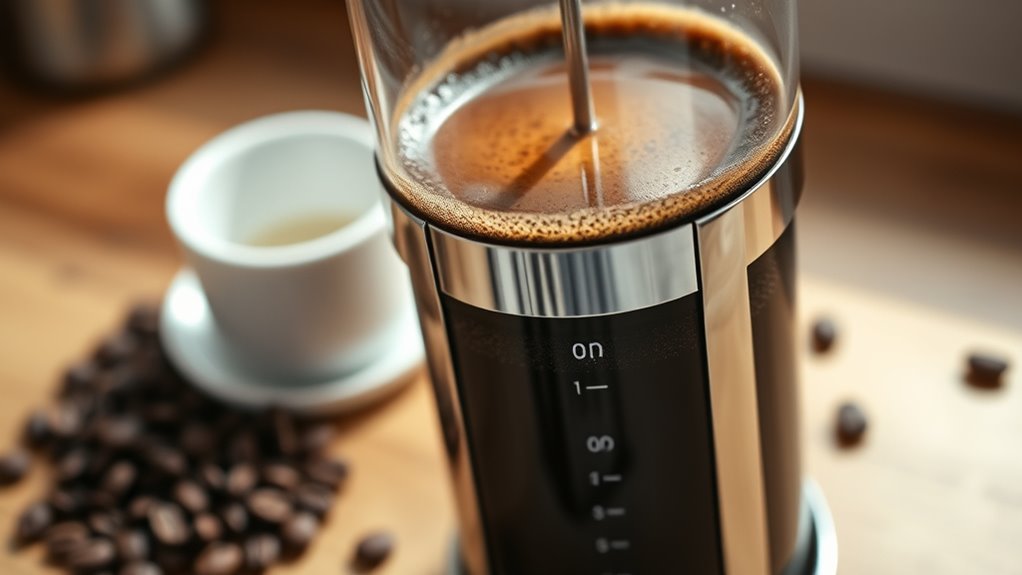
If you want to make authentic espresso, a French press won’t deliver the high-pressure extraction needed to achieve it. True espresso requires at least 9 bars of pressure, which a French press simply can’t provide.
However, you can still brew a concentrated, espresso-like coffee with it.
Here’s what to keep in mind: use a finer grind and increase the coffee-to-water ratio for a stronger brew. Shorten the steeping time to avoid over-extraction and bitterness.
Expect a robust, full-bodied coffee without the characteristic crema or intensity of true espresso.
While a French press creates a rich and bold cup, it doesn’t replicate espresso’s precise pressure-based extraction. So, it’s not authentic espresso but a close alternative. Understanding the importance of pressure and extraction time can help you better appreciate why a French press falls short of true espresso.
What Grind Size Should You Use for French Press Espresso?
To get that rich, espresso-like flavor from your French press, you’ll want a grind that’s finer than usual—but not as fine as traditional espresso. Think fine sea salt.
If your grind is too coarse, you won’t extract enough flavor. On the other hand, going too fine can lead to bitterness and make pressing difficult. Achieving the right grind size is crucial because grind size significantly affects extraction and flavor balance.
Ideal Grind Coarseness
How fine should your grind be when aiming for French press espresso? You want a grind size finer than the usual French press coarseness but not as fine as espresso machine grounds. Think of fine sea salt. This balance is essential to avoid sediment passing through the mesh filter or ending up with a weak brew.
To get it right:
- Aim for a particle size between 0.3 to 0.5 mm for ideal extraction.
- Avoid too fine a grind to prevent gritty texture and sediment.
- Steer clear of overly coarse grounds to guarantee full flavor extraction.
Adjust your grinder to a medium-fine or fine setting to mimic espresso quality while respecting the French press’s design limits. It’s all about finding that sweet spot where flavor and texture come together perfectly. Keep in mind that espresso extraction relies on high pressure which a French press cannot replicate, so grind adjustments are key to optimizing flavor within its limitations.
Fine vs Coarse Grounds
Although French press brewing traditionally calls for coarser grounds to prevent sediment and maintain clarity, achieving an espresso-like intensity requires careful consideration of grind size.
You might be tempted to use a fine grind to mimic espresso, but fine grounds can slip through the mesh filter, leaving your coffee cloudy and gritty.
They also increase resistance when you press the plunger, making it tougher to push and risking over-extraction, which can ruin flavor.
Instead, aim for a medium to coarse grind, about the size of sea salt, to balance extraction and clarity.
While this won’t replicate true espresso’s fine texture, it helps you get a richer, more intense brew without sacrificing the French press’s signature smoothness.
It’s all about finding that sweet spot between flavor and texture.
Because grind size consistency is crucial for balanced flavor and extraction, investing in a high-quality burr grinder can improve your French press results.
Grind Size Impact
When you dial in the right grind size for French press espresso, you reveal a delicate balance between bold flavor and smooth texture. You want a grind finer than standard French press but coarser than traditional espresso. Think coarse sea salt or slightly finer. This grind size optimizes extraction without clogging the filter or creating excessive sediment.
Keep these points in mind:
- Too fine (like powdered sugar) leads to over-extraction, muddiness, and pressing difficulties.
- Medium-fine grounds improve water flow, creating a controlled extraction closer to espresso intensity.
- Too coarse results in a weak, under-extracted brew lacking richness.
Adjusting your grind size carefully guarantees you capture espresso-like depth while maintaining the French press’s unique character. It’s all about finding that sweet spot that works for your taste and your press.
Give it a try and see how your brew transforms!
How to Adjust Coffee-to-Water Ratios for Stronger French Press Espresso
To craft a stronger French press espresso, you’ll want to increase your coffee-to-water ratio considerably. Aim for about 1:10 or 1:12.
For example, use 20 grams of coffee per 200 ml of water to achieve a bolder, more concentrated cup.
You can also measure by volume, using 2 to 3 tablespoons of grounds per 4 ounces of water to intensify the flavor.
This adjustment boosts the espresso-like strength without overwhelming bitterness.
Remember, pairing this ratio with a slightly reduced steep time, around 1 to 2 minutes, prevents over-extraction while preserving richness.
By fine-tuning these ratios, you control the intensity.
This way, you can tailor your French press espresso to deliver a robust, satisfying taste every time.
Keep in mind that grind size plays a critical role in extraction, so using an extra-fine grind similar to espresso can help achieve the desired strength.
How to Brew Espresso-Style Coffee With a French Press
Since achieving an authentic espresso with a French press requires careful adjustments, you’ll want to start by selecting a very fine grind, almost like powdered sugar.
Next, increase your coffee-to-water ratio to about 1:10 or 1:12 to create a stronger, more concentrated brew.
Pour water heated to around 200°F (93°C) immediately over the grounds to guarantee ideal extraction.
Steep for just 1-2 minutes to avoid bitterness and maximize intensity.
It’s a bit different from your usual French press method, but trust me, it’s worth it for that bold espresso-style flavor.
Remember these key steps:
- Use a fine grind mimicking espresso grounds.
- Steep briefly for 1-2 minutes.
- Maintain a coffee-to-water ratio close to 1:10.
Following these precise steps will help you brew a bold, espresso-style coffee with your French press.
Give it a try, and enjoy your strong, delicious cup!
Best Practices for Pressing and Serving French Press Espresso
Although brewing espresso-style coffee in a French press requires care, pressing and serving it correctly is just as crucial to preserve its rich flavor and smooth texture.
Press the plunger slowly and evenly, applying gentle, steady pressure to avoid disturbing the grounds or forcing sediment through the mesh filter. Aim to press gradually over 10-15 seconds for a stronger, more espresso-like extraction.
Preheat your French press and serving cup to maintain ideal temperature, ensuring the flavors stay vibrant longer.
Once pressed, serve immediately to capture the fresh, full-bodied taste and prevent bitterness from developing.
By mastering these techniques, you’ll enjoy a remarkably smooth, intense coffee experience that rivals traditional espresso, all from your French press.
Give it a try and see how great your coffee can be!
How Does French Press Espresso Taste Compared to Real Espresso?
You’ll notice that French press espresso has a fuller body and rich flavors, but it doesn’t have the intense concentration or the crema you get with real espresso.
The texture is more mellow and less syrupy, which makes it feel a bit smoother.
When it comes to aroma, it carries bold, earthy notes, but it’s missing that sharp complexity you usually expect from an authentic shot.
Knowing these differences helps you appreciate what each brewing method brings to your cup in its own unique way.
Flavor Profile Differences
When comparing French press espresso to authentic espresso, you’ll notice a fuller body and richer mouthfeel thanks to the oils extracted during steeping. However, French press espresso lacks the creamy crema and sharp acidity that true espresso delivers.
Its flavor profile tends to be more robust, chocolatey, and nutty, while authentic espresso offers concentrated bittersweet notes with bright, complex layers.
Here are the key flavor differences:
- French press espresso has a bolder, earthier taste with some sediment due to the coarser grind and absence of pressure.
- True espresso boasts a smoother, tangier flavor with intricate acidity.
- French press misses the layered complexity and crema that define real espresso.
Your choice depends on whether you prefer bold robustness or refined complexity. It really comes down to what kind of coffee experience you’re after.
Texture And Mouthfeel
Beyond flavor, texture and mouthfeel play a major role in how you experience French press espresso compared to authentic espresso. French press espresso delivers a richer, oilier mouthfeel since it retains more coffee oils and lacks the creamy crema layer. However, it can feel heavier and slightly gritty if sediment isn’t filtered well.
In contrast, real espresso offers a smooth, velvety, and frothy texture created by high-pressure extraction.
| Aspect | French Press Espresso |
|---|---|
| Mouthfeel | Full-bodied, oily, slightly gritty |
| Texture | Thick, robust, less smooth |
| Crema | Absent |
| Body | Heavy, rich |
You’ll notice French press espresso feels more straightforward and heavier, missing the silky finesse of traditional espresso.
Aroma And Crema Presence
Although French press espresso can’t produce the thick, golden crema that authentic espresso has, it still delivers a robust and full-bodied aroma that coffee lovers will appreciate. You won’t get the frothy layer on the surface since French press lacks the high-pressure extraction essential for crema formation.
But the scent remains rich and inviting, even if it mightn’t have espresso’s complex, layered notes.
Here’s what you can expect:
- A strong, aromatic cup with a richer profile than standard French press coffee.
- Absence of the intense depth and crema unique to true espresso.
- A smooth surface without the characteristic froth but with a satisfying, bold aroma.
In short, French press “espresso” offers aroma, but it can’t fully replicate espresso’s signature crema and nuanced flavors.
Common Mistakes When Making French Press Espresso
If you want to make a rich, espresso-like brew in your French press, avoiding common mistakes is essential to achieving the perfect cup.
First, don’t use too fine a grind like traditional espresso. It lets grounds slip through the filter, muddying your coffee.
Steep for no longer than 4-5 minutes. Oversteeping extracts bitterness and harsh flavors.
Always preheat your French press and cups to keep your coffee hot and flavorful.
Use water between 195°F and 205°F to avoid under-extraction or bitterness.
When pressing the plunger, apply gentle, steady pressure. Pushing too hard disturbs the grounds, causing sediment and cloudiness.
Mastering these details guarantees a smooth, balanced brew that respects your French press’s unique capabilities. It’s all about the little things for a great cup!
Alternatives to French Press Espresso at Home
When you want a stronger, more authentic espresso experience at home, exploring alternatives to the French press can make a big difference. The French press is great for immersion brewing, but it doesn’t have the pressure needed for true espresso extraction. So, if you’re after that rich, bold espresso flavor, you might want to try something else.
Here are three powerful alternatives to consider:
Here are three great alternatives to enjoy bold, espresso-style coffee at home without special machines.
- Moka Pot: This uses stovetop pressure to brew a rich, espresso-like shot with finely ground coffee. It gives you a fuller flavor compared to a French press.
- AeroPress: It offers adjustable pressure and a short brew time, so you can quickly and precisely craft concentrated, espresso-style coffee.
- Cold Brew Concentrate: Steeped for 12 to 18 hours, it produces a smooth, intense coffee. You can dilute it to mimic the strength of espresso.
These options will help you get that bold espresso taste without needing specialized machines. Pretty handy, right?
Frequently Asked Questions
Can I Use Pre-Ground Coffee for French Press Espresso?
You can use pre-ground coffee for French press espresso, but avoid fine espresso grind. Choose coarse, French press-labeled coffee instead.
Freshly grinding beans gives you better flavor and smoother pressing. This way, you’ll get a richer, cleaner cup every time. It’s definitely worth the little extra effort!
How Does Water Temperature Affect French Press Espresso Taste?
Water temperature is the silent artist shaping your French press espresso’s soul. Too hot, and it scorches bitterness. Too cool, and it mutes flavor.
But when you hit 195°F to 205°F, you reveal rich, balanced, full-bodied perfection every time. It’s all about finding that sweet spot.
Is It Possible to Froth Milk for Lattes With a French Press?
Yes, you can froth milk for lattes with a French press by pumping the plunger rapidly. This creates creamy, velvety microfoam perfect for lattes. Just use warm milk and clean your press thoroughly afterward for the best results.
It’s a simple trick that works surprisingly well. Plus, it saves you from needing a separate frother. Give it a try next time you want a homemade latte!
Can I Make Iced Espresso-Style Coffee Using a French Press?
Yes, you can make iced espresso-style coffee using a French press. Start by using finely ground dark roast coffee. Brew a concentrated shot with hot water for 1 to 2 minutes.
Then, pour it over ice right away. This helps preserve the bold flavor and chills the coffee quickly. It’s a simple way to enjoy iced espresso without an espresso machine. Give it a try!
How Long Can French Press Espresso Be Stored Before Tasting Stale?
You should drink French press espresso within 30 minutes for peak flavor. If you store it sealed at room temperature, it’ll taste stale after 1-2 hours.
Refrigeration extends freshness up to 12 hours but dulls flavor. So, if you want the best taste, it’s really worth enjoying it fresh. Otherwise, the flavor just won’t be the same.
Conclusion
While a French press won’t deliver the true crema-rich punch of an espresso machine, it’s a clever workaround when you’re in a pinch. With the right grind and coffee-to-water ratio, you can brew a strong, bold cup that’s close enough to keep espresso lovers satisfied.
Remember, practice makes perfect. So don’t throw the baby out with the bathwater if your first attempt falls short. Embrace the journey and savor every sip.