You need a very fine grind, about the texture of table salt, to get the best espresso extraction. This size maximizes surface area and lets water extract rich flavors evenly within 25-30 seconds under pressure.
If your shot pulls too fast, try adjusting the grind finer. If it’s slow, make it a bit coarser. Also, keep in mind your roast level when tweaking your grind.
Grinding fresh just before brewing and regularly calibrating your grinder can really make a big difference. Keep exploring and experimenting to master all the little nuances of espresso grind size.
Why You Need a Very Fine Grind for Espresso
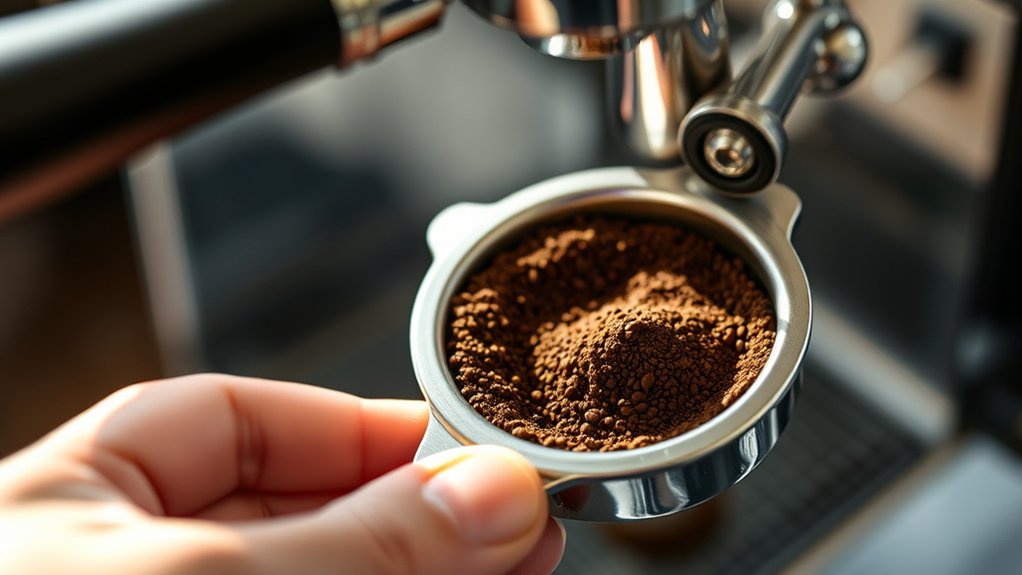
Because espresso relies on high-pressure extraction, you need a very fine grind, about the texture of table salt, to get it right. This grind size maximizes the surface area exposed to water, allowing for efficient extraction within a short timeframe, usually 25-30 seconds. The precise grind size is crucial because it directly influences the extraction time and balance of flavors in the shot.
When you grind too coarsely, water flows too quickly, causing under-extraction and leaving your espresso weak and sour.
On the other hand, an overly fine grind slows water flow, risking over-extraction, bitterness, and potential machine issues like clogging or channeling.
By aiming for a consistent, precise grind at this fine level, you enable even extraction across the coffee puck.
This balance is vital for producing rich, full-bodied espresso with complex flavors that make every shot worthwhile.
Adjusting grind size is a key method to maintain the ideal shot timing that ensures balanced flavor and extraction quality.
How Grind Size Affects Espresso Extraction and Flavor
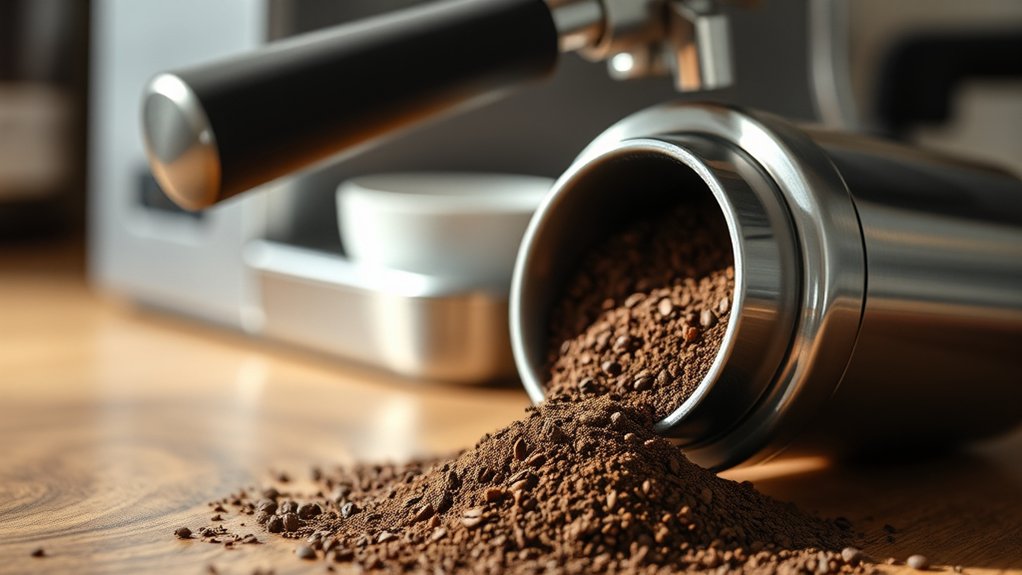
When you adjust your grind size, you directly influence how water interacts with the coffee grounds during extraction. A finer grind increases the surface area, speeding up extraction but risking over-extraction, which can cause bitterness.
Conversely, a coarser grind slows water flow, potentially leading to under-extraction and a sour, weak espresso.
A coarser grind reduces water flow, risking under-extraction and resulting in a sour, weak espresso.
The ideal grind generally falls between 200-400 microns, striking a balance for best extraction time and flavor clarity. Even slight adjustments by a few microns can dramatically affect shot timing, taste, and crema quality.
Maintaining a consistent, uniform particle size is essential to avoid channeling, ensuring even extraction and richer flavor.
Mastering grind size control lets you dial in espresso that’s balanced, vibrant, and satisfying every time.
It is also important to use calibrated equipment to ensure your grind adjustments translate accurately into consistent shot quality.
The Role of Coffee Bean Roast in Espresso Grind Settings
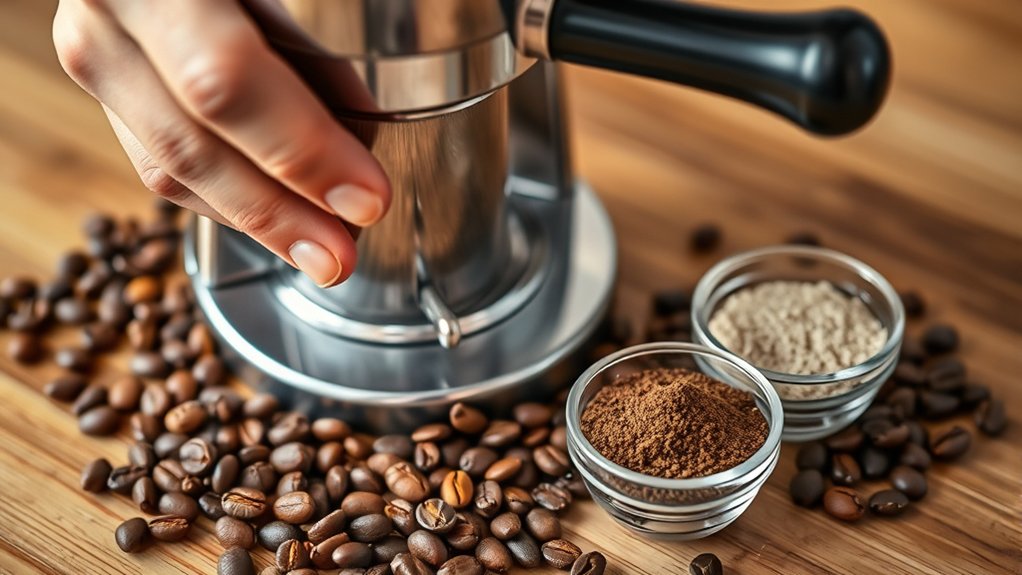
Adjusting grind size isn’t just about particle consistency; the roast level of your coffee beans plays a significant role in determining the ideal setting. Darker roasts, being less dense and more brittle, require a finer grind to balance extraction time and flavor.
Lighter roasts, denser by nature, usually need a slightly coarser grind to avoid over-extraction and bitterness.
The increased porosity in darker roasts also affects how they grind and extract. So, it’s not just about size but also how these beans behave during brewing.
Consider these points when adjusting your grind size based on roast:
- Dark roasts demand finer grinds for optimal extraction.
- Lighter roasts benefit from coarser grinds to prevent harshness.
- Roast porosity impacts grind texture and extraction flow.
- Proper adjustment controls shot clarity and flavor balance.
Tailoring grind size to roast level ensures a better espresso experience. It really makes a difference in the final cup.
Choosing the Right Grinder for Espresso Grind
Selecting the right grinder plays an essential role in achieving the perfect espresso grind size. It directly impacts the consistency and quality of your shot.
You’ll want a high-quality burr grinder with micrometer adjustments for uniform particle size. This helps prevent channeling and uneven extraction.
Stepless grinders let you fine-tune grind size, which is great for optimizing flavor balance. Manual options like the Comandante MK3 give excellent control but require more effort.
Remember, regular calibration and cleaning keep your grinder performing at its best.
| Grinder Type | Adjustment Style | Benefits |
|---|---|---|
| Burr Grinder | Micrometer | Uniform grind, consistent |
| Stepless Grinder | Infinitely variable | Precise flavor tuning |
| Manual Grinder | Hand-crank | Excellent control |
| Maintenance | Cleaning & Calibration | Consistent extraction |
How to Grind Espresso Beans Fresh for Maximum Aroma
Because espresso’s delicate oils start degrading moments after grinding, you should always grind your beans immediately before brewing to capture their full aroma. Grinding fresh ensures you retain up to 60% of the coffee’s aroma within 15 minutes, maximizing flavor and complexity.
To grind espresso beans fresh for maximum aroma, follow these key steps:
- Use a burr grinder to achieve a consistent, fine grind size, similar to table salt.
- Grind just before brewing to prevent aroma loss and oxidation.
- Measure your beans precisely to maintain consistent extraction.
- Store beans properly to preserve freshness until grinding.
Doing this might seem like extra work, but trust me, it’s worth it. Freshly ground beans make a noticeable difference in your espresso’s flavor and aroma. So, keep those beans fresh and grind right before you brew!
How to Calibrate Your Grinder for Perfect Espresso Shots
Start by locking in a consistent dose and stable temperature; this helps build a solid foundation for your shots.
Then, make small, precise grind adjustments to fine-tune the extraction time without overcorrecting.
And don’t forget—whenever you switch beans or roast levels, it’s a good idea to recalibrate to keep your espresso tasting its best.
Consistent Dose And Temperature
When you want to achieve perfect espresso shots, calibrating your grinder is vital to guarantee a consistent dose and temperature. Consistency in grind size directly impacts extraction time, which affects temperature stability during brewing.
To calibrate effectively, follow these steps:
- Zero and stabilize your grinder to prevent fluctuations in particle size.
- Use a scale to dose a precise amount of coffee, typically 20 grams, for each shot.
- Observe extraction time, aiming for 25 to 30 seconds to maintain ideal temperature and flavor balance.
- Make small, incremental burr adjustments while grinding to control particle size within the 200-400 micron range.
Regular calibration, especially when changing beans or roast levels, ensures you maintain a consistent dose and temperature for the best espresso extraction.
It’s a simple habit that really pays off in every cup.
Incremental Grind Size Adjustments
Maintaining a consistent dose and temperature sets the foundation for great espresso, but dialing in your grinder with incremental adjustments brings you closer to perfection.
Start by calibrating your grinder’s zero point using a calibrated scale or digital burr distance detection. Make small changes, about 0.1 to 0.2 millimeters, to the burr gap while the grinder runs, ensuring an even particle size distribution.
After each tweak, pull a shot and time the extraction. Aim for 25 to 30 seconds to achieve balanced flavor. Be sure to record every setting and shot outcome meticulously.
This methodical approach helps you develop a reliable calibration routine customized for your beans and gear. Incremental grind size adjustments give you precise control over extraction and turn good espresso into exceptional.
Recalibrate For Bean Variations
Although your initial grinder calibration sets a strong foundation, you’ll need to recalibrate whenever you switch beans or notice extraction inconsistencies. Variations in bean origin, roast level, and age affect water absorption and grind uniformity, which can change the shot quality.
To recalibrate effectively, focus on these steps:
- Adjust burr separation to target a consistent particle size between 200-400 microns.
- Use shot timing and flow rate as real-time feedback. If shots pull too fast or slow, tweak the grind incrementally.
- Record your grinder settings and shot parameters to track changes across different beans.
- Always recalibrate after changing bean type or roast to keep your extraction on point.
Fixing Extraction Problems by Adjusting Grind
Since grind size directly influences water flow and extraction time, adjusting it becomes your most effective tool for fixing common espresso extraction problems.
If your espresso tastes sour or weak, it’s a sign of under-extraction. Making the grind finer slows water flow, increases extraction time, and improves flavor balance.
Conversely, if your shot is bitter or harsh, coarsening the grind speeds up water passage and reduces over-extraction.
Make small, precise adjustments around 0.1 to 0.2 mm to see noticeable changes in shot quality.
Always monitor extraction time and flavor notes after each tweak to figure out if you need to go finer or coarser.
Consistency and proper calibration are key. By fine-tuning your grind, you’ll troubleshoot extraction issues effectively and pull better espresso every time.
How Espresso Grind Size Differs From Other Brewing Methods
When you brew espresso, you need a grind size that’s considerably finer than what you’d use for methods like French press or cold brew. Espresso grind size ranges between 200-400 microns, creating a uniform, powdery consistency. This fine grind boosts surface area, speeding up extraction under high pressure.
Using coarser grounds leads to weak, under-extracted shots, while overly fine grounds cause bitterness from over-extraction. So, getting the grind just right is really important.
Coarser grounds yield weak espresso, while too fine causes bitterness—precision in grind size is essential.
Here’s why espresso grind size differs from other methods:
- Espresso demands a much finer, consistent grind.
- High pressure extraction needs increased surface area.
- Shot timing (25-30 seconds) relies on precise grind control.
- Coarser grinds suit longer, gentler methods like French press or cold brew.
Mastering this difference is key to pulling balanced, flavorful espresso shots. Once you get it down, your espresso will taste amazing every time.
Frequently Asked Questions
How Does Water Temperature Impact Espresso Extraction?
Water temperature directly impacts espresso extraction by controlling solubility. If you use water that’s too hot, your espresso will taste bitter. But if it’s too cool, the flavor tends to be sour.
Can Grind Size Affect Espresso Crema Quality?
Yes, grind size directly affects your espresso’s crema quality. Finer grounds boost crema thickness and richness, but too fine risks bitterness.
Coarser grinds weaken crema, so you’ll want a consistent, precise grind for the best results. It’s all about finding that sweet spot to get a great crema without any off flavors.
What Is the Ideal Espresso Dose by Weight?
Think of brewing espresso like baking: you wouldn’t eyeball flour. You’ll want to weigh 18 to 20 grams for a double shot to guarantee consistent strength and flavor every time you pull that perfect, rich espresso.
Weighing your coffee helps keep things precise. That way, your espresso tastes just right every time you make it—no surprises. It’s all about dialing in the perfect balance.
How Often Should I Clean My Espresso Grinder?
You should clean your espresso grinder at least once a week to prevent buildup. Brush it daily to remove surface grounds. This helps keep things fresh and ready to go.
Every 2 to 4 weeks, do a deep clean. This is key to maintaining the best flavor and grind consistency. Keeping up with this routine will make your espresso taste great every time.
Does Grind Size Affect Espresso Machine Pressure Settings?
When it comes to espresso, you know every little tweak counts. Yes, grind size directly impacts your machine’s pressure. Too fine or coarse, and you throw the whole extraction out of whack.
Adjust wisely for balance. It’s all about finding that sweet spot where flavor and pressure work together perfectly. Keep experimenting until you nail it.
Conclusion
You hold the key to revealing espresso’s rich symphony by mastering grind size. Think of it as tuning a fine instrument. Too coarse, and the melody’s dull; too fine, and it’s overwhelming.
By dialing in your grind, adjusting for roast, and calibrating your grinder, you coax every drop of flavor from your beans. With each tweak, you craft a cup that sings with balanced intensity and aroma. Every shot becomes a masterpiece.