You should start timing your espresso shot from pump activation to capture the full extraction, including pre-infusion. Aim for a 25-30 second extraction to balance flavor, aroma, and crema quality. Adjust grind size, dose, and tamp pressure as needed.
Light roasts may require longer shots, up to 40 seconds. Dark roasts usually need shorter times around 25-30 seconds. Mastering these variables guarantees consistency and precision. Explore how to fine-tune your technique for the best results.
When Should You Start Timing Your Espresso Shot?
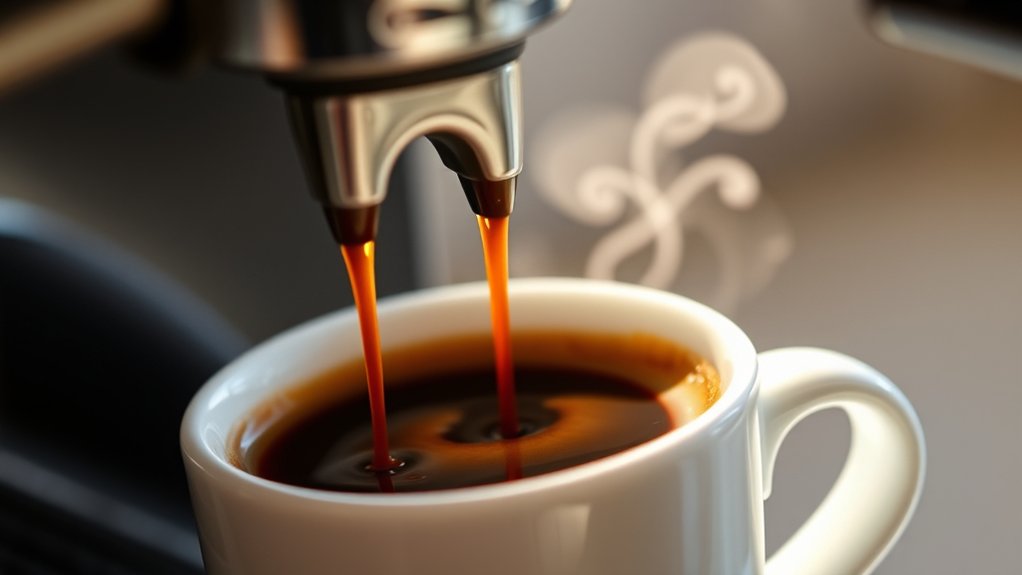
Although some espresso machines automatically start the timer when the first drop appears, you should generally begin timing your shot from the moment the pump activates to include pre-infusion. Starting at pump activation ensures you capture the entire extraction process, which is influenced by factors like extraction temperature and grind size.
Begin timing your espresso shot at pump activation to include essential pre-infusion and fully capture extraction variables.
Both of these affect how quickly water passes through the coffee puck and how the flavors develop. Timing from the first drip can leave out important pre-infusion phases, which might lead to inconsistent results.
Aim for a total shot time of 25-30 seconds from pump start. Adjust your grind size or extraction temperature as needed to stay within this window.
Consistent timing from pump activation helps you reproduce the ideal extraction. It balances flavor and strength with precision and technical control.
Including the pre-infusion stage in your timing is crucial because it wets the coffee evenly, activates the bloom, and helps reduce channeling for a better shot.
How Does Pre-Infusion Affect Espresso Shot Time?
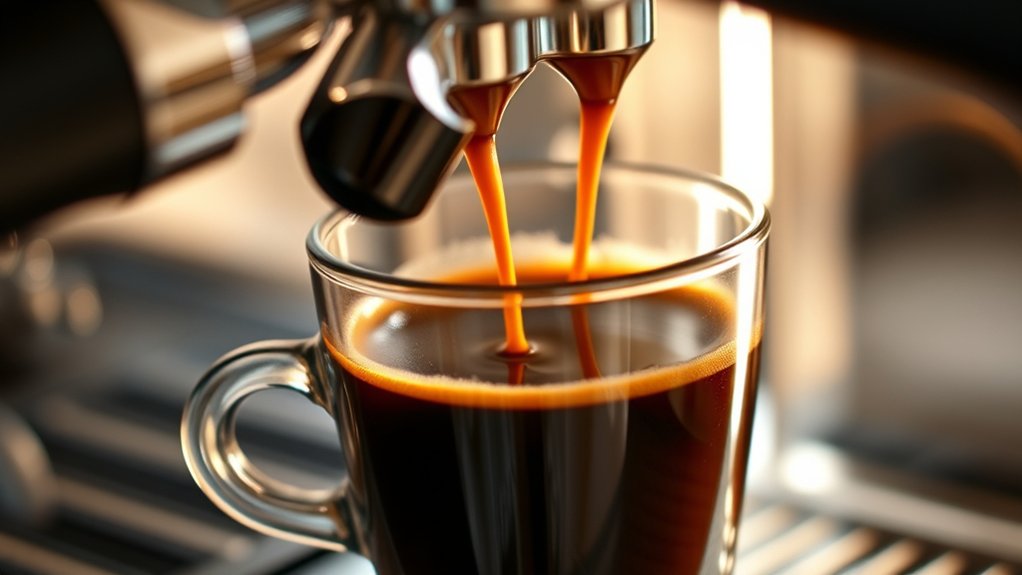
Understanding when to start timing your espresso shot naturally leads to examining how pre-infusion impacts the overall extraction duration. Pre-infusion effects play a vital role in setting the stage for consistent extraction. When you include pre-infusion in your shot timing—starting from pump activation or first drip—you account for its low-pressure wetting phase, typically around 5 seconds.
Key influences of pre-infusion on shot time include:
Extending total shot duration, often pushing it toward 35-40 seconds with longer pre-infusion periods. It promotes even saturation of coffee grounds, which helps reduce channelling and enhances extraction consistency.
Plus, it improves flavor balance and crema development by adjusting pre-infusion length.
Finding the Right Shot Time for Different Coffee Roasts
Since different coffee roasts release their flavors at varying rates, you need to adjust your shot time accordingly to achieve the best extraction.
Light roasts demand longer extraction times, typically 30-40 seconds, to fully develop their complex flavor profiles.
Light roasts need longer extraction times, around 30-40 seconds, to unlock their full complex flavors.
Dark roasts, conversely, require shorter shot times around 25-30 seconds, as their oils and flavors extract more quickly.
Medium roasts often hit a sweet spot within the 25-30 second range, producing balanced acidity and sweetness.
To dial in the right shot time, fine-tune your grind size and tamp pressure.
A finer grind and firmer tamp increase resistance, extending shot time, while coarser grinds and lighter tamp pressure shorten it.
Adjusting these variables per roast ensures ideal balance between acidity, sweetness, and bitterness in your espresso.
It’s all about finding that perfect timing to bring out the best in your coffee.
Using the 25-30 Second Rule for Single vs. Double Shots
You’ll want to keep your extraction time between 25 and 30 seconds for both single and double shots. This helps guarantee a balanced flavor and proper crema development.
The key difference is really in the dose and yield. Singles use about half the coffee and output of doubles, but the timing stays the same.
Just adjust your grind size or dose to hit that 25-30 second window. That way, you maintain flavor consistency no matter the shot volume.
Consistent Timing Importance
Although single and double espresso shots differ in dose and yield, both should be extracted within the same 25-30 second window to guarantee balanced flavor and aroma. Consistent timing is essential for maintaining the quality and reproducibility of your espresso, regardless of shot size.
You need to focus on ensuring temperature stability throughout extraction to prevent flavor inconsistencies. Regular machine calibration is also important to maintain accurate pressure and flow rates.
Using a timer helps you precisely monitor shot duration for both single and double extractions.
Sticking to this timing rule allows you to achieve ideal extraction and crema quality. By controlling these variables, you’ll produce espresso shots with consistent flavor profiles every time.
This confirms that your technique and equipment are properly tuned for both single and double shots.
Dose And Yield Differences
How do dose and yield differences affect your espresso extraction timing? Despite varying doses, like 7-9 grams for singles and 14-18 grams for doubles, the ideal extraction time stays the same: 25-30 seconds. This consistency helps ensure balanced flavor by avoiding over- or under-extraction no matter the volume.
Coffee density plays a big role in how you adjust grind size and tamp pressure to keep this timing steady. Denser coffee usually means you’ll need a finer grind or firmer tamping to hit that extraction window consistently.
Yield differences, such as 25-30 ml for singles versus 50-60 ml for doubles, don’t change the extraction time. But they do require precise calibration of your variables to make sure the extraction is even.
Flavor Balance Considerations
When aiming for balanced flavor in espresso, maintaining the 25-30 second extraction window is essential for both single and double shots. This timeframe ensures optimal extraction of flavor compounds, preserving the coffee’s flavor complexity and aroma preservation.
Whether pulling a 7-9g single or a 14-18g double shot, consistent timing prevents over- or under-extraction, which can disrupt flavor balance.
By sticking to this rule, you’ll achieve uniform flavor profiles across shot sizes and maximize aroma preservation for a richer sensory experience. It also makes troubleshooting easier since you’re standardizing extraction variables.
This precision in extraction time lets you unlock the full potential of your espresso. You’ll get a well-balanced shot that highlights nuanced flavor complexity, no matter the dose size.
How to Adjust Shot Time for Different Roasts and Flavors
Since espresso extraction time directly influences flavor balance, you’ll want to tailor your shot duration according to the roast profile. Start with a target shot time of 25-30 seconds, then adjust in 1-2 second increments based on roast and flavor.
Espresso extraction time shapes flavor balance—begin with 25-30 seconds, then fine-tune by roast and taste.
For light roasts, extend extraction to 35-40 seconds to capture delicate acidity and complexity. Darker roasts benefit from shorter shots around 25 seconds to avoid bitterness caused by over-extraction.
When adjusting shot time, remember that grind size and tamp pressure also affect flow rate and extraction. Finer grinds and firmer tamping slow extraction, allowing you to shorten shot time. Meanwhile, coarser grinds and lighter tamping speed it up, which means you’ll need longer extraction for balanced flavors.
Keep an eye on these variables to optimize each roast’s unique profile. It’s all about finding the sweet spot that brings out the best in your coffee.
How to Troubleshoot Shot Timing for Consistent Espresso
Although achieving the ideal shot timing can be challenging, you can troubleshoot inconsistencies by systematically evaluating key variables such as grind size, dose, tamp pressure, and machine temperature.
Start by using a timer to measure extraction time, aiming for 25-30 seconds for a standard double shot.
Then verify these critical factors: check grind consistency and adjust grind size incrementally by 0.5-1 notch if shots run too fast or slow. Confirm dose accuracy and tamp pressure to ensure even extraction.
Also, verify proper machine calibration and stable temperature for maximum pressure and flow.
Monitor shot quality by observing rich crema and honey-like flow.
Consistently record shot times and tasting notes to fine-tune your process and maintain reproducibility.
This methodical approach guarantees consistent espresso extraction.
Frequently Asked Questions
What Is the Ideal Water Temperature for Espresso Extraction?
You want your water temperature between 195°F and 205°F to optimize coffee bean freshness extraction. This range also supports precise milk frothing techniques. It ensures balanced flavor and crema without bitterness or sourness in your espresso shots.
Keeping your water in this temperature zone helps you get the best taste out of your coffee. Plus, it makes your milk frothing game on point, so every cup feels just right.
How Does Grind Size Impact Extraction Time and Flavor?
Think of grind consistency as a gatekeeper controlling water flow. If you adjust it finer or coarser, you directly impact extraction time and flavor balance.
This helps prevent bitterness or sourness, leading to a perfectly balanced espresso shot. It’s pretty cool how a small change can make such a big difference.
Can Tamping Pressure Affect Espresso Shot Timing?
Yes, tamping consistency directly affects espresso shot timing by controlling resistance and flow rate.
When you combine that with coffee freshness, maintaining uniform tamping pressure guarantees predictable extraction. This helps you avoid over- or under-extraction, which is key for getting ideal flavor and shot quality.
What Role Does Espresso Machine Pressure Play in Extraction?
Like a conductor guiding an orchestra, you control espresso machine pressure to extract flavors precisely. Maintaining machine pressure guarantees coffee bean freshness shines. Proper machine maintenance keeps pressure steady, preventing over or under-extraction for balanced shots.
It’s all about finding that sweet spot. When pressure is just right, every shot comes out tasting rich and full-bodied. Too much or too little pressure, and you risk losing those subtle flavors you worked so hard to get.
How Often Should Espresso Shot Timing Be Recalibrated?
You should recalibrate espresso shot timing weekly during equipment maintenance to guarantee flavor consistency. Also, adjust timing after any changes in beans, grind size, machine temperature, or servicing to maintain ideal extraction precision.
It might sound like a lot, but these tweaks make a big difference in your espresso’s taste. Staying on top of this helps you get that perfect shot every time. Just think of it as fine-tuning your coffee for the best experience.
Conclusion
You can’t just blindly press start and hope for espresso perfection. Timing is everything. If your shot drags on forever or rushes like a rollercoaster, you’re sabotaging flavor precision.
Master that 25-30 second window, tweak for roast profiles, and harness pre-infusion like a pro. Nail your extraction time, and you’ll gain access to espresso nirvana every single time.
Miss it, and you’re stuck with bitter disappointment or watery regret. No middle ground here.